The Gray Box Opens Up
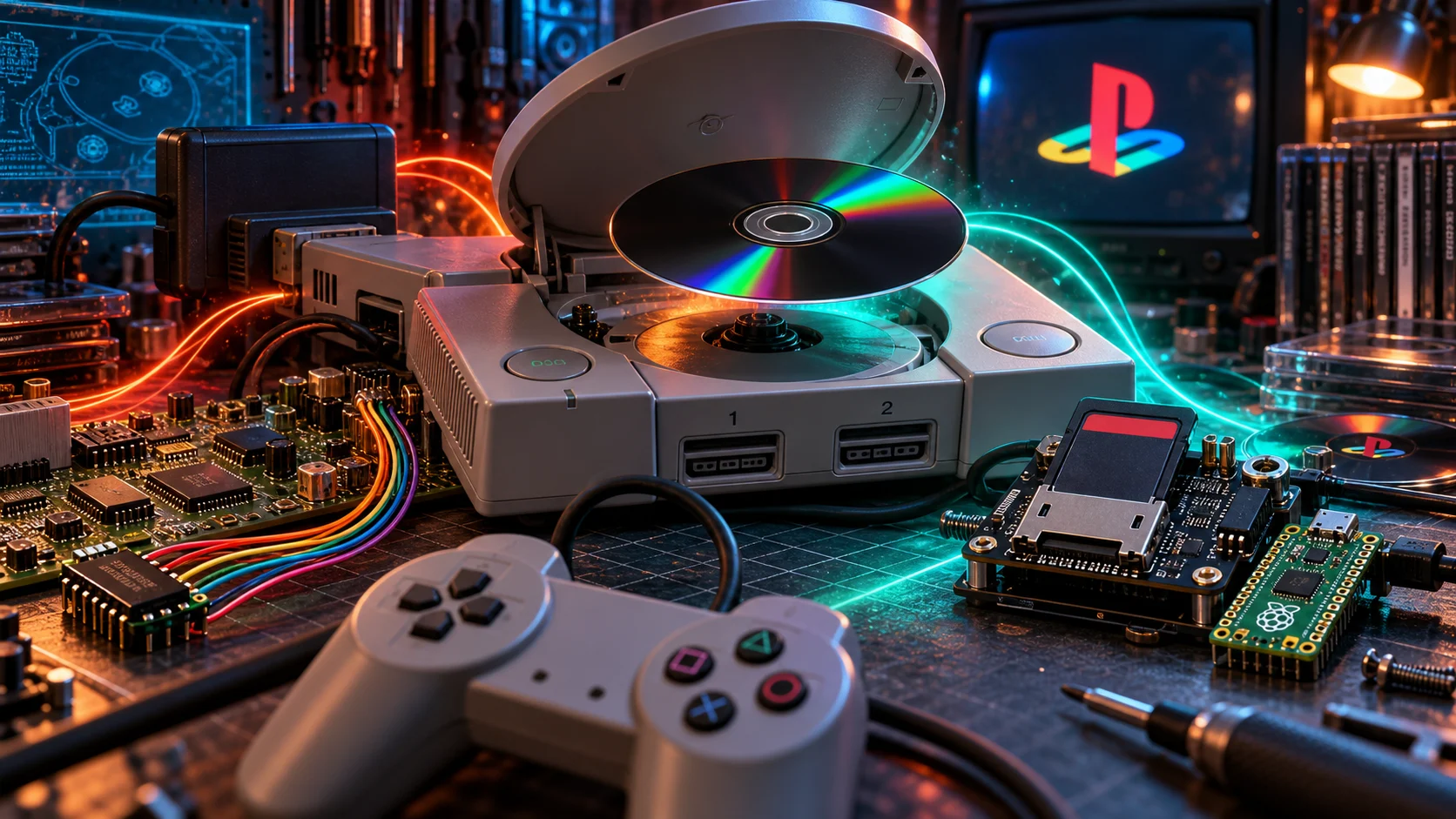
The original PlayStation did not look like a hacker’s machine. In its ordinary retail form, it was a gray or dark-gray appliance with a top-loading compact-disc drive, two controller ports and a power button that promised uncomplicated entertainment. Sony’s design suggested that the difficult work had already been done. Players supplied the disc; the console supplied the experience.
Yet the machine was unusually rich in seams. Its MIPS processor, custom graphics hardware, CD-ROM controller, memory-card interface and expansion buses all had to cooperate through carefully timed conversations. Those conversations were designed for speed and cost, not for absolute secrecy. By the middle of the 1990s, people were discovering that a PlayStation could be persuaded to hear a signal that had not arrived from the disc itself.
The real barrier was hidden in the relationship between the pressed disc, the optical pickup and the CD controller. Once enthusiasts learned where that relationship became an electrical signal, the PlayStation stopped looking like a sealed box. It became a system with an accent: a brief phrase spoken at startup, in the right electrical dialect, at exactly the right moment.
The R3000A Meets the Compact Disc
At the center of the machine was a 32-bit MIPS R3000A-compatible processor. It was a streamlined reduced-instruction-set design, powerful enough to run the PlayStation’s games but economical enough for a mass-market console. The processor worked alongside the Geometry Transformation Engine, which accelerated the calculations needed to position polygons, and a graphics processor that accepted commands through a distinctive packet-based interface.
The hardware was capable, but never lavish. Two megabytes of main RAM, one megabyte of video RAM and a specialized CD-ROM subsystem forced developers to plan around scarcity. A level, texture, sound effect or animation sequence was not simply present in memory waiting for the CPU. Data moved in carefully managed bursts. The disc drive was part of the machine’s rhythm: it fed executable code, textures, compressed video, music and streamed sound through a controller that games expected to behave in particular ways.
That made the CD-ROM drive more than a storage device. It was a participant in the boot process. Before a game’s executable was comfortably running, the console had to decide whether the disc in the drive was a legitimate PlayStation disc for that territory. The answer depended on information physically embedded in the disc’s lead-in area, associated with the wobble-related signal used by the optical system.
The word wobble can make the process sound more mystical than it was. A compact disc is not a flat platter of data in the abstract; it is a physical medium read by an optical system with its own timing and tracking signals. Pressed PlayStation discs carried a regional authentication marker in that physical lead-in behavior. The optical electronics and CD controller transformed what the pickup sensed into a shorter electrical exchange that the console could examine.
In conceptual terms, the machine asked the drive to present a regional identity. Japanese discs used an SCEI marker. North American and related NTSC territories used SCEA. European and related PAL territories used SCEE. Those identifiers were not merely printed on the package. They were part of the console’s early conversation with the disc.
This is why an ordinary CD burner could reproduce much of a PlayStation disc without reproducing all of a PlayStation disc. A recorder could write data sectors, ISO files, CD-XA material and audio tracks. It could create a table of contents that looked convincing to a computer. It could produce a CD-R that loaded perfectly in a PC and still failed immediately in a PlayStation.
The missing ingredient was the pressed-disc authentication feature in the lead-in area. A conventional recorder’s pre-groove and ATIP information were intended for the recorder itself. They were not a blank canvas on which a hobbyist could simply paint Sony’s pressed-media signal. The console was not checking whether the disc was black, nor was it decrypting a secret game executable. It was looking for a physical credential that ordinary recordable media could not write in the same way.
The first modchips attacked that distinction at its weakest point. They did not recreate the optical wobble. They waited for the optical and CD-controller hardware to turn the wobble-derived information into an electrical signal, then manipulated that electrical conversation. The breakthrough was not a key that unlocked every part of the PlayStation. It was access to one exposed sentence in the boot sequence.
Before There Was a Single Inventor
The PlayStation modchip story begins with several overlapping histories rather than one clean invention. Commercial hardware was circulating in Hong Kong by the first half of 1996. By spring of that year, Scott Rider encountered a United States PlayStation that could boot a Japanese game and examined the chip installed inside it.
Rider’s Mod Chip Chronicles is valuable precisely because it does not begin with a triumphant claim of invention. He encountered an existing commercial device. Its behavior had to be studied as a black box. Something inside the console was causing a machine intended for one region to accept a disc from another, but the package, wiring and firmware did not announce how.
The chip Rider examined was physically substantial, a fourteen-pin microcontroller installation with a conspicuous collection of wires. He watched what happened during startup, measured the signals and worked backward from the console’s behavior. A logic analyzer made the otherwise invisible exchange visible: a short sequence appeared at a specific stage, and the console responded as though the disc had supplied the expected regional credential.
The early arrangement was electrically direct. The chip waited for startup, interfered with the original authentication path and injected the required regional string. On the earliest designs, it could continue emitting its sequence after the console had already made its decision. That was not elegant, but it did not need to be elegant. It exploited a permissive moment in the boot process.
Rider’s later public work transformed the situation. His reverse engineering was subsequently published and was published in 1997, with a documented 1997 code revision becoming an important reference point for later ports. Public code mattered because it changed the economics of the scene. An imported commercial chip was an expensive curiosity. A small microcontroller carrying a reproducible program could become a mail-order board, a kit, a clone or a design adapted to an entirely different motherboard.
That distinction separates discovery from invention. Rider’s investigation made the mechanism understandable and reproducible. It does not prove that he designed the first Hong Kong commercial chip. The available record also does not establish a single unnamed Hong Kong engineer, reseller or later commercial figure as the universal inventor of the global PlayStation modchip scene.
The design family spread through many hands. Commercial boards were inspected. Public code was ported. Timing was adjusted. Wiring was reduced. Chips were renamed. A device sold as Mayumi might share a lineage with another design without being identical to it. MM3 and ONEchip represented later stages and feature sets rather than one universally frozen standard. The history is therefore cumulative: imported hardware, contemporary investigation, public code, cheaper microcontrollers, installer experimentation and commercial repackaging all contributed to the result.
That messy beginning is part of the appeal. The PlayStation did not fall to a single master key. It was opened by people who noticed that the machine’s physical authentication system eventually became an ordinary electrical signal—and that ordinary signals could be measured, delayed, gated and imitated.
Eight Wires and a More Precise Chip
Mayumi v4 became one of the best-known eight-wire PlayStation modifications. On supported motherboards, its connection to a console clock helped synchronize the chip; the familiar MM3 arrangement generally used seven wires and a different timing approach. Those extra connections were part of how a chip observed the machine, rather than a measure of how many games it could unlock.
An eight-pin package was something else. It described the physical semiconductor package. An eight-wire installation described the connections made between a chip or carrier and the console. The numbers could happen to match, but they did not describe the same property.
The Mayumi v4 and MM3 comparison is revealing because it shows why wire counts became scene shorthand. A Mayumi v4 arrangement could include the power, ground, timing and signal connections required by its implementation, while MM3 used a different balance of connections and synchronization behavior. Later boards changed which clock or control signal was useful. A design that worked on one family of motherboard could require a different timing relationship on another.
Power and ground were the unglamorous necessities. A reset or startup condition gave the microcontroller a predictable beginning. A clock or synchronization source gave it a sense of time. The data path carried the replacement authentication pattern. A gate or related control function could prevent the drive’s original signal from competing with the injected one during the critical window.
The important difference between early and later designs was not simply the number of wires. It was the relationship between timing and the console revision. Early chips could use fixed delays: wait a known interval after startup, emit the expected pattern and stop, or continue longer than necessary. Later designs became more sensitive to the motherboard’s actual signal behavior. Some used synchronization or clock-related information to align the injection more accurately. Others gated the original signal differently.
That is why the same name could conceal different practical results. Mayumi v4, MM3, ONEchip and later open designs such as PsNee belonged to a broad family of authentication injectors, but their supported boards, timing strategies, regional behavior and additional features differed. One installation might be described as seven-wire and another as eight-wire while both performed the same broad job through different electrical arrangements.
Stealth, Anti-Mod Detection and the Other Checks
The first chips were wonderfully rude. They forced the expected region string into the authentication path and sometimes kept speaking after the console had stopped asking. That behavior was enough for many imports and copied discs, but it left a recognizable electrical footprint. As Sony revised the CD controller and games became more suspicious of unusual drive behavior, chip designers began trying to make the intervention less obvious.
Stealth did not mean invisibility in the modern cybersecurity sense. It usually meant stopping the injected signal after the authentication exchange, or synchronizing the intervention so that the console saw something closer to ordinary drive behavior. A chip that became quiet at the right time was less likely to be noticed by later software or by drive operations that expected the signal line to behave normally.
The timing was revision-dependent. Older motherboards exposed one set of useful relationships between data, clock and gate signals. Later revisions changed the signal-processing behavior, including chopped or clock-related forms of the injected signal. A fixed-delay strategy that worked on one board could be unreliable on another. Synchronized or gated designs were not simply later versions of the same universal trick; they were responses to changing electrical conditions.
Mayumi v4, MM3 and ONEchip should therefore be treated as named implementations within a changing family. Some offered region selection. Some added stealth behavior. Some included BIOS-related features. Some were sold under names that covered more than one revision. The label on a chip was never a guarantee that it would behave identically on every PlayStation motherboard.
Anti-mod detection was one layer of the problem. A game or system could perform additional checks intended to detect the behavior of older chips. It might examine drive responses, timing or later commands. Stealth designs tried to reduce the telltale evidence. A chip that defeated the original boot authentication could still fail when a title performed a more suspicious follow-up.
LibCrypt was another layer entirely. It used protected information in CD subchannels rather than simply relying on the lead-in authentication sequence. A classic modchip could make a CD-R pass the initial regional check without supplying the subchannel information a LibCrypt-protected game expected. Later software loaders and optical-drive emulators could patch or synthesize that behavior, but it is inaccurate to describe every 1990s injector as a LibCrypt solution.
Video-region behavior was separate again. An imported disc might pass authentication while the console continued to operate with the wrong refresh assumptions. PAL and NTSC systems differed in video timing and BIOS behavior. A Japanese or American game could boot on a PAL machine yet produce an unstable, monochrome or otherwise unsuitable display. Some later chips added region selection, BIOS patches or timing workarounds, but those functions were not identical to the authentication bypass.
The PAL PSone added its own complications. Compact later hardware changed the motherboard and BIOS landscape, and some implementations needed an additional territory or BIOS-related patch. The existence of a PAL anti-import failure did not mean that every PAL game used the same anti-mod check. Compatibility depended on the model, BIOS, title and chip behavior.
This is why “region-free” was always a loose phrase. It could mean that a disc passed the SCEx-style authentication exchange. It could mean that a game’s anti-mod check was avoided. It could mean that video timing was corrected. It could mean that LibCrypt was handled. Those were related problems, but they were never one problem with four interchangeable names.
The Rear Port Becomes a Laboratory
The most visible invitation to experimentation was on the back of early and mid-generation fat PlayStations: a wide parallel I/O expansion connector. It appeared across multiple early hardware generations, not only on the launch model. It was removed from later SCPH-900x revisions and never appeared on the PSone.
The connector was easy to confuse with the other sockets clustered around the rear of the console. It was not the serial connector, the AV Multi Out or the optical digital output. It was a separate expansion interface with a path into the console’s bus and memory environment. To ordinary buyers it was an obscure accessory port. To hardware makers it was a potential route to code execution.
Action Replay, GameShark, Pro Action Replay, Xplorer, Game Enhancer and Goldfinger filled that accessory market. Their hardware and firmware varied: some concentrated on cheats, some offered PC communication, and some contained flash memory that enthusiasts could rewrite. Similar-looking shells could hide different capacities and capabilities.
A compatible expansion-ROM cartridge could run its own menu during the BIOS startup sequence, before the console loaded a game from CD. It did not need a licensed disc simply to execute that cartridge code. The remaining obstacle was different: starting an unauthenticated game disc still required a suitable swap, modchip or software drive-unlock method. That separation explains both the power and the limitations of the old plug-in devices.
Once a cartridge could launch code at power-on, its flash memory became useful for more than cheat menus. A hobbyist could replace the firmware with a loader or development monitor. The rear connector exposed a route into the machine that an ordinary CD-R did not offer.
Caetla turned compatible cheat hardware into a development monitor. Its PC-link workflows, historically associated with parallel-port transfer hardware and host tools, let hobbyists send executables and inspect the machine without producing a new disc for each build. A programmer could change a small piece of code, transfer it and test again on a real PlayStation. That quick iteration made the accessory valuable long after its original cheat list became obsolete.
Unirom later combined cartridge firmware, boot menus, homebrew launching and memory-card tools. Once installed in a compatible flash cart, the console could boot that firmware directly. Unirom could then use the documented nocash drive unlock on supported non-Japanese systems, avoiding the old swap ritual for that boot path. Japanese consoles are an important exception to that normal unlock route and require a different supported method. Running the firmware and unlocking the drive remained separate steps, but the software joined them into a much easier experience.
NoPS—NOTPSXSerial—provides modern serial/TTY tooling for Unirom, including executable transfer, memory inspection, memory-card operations and cartridge flashing. This is a later serial workflow, distinct from the classic Caetla parallel-PC-link setups. Together they show the range of work the same console could support: cheat menus for players, a rapid upload loop for programmers and preservation tools for old saves.
Boot Discs, Lid Switches and the Swap Culture
The original PlayStation was already top-loading, so its swap culture had nothing to do with the later PlayStation 2 market for flip-top tray conversions. When period discussions mentioned a replacement lid or disc-changing cover, they meant a new top cover, a modified spring or a method of holding the lid-detection switch in the state that told the console the cover remained closed.
The mechanical premise was simple. The console knew that the lid had opened because a small switch changed state. If the user could keep that signal in the closed position, the drive could continue operating while the disc was changed. The difficult part was exploiting the software sequence without causing the BIOS or game to notice that the medium had been replaced.
A typical swap sequence used one disc to establish a valid early boot state, then substituted another disc before a later read or launch operation. The first disc might be an authentic game, a commercial boot disc or a disc supplied with a cartridge ecosystem. The second disc supplied the program or game the user actually wanted to run. The method did not reproduce the pressed-disc authentication signal. It relied on the order in which the BIOS and CD controller performed their work.
PS-X-Change belonged to this commercial boot-disc world. It provided a prepared pressed disc and a menu or sequence intended to make import play and swapping more convenient. It was not the same thing as a homemade CD-R that simply contained a game image. Nor did the existence of a boot disc mean that every title would work through the same sequence. The tool had to cooperate with the console’s timing, disc layout and later reads.
The limits became obvious with multitrack games and CD audio. A simple data disc could behave differently from a title with a data track followed by streamed music. The table of contents mattered. Track counts mattered. The point at which the BIOS or game re-read the disc mattered. Drive speed, lead-out behavior, audio playback and reset commands could expose the substitution.
Some games booted and then failed when they attempted to stream music or inspect a later track. Others reached the title screen but broke when they performed a second authentication-related operation. A swap that worked for one game was not a universal method. Its success depended on the assumptions made by both the boot software and the target game.
Ordinary multidisc play should not be confused with this history. When Final Fantasy or another legitimate title asks the player to insert Disc 2, changing discs is simply part of the designed experience. A bypass swap uses the same top-loading hardware but takes advantage of a vulnerable point in startup. The physical act looks similar; the technical purpose is different.
The swap culture was valuable even when it was temperamental because it exposed the PlayStation’s boot order. Enthusiasts learned that authentication, file access, audio playback and disc changes were separate stages. They learned that a disc did not need to be accepted in the same way at every moment. Later loaders and optical emulators would turn those observations into software and firmware rather than relying on a user’s timing and a cooperative lid switch.
Net Yaroze: Sony Opens an Official Door
Sony’s own answer to the desire for experimentation was Net Yaroze. The program launched in Japan in 1996, followed by wider European and North American availability in 1997. Its black enclosure made it visually distinctive, but the color was an identifier for a development product, not the security feature of the ordinary gray retail PlayStation.
Net Yaroze packaged a modified console, PC-side tools, documentation, libraries and a serial communication route. It offered hobbyists, students and small teams something unusual for a major console: a supported way to compile software, transfer it and test it on genuine PlayStation hardware. The machine was still a PlayStation, with the same constrained memory and specialized graphics system, but the owner had an official route through the wall that surrounded professional development.
That route was carefully bounded. Net Yaroze was not an unrestricted retail SDK and not a complete substitute for Psy-Q. Licensed developers had access to professional compilers, libraries, debugging hardware, technical support and workflows that Sony did not expose in their entirety to the hobbyist program. Yaroze supplied enough to make development practical, not enough to erase the commercial distinction between a hobbyist and a studio.
Its restrictions shaped the work produced with it. Programmers learned to build within limited memory, modest transfer speeds and a relatively narrow library environment. Small games and technical demonstrations became the natural form. The point was not to recreate a publisher’s production pipeline in a bedroom. It was to let one person or a small group explore the console’s graphics, sound and controls without first obtaining a professional license.
The surviving projects show both the charm and the boundaries of the program. A Dog Tale, preserved from the 1997 Yaroze era, is a demonstration project rather than a lost commercial game. Its value lies in the way it documents what hobbyist developers were actually making with the official tools: compact, technically focused work that treated the PlayStation as a serious creative platform.
Modern preservation projects such as Yarexe address a different problem. They translate Yaroze-era executable and SIOCONS formats into forms that contemporary tools can understand. That is not evidence that the old environment was more capable than it was. It is evidence that the community is now preserving the tools and file formats required to study its output.
Nortis offers a separate modern case study. Built with PSn00bSDK and intended to run on original PlayStation hardware, it revisits the idea of a small independent game without claiming to be a direct continuation of a particular Yaroze codebase. A 1997 Yaroze demonstration and a modern open-source PSn00bSDK game belong to different technical generations. They are connected by the hardware and by the desire to create for it, not by an unbroken toolchain.
Yaroze’s importance was therefore both practical and symbolic. It proved that Sony could permit a controlled form of hobbyist development without surrendering the professional ecosystem. It also gave the homebrew community an official vocabulary for the machine: executable formats, serial transfer, libraries, memory budgets and a real console on the desk.
Psy-Q, Open Tools and the Problem of Getting Code There
The first homebrew problem was not writing code. It was getting code onto the machine. A programmer could understand the MIPS instruction set, produce a valid executable and still have no convenient way to launch it on an unmodified retail PlayStation.
Professional studios solved that problem through Sony’s development ecosystem, commonly associated with Psy-Q and dedicated development hardware. Those tools supported commercial production with compilers, libraries, debuggers, target units and technical documentation. They were designed to ship games, not merely to demonstrate that a home computer could draw a triangle on a television.
Net Yaroze lowered the barrier but did not remove it. Cartridges and Caetla lowered it again. Serial loaders provided another path. Reverse-engineered documentation made the hardware less mysterious. Each development route addressed a different section of the chain between source code and a running program.
Modern open projects organize those pieces into a new layer. PSX-Dev documentation, PSX-EXE utilities, PSX-SPX and nocash’s technical notes explain the executable format, memory map, CD-ROM controller, GPU command language, interrupts, DMA behavior and expansion interfaces. Their value is not simply that they list registers. They make it possible to ask why a program works in an emulator but freezes on original hardware, why an audio stream stutters or why a display list produces a different result after a reset.
PSn00bSDK provides a more approachable contemporary toolchain. It offers C and C++ support, libraries, a CMake-based build system, asset converters, CD-image tools, examples and documentation. A new developer can begin with familiar modern workflows while still targeting a machine whose hardware must eventually be addressed directly.
The SDK is not a perfect reconstruction of Psy-Q. Its documentation identifies unfinished areas, including parts of audio streaming and CD-ROM support, and acknowledges that some graphics code has a complicated provenance. That incompleteness is historically meaningful. The community is not simply opening a sealed official kit. It is rebuilding an ecosystem from documentation, observation, old files and new experiments.
A modern PlayStation program therefore rests on several layers. A compiler and linker target the MIPS processor. Libraries talk to the GPU, GTE, controllers, sound system and CD-ROM. Asset tools convert images, maps and audio. An emulator or real console tests the result. Finally, a loader path delivers the executable through a disc, cartridge, serial link, memory-card exploit, modchip or optical-drive emulator.
That last step remains easy to overlook. Homebrew development and boot modification are related, but they are not identical. Writing code is one problem. Convincing a retail machine to execute it is another. The history of PlayStation homebrew is largely the history of people building bridges between those two problems.
Homebrew That Fits the Hardware
The PlayStation’s limitations are not merely obstacles. They are the style of its homebrew. The R3000A is modest by modern standards. Main memory is tight. The GPU expects a particular command-driven method of rendering. Textures, polygons, ordering tables and DMA transfers all compete for time and space.
The hardware also lacks many conveniences programmers now take for granted. Perspective correction is limited, so textures can warp. The graphics processor favors a distinctive packet-based approach. The CPU, GTE, GPU and CD-ROM controller must be kept moving without the abstraction layers of a modern engine. Programmers learn to think in display lists, texture pages, buffers, transfer windows and carefully timed operations.
Nortis makes that process tangible. James Breck-McKye’s falling-block puzzle game is written in C with PSn00bSDK and runs on original hardware. Its public development account follows a prototype through the move to the PlayStation, exposing the work behind input, drawing and memory management. It is the kind of project a reader can understand at a glance while its source reveals how much console-specific work sits beneath familiar gameplay.
A Dog Tale preserves another end of the timeline: Ira Rainey’s Net Yaroze game-demo source. Surviving projects like this show the official hobbyist system as something people actually used to make games, rather than just a rare black console. The source, assets and build assumptions provide a record of the small-scale development culture that grew around Yaroze. Modern homebrew and preserved Yaroze work share a machine, but reach it through different toolchains and distribution paths.
The demoscene pushes the machine in another direction. Its programmers treat the PlayStation as a collection of timing puzzles. The GTE can transform geometry rapidly. DMA can move data without making the CPU perform every transfer. The GPU accepts commands that can be arranged into unexpectedly elaborate effects. Video timing and interrupts become creative material.
Bare-metal projects go further by discarding familiar library assumptions and addressing the hardware directly. They are useful historical evidence because they show what lies beneath the console’s game-facing personality: buses, coprocessors, interrupts, command packets, memory regions and behaviors that are often only partially documented.
Technical documentation becomes a creative instrument in this environment. PSX-SPX and nocash’s notes allow a developer to ask whether a CD command can arrive during a reset, how a title identifies its disc, which transfers can overlap with GPU work, why a particular subchannel matters or what a memory-card protocol assumes about timing. Every answer reduces the difference between an executable that looks correct in theory and a program that works on a thirty-year-old console.
The resulting homebrew does not need to compete with Final Fantasy VII to matter. A small game, a port of an open-source project, a demoscene effect or a diagnostic program can reveal more about the machine than a large commercial production whose engine hides its assumptions. Homebrew turns the PlayStation from a historical object into an experiment that still produces new evidence.
The Memory Card Learns to Boot
The next major shift moved the bootstrapping problem from the rear port to the memory card. FreePSXBoot, developed and refined in 2021, exploited the PlayStation’s handling of memory-card data and BIOS behavior so that a prepared card could lead the machine into arbitrary code without requiring a specially prepared game disc for the initial exploit path.
The idea was elegant because it used an object Sony had designed for saves rather than for program loading. The memory card was small, slow and never intended to be a boot device, but the console had to read its directory and data structures in predictable ways. Those predictable operations created a surface on which carefully arranged data could influence execution.
FreePSXBoot’s support history also shows why “universal softmod” is too blunt. BIOS revisions, console models and memory-card slots matter. Support arrived in stages, with different BIOS families identified and tested separately. Slot-two behavior required additional work. Debug units and Net Yaroze hardware could not simply be assumed to behave like ordinary retail consoles.
FreePSXBoot should not be confused with the PlayStation 2’s FreeMcBoot. The names suggest a family resemblance, but the platforms, exploit surfaces and histories are different. FreePSXBoot is a PlayStation memory-card exploit shaped by the original machine’s BIOS and card-handling behavior.
Tonyhax followed a different route. The original project, associated with Socram8888, used a savegame exploit: specially prepared save data, reached through a compatible game and its save-management path, created an opportunity to launch code. Tonyhax International, associated with Alex Free’s later fork and expanded development, broadened the project’s model, regional and title ambitions.
The two projects belong to the same software-only turn but should not be merged into one mechanism. FreePSXBoot attacks the console’s memory-card handling and BIOS behavior directly. Tonyhax begins with the way a particular game or save system reads crafted data. Both alter the route to execution rather than continuously injecting an authentication signal into the CD controller.
Their historical significance is larger than convenience. A permanent hardware modification was no longer the only path into the machine. The memory card, once a sealed save container, had become a bootstrapping surface. The PlayStation could now be persuaded to run software through data it had accepted for an entirely different purpose.
The Save-Data Workshop
The memory card’s new importance created its own ecosystem of tools and peripherals. MemcardRex became a practical way to inspect, convert, preserve and organize physical and virtual memory cards. Its value extends beyond exploits. A memory card is a fragile archival object, and moving its contents into readable formats makes decades of saves easier to preserve.
PicoMemcard and related Raspberry Pi Pico projects emulate the PlayStation’s memory-card protocol while storing data on modern flash media. Other devices, including SD2PSX and MemCard Pro families, organize virtual cards and provide large libraries of saves. The projects differ in hardware, firmware and game-identification behavior, but they share a basic idea: the memory card can become a managed storage environment rather than a tiny block of proprietary plastic.
Game-ID projects add another layer. A modern device may need to know which title is running before it can select the correct virtual card. That information can arrive through a patched BIOS, cooperation from an optical solution or a device-specific protocol. Automatic per-game memory cards are therefore not simply a matter of placing more files on an SD card. The console and the peripheral must agree about identity.
Storage is not bandwidth. A memory-card emulator can provide room for hundreds of save files and carry an exploit image, but it does not automatically replace the CD-ROM data path. The card interface was designed for saves and small exchanges, not for continuously streaming a game’s sectors, compressed video and CD audio.
Replacing the Disc
The first modchips persuaded the console to accept a disc. An optical-drive emulator attempts something more ambitious: it models the behavior of the drive well enough that the console and game continue to believe an optical mechanism is present.
That means more than returning sectors from an SD card. A game may ask for a table of contents, a particular track, streamed CD audio, subchannel information, a disc-change event, an error response or a reset at an expected time. The emulator must preserve the software’s assumptions about the drive, including assumptions that were never formally documented.
PSIO made this problem visible through the PlayStation’s rear expansion architecture. Its switchboard redirected relevant CD-ROM bus control lines, allowing the cartridge-side hardware to emulate the CD-ROM controller while preserving a path to the original drive. It was not simply a memory-card accessory plugged into the back, and it did not intercept every aspect of the optical system through the parallel port alone. Its significance was architectural: the old expansion connector could become a route into the console’s CD-ROM conversation. This was not an entirely solderless plug-in accessory: the switchboard required internal, motherboard-specific soldering and installation work.
PSIO therefore occupied a different point in the machine from a traditional authentication chip. A modchip manipulated the early authentication exchange. PSIO used the expansion architecture and internal switching hardware to participate in the controller-level relationship with the drive. The result could support disc images and multidisc behavior, but compatibility still depended on how accurately the design reproduced the CD-ROM system’s expectations.
xStation moved the optical-emulation idea inside the console. It replaced the optical-drive path with a dedicated board and required installation guides for different motherboard families, including PU-7, early and late PU-8 and PU-18 systems. The model numbers printed on the case were useful but not always sufficient; the same external designation could conceal different board arrangements.
The xStation project’s attention to decoding, seeking, error generation, reset timing and unusual drive behavior explains why an optical-drive emulator is not simply a file browser. A game can boot while still failing later because it requests an operation the emulator does not reproduce correctly. A title may stream music, inspect a subchannel, seek unusually or change discs in a way that reveals the difference between sectors on storage and a simulated drive.
The products attach at different points in the original hardware. PSIO uses the expansion bus and internal switchboard. xStation replaces the drive path through a dedicated internal installation. PicoStation brings programmable-I/O hardware and firmware to the controller-emulation problem. ArcStation is designed around the original drive connectors and an optical-signal connection. Using SD storage does not make these implementations identical.
That distinction matters historically. “Optical-drive emulator” names a goal, not one circuit. The interception point determines what the hardware must reproduce: controller commands, data timing, subchannels, motor and lid behavior, or the optical signal itself. Every deeper imitation inherits more of the original drive’s messiness.
The PicoStation Family
PicoStation brought optical emulation into the inexpensive microcontroller era. The original project, associated with paulocode, became an important open starting point before its repository was archived in May 2024. Its published support focused on PU-8 and PU-18 systems, and its own notes were candid that loading was inconsistent and that some games required repeated attempts.
The archive date marks a transition rather than an ending. Later projects took the code, hardware assumptions and unfinished questions in different directions. Team Resurgent’s PicoStation is a fork, not a synonym for the original repository. Its documentation likewise identifies PU-8 systems associated with early SCPH-100X machines and PU-18 systems associated with later fat hardware, while warning that some games may fail, freeze or behave poorly.
The caution is important because RP2040 hardware can create an impression of effortless precision. The Raspberry Pi Pico’s programmable I/O blocks are useful for tight signal timing while the main microcontroller handles command interpretation and storage. That gives developers a capable platform for watching the console’s drive-facing conversation and responding consistently. It does not automatically produce a perfect CD-ROM clone.
The firmware still has to understand commands, maintain drive state, handle resets, represent tracks and subchannels, respond to errors and preserve enough of the original timing to satisfy software written for a physical mechanism. A Pico can provide the timing tool; it cannot supply the missing reverse engineering by itself.
Megavolt85’s project is another branch, identifying itself as forked from Team Resurgent’s work. Its release page shows RC5 as the latest release, dated July 17, 2026, with notes describing many fixes and added cheats. It remains an evolving project rather than a declaration of universal compatibility. Release labels and feature lists do not turn a developing emulator into a perfect replacement for every original drive.
PicoStation should also be kept separate from xStation. Both replace or emulate a broad CD-ROM function, but their hardware, code histories, supported boards and development goals are distinct. A Raspberry Pi Pico is not evidence that one project is using another project’s firmware. The family resemblance lies in the problem being solved, not necessarily in the implementation.
The significance of PicoStation is partly economic. Earlier optical-drive emulators could seem like specialized hardware projects. RP2040 boards made tightly timed experimentation accessible to a much larger community. Developers could test drive behavior, subchannel handling and state machines with inexpensive hardware, then publish improvements for particular motherboard families.
The result is not one finished PicoStation. It is a visible development lineage: an archived original, active or semi-active forks, board-specific experiments, release candidates and compatibility lists. That is exactly what the PlayStation scene has always looked like when the marketing names are stripped away—small teams measuring the machine, publishing what works and leaving the remaining failures as clues.
Reset, Lid Signals and Multidisc Reality
The original console’s lid switch was a physical statement: the top cover was open or closed. A modern optical emulator has to decide how that statement is represented. Does reset return to a menu? Does the current disc remain mounted? Can a player select the next disc without restarting the console? Does the game see a genuine disc change, or merely a reboot?
Projects associated with PicoStation, PicoIGR-style reset work and other modern loaders treat these questions as part of compatibility rather than as decorative convenience features. A reset mechanism must preserve enough of the console’s expected state to return cleanly to a menu or loader. A multidisc system must change the disc identity without destroying the game’s continuity.
The difference becomes obvious in a legitimate multidisc title. The game may have loaded a program from Disc 1, played audio from one track and then asked for Disc 2 while retaining memory, variables and a specific CD-ROM state. A loader that simply restarts the console has not emulated a disc change. It has begun a new boot.
CD audio sharpens the problem. Many PlayStation games stream music from separate audio tracks or use mixed data-and-audio layouts. An image that contains the executable data but loses the audio relationship can boot and still feel broken. Subchannels add another layer, carrying indexing, timing and, in some cases, copy-protection-related information.
LibCrypt demonstrates the difference between “the game data is present” and “the disc behaves like the original.” A sector-level image may contain the files a game needs while lacking protected subchannel behavior. A controller-facing emulator may need to synthesize that information. An analog-signal emulator may need to reproduce enough of the optical reading process for the same result to emerge through a different path.
Compatibility lists are therefore engineering records. A title may work in ordinary play but fail during a special seek, audio stream, save prompt, reset, second-disc transition or protection check. The physical drive had a messy personality, and preserving the console sometimes means reproducing that personality rather than smoothing it away.
This is also why a traditional disc swap and an emulator’s multidisc feature are different accomplishments. The player who changes from one legitimate disc to another is supplying real media at a moment the game expects it. The emulator must model both sides of the exchange: the game’s request and the drive’s response.
Beyond the Digital Drive Interface
ArcStation presents a solderless drive-replacement approach with model-specific cabling. Its installation documentation identifies an OPTICAL connection carrying optical-pickup signals; that description should not be confused with a claim that every analog detail of a physical laser assembly has been reproduced. PSone lacks some additional connections used for virtual memory cards and controller-based reset. As checked on September 15, 2026, the storefront listed ArcStation as out of stock and described a move away from the preorder model toward regular in-stock sales expected around the end of September. That was an expectation, not confirmed availability.
The distinction between controller emulation and recreating drive signals is significant. A replacement can attach at different points in the original hardware, leaving different amounts of Sony’s circuitry in charge. The practical goal is the same—a convincing substitute for the spinning disc—but the engineering task changes with that boundary. Wider advertised model coverage should be assessed against released hardware and supported installation documentation, rather than assumed from the ODE label alone.
Video Output Is Another Problem
PS1Digital and RetroGEM-style hardware belong to the video-output branch of the story. They address analog video, digital displays, scaling and display compatibility. They do not, by that fact alone, replace the CD-ROM drive or solve authentication.
This distinction is especially important in discussions of imported games. Authentication, BIOS behavior, video timing and digital output can intersect inside one console while remaining technically separate. A machine can boot an imported title and still produce an unsuitable refresh mode. A video board can display that title beautifully while leaving the original optical drive entirely untouched.
PAL and NTSC timing modifications likewise solve a different problem from a modchip. A region-setting chip may make a disc pass the authentication exchange. A timing modification may make the video signal acceptable to a television. A digital video board may convert that output for a modern display. Calling all three a single “region-free” solution hides the engineering differences.
The preservation trade-off is more interesting than a simple old-versus-new argument. Optical emulators reduce wear on aging lasers and make rare software easier to organize, but they must reproduce details the physical drive supplied automatically. Memory-card devices protect saves and make exploit images repeatable without pretending to be high-speed storage. Digital video boards rescue an analog output path while leaving the disc question alone.
The best modern projects do not erase the PlayStation’s constraints. They expose them. A title may still depend on a particular table of contents, CD audio layout, subchannel, reset behavior or timing quirk. A board revision may still determine which signals exist and how they must be interpreted. The console remains a family of related machines rather than one universal circuit.
The Commercial Scene Gets a Legal Shadow
As chips, cartridges and boot discs circulated, the technical scene became a commercial one. Boards were copied, renamed and distributed through regional networks. A design might appear first in a Hong Kong product, then in a hobbyist code release, then in a cheaper PIC implementation and finally in a commercial chip sold under an unrelated name. The products left many labels and few clean chains of ownership.
That is why Paul Owen, Neo Technologies and Team Xecuter must be placed carefully. Owen is a documented figure in the later PlayStation 2 modchip business, especially through the Messiah device and Neo Technologies. Sony Computer Entertainment v Owen, decided in England on January 23, 2002, concerned the Messiah and the circumvention of PlayStation 2 copy-protection and regional-control measures.
The case is not evidence that Owen invented the first PlayStation modchip. It does not establish that he designed the Hong Kong hardware, Old Crow’s implementation, Mayumi, MM3 or the early commercial scene. The documented chronology is separate: Hong Kong chips were circulating by the first half of 1996; Rider encountered one in spring 1996; public reverse-engineering material was published in 1997; and the design family then spread through ports and commercial variants.
Owen’s later association with Team Xecuter belongs to another chapter of the commercial modchip industry, particularly the Xbox-era story. The Team Xecuter name covered a group and brand whose personnel, ownership and public identities changed over time. Later accounts connecting Owen, Neo Technologies, Xbox hardware and Team Xecuter are useful for understanding how the trade matured, but they are not neutral contemporary proof of PS1 invention.
A PlayStation That Still Has Work to Do
A working PlayStation today can contain traces of several eras at once: an old chip beneath the shield, a cartridge in the rear port, an exploit on a memory card and an SD-based replacement where the optical mechanism used to sit. Each addition tells a different story about the problem its designer was trying to solve. The chip got a disc through authentication. The cartridge gave programmers access. The exploit made software booting easier. The drive replacement answered the slow failure of moving parts.
The lasting achievement is the body of knowledge that connects those projects. Old chip source can explain a wire found inside a secondhand console. A saved developer demo can still become a program on the original machine. A failure during a disc change can lead to a more accurate drive implementation. New games can be written with openly maintained tools. Thirty years after its launch, the PlayStation is still receiving more than repairs: people are giving it new software and new ways to keep running it.
More console histories and PlayStation walkthroughs
Follow the parallel stories in our original Xbox modding history, GameCube homebrew history and Nintendo Switch security history. Continue with our PlayStation 2 modding history. For the games themselves, explore our Metal Gear Solid walkthrough, Castlevania: Symphony of the Night guide, Silent Hill walkthrough and PlayStation console guide.