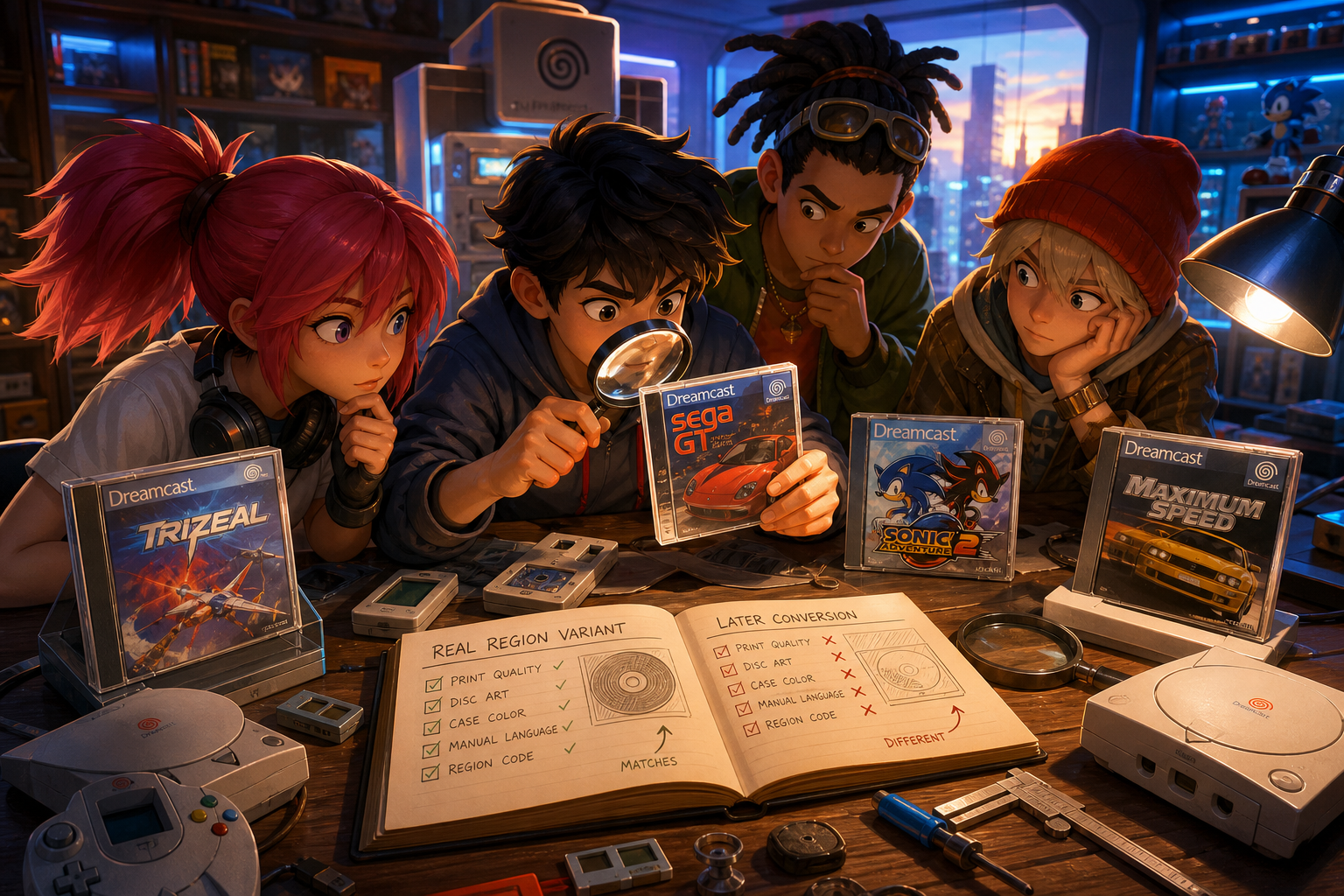
A Dreamcast listing that says PAL or NTSC sounds more helpful than it often is. It tells you something about the market a copy was sold into, but it does not fully answer whether your console will boot the disc, whether your display chain will show it properly, which languages are actually included, or whether the game has its own release-specific quirks. For collectors, those are different buying problems with different evidence.
That distinction matters because Dreamcast hardware and software documents separate territory coding from video output. A game can match your language preference and still fail to boot on a stock console. A game can boot correctly and still raise a separate display problem with a television, scaler, monitor, or cable choice. A European release can also differ in paperwork and language support without that automatically telling you anything useful about refresh behavior.
Sonic Adventure, Rayman 2: The Great Escape, and Skies of Arcadia make good case studies because they highlight three different failure points. Sonic Adventure shows how easily buyers mix original Dreamcast evidence with later rereleases. Rayman 2 is a reminder that display behavior can be title-specific rather than territory-wide. Skies of Arcadia shows why language, paperwork, and complete multi-disc sets matter just as much as the front cover. If you learn to separate those checks, PAL versus NTSC becomes a practical comparison instead of a vague argument.
PAL versus NTSC is really four separate buyer questions
Collectors often ask whether the PAL version or the NTSC version is better, but that phrasing hides the real work. On Dreamcast, the safer question is which copy matches your console, your display path, your preferred language, and your standard for completeness. Those four points overlap, but they are not interchangeable. If you skip one, the other three do not rescue the purchase.
The first question is boot region. Will this disc start on the console you actually plan to use, especially if you are buying for a normal retail system rather than a modified setup? The second question is video behavior. Even if the game boots, will your current display chain handle the way that exact release outputs its picture? The third question is language. European Dreamcast releases in particular can package several text languages together, and spoken language does not always answer the same question as menu or subtitle language. The fourth question is title-specific difference. Some games are simple one-disc buys. Others have multiple discs, multilingual paperwork, or release details that matter more than the region nickname on the listing.
Once you divide the job that way, listings become easier to read. A seller may accurately say PAL while still giving you almost nothing you need. A front cover might hint at the market, but it does not confirm the exact disc, the manual, the included languages, or whether all required discs are present. Dreamcast buying gets easier when you stop trying to solve everything with one region label.
- Separate boot compatibility from display compatibility before you compare prices.
- Treat language as a different question from both region coding and video output.
- Expect title-specific exceptions instead of assuming every PAL or every NTSC release behaves the same way.
- Use the listing photos to confirm contents, not just to admire the front art.
- If one answer is missing, treat the purchase as unresolved rather than good enough.
Start with boot region, because cables do not decide whether a stock console accepts a disc
Dreamcast software uses territory coding, so the first practical issue is whether the console will accept the game at all. Sega development documentation identifies target areas such as Japan, North America, and Europe, and it also allows more than one target-area symbol to be assigned to a title. That means a collector should think in terms of the exact software release and its intended boot compatibility, not just a casual cover-art label.
This is why a cable, VGA box, or display adapter should never be your first buying filter. If the disc does not match the console’s normal boot requirements, changing the way the picture travels to the screen does not solve that part of the problem. A seller who says it looks great through a certain cable may still have told you nothing useful about whether the copy is suitable for your unmodified North American, Japanese, or European console.
The collector-safe habit is simple. Ask the seller what region markings are visible on the disc and back cover, and ask what console region they used if the game was tested. If the answer is vague, or if the listing depends entirely on a stock photo or front insert, you do not yet know enough. Dreamcast collecting rewards the buyer who confirms the disc itself instead of trusting the broadest possible label.
- Ask which console region the seller used for testing, if they tested the game.
- Request clear photos of the disc label and back cover, not just the front insert.
- Do not assume a cable or adapter changes normal software region checks.
- Remember that some Dreamcast software can carry more than one area designation.
- Treat a cover-only listing as incomplete evidence.
Video mode is a different problem from region lock
Dreamcast hardware supports multiple video-output paths, including NTSC, PAL, and VGA. That is useful for collectors, but it also creates confusion because buyers often collapse boot compatibility and display behavior into one argument. They are not the same. A game can be correct for your console region and still raise a separate question about how that release behaves on your television, monitor, scaler, or converter.
This matters because PAL does not automatically mean one identical experience across the entire library, and NTSC does not automatically guarantee that every display-related concern disappears. The hardware can output more than one kind of signal, but a collector still has to care about the exact game, the cable path being used, and the display on the other end. If your setup is built around VGA, for example, that is a valuable compatibility check, but it comes after confirming that you are shopping for the right disc in the first place.
The practical lesson is to stop using a region name as shorthand for every display question. If a disc boots but the picture path is wrong for your current setup, that is a video-chain issue. If the disc does not boot, that is not proof that your screen rejected the signal. Separating those ideas protects you from buying the wrong game first and then wasting money on accessories that were never going to answer the real problem.
- Confirm that the console can boot the game before you optimize the video path.
- Treat NTSC, PAL, and VGA as distinct output concerns rather than synonyms for region.
- Do not assume a PAL label alone tells you the exact display behavior of a title.
- If you use a modern screen setup, ask display questions after the disc is identified.
- Use adapters to solve picture-path problems, not to guess away software-region issues.
How to read Dreamcast listings without guessing
A strong Dreamcast listing does more than name the game and show the cover. For region-variant buying, the useful listing is the one that identifies the exact release and its contents. At minimum, you want enough evidence to confirm the console region you need, the disc that is actually included, the exact Dreamcast edition rather than a later rerelease, the number of discs, the manual language, and any release-specific detail that could change the buying decision.
That checklist matters because mixed sets are common enough to deserve suspicion. A seller can pair the right front insert with the wrong disc, or combine a European case with a different market’s paperwork. Those errors are not always malicious. Sometimes the seller genuinely does not know. For the buyer, the result is the same: incomplete information. The more a listing relies on generic phrasing such as complete, tested, or import, the more you should ask for photos that verify what those words really mean.
Collectors who read listings this way stop gambling on assumptions. They also notice that some supposed bargains are simply unresolved listings with a lower price attached. If the game is one disc and language does not matter to you, uncertainty may be acceptable. If the game is multi-disc, multilingual, or tied to a specific display preference, unresolved details are a reason to slow down, not to rush because the thumbnail looks right.
- Verify the exact Dreamcast release, not a later port, compilation, or remaster.
- Check disc count before purchase, especially for large RPGs.
- Ask whether the manual and inserts match the pictured case and disc.
- Treat tested, complete, and import as incomplete until supported by photos.
- Prefer listings that show the physical item from multiple angles.
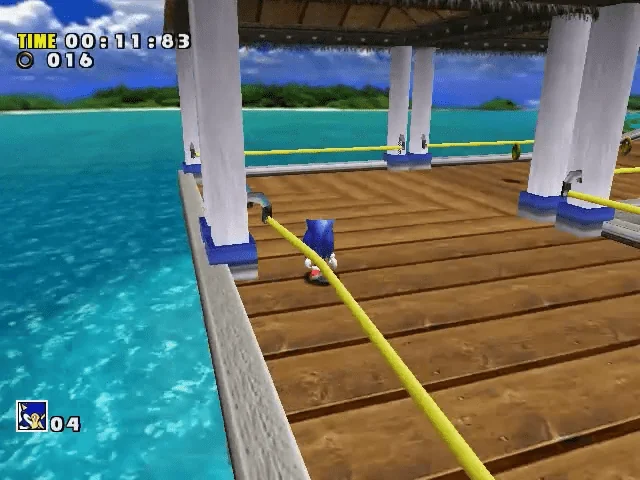
Sonic Adventure: the main risk is edition drift, not just region drift
Sonic Adventure is one of the easiest Dreamcast games to research badly because so much later material exists. A collector shopping for the original Dreamcast release can accidentally pull in information from Sonic Adventure DX, compilations, digital rereleases, or platform summaries that were never describing the first Dreamcast edition at all. That kind of evidence drift is common with famous games and can be more damaging than a simple PAL-versus-NTSC mix-up.
For the original Dreamcast release, stick to Dreamcast-era sources and Dreamcast-era packaging. The Dreamcast manual identifies it as Dreamcast software and notes VMU compatibility, which is the sort of original-platform detail that belongs in a buying check. That does not sound dramatic, but it helps keep your research anchored to the actual edition being sold. If a listing headline says only Sonic Adventure, you still need the disc and case photos to confirm that it is the original Dreamcast issue for the market you want.
The useful lesson from Sonic Adventure is that not every regional buying problem is about performance myths or cable debates. Sometimes the biggest practical error is shopping by title alone and assuming that every fact attached to that title applies to the same release. If you want the original Dreamcast version, make the seller prove the original Dreamcast version. Familiar box art and a famous name are not enough.
- Use Dreamcast-era sources when checking the original Sonic Adventure release.
- Do not rely on DX-era descriptions to judge the Dreamcast original.
- Confirm the platform from the disc and case, not only from the listing title.
- If the seller uses stock imagery, ask for photos of the exact item.
- Keep VMU and other platform-era features tied to the specific Dreamcast edition.
Rayman 2: this is where title-specific display questions matter
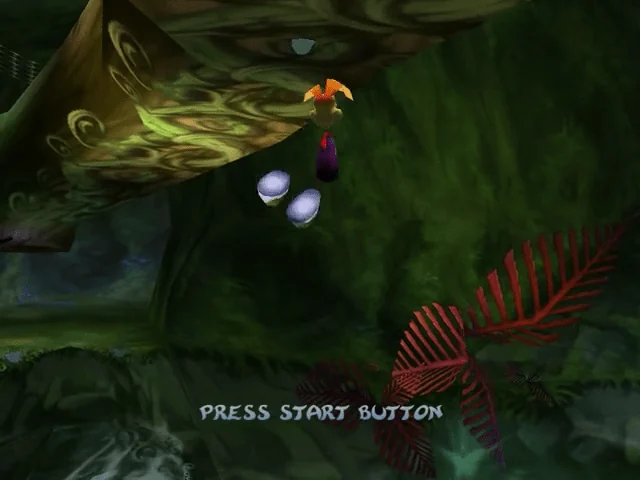
Rayman 2: The Great Escape is a good reminder that display behavior can be a game-by-game issue instead of a region-wide rule. The Dreamcast release has its own Dreamcast-specific documentation and features, which is enough to make it a poor fit for blanket assumptions such as all PAL Dreamcast games behave one way or all NTSC copies answer every refresh question the same way. If a buyer cares about how a specific title behaves on a particular display chain, Rayman 2 is the kind of listing that deserves closer inspection.
The collector takeaway is not that one territory automatically wins. It is that some games attract strong assumptions about refresh behavior, aspect presentation, or other display details, and those assumptions can spread farther than the evidence. That is why a serious buyer should ask the seller for proof of the exact Dreamcast edition and, when display behavior matters, for manual photos or confirmation based on the actual copy being sold rather than on memory, forum shorthand, or a different platform release.
Rayman 2 therefore works as the cautionary middle case between Sonic Adventure and Skies of Arcadia. Sonic Adventure warns you not to drift into later editions. Skies of Arcadia warns you not to ignore completeness and language. Rayman 2 warns you not to assume that the region label on the outer case already settled every video-mode question that might matter to your screen setup.
- Confirm that the listing is for the Dreamcast version, not another platform port.
- If display behavior matters to you, ask for evidence tied to the exact copy.
- Do not assume every PAL Dreamcast game shares the same useful video options.
- Treat title-specific display claims as something to verify, not to inherit from rumors.
- Use the manual and the disc as stronger evidence than a seller’s shorthand description.
Skies of Arcadia: region shopping becomes a completeness and language test
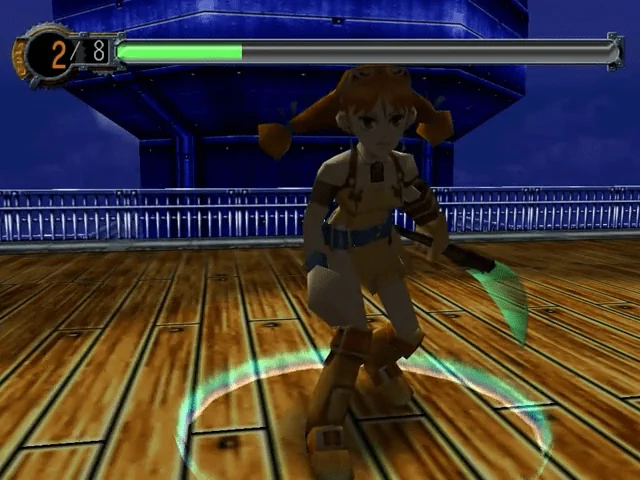
Skies of Arcadia is where many collectors discover that region buying is about more than the cover and the boot logo. The original Dreamcast release is a two-disc game. That means completeness is not a cosmetic preference. A missing disc is a functional problem. If a listing shows only one disc, or shows a case without both discs clearly visible, the correct response is to ask before paying rather than hoping the missing part exists off-camera.
Language also matters here in a more practical way than buyers often expect. European Dreamcast releases can bundle several in-game text languages while still presenting one broad market identity on the cover. For Skies of Arcadia, that makes the European version especially useful as a collecting example because spoken language, text language, and manual language are not the same check. A buyer may care about readable menus and story text far more than about what the spine calls the region. Another buyer may want the paperwork to match a specific country-language collecting standard even if the game itself offers several language options.
This is also the title in this guide where paperwork can tell you a great deal about whether the set is authentic and matched. A multilingual manual or region-appropriate inserts are not minor extras when you are trying to decide whether a European copy is really a complete European set or a hybrid assembled from spare parts. If you care about complete-in-box collecting, Skies of Arcadia is the strongest case for demanding disc photos, manual photos, and a direct answer about what is actually included.
- Always confirm that both Skies of Arcadia discs are present.
- Do not buy a multi-disc RPG from front-cover photos alone.
- Keep spoken language, in-game text language, and manual language as separate checks.
- Ask for manual photos if complete-in-box condition matters to you.
- Be cautious of mixed sets built from replacement cases, manuals, or discs.
What to ask before you pay, and how to make the final choice
A useful pre-purchase message does not need to be long. It needs to be specific. Ask which console region the game was tested on, what markings appear on the disc and back cover, whether the photos show the exact item, whether every required disc is present, and what language the manual and in-game text use if known. If the title is one that buyers frequently discuss for display behavior, ask the seller whether their answer is based on the actual copy or on general knowledge about the game.
This style of message helps because it turns vague optimism into verifiable detail. If the seller can answer clearly, you reduce risk. If the seller cannot answer, that does not automatically mean the item is bad, but it does mean the listing still contains uncertainty. That uncertainty should affect either the price you are willing to pay or your willingness to buy at all. Collectors get into trouble when they treat missing information as harmless instead of treating it as an unpriced cost.
The final decision framework is straightforward. Choose the copy that meets your boot needs first. Then confirm it suits your intended display path. Then narrow by language and paperwork. Then apply title-specific filters such as original-edition accuracy for Sonic Adventure, display-related verification for Rayman 2, and two-disc completeness plus multilingual paperwork for Skies of Arcadia. Once you compare copies in that order, PAL and NTSC become helpful descriptions instead of misleading shortcuts.
- Ask what console region the seller used for testing.
- Ask for photos of the disc labels, back cover, and included manual.
- For Skies of Arcadia, ask directly whether disc 1 and disc 2 are both present.
- For famous games with later rereleases, ask the seller to confirm the original Dreamcast edition.
- Choose the copy that fits your console, screen, language, and completeness standards in that order.
Dreamcast collecting gets clearer when you stop treating PAL versus NTSC as a single verdict. Boot compatibility, video output, language, and game-specific differences are separate checks, and any one of them can change which copy is right for you. A region label can point you in the right direction, but it is not the whole answer.
The practical winner is not automatically PAL or automatically NTSC. The best buy is the copy that will boot on your console, behave well on your display path, include the language and paperwork you actually want, and match the exact release standard you are collecting for. If you verify those points before you pay, you will avoid most of the mistakes that make Dreamcast region shopping feel harder than it really is.