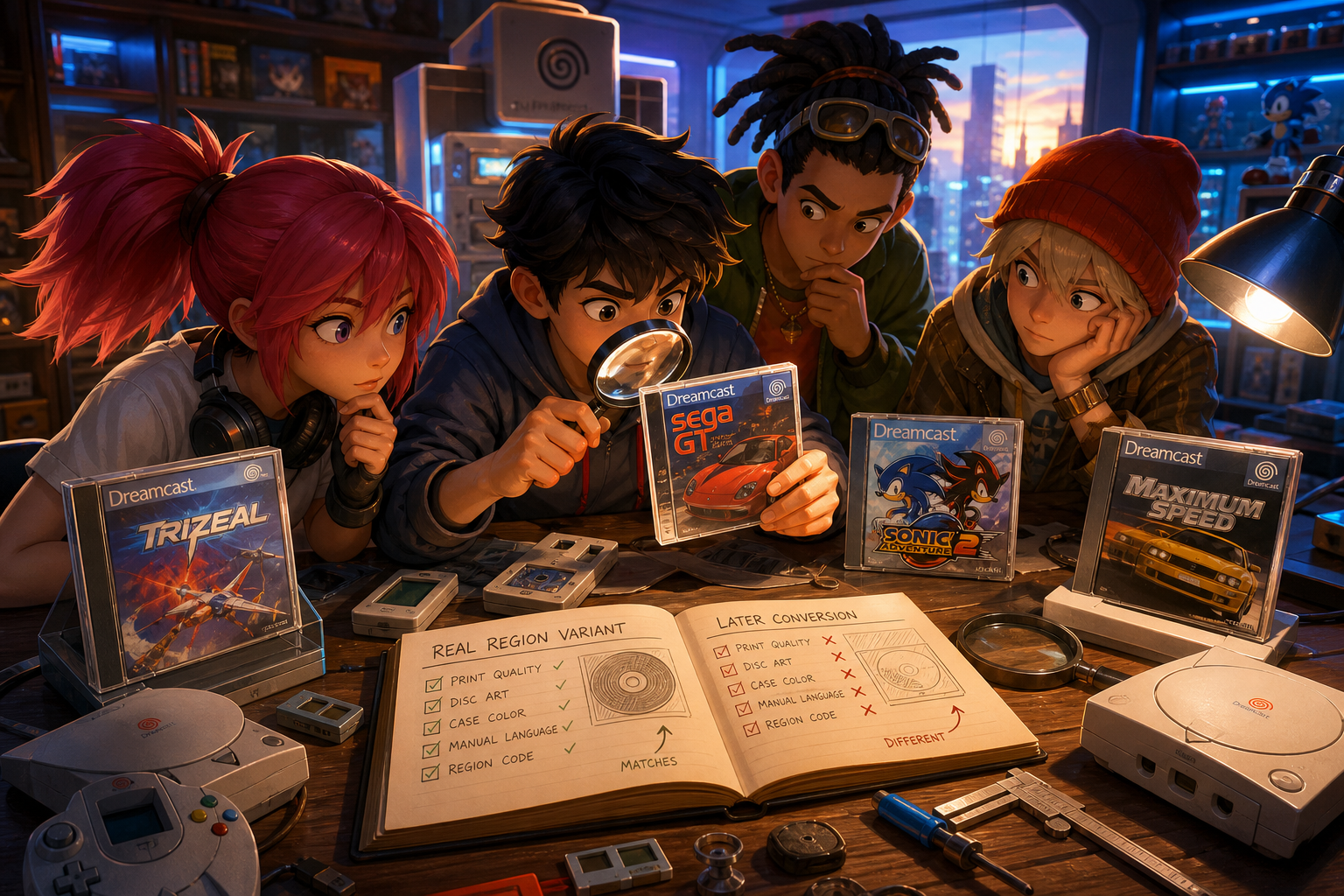
A colored band on a retro game case can make a release look easy to identify. In practice, that label answers only one question: which retail presentation the publisher used for that package. It does not, by itself, prove that the disc came from a particular production run, that the software changed, or that every paper item belongs with the case.
Collectors looking for a specific edition should separate four questions before buying. Is this the correct region? Is the case the intended label variant? Do the manual and inserts match? Does the disc carry the expected identity? That method is more dependable than trusting a marketplace title such as original, complete, black label, Greatest Hits or Player’s Choice.
A retail label is evidence, not a verdict
Sony’s Greatest Hits branding and Nintendo’s Player’s Choice branding generally identify later budget-oriented retail presentations. The visible label can distinguish an original-looking package from a later catalog presentation, which makes it valuable first-stage evidence. It can also matter greatly to a shelf collector who wants a particular spine, cover design or regional issue.
What the label cannot safely establish is just as important. A budget release is not automatically a corrected version, a censored version, a lower-quality pressing or a separate software build. Conversely, an original-style cover is not proof that the disc was manufactured during the launch window. Cases, discs and manuals are frequently mixed after resale, and replacement artwork can conceal that history.
Treat the retail label as packaging evidence. Treat a catalog code, disc marking or independently documented disc record as product-identity evidence. Those are related clues, but they are not interchangeable. A careful listing should make the physical components agree rather than asking the buyer to infer everything from a banner on the front cover.
- Record the exact wording on the front cover and spine.
- Identify the region before comparing any code with an online record.
- Do not infer software changes from the color or position of a budget-label banner.
- Assume a loose case and loose disc may have been paired after the original sale.
Use an evidence ladder for a specific release
Start with the region and platform. On PlayStation 2, compare the North American packaging style and printed catalog information with the release you want. On GameCube, check the regional designation, product code and Nintendo case artwork. A European or Japanese copy may be genuine and desirable, but it is not interchangeable with a North American target.
Next compare the front, spine and back cover. The spine is especially useful when a seller photographs only the front. Then inspect the disc face and, where possible, the inner-ring or mastering information. A disc that carries a different regional or product identifier from the case should be treated as a mismatch until the seller explains it.
Only after those checks should you assess the manual and inserts. Printed paperwork can confirm language, publisher information, control instructions, memory-card information and a code associated with the edition. It can support an identification, but it does not override a contradictory disc. Finally, consult an authoritative manual archive, release record or maintained disc database when the question concerns a revision or a special bundle.
This order prevents a common mistake: allowing a broad barcode or attractive cover to outweigh the identifier printed on the physical software. It also keeps two separate judgments apart: whether an item is complete enough for a collector’s purposes, and whether its components belong to the same release.
- Region and platform.
- Front, spine and back artwork.
- Case and product or catalog code.
- Disc label and internal identifier.
- Manual, inserts and any second disc.
- Documented evidence for a claimed software revision.
Final Fantasy X: SLUS-20312 versus SLUS-20312GH
The North American original PlayStation 2 release of Final Fantasy X is listed with product ID SLUS-20312. The North American Greatest Hits issue is listed with product ID SLUS-20312GH. Those designations give buyers a practical way to distinguish the target, especially when the cover has been replaced or a seller has used a generic listing title.
The front and spine remain useful because the Greatest Hits packaging is visibly different from the original presentation. They should be treated as the first-stage check, not the final answer. Ask for a clear photograph of the disc and compare its printed code with the code expected for the edition. A photograph of the back cover can help establish whether the case and paperwork belong to the same regional product.
Barcode evidence needs restraint here. The available release data lists the original North American release with barcode 662248901077 and also lists the Greatest Hits entry with that same barcode. A matching barcode therefore cannot prove that a copy has the original-label packaging. The code may identify a product family or catalog entry without distinguishing every physical presentation.
Final Fantasy X also has Japanese International, European Platinum, Japanese Mega Hits and Japanese Ultimate Hits editions. Their existence creates a regional and edition trap: Greatest Hits is not a universal name for every later issue of the game. Check subtitle or edition wording, language, region and product code together.
A buyer seeking the original North American presentation should look for agreement between the original-style packaging and SLUS-20312 on the relevant disc. A buyer seeking the North American Greatest Hits presentation should expect the Greatest Hits artwork and should look for SLUS-20312GH where that designation is printed. If the seller shows only the cover, the edition remains unconfirmed.
- Ask whether the disc code is SLUS-20312 or SLUS-20312GH.
- Check the spine and front cover for the matching presentation.
- Do not use the barcode as the sole distinction.
- Separate North American Greatest Hits from International, Platinum, Mega Hits and Ultimate Hits editions.
- Reject an edition-specific claim when the seller hides the disc and provides only stock artwork.
The Wind Waker: original, Player’s Choice or Limited Edition
The GameCube release history of The Legend of Zelda: The Wind Waker is more complicated because several collector targets can look superficially similar. The maintained Redump record for the North American disc associates the title with Original, Limited Edition, Player’s Choice and Player’s Choice Best Seller categories. Those categories should not be collapsed into one generic Wind Waker GameCube listing.
The Limited Edition is the critical package distinction. It was sold with an additional Ocarina of Time and Master Quest bonus disc. If the goal is that bundle, the second disc is not an optional extra or a decorative accessory; it is part of the package identity. A standard Wind Waker disc in a convincing case does not make the item a verified Limited Edition.
The verified disc record identifies the Wind Waker disc serial as DL-DOL-GZLE-USA and records the internal serial as GZLE01. It also lists additional serials for covers, manuals and inserts. Those identifiers are useful because they show that a release consists of multiple physical components with their own printed evidence. They also demonstrate why a single barcode cannot authenticate an entire package.
The Redump record documents a verified Wind Waker disc associated with several release categories, but that does not mean every retail component from those categories is interchangeable. It confirms a disc identity, not the condition of a particular seller’s case, manual or bundle. If a listing claims Limited Edition, identify the actual bonus disc and its packaging separately.
Player’s Choice artwork indicates a later retail presentation. Its presence alone does not establish a different game build. Unless a title-specific source identifies a reproducible software difference, describe the Player’s Choice copy as a packaging and cataloging variant rather than calling it corrected, inferior or technically different.
- Decide whether the target is Original, Player’s Choice, Player’s Choice Best Seller or Limited Edition.
- For Limited Edition, require photographs of both discs.
- Check the Wind Waker disc serial, including DL-DOL-GZLE-USA where applicable.
- Compare the case, manual and inserts rather than assuming one matching cover proves completeness.
- Do not substitute Player’s Choice artwork for a Limited Edition bonus-disc package.
Super Mario Sunshine: when the product ID does not settle the label
Super Mario Sunshine demonstrates why collectors should not expect every packaging change to receive a cleanly different product identifier. Available reference data lists the original North American GameCube release with product ID DOL-GMSE-USA. The Player’s Choice release is also represented with that broad product ID and the same barcode in the supplied catalog information.
That overlap does not make the two packages indistinguishable. The cover, spine and Player’s Choice branding still identify a different retail presentation, which matters if the collection is organized around original labels or Player’s Choice artwork. It does mean that a barcode or broad product ID cannot, by itself, answer which cover variant belongs in the collection.
Keep the region boundary firm. Japanese and European examples use different identifiers, including DOL-GMSJ-JPN for Japan and DOL-GMSP-UKV for Europe. A photograph that shows only the disc title logo is not enough to establish a North American Player’s Choice copy. Ask to see the full disc face, spine and back cover.
The manual and paper goods provide another cross-check. Look for matching regional language, Nintendo promotional material and catalog information. These items can be missing, swapped or replaced independently of the disc. If the disc and case agree on the intended region but the manual clearly belongs to another presentation, record the item as mixed rather than silently treating it as a fully matched edition.
For most buyers, the choice between original and Player’s Choice is primarily about packaging, catalog identity and shelf appearance unless a specific, documented software difference is established. That is a more defensible conclusion than declaring one label universally superior.
- Compare DOL-GMSE-USA with the case’s regional presentation.
- Do not assume the shared product ID or barcode identifies the cover label.
- Exclude DOL-GMSJ-JPN and DOL-GMSP-UKV from a North American target.
- Check the manual’s language and printed information.
- Describe mixed case, disc and paperwork honestly.
Manuals, inserts and catalog numbers work as a set
A manual is useful because it is printed evidence tied to a platform, region and product family. Nintendo’s official GameCube manual archive lists an English instruction manual for The Legend of Zelda: The Wind Waker. That confirms an authoritative comparison point for the title, although the archive does not prove that every retail package used identical paper components.
Original manuals can be compared for control instructions, memory-card information, publisher details and printed identifiers. They are more useful when considered alongside the case and disc. A manual from one edition should not automatically be assumed to belong with another case, particularly when a game has an original presentation, a later budget presentation or a bonus-disc bundle.
The same problem applies to registration cards, advertisements, warning leaflets and bonus-disc inserts. A seller may place a replacement manual inside an original case, or retain the original manual after selling the disc separately. A clean-looking package can therefore be mixed even when every individual component is authentic.
Use catalog numbers as links between components, not as magic authentication marks. Compare the code on the manual with the cover record, then compare both with the disc and the region. If one item conflicts, document the conflict. A nearly complete package with a mismatched manual may still be useful to a player, but it is not the same collecting object as a matched edition.
This is separate from the meaning of CIB. CIB describes a condition or completeness claim; it does not identify whether the contents are Original, Greatest Hits, Player’s Choice, Limited Edition or a bundle. A case, manual and disc can all be present and still represent three different source packages.
- Compare manual language and region.
- Look for printed product or edition identifiers.
- Check inserts for bonus-disc or bundle references.
- Treat conflicting components as evidence of a mixed package.
- Keep completeness and edition identity as separate notes.
Questions to ask before buying a specific release
A good listing should let you establish identity before money changes hands. Ask for photographs taken together: front cover, spine, back cover, disc face, disc inner ring, manual cover and every additional disc or insert. A single stock image is suitable for browsing, not for authenticating a particular copy.
Ask the seller to transcribe codes instead of relying on an interpretation such as black label or rare version. For Final Fantasy X, request confirmation of SLUS-20312 or SLUS-20312GH. For The Wind Waker, ask whether the bonus disc is physically included when the listing claims Limited Edition. For Super Mario Sunshine, ask which regional product marking appears on the disc and case, since the original and Player’s Choice records can share a broad identifier.
Ask whether the photographed disc is the disc being sold. Marketplace listings sometimes use a stock cover photograph while the actual disc is loose, replaced or unavailable. If the seller cannot answer, treat the edition as unknown rather than filling in the missing details from the cover.
Use a stop-buying rule: if the edition depends on a hidden disc code, missing second disc or unreadable spine, do not pay an edition-specific premium. You can still make an offer for an unidentified copy, but do not price it as the confirmed target.
When a seller says same game, different cover, that may be a reasonable description of a Player’s Choice or Greatest Hits package, but it does not answer whether the disc, manual and region match. Clarify each part rather than arguing from label terminology.
- Can the seller show the exact disc, not just stock artwork?
- Are all codes readable rather than guessed?
- Is every claimed bonus disc photographed?
- Do the case, disc and manual share the intended region?
- Would you still buy it if the label variant were unconfirmed?
- If not, stop until the missing evidence is supplied.
Claims a label cannot prove
The most persistent mistake is treating a later retail label as a quality ranking. Greatest Hits and Player’s Choice do not universally mean bad pressing, just as an original cover does not universally mean best disc. Manufacturing identity, software revision and package presentation are separate subjects.
A second mistake is assuming that every later label contains a bug fix or altered game. Such a claim requires a title-specific source identifying the exact revision and the difference. Cover colors, banner placement, barcodes and marketplace descriptions are not enough. If no reproducible disc evidence exists, use careful language: the item is a later retail or packaging variant, and the software difference is unverified.
A third mistake is assuming that an original-style cover contains an original disc. Replacement cases and manuals are common enough that visual neatness cannot substitute for matching identifiers. The Wind Waker Limited Edition makes the danger obvious: without the bonus disc, the package is not the same bundle, regardless of how convincing the outer case appears.
Finally, do not generalize one game’s catalog practice to another. Final Fantasy X uses a recognizable North American Greatest Hits code distinction, while Super Mario Sunshine’s available original and Player’s Choice records share a broad product ID and barcode. Each title needs its own comparison.
- Do not rank labels as automatically better or worse.
- Do not call a revision corrected without title-specific evidence.
- Do not call a bundle complete without its required second disc.
- Do not generalize North American identifiers to Japanese or European copies.
- Use unverified when the disc evidence is incomplete.
For Final Fantasy X, the SLUS-20312 and SLUS-20312GH distinction provides a strong starting point, but region, cover and disc still need to agree. For The Wind Waker, the Limited Edition bonus disc is the decisive package check. For Super Mario Sunshine, shared product information makes the cover, spine and physical disc photographs especially important.
Choose the original presentation when artwork and launch-style packaging are the goal. Choose Greatest Hits or Player’s Choice when that catalog variant fits the collection or when a clearly identified playable copy is wanted. Choose The Wind Waker Limited Edition only after every advertised disc and insert is verified. In all three cases, the safest purchase is the one whose region, packaging, paperwork and disc identity can be shown rather than merely asserted.