A console built for a future that arrived too quickly
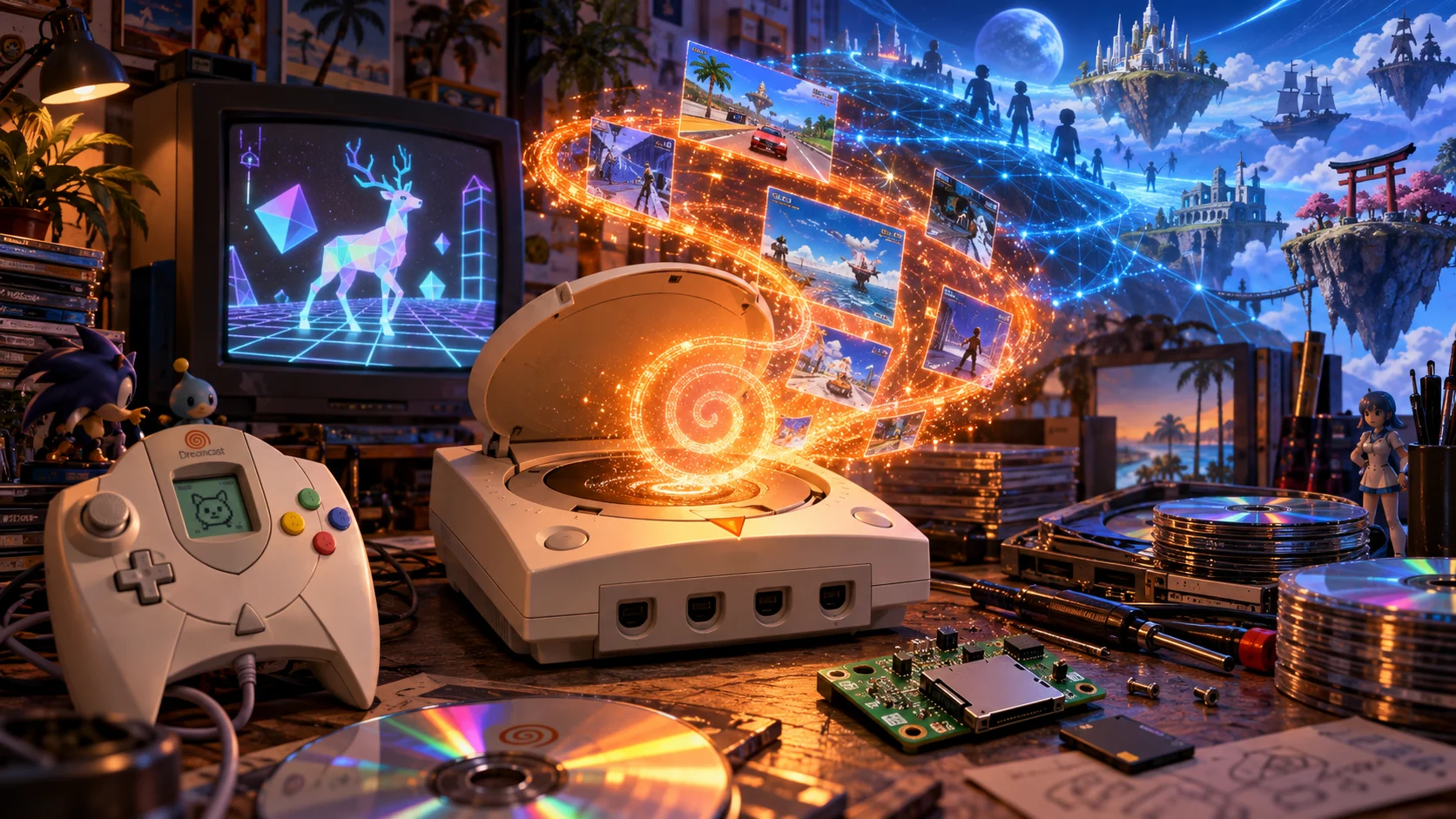
The Dreamcast arrived in Japan on November 27, 1998, carrying Sega’s last great hardware gamble. In North America, the launch came on September 9, 1999; Europe followed on October 14. Its off-white controller and compact, curved case looked unlike anything Sega had made before. A detachable VMU sat in the controller, the modem was built into the console, and arcade-scale three-dimensional graphics appeared without an expansion cartridge or optional network accessory.
The machine suggested that a console could be several things at once. It was a games player, a small network computer, a memory-card platform with its own screen and controls, and a close relative of Sega’s NAOMI arcade hardware. It also contained an unexpected second personality in its optical drive. Retail games used GD-ROM, a proprietary high-density format holding roughly one gigabyte. Compatible Dreamcast units could also recognize MIL-CD, Sega’s officially supported interactive-music format, on an ordinary compact disc.
MIL-CD was not a pirate standard and did not duplicate the proprietary high-density GD-ROM format. It was a legitimate multimedia feature whose boot behavior created an alternate route into executable software. Once programmers, reverse engineers and scene groups examined that route, the machine became unusually receptive to independent code and unauthorized releases. Those developments overlapped in time, but they were not one project and did not share one purpose.
The Dreamcast’s later reputation for openness therefore has two origins. Sega designed a technically ambitious console with a standard modem, accessible peripherals and a related arcade architecture. Sega also gave its firmware a sanctioned reason to boot something other than a retail GD-ROM. The first condition attracted programmers. The second gave them a door.
Inside the SH-4 machine
The Dreamcast’s central processor was Hitachi’s 200 MHz SH-4, a RISC design with a floating-point unit that made three-dimensional mathematics practical for a relatively inexpensive console. Sega paired it with NEC’s PowerVR2 graphics system. PowerVR’s tile-based deferred-rendering approach differed from the immediate-mode pipelines common on contemporary PCs: the chip divided the image into tiles, resolved visibility and then rendered surfaces that needed to appear. The method helped deliver strong 3D results without requiring a large amount of conventional graphics memory.
The memory figures are worth keeping exact. The Dreamcast had 16 MB of main RAM, 8 MB of video and texture memory, and 2 MB of sound memory. The system did not possess a single undifferentiated pool that could be described as “32 MB of RAM.” Those separate resources shaped every commercial game, port and homebrew project. Sound had its own processor and memory, while the PowerVR2 required programmers to think carefully about textures, command lists, DMA and scene organization.
NAOMI used a closely related CPU and graphics lineage, which made arcade-to-home conversions more practical than on many earlier Sega systems. The arcade board was not simply a Dreamcast with a different disc drive. It could use different memory arrangements, cabinet interfaces and storage methods, but the relationship was technically meaningful. Developers who understood one platform could often carry knowledge, tools or assets to the other.
The VMU made the architecture feel even less like a sealed appliance. It combined a tiny screen, controls, processor and sound with nonvolatile flash storage for saves. Batteries powered its standalone screen and small games; removing those batteries did not erase the saved games. Docked in a controller, the display could show secondary information while the television carried the main game. The modem performed a similar psychological trick, making communication part of the console’s identity before most players had broadband or expected every system to maintain an online account.
That combination mattered to hackers because the Dreamcast was already full of boundaries that met at the hardware level. The optical drive talked to firmware. The controller ports accepted a computer-like accessory. The VMU exposed a small programmable device. The modem offered a development and communication channel. The machine did not become open by accident in one place; it was open enough in several places for determined outsiders to connect them.
GD-ROM was not a giant CD-R
GD-ROM created one of the era’s most persistent misconceptions. Sega’s format held approximately one gigabyte, but it was not simply a normal CD-ROM stretched to a larger capacity. A Dreamcast disc contained a conventional low-density area and a high-density area separated by a security region. Ordinary CD hardware could read the compact-disc portion. The high-density game area used Sega’s proprietary arrangement and addressing.
That distinction produced several different technical objects. A full GD dump attempted to preserve the high-density data and the original track layout. A reduced CD-R release had to fit within approximately 650 or 700 MB and might remove or recompress video, audio, languages, dummy data or bonus material. A homebrew disc contained an independently produced executable. A later optical-drive emulator presented a stored image to the console by replacing or intercepting the original drive. Calling all four things a “rip” concealed major differences.
A complete game was not reproduced merely by copying visible files into a folder. A playable Dreamcast image described sessions, tracks, sector modes, boot information and filesystem structures. In the self-boot era, the relationship between the initial boot session and the data session was particularly important. DiscJuggler CDI files became closely associated with Dreamcast releases, while CDRWIN BIN/CUE and Nero NRG appeared in other workflows. Later applications, including versions of ImgBurn, added support for some established formats. There was never one mandatory program for every year, image type or release.
The physical limit of the CD-R also shaped the scene’s output. Some games fitted after dummy files and duplicate assets were removed. Others lost speech, music, movies, languages or entire modes. A conversion that ran from compact disc was not necessarily a faithful archive of the GD-ROM. It was often an engineered compromise, and preservation work later had to distinguish between a reduced CD-R image and a fuller GDI image.
The old laser legend is equally oversimplified. Burned discs could be difficult for an aging or poorly calibrated drive to read, and bad media could increase mechanical strain or expose an existing fault. There is no universal rule that CD-R automatically destroyed every Dreamcast laser. Drive condition, disc quality, image construction and the particular console all mattered.
MIL-CD and the alternate boot path
MIL-CD, or Music Interactive Live CD, was intended to make music discs interactive. Sega’s firmware could inspect a CD’s session arrangement, identify a designated bootstrap and transfer control to executable material. The feature belonged to Sega’s commercial multimedia strategy. It was not a deliberate invitation to duplicate GD-ROMs, and it did not disclose the high-density area to an ordinary PC burner.
Marcus Comstedt’s public Dreamcast hardware and programming documentation clarified crucial parts of this process. The relevant CD-R arrangement used multiple sessions, including an audio first session and a CD/XA data session containing the boot material. An IP.BIN bootstrap helped describe the program to the console. The executable path involved Dreamcast-specific data handling, including scrambling and descrambling behavior. Those findings explained how a carefully structured disc could boot; they did not turn a GD-ROM into a normal compact disc.
That distinction is fundamental. MIL-CD supplied the official firmware behavior. Independent work identified how to construct a disc that used the behavior. Scene groups then developed boot discs and self-booting releases for unauthorized distribution. Homebrew developers used the same broad route to launch free software. The shared mechanism did not make the projects identical.
Comstedt’s contribution was substantial, but the origin story was not a one-person invention. His hardware and boot documentation formed one strand of research. Other programmers developed libraries, toolchains and demonstrations. The free-development community and the copying scene often examined the same machine at the same time, sometimes using related discoveries without becoming a single organization.
The Dreamcast’s vulnerability was therefore architectural rather than magical. Sega had not simply forgotten to protect a game disc. It had built a legitimate alternate boot path for interactive music and then placed that path in a consumer machine whose firmware, optical drive and executable format could be studied by outsiders. The gap between intended use and possible use became the scene’s opportunity.
The debug machines and the first demonstrations
Before Utopia became famous, Hitmen and Realworld Technology’s Skywalker worked on the Dreamcast Debug Handler. This host-computer interface exposed memory, transferred files and supported boot-related patches. The original arrangement involved roughly forty connections; a later Lite design reduced that to sixteen. It was specialized development hardware rather than a consumer import chip.
At Mekka Symposium in April 2000, the A.G.E. audiovisual demo booted from CD-R with assistance from the Debug Handler. A computer, soldered connections and experimental software helped turn the retail console into a development target. Hitmen subsequently postponed a broader public release in October 2000 because the interface was not reliable enough.
Such experiments made testing repeatable. Instead of seeing only the finished picture on a television, a programmer could investigate what happened inside the machine and change a test program. A demo could explore animation, music and visual effects without needing the levels, menus and assets of a full game. That small scale suited people learning unfamiliar hardware in their spare time.
The early demonstrations belong alongside the later boot-disc story. They show an independent programming culture already taking shape before copied games made Dreamcast hacking widely notorious. Utopia would reach a much larger audience, but public visibility and the beginning of technical experimentation were different milestones.
The Utopia reindeer and the scene’s visual language
In June 2000, Utopia’s boot disc turned a technical route into a cultural event. The famous rotating reindeer appeared before software that Sega had not authorized, making the boot process visible to people who had no reason to know about sessions, firmware or executable formats. The image was whimsical and instantly legible: the Dreamcast was doing something outside the retail script.
Utopia was a bootloader, not a replacement for GD-ROM and not a complete game-distribution system. Early users commonly started the boot disc and then changed discs or followed a release-specific sequence. That inconvenience encouraged self-boot development, in which the boot behavior was incorporated into the release so that a compatible console could start directly from the CD-R.
The scene’s release intros created a different kind of spectacle. A cracktro could display rotating group logos, tracker music, particle effects, real-time polygonal objects, greeting scrollers and credits before handing control to a game. Some used prerecorded material, but many were executable presentations built for the Dreamcast’s hardware. The word “demo” was consequently used for several different things: a stand-alone demoscene work, a homebrew test, a boot disc, a cracktro or a video capture of any of them.
Kalisto and Echelon became prominent names in Dreamcast release culture. One preserved example is Echelon’s intro for 18 Wheeler, catalogued as a May 2001 production. An attached cracktro gave the release group its own opening performance before Sega’s game began. Its purpose was recognition: a name, a visual signature and a set of credits that travelled with the release. That is the kind of presentation many players remember as a little demo before the game, distinct from both Sega’s normal startup and Utopia’s separate boot disc.
NFO files gave the scene its own written culture. They listed release versions, regional tags, suppliers, crackers, coders, musicians, compression notes, known defects, fixes and greetings. The documents were promotional and partisan, but they reveal a competitive ecosystem. Groups competed over speed, completeness, self-boot reliability, compression and presentation. A release that omitted music or failed in VGA might be followed by a fix. A later version could remove the need for a separate boot disc or improve the menu.
The technical work could be clever while the distribution remained unauthorized. Release groups had to understand disc layout, executable handling, compression and the limits of a compact disc. They also chose what to sacrifice. Video might be recompressed, audio reduced, languages omitted and dummy files removed. A successful conversion could preserve the central game surprisingly well; another could lose the material that gave the original its atmosphere. Scene ingenuity and copyright infringement existed in the same release.
Watch: Echelon’s Tokyo Xtreme Racer 2 intro
This recording, uploaded by ThunderTHR, shows the Echelon cracktro associated with Tokyo Xtreme Racer 2—a concrete example of the scene intros remembered by Dreamcast players.
Watch: Echelon’s Confidential Mission intro
This recording from RealDonnyK presents another Echelon cracktro, identified by the uploader as the 2001 Confidential Mission intro.
Regions, chips and the untidy production line
Dreamcast modification history is often compressed into the phrase “play imports,” but several different problems were involved. A region patch changed or bypassed a game’s regional check. A boot disc supplied a route into software the console might otherwise reject. A modchip altered hardware or firmware behavior. VGA compatibility concerned video output. None of these functions automatically supplied the others.
Early import users employed products such as Action Replay CDX and Code Breaker, software patches and, in some cases, four-wire modchips. A four-wire installation could provide automatic boot behavior for imports and particular discs, but it should not be described as a universal requirement for CD-R use. The exact function depended on the product, console revision and software. Datel’s Action Replay CDX belonged to the commercial import and cheat-device market, even though its CD-based route overlapped with the practical territory occupied by Utopia.
MIL-CD support also varied across hardware revisions. VA0, VA1 and VA2-family labels became convenient shorthand, but production did not form a perfectly tidy calendar. Early units are broadly associated with MIL-CD capability, while later BIOS revisions removed or disabled the alternate route on some machines. Transitional production and regional differences make blanket statements such as “every VA2 works” or “everything after October 2000 is impossible” unreliable.
The same caution applies to repair work. Replacement or dual-BIOS projects addressed boot behavior. Battery changes addressed clock and backup functions. Fan, power-supply and optical-drive repairs addressed aging hardware. A modification that solved one problem did not automatically solve the others. The Dreamcast’s first hacking era taught owners to think in layers: firmware, disc format, region, video mode and motherboard revision were related systems, not one switch marked “modded.”
The free-development breakthrough
The Dreamcast’s homebrew history moved from demonstrations to software when programmers began building free tools around the machine. Marcus Comstedt’s documentation explained hardware and boot behavior, but he was not the sole author of the free SDK ecosystem. The KallistiOS project history credits Megan Potter, Jordan DeLong and Mike “Tursi” Brent with the early libdream work, adapting knowledge from Comstedt’s research. Megan Potter is also credited with originating KallistiOS, which later became a wider community-maintained project.
libdream supplied an accessible library layer for Dreamcast development. It helped programmers initialize the machine, read controllers, use the VMU, access sound and work with graphics without beginning every project at the level of raw hardware registers. KallistiOS built on that foundation with startup code, device libraries, filesystem support, networking, audio and graphics facilities. Later contributors kept expanding, repairing and documenting the system.
The development loop resembled ordinary cross-platform programming even though the target hardware was unusual. Code was written on a desktop, compiled with a GCC-based SuperH cross-compiler, linked into a Dreamcast executable and transferred to the console. A serial connection and dcload-style tools allowed a programmer to send code and receive debug information. The link was slow, but it replaced the need to master a disc image for every test.
The Broadband Adapter offered a faster route where available. The HIT-0400 Ethernet adapter and the less common HIT-0300 LAN adapter were different devices with different speeds, availability and software compatibility. Neither converted every modem game into a broadband title. For development, however, Ethernet transfer and debugging reduced the delay between changing code and testing it.
KallistiOS did not make the hardware ordinary. Developers still had to manage 16 MB of main memory, 8 MB of video memory and 2 MB of sound memory. PowerVR2’s tile-based rendering required an understanding of textures, command lists and scene submission. The libraries made those problems approachable rather than eliminating them. That was enough to turn the Dreamcast from a locked consumer product into a practical independent target.
Games, ports and the small-code revolution
Early homebrew projects demonstrated that the free toolchain could produce software people actually played. Ghetto Pong grew from Jordan DeLong’s original concept and code, with Megan Potter contributing menus, music and sound effects and collaborators adding graphics. Stars became another early KallistiOS-era example. Their scale was modest, but their importance was not: they showed that a Dreamcast executable could be authored outside Sega’s official pipeline and distributed as an independent work.
The tools also gave the community a way to share finished work. DC Tonic, assembled for E3 in May 2001, brought independent Dreamcast productions together on a demonstration disc. Cryptic Allusion, Ganksoft, Moving Target Software Design and Andrew K of Napalm were involved. A collection like that made a scattered development scene visible: visitors could see several independent programs running on the same retail hardware instead of having to follow individual technical discussions.
DreamSNES, credited to Marcus Comstedt, Peter Bortas and Per Hedbor, brought SNES9x-derived emulation to the console. It was an important technical demonstration, but its performance depended on the game and settings. Sound synchronization, timing, special cartridge hardware and memory use could all expose the limits of emulation. NesterDC and NesterDC SE made NES emulation more accessible, while Genesis Plus DC extended the approach to Sega’s 16-bit hardware. These projects were impressive because they negotiated the Dreamcast’s limits rather than pretending those limits did not exist.
ScummVM took a different approach, reimplementing adventure-game engines instead of emulating an entire computer. Its official Dreamcast port has a firm memory boundary: SCUMM v7 and v8 adventures, including The Dig, Full Throttle and The Curse of Monkey Island, are unsupported. Smaller adventures can still make an excellent match for the console. This limitation describes the documented Dreamcast backend; experimental third-party builds may make different compromises. Engine reimplementation saves work, but it cannot turn a large game’s assets into an unlimited-memory workload.
Doom and Quake ports benefited from targeting the console directly. Native code could use the SH-4, PowerVR2, controller and sound hardware more efficiently than a general emulator. Neo4All and related projects pushed toward arcade emulation, where compatibility and speed varied by system and game. The results were rarely universal. A title might boot with missing effects, slowdowns or imperfect sound, while another ran remarkably well. The achievement lay in making the old machine a laboratory for learning how several generations of hardware worked.
Debugging, DreamShell and the changing loader
The Dreamcast Debug Handler showed one path toward development; the serial port showed another. A programmer could compile a test build, transfer it to the console, inspect memory and repeat the process without mastering a finished disc image. This mattered more than raw transfer speed. It made the console iterative.
DreamShell, associated with DC-SWAT, extended the idea into a software environment and loader. It could provide dashboards, file handling and alternative loading arrangements depending on the hardware. A serial SD adapter used the console’s serial connection and was constrained by that bottleneck. An internal G1 ATA or IDE modification changed the storage path and could provide substantially different performance. DreamShell was the software environment that used such arrangements; it was not itself an optical-drive emulator.
The distinction became important as enthusiasts began to use the words “load from SD” for unrelated systems. A serial adapter, an internal storage modification and an ODE could all involve flash storage while interacting with the Dreamcast at different points. The first moved data through a slow external interface. The second used the internal expansion bus. The third replaced or intercepted the original optical drive. Treating them as interchangeable erased the engineering that made each useful.
DreamShell also represented a change in ambition. Early hackers wanted the console to accept one independent executable. Later users wanted file browsers, larger storage, fast testing, dashboards and preservation-friendly access to a library. The Dreamcast’s development culture gradually became a systems culture. Libraries, loaders, debugging tools and storage hardware formed a stack, each layer solving a different problem.
This stack never made every game compatible. Images could be incomplete or reduced. Games could depend on particular track layouts, audio behavior, video modes or timing assumptions. But it gave the community enough control to keep experimenting after Sega had stopped maintaining the platform.
Bleemcast and the commercial emulator argument
Bleemcast occupied a different category from free homebrew. It was a commercial, unlicensed PlayStation emulator for Dreamcast, sold as three game-specific discs: Gran Turismo 2, Tekken 3 and Metal Gear Solid. Customers were expected to use their original PlayStation discs. Bleemcast was not a generic product that promised perfect compatibility with the whole PlayStation catalogue.
Specialization was its technical strategy. By concentrating on a small number of famous and demanding games, the developers could optimize performance around known software instead of trying to reproduce every PlayStation behavior. The result was closer to a set of bespoke emulator products than to a universal PlayStation inside a Dreamcast.
The legal conflict with Sony made Bleemcast unusually visible. It became part of the public argument over emulator development, reverse engineering and the rights attached to compatibility software. The dispute should not be reduced to a simple morality play. Litigation expenses, the difficulty of selling unlicensed technology, the narrow product strategy and the realities of a shrinking Dreamcast market all affected the company’s prospects.
Bleemcast’s historical importance lies in demonstrating what the Dreamcast could do as an emulation target. It hosted a commercial competitor-console emulator with striking results while still requiring original software. That combination made it technically ambitious and commercially precarious.
The commercial indie afterlife
Sega stopped manufacturing Dreamcast hardware, but independent developers did not stop writing for it. KallistiOS and related tools reduced the barrier to creating software for the remaining audience. These projects were unlicensed in the sense that Sega was no longer approving new Dreamcast releases, but independently authored commercial games were not the same thing as pirated copies of Sega’s catalogue.
DUX, associated with HUCAST and KTX Software Development, presented a new shooter designed for the platform. Sturmwind, developed by Duranik and released through independent publishing arrangements, treated the Dreamcast as a serious target for a substantial modern shoot-’em-up. NG:DEV.TEAM’s Gunlord connected the machine to a wider arcade and Neo Geo-inspired development culture. Bitmap Bureau’s Xeno Crisis later brought a modern arena shooter to the console.
Senile Team’s Intrepid Izzy provides a useful dated example. The Dreamcast release appeared on August 20, 2021. Senile Team later announced a legitimate digital ODE release in March 2023, illustrating how modern image distribution can be authorized by the creator rather than being an act of piracy. The delivery medium may resemble a copied image technically, but authorization and provenance determine the legal and commercial meaning.
A.G.E. belongs to a different historical moment: a technical demonstration made with debug hardware at Mekka in 2000. Intrepid Izzy belongs to the later commercial continuation of the platform. Between them lies a history in which the same machine served as a development experiment, a scene target, a preservation object and a market for new games.
The commercial releases also show why “homebrew” is too broad a label. A hobby demo, an emulator, a free port and a professionally packaged independent game may all use KallistiOS, yet their creators, distribution rights and economic purposes differ. The Dreamcast’s open afterlife preserved those differences rather than eliminating them.
Before Dreamcast, consoles were already online
The Dreamcast did not invent networked console activity. Nintendo’s Famicom Modem connected Japanese homes to services involving information, trading and financial functions. Sega experimented with the Mega Modem. XBAND provided online competition for Sega Genesis and Super Nintendo titles. Sega’s Saturn NetLink offered web browsing and multiplayer in North America. Other systems supported rankings, downloads, messaging or proprietary online clubs.
Dreamcast’s distinction was making Internet connectivity a standard part of the machine’s identity in its principal launch markets. The modem was built in rather than sold as a specialist accessory. Sega could advertise a console that browsed, sent mail, downloaded material and played games over a telephone line. That made Dreamcast one of the first mainstream consoles to treat Internet access as ordinary equipment, not a luxury peripheral.
The modem’s regional specifications differed. Japanese machines used a 33.6 kbps modem, while North American consoles were commonly identified as 56k. Europe had its own service arrangements and regional partners. The hardware number mattered, but so did local telephone infrastructure, tariffs, ISP agreements and the portals Sega supplied.
Japan received Dream Passport. North America encountered PlanetWeb and later SegaNet. Europe received Dreamarena. These were not merely translated versions of one global network. Browser software, registration, portals, email arrangements and game services varied by territory. The web itself was also young, slow and technically limited. A Dreamcast browser could handle lightweight pages and communication, but not the modern web’s scripts, media and security expectations.
“Online” covered several levels of activity. A game might download characters, retrieve new content or upload scores without supporting a live match. Another might provide a contest or ranking service. A third might connect players in real time. Dreamcast used all three models, and confusion began whenever a ranking feature was described as multiplayer or a live game was treated as merely a download service.
Sega Rally 2 changes the chronology
The early Dreamcast online history should begin with Sega Rally 2 in Japan, released in January 1999. Its Japanese version supported real-time racing for up to four players over the network. That is a materially different milestone from a ranking table or downloadable feature: multiple players could compete in the race itself.
The Western versions did not preserve that same online mode, which is why the fact disappears from many English-language histories. Players in North America and Europe encountered a different software and service landscape. The Japanese release demonstrates that Sega had already built a real-time networked console game before ChuChu Rocket!, NFL 2K1 or Phantasy Star Online became the titles most associated with Dreamcast connectivity.
ChuChu Rocket!, released in Japan in November 1999, was one of the earliest prominent real-time Dreamcast online games. Its puzzle rules were simple enough for a telephone connection and its social design made the modem feel immediately useful. It did not create Dreamcast networking, but it helped turn the hardware feature into a recognizable form of play for a wider audience.
These distinctions make Sega Rally 2 more important, not less. The first online feature, first ranking service, first regional release, first real-time match and first widely remembered online game are different categories. Sega Rally 2 supplies a concrete early example of actual Dreamcast network racing, while ChuChu Rocket! shows how quickly the idea could become a visible part of the platform’s culture.
NFL 2K1, Quake III and Phantasy Star Online
NFL 2K1, released in North America in September 2000, brought the modem into the center of a commercial sports game. Its Dreamcast online mode could connect two consoles, with up to four local players on each side for eight participants in total. That scale was remarkable on a console using telephone connections, even though latency, regional service and the size of the player population affected the practical experience.
The feature also exposed a business loop. Network play made the console more attractive, but its value grew with the number of owners, and the number of owners depended partly on compelling software. Sega needed games to sell hardware, hardware to create opponents and opponents to justify network features. A small installed base could make a technically excellent online mode feel empty.
Quake III Arena made the technical demonstration more dramatic. The Dreamcast version, released in October 2000, supported modem and Broadband Adapter connections, with Dreamcast matches of up to four players and limited interaction with PC players under period-specific conditions. Cross-play was not the seamless universal service expected today. Version compatibility, available maps, servers, connection quality and control differences all mattered. The achievement was genuine, but the conditions were narrow.
Phantasy Star Online arrived in Japan in December 2000, North America in January 2001 and Europe in February 2001. It became the platform’s defining online experience by combining lobbies, character progression, cooperative exploration, equipment collection and the possibility of meeting strangers repeatedly. It was a pioneering console online RPG, not the first online RPG in the world and not Sega’s invention of persistent role-playing.
PSO’s power came from turning connection into routine. Players logged in, formed parties, explored, returned to the lobby and built memories around characters that lived across sessions. The telephone modem was slow, but the structure of the game made the delay part of a ritual rather than merely a technical defect. The machine’s most persuasive online world arrived just as Sega was preparing to leave hardware.
DreamPi and the return of the servers
When Sega’s original services disappeared, the Dreamcast did not lose its ability to communicate. It lost the providers, authentication systems and servers at the other end of the line. Modern revival projects exploit that difference.
DreamPi, created by Luke Benstead, known as Kazade, bridges the Dreamcast’s dial-up modem to modern networking. The console still behaves as though it is dialing a period service, while a small computer handles the present-day Internet connection. The Dreamcast already understood TCP/IP; the bridge supplies a reachable dial-up environment and forwards its traffic. Keeping the old client working avoids requiring every game to be rewritten for a new network adapter.
On September 10, 2026, Shuouma restored online play for the Japanese version of Sega Rally 2, with DreamPi 2.1 providing the required connection support. That brought back a four-player feature omitted from the Western releases. It is a particularly satisfying restoration: a game whose network racing had largely disappeared from English-language accounts could again demonstrate what Sega shipped in early 1999.
Sylverant remains closely associated with restored Phantasy Star Online service, events and replacement servers. These projects do not recreate SegaNet as one corporate network. They preserve particular games, protocols, clients, account systems and community habits. One title may recover cooperative play but not every ranking or download. Another may work only with a particular regional release or server configuration.
The modern network is therefore a patchwork rather than a resurrection of the original commercial environment. Yet the fact that Sega Rally 2, PSO and other games can communicate decades later demonstrates how much of the Dreamcast’s networking was implemented in the software and protocol assumptions of the games themselves. The modem became an archaeological instrument: connect the old machine to a new bridge, and a vanished service can sometimes speak again.
Did piracy kill the Dreamcast?
Piracy did not need to be the sole cause of failure in order to damage Sega’s business. Once owners obtained a boot disc and compatible CD-R releases, a game that had been sold on a proprietary high-density medium could circulate through ordinary compact discs. The public existence of Utopia demonstrated technical availability to the enthusiast and copying scene; it did not prove that a substantial share of all Dreamcast owners used it.
The economic mechanism is nevertheless clear. Some copied games substituted for purchases. Some users who copied several titles would have bought at least some originals. Others would never have purchased those games, or used copied releases as informal trials. Sega published no reliable figure separating these possibilities. There is no defensible percentage of lost sales derived from the number of scene releases or burned discs.
A proprietary disc format protected distribution only while the console insisted on the original medium. Once an alternative boot path worked, copied releases could reach players through comparatively cheap equipment. The difficult work of extraction and conversion could be performed once by a technically skilled group, then distributed to users who knew little about the hardware. That separation between the complexity of creating a release and the simplicity of reproducing one helps explain why the discovery attracted so much attention.
The timing argues against the slogan that piracy alone killed the console. Sega’s financial trouble predated Utopia’s June 2000 appearance. Japanese Dreamcast performance was weak. The Saturn and 32X had damaged consumer confidence and developer trust. Sega was still carrying the cost of earlier hardware decisions while trying to build an installed base for a new machine. The company cut the Japanese launch price from ¥29,800 to ¥19,900 in June 1999, a move designed to stimulate adoption but one that placed pressure on hardware economics.
Sony’s PlayStation 2 intensified the problem. It carried the original PlayStation’s enormous installed-base advantage, a powerful brand and a DVD drive that gave consumers a living-room reason to buy it beyond games. Dreamcast had a head start, a lower price and impressive arcade conversions, but it could not offer the same movie-playback proposition.
Third-party support was uneven. Electronic Arts’ absence weakened Dreamcast’s position in Western sports and mainstream retail. Sega’s Visual Concepts teams produced excellent alternatives, and the 2K series became one of the platform’s great achievements, but a handful of strong games could not substitute for the broad publisher commitment needed to make a console appear inevitable.
Sega’s 2001 annual reporting described losses and investment risks in the consumer business before the June 2000 boot-disc breakthrough. It also recorded sluggish growth and the continuation of software activity after hardware production ended. Those figures should not be read as though every reported net loss belonged to Dreamcast alone. They show a company under broad financial pressure, not a ledger assigning one cause to one product.
The January 31, 2001 restructuring announcement made the strategic decision explicit: Dreamcast hardware manufacturing would end after March 31. Sega did not announce that every game or support service vanished immediately. Software continued after hardware production stopped, and network communities outlived the manufacturing business.
Piracy was therefore a contributor and a commercial liability, not a monocausal explanation. It weakened the protection Sega expected GD-ROM to provide and likely reduced software revenue in ways that mattered to a fragile platform. But older structural problems, PlayStation 2 and DVD competition, publisher support, subsidized hardware economics, poor Japanese performance and accumulated financial strain were already decisive pressures.
The irony is that the same openness later extended Dreamcast’s life. Free development tools, independent games, emulators, optical-drive replacements and revived servers all depended on outsiders being able to work around the original consumer design. That later value does not cancel the copyright harm of unauthorized releases. It shows that the console’s commercial vulnerability and its cultural durability came from the same porous architecture.
The optical drive becomes optional
The modern optical-drive-emulator story begins with aging hardware rather than with the original piracy scene. A Dreamcast’s top-loading mechanism contains a laser assembly, motors, gears and electronics that wear with time. An ODE replaces or intercepts the optical-drive interface and presents stored disc images to the console. It is not a Dreamcast emulator, not a network adapter and not the same as DreamShell running from an SD accessory.
GDEMU, created by Deunan, established the best-known SD-based approach. The original design supports VA1 Dreamcasts. Its documentation warns against using it in VA0 machines because of the electrical differences, and VA2 and VA2.1 systems are unsupported. This is a direct compatibility limitation, not merely an invitation to experiment. Later clones and modifications may differ in components and firmware, but their behavior should not be generalized to the original GDEMU design.
USB-GDROM, associated with Mnemo, uses USB storage for a similar drive-replacement purpose. The storage interface and menu environment differ from GDEMU’s SD-centered approach, and firmware and compatibility details belong to the product’s current documentation. The historical point is that both devices emulate the drive relationship rather than relying on the old MIL-CD boot path.
Terraonion’s MODE supports Dreamcast and Saturn and offers SATA, USB and microSD storage. Its manual identifies Dreamcast VA0 and VA1 support through its own voltage-conversion arrangement and explicitly excludes VA2. MODE’s menu, multidisc handling and storage choices differ from GDEMU and USB-GDROM. Product-specific compatibility matters more than the general label “ODE.”
An ODE can present GDI images that retain the Dreamcast’s high-density tracks, mixed-mode audio and original layout more faithfully than a reduced CD-R image. It can also present CDI conversions with removed or recompressed content. Supporting CDI does not make CDI equivalent to GDI as an archival object. Multidisc swapping, audio tracks, offsets, boot behavior and VGA quirks still depend on the image and firmware.
DreamShell belongs in a different category. A serial SD adapter sends data through the serial port and is limited by that bottleneck. Internal G1 ATA or IDE hardware changes the storage path. DreamShell is the software environment or loader using such arrangements. An ODE intercepts the optical-drive interface directly. All may be described casually as “loading from SD,” but they solve different problems at different points in the system.
Digital video, repairs and new peripherals
Video preservation followed a separate path. DCHDMI, also known as DCDigital, extracted digital video from the Dreamcast and became an important historical HDMI solution. Pixel FX now lists DCDigital as discontinued, so it should be described as a successful earlier product rather than as an interchangeable current option.
Retro GEM is a later Pixel FX Dreamcast HDMI product with its own installation documentation and motherboard compatibility. Its supported Dreamcast configurations include VA0 and VA1 in the relevant documentation. It is not safe to generalize those requirements to every VA2 board or to treat Retro GEM as identical to DCDigital. The product’s existence demonstrates the continuing demand for a clean digital video path, not a universal compatibility guarantee.
Video output remains separate from storage, region and software-level VGA support. An HDMI modification does not make a game region-free or automatically convert a non-VGA title. Similarly, an ODE does not solve display compatibility. Modern owners often combine several modifications, but each addresses a different layer.
The VMU has received its own revival products. VM2 and VMU Pro attempt to preserve or extend the memory card’s display, storage, battery and controller functions. Their features are not identical, and new firmware or expanded storage does not mean every original game behaves exactly as it did with Sega’s hardware. The important continuity is conceptual: the VMU was already a tiny computer, so it remains unusually suitable for modern reinterpretation.
Power supplies, fans, batteries and optical mechanisms also age independently. A replacement PSU addresses power hardware. A fan replacement addresses cooling. Replacing the console’s rechargeable clock battery addresses lost date and time settings; the VMU’s separate batteries power its portable functions. A repaired original drive preserves the original disc experience, while an ODE removes dependence on the drive. No single repair represents the whole modern Dreamcast.
That modularity explains the machine’s longevity. One owner may preserve a stock console and original GD-ROMs. Another may use MODE or GDEMU, a digital-video board and a modern VMU. A developer may use KallistiOS with serial or Ethernet debugging. A PSO player may connect through DreamPi to Sylverant. These are different afterlives sharing one shell.
A console with several afterlives
Commercially, the Dreamcast ended when Sega stopped making hardware. Technically and culturally, it did not end there. The modem remained usable when volunteers rebuilt servers. The optical drive became a replaceable interface. The video circuitry became a target for digital extraction. The VMU became a template for new peripherals. Independent developers treated the console as a living target long after Sega left the hardware business.
Its history is compelling because no single community owns it. Reverse engineers documented the boot path. Scene groups used that path to circulate unauthorized software and created cracktros that remain memorable. Demoscene coders explored the SH-4 and PowerVR2. Homebrew developers built libdream and KallistiOS. Emulator authors brought older machines to the console. Commercial independents released new games. Hardware makers replaced aging storage and video systems. Network volunteers reconnected games that Sega’s infrastructure could no longer support.
The same openness produced opposing consequences. It lowered the barrier to free programming and legitimate independent releases. It also weakened the protection Sega expected from GD-ROM and helped copied software spread. Preservation can keep a machine alive without retroactively making every historical use lawful. A creator-authorized ODE release such as Intrepid Izzy is not the same thing as an unauthorized CDI. A restored PSO server is not the same thing as SegaNet. A homebrew port is not a copied retail game.
The Dreamcast’s final achievement was not simply being early online or unusually easy to modify. It created a platform whose boundaries could be repurposed. A console built for dial-up can still reach a private server. A machine designed around a proprietary disc can accept a modern storage substitute. A discontinued development target can receive new games decades later. Sega’s last console was commercially brief, but its architecture left enough doors open for programmers, restorers and players to keep finding them.
More Dreamcast stories and console histories
Explore the unusual commercial emulator in our Bleemcast history. For more hardware stories, read our original PlayStation modding history, PlayStation 2 modding history and original Xbox modding history. Return to the games with our Shenmue walkthrough, Skies of Arcadia guide and Sonic Adventure walkthrough.