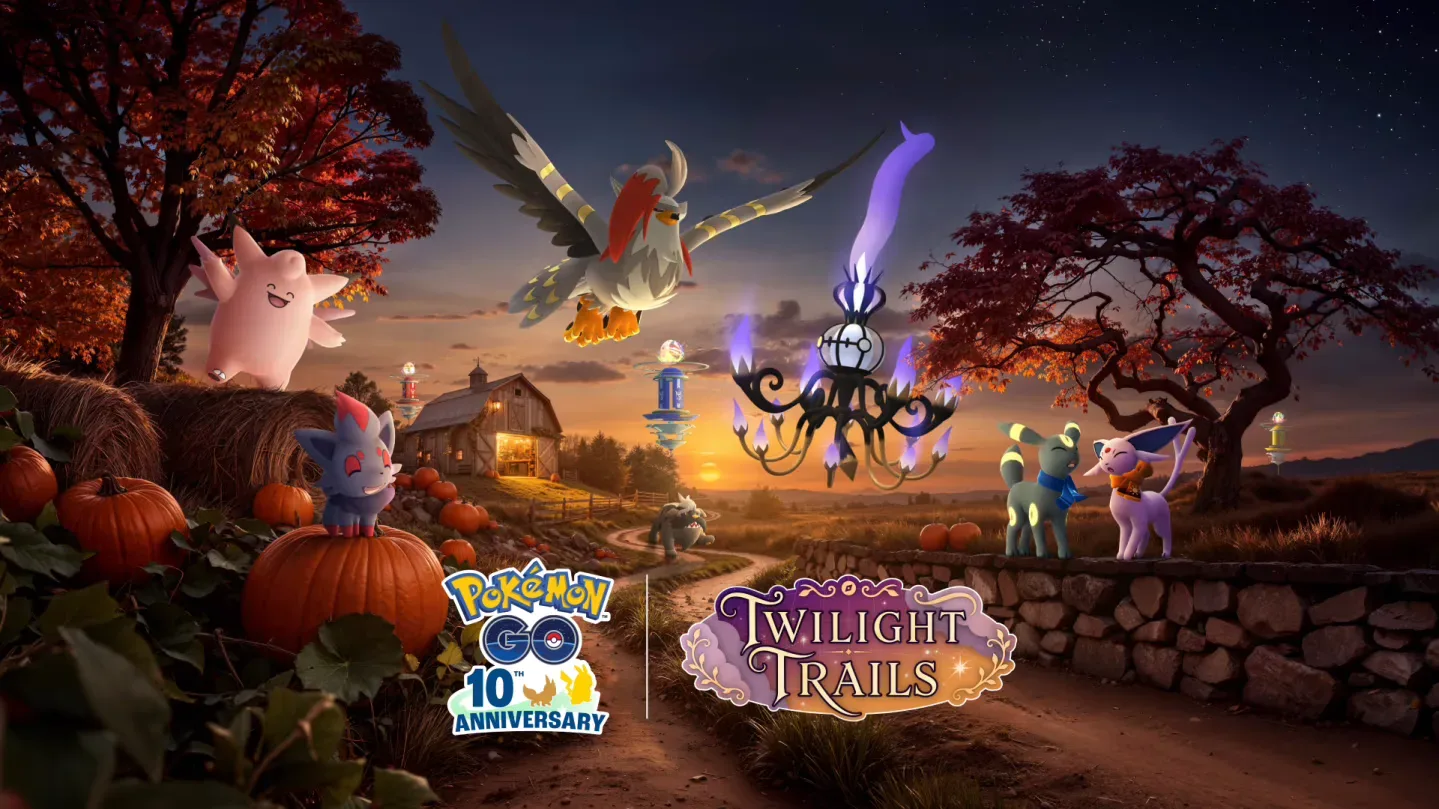
Pokémon GO is stretching Halloween 2026 beyond the calendar’s final night with a two-part event built around costumed encounters, Halloween décor, Candy bonuses and a substantial upgrade for Mega Sableye. Part I begins Tuesday, October 27 at 10:00 a.m. local time and ends Sunday, November 1 at 10:00 a.m. local time. Part II picks up immediately at that same local-time handoff and runs until Thursday, November 5 at 8:00 p.m. local time.
The split matters. The first half is the window for several newly costumed Pokémon and its particular raid and wild-encounter mix. The second half brings the debut availability of Shiny Greavard and introduces a new option for Mega Sableye at Super Max Level. A Halloween 2026 GO Pass spans both portions, meaning players have a single event progression track to manage while the featured spawns and priorities change.
Halloween 2026 schedule at a glance
- Part I: Tuesday, October 27, 2026, 10:00 a.m. to Sunday, November 1, 2026, 10:00 a.m. local time.
- Part II: Sunday, November 1, 2026, 10:00 a.m. to Thursday, November 5, 2026, 8:00 p.m. local time.
- GO Pass reward claim deadline: Saturday, November 7, 2026, 8:00 p.m. local time.
Across both parts, PokéStops and Gyms will receive Halloween-themed decoration, while event Pokémon encounters remain part of the experience. The event also has a sound-focused flourish in its opening stage: a remix of the Lavender Town theme will play nightly during Part I. That is cosmetic rather than a gameplay bonus, but it is an easy detail to miss for anyone who normally plays with game audio disabled.
Part I puts three new costumes on the hunt
Part I’s headline is a trio of costume debuts: Pikachu wearing a hat and capelet, Zubat wearing a top hat, and Sinistea wearing a bow. Each may be encountered as Shiny, though Shiny availability remains luck-dependent rather than guaranteed.
For more context, explore Ma$e Teases Stat Baby Over Drake’s Birthday Party and ‘Not Like Us’.
How those costumes are obtained is not identical:
- Pikachu wearing a hat and capelet appears in one-star raids.
- Sinistea wearing a bow also appears in one-star raids.
- Zubat wearing a top hat appears in the wild.
That division gives Part I two distinct routines. Trainers looking for the raid-exclusive costume pair will need to concentrate on one-star raids, while the top-hatted Zubat is the costume to prioritize while moving through areas with regular wild spawns. Neither method promises a Shiny encounter. The event wording is deliberately conditional: players can encounter Shiny versions if fortunate, not earn one by completing a set number of raids or catches.
Other themed wild Pokémon named for Part I include Duskull, Piplup wearing a Halloween Mischief costume and Drifblim wearing a Halloween Mischief costume. The full wild pool is not specified, so these should be treated as examples of available event spawns rather than a complete checklist.
Related coverage includes Pokémon GO Halloween 2026 Event Brings Costumed Debuts, Shiny Greavard and Mega Sableye Upgrade.
Spooky surprises add an extra reason to tap
Part I also includes “spooky surprises” left behind by mischievous Pokémon. Tapping one can result in an encounter with an event-themed Pokémon or award Pikachu Candy, Zubat Candy, Sinistea Candy, or—more rarely—Rare Candy.
In practical terms, the feature creates an additional interaction layer beyond catching and raiding. The possible outcomes are varied, and there is no stated guarantee of a particular Pokémon, species Candy, or Rare Candy reward. It is therefore best viewed as an opportunistic bonus. Rare Candy is particularly flexible because it can be used on a Pokémon of the player’s choosing, while the named species Candy applies only to its matching evolutionary family.
For players whose main goal is one of the newly costumed Pokémon, the specific Candy drops could be useful, but the raids and wild encounters remain the clearly identified ways to pursue the actual costumes. The surprises may help build resources; they should not be mistaken for a confirmed alternate route to every debut.
Part II brings the first chance at Shiny Greavard
When Part II begins on November 1, Shiny Greavard becomes available in Pokémon GO for the first time. It may be found in the wild, through GO Pass tasks, or through Field Research tasks. As with the Part I costume Shinies, the chance is described as luck-based.
For the purposes of event planning, this is the central change between the two halves. A player interested in costumes can make use of Part I’s raid targets and wild Zubat, but someone focused on Shiny Greavard needs to reserve attention for the November 1–5 window. Having three stated sources—wild encounters, GO Pass tasks and Field Research—does not establish odds or guarantee how frequently Greavard will appear through any one route. It does, however, give players more than one activity type to pursue during Part II.
Part II’s named wild event Pokémon also include Litwick, Rowlet wearing a Pokémon Halloween costume and Gengar wearing a Spooky Festival costume, with additional species indicated but not enumerated. Costumed Rowlet and Gengar are therefore part of the later Halloween roster, while the source information does not provide encounter rates or a complete list of event spawns.
The timing is worth watching closely because Part II does not run to the end of November 5. It ends at 8:00 p.m. local time, rather than the 10:00 a.m. start and handover used earlier in the event. Anyone setting aside a final session should treat that evening cutoff as the firm endpoint for the event’s stated Part II features.
Mega Sableye can reach Super Max Level
Part II’s largest battle-related development is Mega Sableye gaining access to Super Max Level. Pokémon eligible for that level can learn an additional Charged Attack while Mega Evolved. For Sableye, that added attack is Night Shade+.
A Charged Attack is an attack used in battle after its energy requirement is met. The significance here is not simply that Mega Sableye receives a named move; it is that the Super Max Level system adds another attack option during its Mega Evolution. The result is more decision-making in battle than a Mega Sableye limited to its pre-existing attack configuration.
There are important limits to what has been established. Night Shade+ is described as available while Sableye is Mega Evolved, and no damage values, energy costs, battle format claims or move-specific strategy have been provided. It would be premature to call it essential for a particular matchup or to assign it a place in a ranking. What is clear is that trainers who can take Mega Sableye to Super Max Level will be able to use the additional Charged Attack during that Mega state.
Super Max Level had previously been encountered during Mega Finale, and the Halloween event extends that capability to Mega Sableye. For players who use Mega Pokémon in battles, Part II is the portion of the Halloween event with the clearest long-term mechanical implication.
GO Pass milestones: more Candy first, Stardust next
GO Pass: Halloween 2026 is available throughout both event parts. Its bonuses are tied to reaching Major Milestones at specified ranks, rather than automatically applying to all participants at the start.
- Tier 1, Rank 10: 2× Catch Candy.
- Tier 1, Rank 10 with GO Pass Deluxe: 3× Catch Candy.
- Tier 2, Rank 20: 2× Catch Stardust.
- Tier 2, Rank 20 with GO Pass Deluxe: 3× Catch Stardust.
Catch Candy is the Candy granted by catching Pokémon, while Catch Stardust is the Stardust awarded from catches. Candy is species-specific in ordinary use and supports Pokémon powering up and evolution requirements; Stardust is a broadly shared upgrade resource. The milestone order consequently favors Candy accumulation at Rank 10 and then adds a wider upgrade-resource bonus at Rank 20.
The Deluxe versions listed at each tier improve the multiplier by one: 3× rather than 2×. The information supplied identifies these bonuses but does not state the pass’s price, all reward contents, the tasks needed for ranks, or how quickly a player can progress. Players should avoid assuming that the boosts apply before the relevant Major Milestone is reached.
There is also a post-event administrative deadline: rewards unlocked in the GO Pass expire at 8:00 p.m. local time on Saturday, November 7. That is later than Part II’s November 5 ending, which leaves time to claim earned rewards, but it is not an indefinite grace period. A useful routine is to check the pass after the Halloween activities end and again before the stated deadline, particularly if milestones were reached late in the event.
How to prioritize the two-part event
The cleanest way to approach Halloween 2026 is to separate goals by the dates on which they are actually supported. In Part I, use one-star raids for the costumed Pikachu and Sinistea, keep an eye on wild spawns for the costumed Zubat, and interact with spooky surprises when they appear. If the goal is merely to experience the event atmosphere, this is also the period for the nightly Lavender Town remix.
In Part II, shift attention toward the first availability of Shiny Greavard across the wild, GO Pass tasks and Field Research. The same period is where Litwick, costumed Rowlet and costumed Gengar enter the named event spawn mix, and where Mega Sableye’s Super Max Level option becomes relevant.
Finally, the GO Pass milestones reward continued catching across both halves. Rank 10’s Catch Candy bonus could be especially useful during a costume-focused opening weekend, while Rank 20’s Catch Stardust bonus offers an incentive to keep catching into Part II. That is an interpretation of the bonus structure, not a promise of progression speed: reaching those ranks and deciding whether Deluxe is worthwhile remain individual choices.
Halloween 2026 is therefore not one undifferentiated week of spooky spawns. It is a short first chapter for new costume debuts, followed by a second chapter that makes Shiny Greavard available and expands Mega Sableye’s options. Trainers with limited time will get the most value from choosing their target first—and paying attention to the local-time cutoffs rather than assuming every feature lasts throughout the full event.