One Name, Two Very Different Products
The word “bleem” describes two related but distinct products. The first bleem! was a commercial PlayStation emulator for Windows PCs, released in 1999. It aimed to support a broad range of original PlayStation software on a general-purpose computer. The later Dreamcast product, styled bleemcast!, was not simply that Windows program moved onto Sega hardware. It was a specialized family of three game-specific boot discs released commercially in 2001.
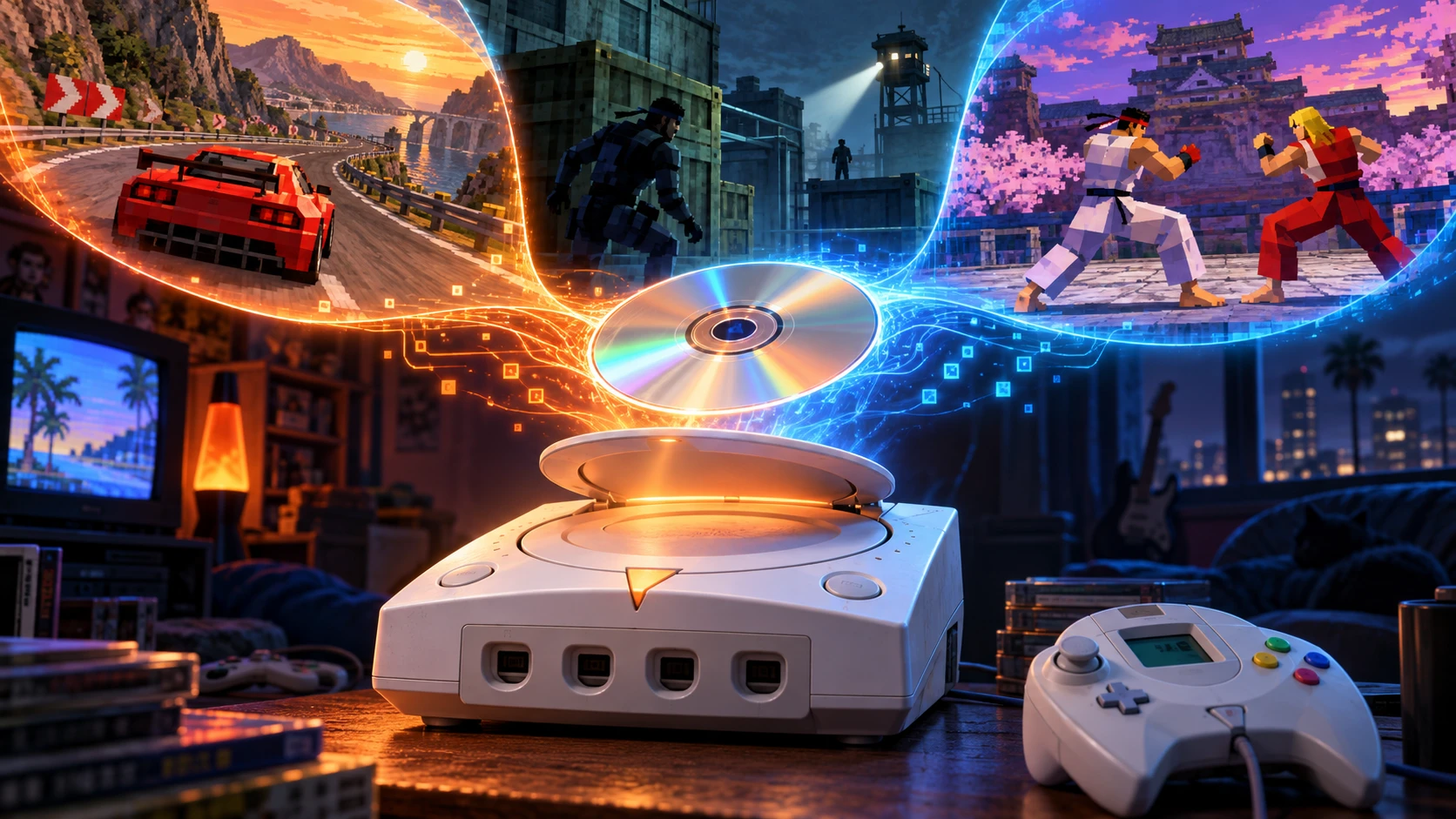
Each retail disc targeted one PlayStation game: Gran Turismo 2, Metal Gear Solid, or Tekken 3. The customer bought the bleemcast! disc separately from the corresponding PlayStation game and supplied the original game CD. Early publicity discussed broader “Bleempak” plans, sometimes describing packages capable of supporting large numbers of games. Those proposals should not be confused with the products that reached stores. The commercial Dreamcast story ended with three released titles, not a universal library or a four-disc collection supporting hundreds of games.
The 1999 Windows bleem! Project
The original PC bleem! was designed for Windows 95 and Windows 98-era computers. Its proposition was direct: insert an original PlayStation CD into a PC drive, run the emulator, and reproduce the console game without using Sony hardware. A PC offered more memory, a faster general-purpose processor, configurable graphics hardware, and a display capable of producing a cleaner image than a conventional television.
Bleem! was neither a conventional game port nor a publisher-approved reissue. It was independently sold runtime software intended to process games supplied by the user. That made it attractive to owners who wanted to use an existing collection on another machine, but it also made the program look to Sony like a substitute for buying a PlayStation.
David Herpolsheimer was the company’s public-facing president and a central business figure. Randy Linden was the principal programmer and an important technical leader. Linden’s earlier work, including the demanding Super Nintendo version of Doom, helped establish his reputation for low-level console programming. Herpolsheimer handled business direction, negotiations, and strategy; Linden was central to the engineering that made the Dreamcast project possible.
Why Dreamcast Was an Attractive Target
Dreamcast was an appealing target because it was considerably more powerful than the original PlayStation while remaining a fixed, known platform. Sega’s console used a 200 MHz Hitachi SH-4 RISC processor, a PowerVR2 DC graphics system, 16 MB of main memory, 8 MB of video memory, dedicated audio hardware, and GD-ROM media. Its architecture was modern enough to offer substantial performance, yet standardized enough that an emulator could be tuned for one machine rather than a changing collection of PC configurations.
The PlayStation used a MIPS-based R3000A-derived CPU and a graphics subsystem built around fixed-function operations that differed fundamentally from Dreamcast’s PowerVR tile-based deferred renderer. The systems were not binary-compatible. PlayStation instructions could not simply be placed in Dreamcast memory and executed by the SH-4. Some form of interpretation, translation, or other mediation was required, along with handling for graphics, CD access, sound, input, timing, and memory-card behavior.
Linden’s later descriptions support the importance of low-level SH-4 and PowerVR programming and of optimizing for individual games. They do not publicly document every internal mechanism used by every retail binary. The safest technical account therefore explains the problems an emulator had to solve without presenting an unverified disassembly of bleemcast!.
Herpolsheimer’s Proposal and Linden’s Engineering Role
According to Linden’s later account, Herpolsheimer proposed bringing bleem! to Dreamcast and pursued contact with Sega. Linden studied the SH-4 and PowerVR hardware and concluded that the platform could run a specialized emulator while potentially presenting PlayStation games more cleanly than the original console. Herpolsheimer and attorney Scott Karol traveled to Japan to meet Sega executives, while Linden concentrated on technical development.
This division of labor corrects two common oversimplifications. Bleemcast! was not a Sega or Sony conversion of copyrighted game software. Sega’s interest did not make it a licensed Sony port. At the same time, Linden was not merely a company spokesman. The project depended on his platform research and on the engineering work required to make unrelated console architectures cooperate.
The development story also shows that regional behavior mattered. Linden described using multiple Dreamcast systems, including PAL and Japanese hardware, and differentiating consoles during testing. That demonstrates engineering concern about regional variation, but it does not prove that every retail disc worked interchangeably on every Dreamcast.
Running a different machine in software
Bleemcast! did not take a PlayStation game and recompile it as a Dreamcast game. Nor did Sony port Gran Turismo 2, Metal Gear Solid, or Tekken 3 to Sega’s console. The original program remained PlayStation code on the user’s PlayStation disc. Bleemcast! supplied a software environment that translated or mediated its execution and represented enough of the expected hardware for the game to function.
At the CPU level, the central challenge was the difference between MIPS instructions and SH-4 instructions. A conceptual emulator may interpret guest instructions one at a time, translate groups of instructions into native operations, or combine several approaches. It must preserve the guest machine’s visible state: registers, memory, control flow, interrupts, and the results that later instructions expect. Whether the retail discs used a particular form of cached translation throughout cannot be established merely from the general requirements of emulation.
Graphics posed a comparable challenge. PlayStation games issued commands for Sony’s GPU and expected its framebuffer rules, texture formats, blending behavior, polygon conventions, and quirks. PowerVR2 could not execute those commands directly. Bleemcast! had to convert their visual intent into Dreamcast-compatible work while keeping game logic, menus, effects, timing, and scene changes coherent. The result was emulation of the original game, rather than a native remake.
Translation, State, and Graphics Mapping
The best conceptual model for bleemcast! is a layered compatibility system. One layer had to represent the PlayStation processor and memory environment. Another had to mediate graphics commands. Other responsibilities included CD reads, audio, input, timers, and memory-card activity. These are the categories of behavior any sufficiently capable PlayStation emulator must address; they should not be mistaken for a verified map of the retail Dreamcast binaries.
State is crucial because emulation does not merely calculate isolated mathematical results. A later instruction may depend on an earlier register value, memory write, interrupt, DMA operation, or timing relationship. A game may also depend on synchronization between its CPU, graphics processor, CD drive, sound hardware, and peripherals. The emulator had to present a sufficiently faithful PlayStation-like environment while doing the work on unrelated Dreamcast components.
Graphics mapping offered the most visible opportunity for enhancement. Existing PlayStation polygons and textures could be processed through a newer rendering path, potentially producing a cleaner image. But the source textures, models, animation data, movies, and game rules remained those of the PlayStation release. A sharper presentation did not mean that the assets had been remade.
Why the Dreamcast Discs Became Game-Specific
The original ambition was much broader. Public plans discussed Bleempaks that could support large groups of PlayStation games, sometimes with claims approaching one hundred titles per package. A general Dreamcast bleem! would have been extraordinary: one disc could turn the console into a broad PlayStation platform. Yet every game brought its own executable behavior, graphics quirks, timing demands, controller assumptions, media access, and save requirements.
Dreamcast also lacked the convenient hard-drive environment of a PC. A general product could not easily receive frequent compatibility updates or depend on a changing driver model. Gran Turismo 2 alone was a large, demanding title spread across two PlayStation CDs, and polishing it required substantial effort. A small company could not simply multiply that work by a hundred and expect consistent results.
The eventual solution was one specialized boot disc per game. A title-specific build could be tuned for a particular executable and tested against a narrow set of behaviors. That did not make it a conventional port, because the original game code and data still came from the PlayStation disc. It did make bleemcast! more specialized than a wholly generic emulator: the retail discs were curated compatibility products rather than a universal library.
What the Retail Boot Disc Actually Did
A retail bleemcast! disc was a boot disc and emulator, not a bundle containing Sony’s game. The purchaser bought the Dreamcast disc and separately owned the matching PlayStation CD. The boot process loaded bleemcast!’s software, after which the user supplied the corresponding PlayStation game. A bleemcast! Gran Turismo 2 disc was therefore not Gran Turismo 2 itself; it was the compatibility layer for the owner’s game disc.
This distinction explains why the products should not be called Sony releases, Sega ports, or licensed bundles. Bleemcast! did not redistribute the complete PlayStation game. Its commercial model relied on the user supplying the copyrighted software. That fact formed part of Bleem’s legal and commercial position, though it did not prevent Sony from pursuing other theories or applying litigation pressure.
The model resembles modern emulator use in one limited respect: the runtime and game are separate. But legal questions cannot be reduced to that single fact. Advertising, reverse engineering, trademarks, patents, distribution, and the source of game copies can raise different issues. The retail structure is historically clear even if broader legal conclusions require care: the boot disc and owned game disc were separate products.
The Three Actual Retail Releases
The retail bleemcast! catalog consisted of three game-specific products. Contemporary GameSpot reporting announced the first retail release, Gran Turismo 2, for May 1, 2001 in the United States. Some later database records list June 4, 2001 instead. Those entries should be treated as later database dates, not silently substituted for the contemporary announced date. The useful historical formulation is that May 1 was the announced U.S. retail date, while June 4 appears in surviving later records.
The second product was bleemcast! Metal Gear Solid, followed by bleemcast! Tekken 3, generally listed with an October 31, 2001 release date. Other titles were announced, demonstrated, discussed, or associated with future plans. They should not be counted as retail releases merely because a prototype, leaked beta, magazine report, or compatibility rumor existed.
The timing was difficult. The PlayStation 2 had launched in the United States before the first bleemcast! release. Sega announced in January 2001 that it would stop manufacturing Dreamcast hardware and leave the console business, with production ending during the following fiscal period. Bleemcast! arrived as a technically ambitious product on a platform whose commercial future had already narrowed.
Gran Turismo 2 as a Technical Showcase
Gran Turismo 2 made an effective demonstration because its ambitions exposed the original PlayStation’s limits. It combined a large vehicle roster, career structure, tracks, replays, menus, and a detailed driving model with polygonal cars, low-resolution textures, shimmering edges, and restricted display clarity. The game was impressive for its platform, but its presentation clearly belonged to the late PlayStation era.
Bleem’s contemporary publicity and release coverage emphasized cleaner output, including advertised support for 640×480 presentation, anti-aliasing, and bilinear filtering. Those claims describe the product’s marketing position; they do not prove that every scene used every advertised technique identically. Reports of less jagged edges or more stable texture presentation are best treated as observed or likely effects of the alternate rendering path, not as a universal specification for every frame.
The source assets remained unchanged. The vehicles retained their PlayStation geometry and textures, while the driving model, menus, and career structure remained the original game. A demanding racing title could also behave differently in menus, races, replays, loading situations, and visually complex scenes. The defensible claim is that bleemcast! offered a cleaner Dreamcast-derived presentation, not a hidden remake or a guaranteed constant frame rate.
Metal Gear Solid: Spectacle and Compromise
Metal Gear Solid was a difficult and attractive target because it combined real-time environments, character animation, scripted events, codec conversations, sound cues, inventory systems, weapons, and cinematic transitions. Emulating it required more than drawing corridors. The compatibility layer had to keep stealth mechanics, camera behavior, event triggers, audio timing, and scene changes coherent while representing hardware the Dreamcast did not possess.
Bleemcast! could improve the appearance of real-time graphics, but it could not automatically transform the game’s movies into modern high-definition video. Prerendered sequences, compressed audio, textures, and models remained bounded by the source software. A user-authored guide for the Dreamcast version records graphical defects and limitations, including save-related constraints. That evidence prevents the product from being described as flawless.
Metal Gear Solid also made peripheral differences visible. The original game expected a PlayStation controller and memory card, while Dreamcast offered a different controller arrangement and VMU storage. Bleemcast! had to translate both. The result was not a conventional Dreamcast edition authored by Konami. It was a specialized emulator that allowed the original PlayStation game to execute through Sega hardware, with selected presentation improvements and practical compromises.
Tekken 3 and the Final Retail Disc
Tekken 3 completed the commercial set. Fighting games are demanding emulation targets because input timing, animation transitions, hit detection, sound synchronization, and frame-dependent attacks are central to the experience. A game can look convincing while still feeling wrong if input response or timing drifts. Tekken 3 therefore tested bleemcast!’s ability to preserve interactive behavior, not merely produce attractive screenshots.
The choice was commercially logical. Tekken 3 was one of the PlayStation’s best-known 3D games, visually recognizable in demonstrations and sufficiently self-contained to serve as a third showcase after the racing and stealth titles. Surviving listings identify the Dreamcast release as an October 2001 product.
Yet “Tekken 3 on Dreamcast” does not mean Namco produced a native Dreamcast port. The original PlayStation game remained the source, the boot disc supplied Bleem’s runtime, and the owner supplied the PlayStation disc. Cleaner output did not create new character models, arenas, animation systems, or a universal guarantee of arcade-perfect behavior.
What Visual Enhancement Could and Could Not Do
Image quality has several layers. A renderer can process polygons through a newer graphics system, apply filtering, reduce some forms of jaggedness, and present the result through a cleaner output path. None of those operations necessarily increases the intrinsic detail of the source texture. A low-resolution texture may look less harsh when filtered, but it remains low resolution.
This distinction applies across the three releases. Cleaner cars do not give Gran Turismo 2 new models. A sharper corridor does not make Metal Gear Solid’s movies high-definition. Smoother character edges do not add animation frames to Tekken 3. Game logic, enemy behavior, physics, menu structure, script timing, save data, and story content do not improve simply because the rasterizer is more capable.
Sega documented Dreamcast capabilities such as anti-aliasing, mip-mapping, alpha blending, and trilinear filtering, while contemporary Bleem coverage advertised some of those features in connection with the product. A hardware specification or marketing claim does not prove that a particular retail game used each feature in every scene. Claims of fixed resolution, constant frame rates, universal anti-aliasing, or flawless rendering go beyond the evidence.
The Controller Mapping Problem
The PlayStation and Dreamcast controllers did not offer identical layouts. A PlayStation pad provided a directional pad, four face buttons, Start and Select, and, on Dual Analog or DualShock models, two analog sticks and four shoulder buttons. The standard Dreamcast controller supplied a directional pad, one analog stick, four face buttons, Start, and two analog triggers, with expansion slots for accessories.
Bleemcast! therefore had to map PlayStation functions onto a controller with fewer direct equivalents. Movement and face-button actions could be assigned naturally enough, but games that depended heavily on Select, dual-stick input, or four shoulder buttons faced compromises. Some commands could use combinations or alternate mappings; others were less convenient than on the original controller.
Early plans reportedly included a PlayStation-controller adapter and special Bleem-branded pads because the ordinary Dreamcast controller could not offer a one-to-one match. Those plans should not be confused with standard contents of the three retail discs. Rumble also requires caution. Dreamcast supported an optional vibration accessory, but that capability alone does not establish that each bleemcast! game reproduced every PlayStation rumble event. Exact behavior is title- and documentation-dependent.
VMU Saves and the Memory-Card Mismatch
Dreamcast’s Visual Memory Unit was not a PlayStation memory card. Sega designed the VMU as a removable storage device with its own display, controls, processor, and file system, while PlayStation games expected Sony’s separate memory-card format. Bleemcast! consequently needed to represent PlayStation save data through VMU storage.
That task involved more than giving a file a different name. Games can expect particular block structures, directory behavior, checksums, capacities, and responses to card errors. The emulator had to make a virtual PlayStation card appear consistent to the game while storing information in Dreamcast-compatible memory. The exact implementation of that process should not be presented as established without primary technical documentation.
The clearest specific practical evidence concerns Metal Gear Solid. A user-authored GameFAQs guide says that a standard VMU is sufficient but requires all 200 blocks for the game. That is an observed or guide-reported limitation for that title, not proof of a universal rule for all three releases or all regions. Old instructions involving erasing or formatting a VMU should never be followed casually. Use the exact manual or a reliable scan for the particular disc and region, and back up important saves first.
Regional Compatibility and Disc Revisions
Regional behavior complicates any simple compatibility claim. PlayStation games existed in North American, Japanese, and European versions, with differences in language, censorship, video timing, identifiers, and executable behavior. Dreamcast consoles also existed in regional variants, and boot procedures and television standards could differ.
Linden’s account of testing European and Japanese Dreamcasts shows that regional behavior mattered during development. It does not prove that every retail bleemcast! disc worked interchangeably on every Dreamcast, or that every PlayStation region received equal support. A collector should distinguish the release region, console region, game region, and exact disc revision before asserting that a particular setup is universal.
Revisions matter because a game can change between pressings without changing its title. Executable differences, bug fixes, language content, protection details, and save behavior may all affect an emulator. The same caution applies to prototype discs. Development testing and universal consumer compatibility are separate claims.
Retail Discs Versus Leaked Betas
The bleemcast! story is surrounded by prototype and beta material. Some leaked or development builds are reported to support additional titles, but reported support is not confirmed functionality. A development build might contain diagnostic routines, incomplete save support, experimental graphics, or unusual region handling. It might also fail in ordinary play. The existence of a compatibility list or a brief demonstration does not establish a finished, playable product.
Conversely, a beta that looks impressive in a short demonstration may be less useful than a narrow retail build. A prototype can reveal a menu, permit a disc swap, expose diagnostic code, or use a renderer that was later changed. “It worked in a prototype” and “the retail disc supports it” are separate historical claims.
Preservation also needs a clear ethical boundary. Researchers can document beta history without encouraging piracy downloads or treating unauthorized disc images as substitutes for legally owned games. The historically important objects are the retail boot discs, the original PlayStation games, packaging, manuals, and surviving development evidence.
Bleem’s Major Ninth Circuit Victory
The major Ninth Circuit decision involving Sony and Bleem was Sony Computer Entertainment America v. Bleem, 214 F.3d 1022, decided in 2000. Sony was the appellee, not the party that won the central appeal. The court vacated the preliminary injunction and remanded with instructions to modify it. The decision was principally a Bleem victory on the comparative-advertising issue: the court held that Bleem’s use of PlayStation screenshots could qualify as fair use in that context.
The holding was narrow. It was not a universal judicial ruling that every emulator was legal in every jurisdiction, under every business model, using every reverse-engineering method, or making every possible claim. It did not resolve all later disputes involving Bleemcast!, advertising, trademarks, patents, distribution, or the copying of game software.
The case is often reduced to “Sony sued Bleem and lost,” which obscures the legal issue. Bleem received protection for the comparative advertising considered by the court, but that did not make the company immune from later litigation. Conversely, Bleem’s eventual closure does not erase the appellate holding. The decision and the company’s later business troubles belong in the same history but should not be treated as one all-purpose verdict on emulation.
Other Sony Actions and Litigation Pressure
The PC bleem! dispute and the later Dreamcast commercial story should be kept chronologically separate. The 2000 Ninth Circuit case concerned advertising and screenshot use. Bleemcast! introduced a new platform and new commercial stakes, and Sony continued to challenge the company through additional legal actions and pressure.
Contemporary reporting in November 2001 said that Bleem had closed after sustained legal action. Herpolsheimer attributed the collapse to exhausted financial resources, and reports also carried the company’s claims about Sony’s litigation spending and retailer pressure. Those figures and allegations are statements reported from the company, not automatically judicial findings.
The careful conclusion is that litigation burden was a documented part of Bleem’s business crisis. That is different from saying a court finally declared bleemcast! illegal and ordered the whole product line off the market. A judgment, injunction, settlement position, retailer decision, and voluntary decision to stop spending money are legally distinct events.
Closure in November 2001
Bleem closed in November 2001. Contemporary reporting dated the announcement to November 19 and quoted David Herpolsheimer explaining that litigation had exhausted the company’s financial resources. The same reporting identified the three Dreamcast-compatible products: Metal Gear Solid, Gran Turismo 2, and Tekken 3.
The timing also makes the market context impossible to ignore. Sega had already decided to leave the console hardware business, while Sony’s PlayStation 2 was becoming the successor platform. It is reasonable to infer that Dreamcast’s decline made a small company’s retail strategy harder to sustain. That broader explanation is an inference from the documented timeline, not a court finding and not proof that market decline alone caused the closure.
The defensible retail endpoint is simpler: Bleem ceased operations after three commercial game-specific bleemcast! releases, leaving its larger compatibility ambitions unrealized. Its shutdown was both a legal-business story and a timing story. The technology arrived just as the hardware market it depended on was disappearing.
Game Genie and Action Replay as a Comparison
Game Genie and Action Replay clarify what bleemcast! was not. Cheat devices generally intercept, alter, or substitute values in a game’s memory or code path. They may change lives, money, damage, inventory, or other variables, but they normally leave the host console executing the game’s native code. They modify execution; they do not recreate another console’s CPU, GPU, CD subsystem, controller protocol, timing model, and memory-card environment.
Bleemcast! operated at a different layer. Its purpose was not primarily to change Gran Turismo 2, Metal Gear Solid, or Tekken 3, but to make PlayStation software execute through Dreamcast hardware. Any title-specific patches or optimizations were compatibility mechanisms, not the central consumer feature. A cheat code might redirect a branch or replace a value; an emulator must continuously represent guest instructions, memory, devices, display behavior, and peripheral responses.
The analogy has one useful limit: both products can contain game-specific knowledge. An Action Replay code may target one game’s memory map, while bleemcast! could be tuned to one game’s rendering or timing behavior. But the purposes differ sharply. Modification changes a game; emulation seeks to preserve the game inside a different machine.
Collecting the Three Retail Discs
An authentic retail setup requires both the bleemcast! boot disc and the matching PlayStation game. The pairings are Gran Turismo 2 with bleemcast! Gran Turismo 2, Metal Gear Solid with bleemcast! Metal Gear Solid, and Tekken 3 with bleemcast! Tekken 3. The boot disc does not contain the game, and the PlayStation disc does not contain the Dreamcast emulator.
Gran Turismo 2 requires particular care because the PlayStation game itself consists of two discs: Arcade and Simulation. A complete setup therefore contains the matching bleemcast! Gran Turismo 2 boot disc plus both PlayStation game discs. The two Gran Turismo 2 discs are not substitutes for the boot disc; they are the source game media that the separate Dreamcast disc launches and mediates.
Condition matters. Scratches on either disc can interrupt booting, CD access, or loading. Manuals, inserts, cases, catalog markings, and regional labels help distinguish original retail items from reproductions. Prototype discs, demonstration builds, unofficial reproductions, and downloaded images circulate under overlapping names, so provenance is more useful than a generic claim that an item “runs PlayStation games on Dreamcast.”
Why Bleemcast! Remains Remarkable
Bleemcast! compressed several difficult ideas into a commercial disc at a moment when console boundaries still seemed nearly absolute. A PlayStation game ran on Sega hardware, from original PlayStation media, through a software compatibility layer, with Dreamcast’s stronger processor and graphics system used to present the result in a potentially cleaner way. It was not a simple port, not a Sony rerelease, and not a cheat cartridge.
Its achievement was defined by tradeoffs. Specializing in three games made deeper compatibility work possible, but prevented the promised broad library from appearing. Dreamcast offered processing and graphics capacity, but its controller did not match PlayStation input and its VMU did not match the PlayStation memory card. The emulator could improve rendering, but it could not create high-resolution source art or guarantee perfect behavior. Litigation generated attention while consuming the company’s resources, and Sega’s hardware decline made the project historically striking and commercially fragile.
That combination is why bleemcast! deserves more than nostalgic curiosity. It was a focused experiment in cross-platform execution, a retail demonstration of console emulation before modern distribution made the idea familiar, and a case study in how engineering, peripherals, legal exposure, preservation, and market timing shape a product. Its three discs document the moment a console began to look less like an indivisible box and more like a software environment another machine could, with enough work, reconstruct.
Our Metal Gear Solid walkthrough covers the original PlayStation campaign; it is not a claim that every control or hardware detail is identical under bleemcast. Compare emulation with the game-altering approaches in our Game Genie feature and Action Replay history.
Explore original hardware and editions
We may earn a commission if you buy through this affiliate link, at no extra cost to you.
Search bleemcast Dreamcast on eBay
This opens search results. Verify the exact platform, edition, condition, included accessories and seller before buying.