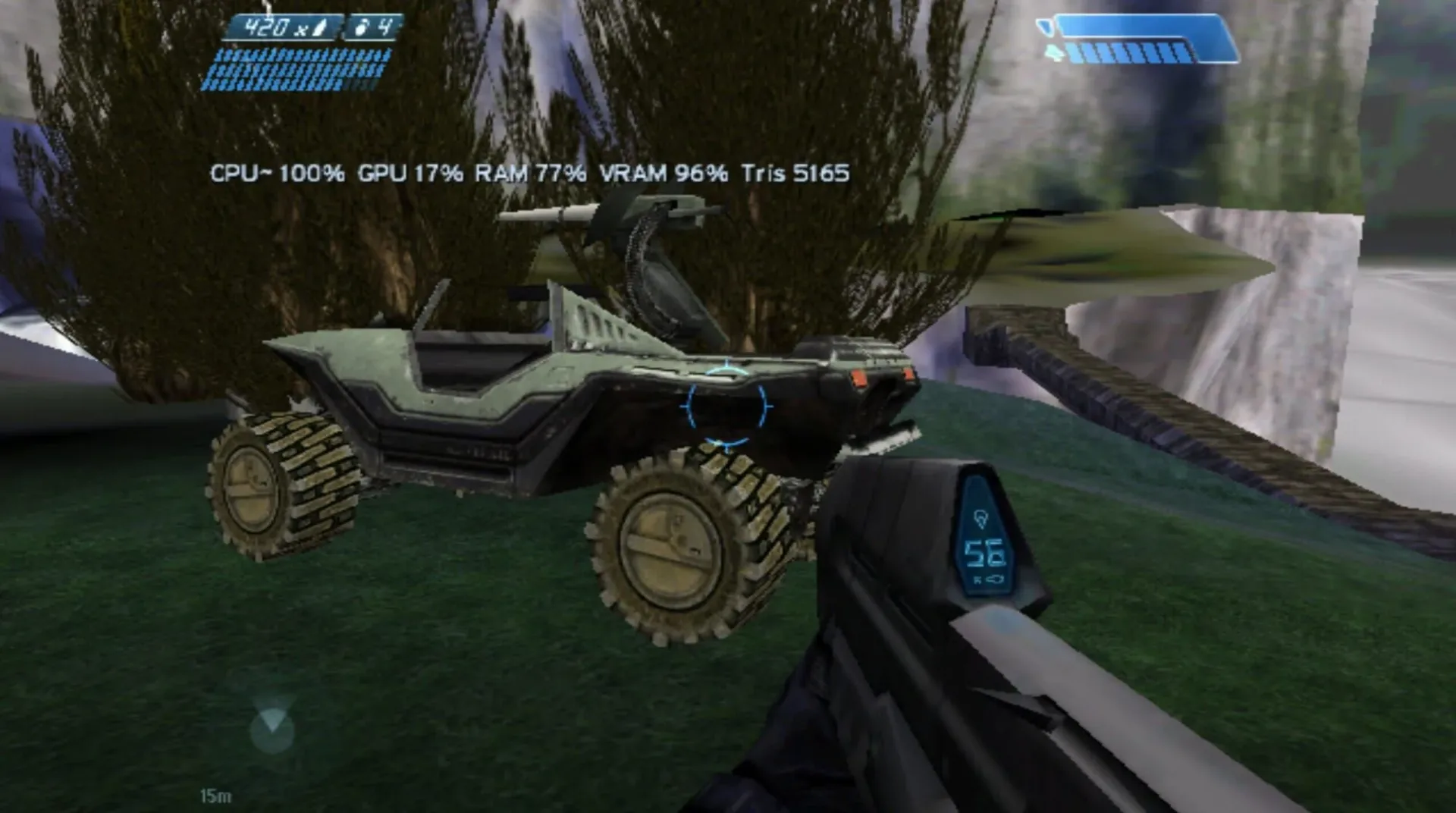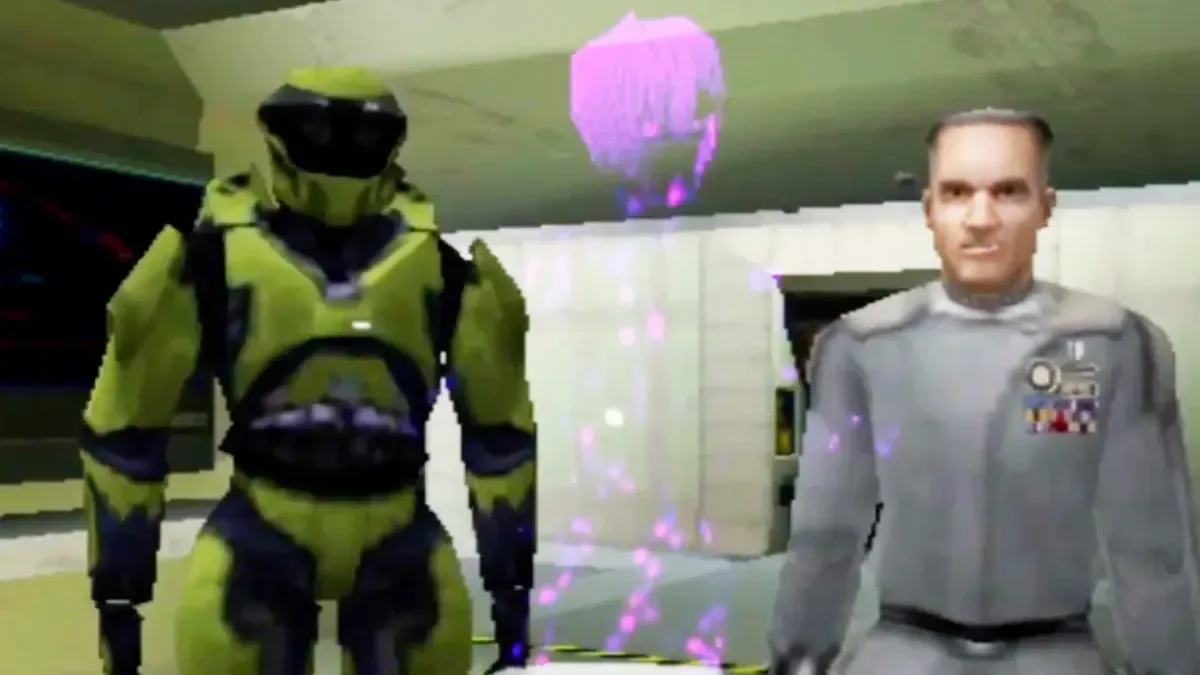
Halo: Combat Evolved is now the latest improbable game to make an appearance on SEGA Dreamcast hardware. Developer JiltedValkyrie has shared more than 20 minutes of footage from an in-progress Dreamcast version, showing parts of the opening aboard the Pillar of Autumn and later exploration on Halo itself. The result is not a polished new way to play Master Chief’s debut. It is, however, a remarkably tangible technical experiment: Halo moving, rendering environments, and supporting combat on a machine with dramatically less processing headroom than the original Xbox.
The project remains very much a work in progress. The footage shows extended loading, visual and gameplay glitches, and performance limitations. Anyone reading “Halo on Dreamcast” as a ready-to-go conversion should temper expectations immediately. At this stage, the significance is not seamless playability; it is that the port exists at all, and that its developer is continuing to identify bottlenecks and improve it.
What the current Dreamcast build shows
JiltedValkyrie’s footage runs for more than 20 minutes and covers recognizable early Halo material. That is important because it goes beyond a menu, a single room, or a short proof-of-concept scene. The build demonstrates the game’s opening setting, the Pillar of Autumn, as well as some time exploring the ringworld.
But the footage also makes clear why this should be treated as an experimental port rather than a completed release. Load times are substantial, glitches occur frequently, and performance is not consistently smooth. Those shortcomings are not side details that can be waved away with a heroic “but it runs” banner. In an action game built around movement, aiming, enemy encounters, and quick changes in on-screen activity, they are fundamental parts of the present experience.
Still, early technical projects are often judged differently from finished games. The relevant question is not simply whether the build currently behaves like the original Xbox version. It plainly has a long way to go. The more interesting question is whether the developer can reduce the heaviest workload enough that the Dreamcast can sustain more reliable scenes across more of the game.
The hardware gap is the point—and the problem
JiltedValkyrie has highlighted the scale of the challenge: the Dreamcast has a 200MHz CPU, while the original Xbox has a 733MHz CPU and a substantially more capable GPU. CPU means central processing unit, the component responsible for carrying out a large share of a game’s calculations. GPU means graphics processing unit, hardware designed to handle graphics-oriented work. A higher clock figure alone never tells the whole story of a system, but the figures here plainly illustrate that this is not a straightforward case of moving a game between comparable platforms.
Halo needs the system to do many jobs at once. The game must process player input, update enemies and allied Marines, manage combat states, draw environments and characters, animate models, and maintain whatever background work is needed to move through a level. When the amount of visible and active activity grows, the available time for each frame shrinks.
That is why a port may seem more comfortable in a quiet corridor than in a fight. Combat adds characters, animation, effects, AI activity, and other demands. A technical build can be playable in one moment and suddenly struggle in the next without that necessarily meaning the underlying port has failed. It means the difficult scenes are revealing the hardware budget.
Why removing old characters can help
One reported optimization targets that budget directly. JiltedValkyrie has said that performance during combat improved after dead enemies and Marines were despawned, freeing CPU cycles. Despawning means removing an entity from the active game world after it is no longer needed. In this case, a fallen character no longer has to remain present for the system to consider, animate, or otherwise manage.
It is a practical trade-off. Leaving every defeated combatant where it fell may be desirable for visual continuity, but the Dreamcast does not have unlimited room for that preference. Clearing away inactive characters means fewer things competing for the system’s attention while a fight continues. On constrained hardware, removing a nonessential workload can be more valuable than preserving a detail that the player may barely notice once the encounter has moved on.
JiltedValkyrie also pointed to skinned vertices as a performance concern. A vertex is a point used to construct a 3D model. Skinning is an animation technique that lets a model’s shape deform as its underlying skeleton moves; it is what helps a character bend, turn, and move as an articulated body rather than as a rigid object. The necessary calculations are useful for believable animated models, but they cost processing time. Keeping those animated vertices from consuming scarce computation can therefore improve frame rate.
Frame rate, commonly expressed as FPS or frames per second, describes how many individual images a game produces each second. More FPS generally makes motion appear smoother and can make controls feel more responsive. The current build’s optimization work is therefore focused on a crucial result, not merely a nicer number in a performance display.
Controls may be the biggest practical barrier
Even if the port’s loading and performance continue to improve, there is an immediate usability complication: it requires a controller with dual joysticks, or a mouse-and-keyboard setup. That makes sense for a first-person shooter such as Halo, where a player normally needs one directional control for movement and another for looking and aiming.
This is a decisive caveat for owners using a standard Dreamcast controller. Seeing Halo run on the console is one thing; comfortably controlling it in the way the game expects is another. The project’s technical achievement does not automatically translate into plug-and-play convenience for every Dreamcast setup.
The input requirement also demonstrates why platform conversions are more than graphics exercises. A game is shaped by its controls as much as its visuals. A version that runs but cannot support appropriate movement and aiming hardware is inherently limited, especially when the game is built around real-time shooting. For prospective followers of the project, controller compatibility deserves as much attention as frame rate reports.
Why projects like this matter to retro hardware fans
This Dreamcast experiment arrives amid a broader fascination with getting Halo onto unexpected older machines, including a recent effort involving Nintendo 64 hardware. There is an obvious resemblance to the long-running “can it run Doom?” tradition: the question is equal parts technical challenge, community spectacle, and affectionate nonsense. The goal is rarely to prove that the old platform is secretly the ideal home for the game. It is to find out what is possible when a developer is willing to push well beyond a console’s original commercial role.
That framing matters because it gives the Dreamcast build room to be interesting without overstating what it is. It does not need to replace the original Xbox experience to be worth watching. It shows an enthusiast grappling with a difficult performance target in public: identifying computational costs, reducing what can be removed, and testing how far the system can be stretched.
There is also a useful reminder here for anyone who treats a port as a simple matter of copying files from one machine to another. A game designed for the original Xbox’s stronger CPU and GPU cannot simply assume that the Dreamcast will process the same scenes in the same manner. Every reduction has consequences. Fewer persistent bodies, less costly character animation work, simplified rendering demands, and altered controls can all be part of the compromise required to create a functional version.
That does not make the project less impressive. It explains why the remaining work is substantial. The early footage is evidence of progress, while its rough edges are evidence of the enormous gap that still has to be navigated.
What to watch as development continues
The most meaningful updates will be the ones that clarify consistency rather than simply extend the running time. Can the build hold up when combat gets busy? Do further optimizations reduce the long pauses between areas? Can glitches be narrowed down? And, perhaps most importantly for players, what hardware will be needed to control it properly?
It will also be worth watching whether the project advances beyond the material currently shown. The Pillar of Autumn and early Halo exploration provide a concrete foundation, but they do not establish that every area, encounter type, or demanding sequence is ready for Dreamcast hardware. The current evidence supports cautious excitement, not assumptions about full-game status.
For now, Halo on Dreamcast is best appreciated as a rough but striking feat of retro development. It is not yet a polished showcase, and it does not hide its compromises. Yet seeing Master Chief’s first adventure operating on SEGA’s hardware remains the kind of gloriously stubborn project that keeps vintage-console communities fascinating. While Halo began on Xbox, Xbox fans following the wider legacy of the series may also want to see the Xbox X25 Anniversary Controller launch details.