The console that looked like a computer
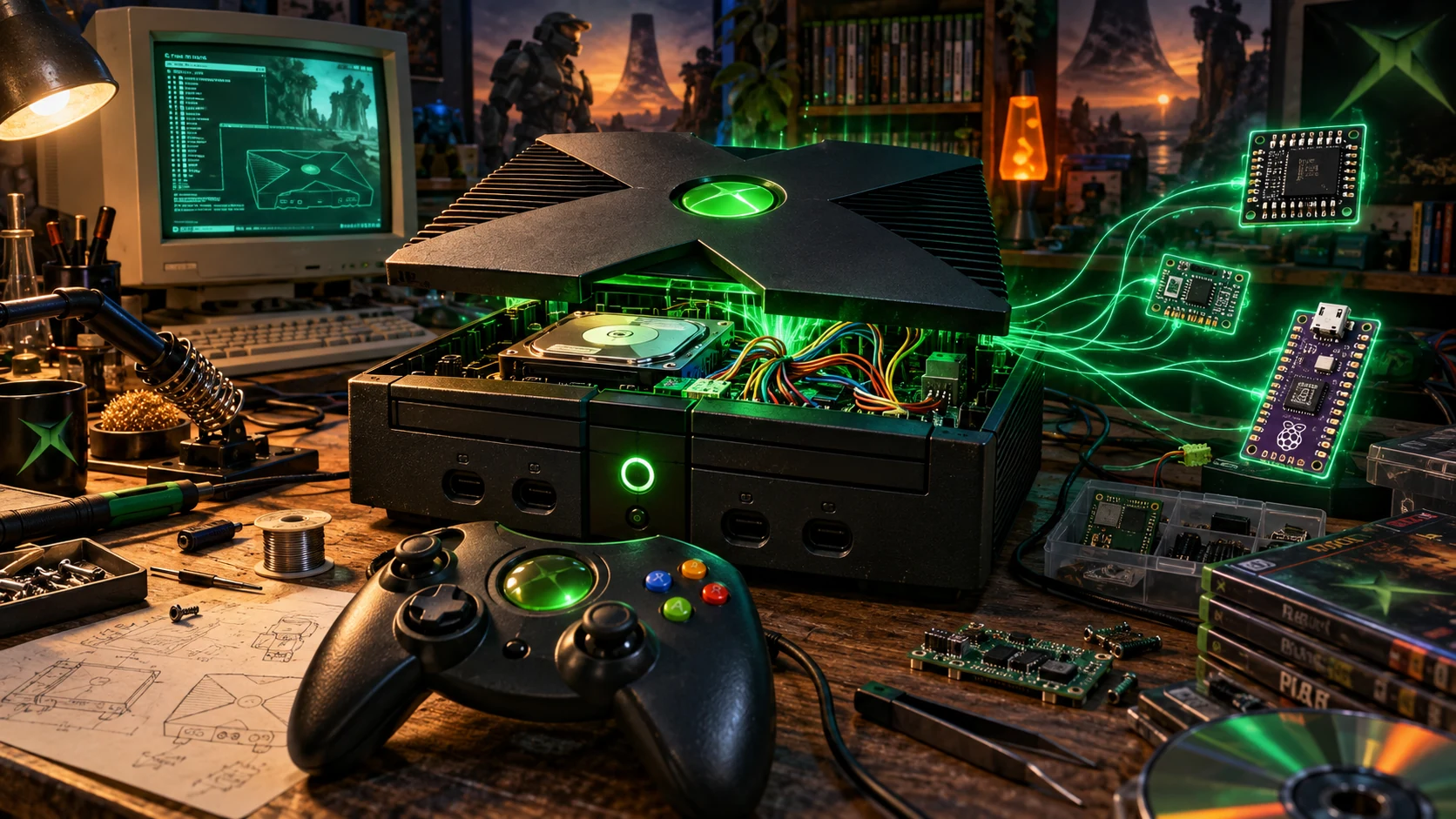
When Microsoft released the original Xbox in North America on November 15, 2001, it presented the machine as a straightforward living-room console. Internally, however, it was an unusually recognizable computer: a 733 MHz Intel Coppermine-derived processor, an NVIDIA NV2A graphics processor, 64 MB of unified DDR memory, an IDE hard drive, Ethernet, an optical drive, and a motherboard built around the MCPX southbridge. Microsoft had taken familiar PC technologies and wrapped them in a tightly controlled software environment.
That combination created the central contradiction of the Xbox. Commodity architecture made development and manufacturing practical, but Microsoft wanted the user experience to remain as closed as a conventional game console. Owners could not simply replace the operating system, install arbitrary programs, or exchange the internal hard drive for another disk without encountering security checks and hardware-specific obstacles.
The machine was therefore neither an ordinary PC nor a sealed appliance in the traditional sense. It was a computer whose openness had been deliberately narrowed. The modding revolution began when researchers recognized that the distinction was architectural rather than absolute. The Xbox contained familiar buses, flash storage, memory, executable formats, and network hardware. The challenge was discovering where Microsoft had placed the boundaries and which boundaries could be crossed.
That work would not happen in one dramatic moment. Different people would dump the accessible flash, study the secure-boot process, recover cryptographic material, build replacement firmware, exploit games, write dashboards, port emulators, and preserve online services. The history is best understood as a sequence of openings rather than one universally agreed first hack.
How Microsoft locked down a familiar computer
The Xbox did not boot like a beige desktop PC. Its processor began with a tiny hidden block supplied by the NVIDIA MCPX chip. The larger external flash contained later boot material and the operating-system kernel. Encryption and integrity checks protected the startup path, while executable signatures restricted which Xbox programs, known as XBEs, could run afterward.
The visible flash also contained a decoy boot block. A researcher who removed and read it could examine convincing-looking code without seeing the instructions actually used at reset. Changing that apparent starting point did not necessarily change the machine's behavior. The real beginning was hidden elsewhere.
Encryption and authentication served different jobs. RC4 concealed early boot material, while checks on the boot chain and executable signatures restricted what could run. A modification had to intervene at a useful point in that sequence, or exploit a program already permitted to execute.
The factory hard drive had its own ATA security lock. Console-specific information stored in a small EEPROM helped the Xbox unlock its disk. That EEPROM also held settings and identity data, separate from the larger firmware flash. This mattered when drives failed: copying a BIOS file did not preserve the information needed to recover a locked disk.
The reward for getting past these controls was unusually large. Ethernet and a hard drive were standard equipment. A working boot route led to a machine that could hold applications, transfer files over the network and run software with a controller from the sofa, without first buying a storage accessory.
bunnie, the bus tap and the code Microsoft hid
Andrew “bunnie” Huang treated the Xbox as a physical computer to be understood, rather than a menu to be fooled. His early work included removing and reading the external flash. That produced a BIOS dump, but it also exposed a puzzle: some of the apparent startup code was not the code actually controlling the machine.
Overwriting the reset vector in the visible flash did not stop the Xbox from booting. Huang reasoned that another component must be supplying the real instructions. A hidden 512-byte MCPX block explained the contradiction. Microsoft had placed secrets inside a custom chip, beyond the reach of an ordinary flash reader, but the processor still needed to receive those instructions to execute them.
Huang's own account dates construction of his LDT, or HyperTransport, bus tap to late February 2002. The link connected the MCPX southbridge with the NV2A northbridge and graphics chip. Watching traffic there allowed him to find the secret boot code as it traveled through the system. Specialized capture hardware and FPGA work made that exchange observable. The silicon concealed the code at rest; the communication needed to use it exposed another boundary.
His May 2002 MIT technical memo, followed by the CHES presentation that August, made the investigation a landmark hardware-security case study. It showed why hiding a secret inside a component is insufficient if useful information subsequently crosses an observable connection. The external flash dump and capture of hidden boot material were separate achievements, with different equipment and implications.
His 2003 book, Hacking the Xbox, brought that style of investigation to a wider audience. Michael Steil and other Xbox Linux contributors also investigated the boot chain, documented weaknesses and built software around discoveries. Commercial chip teams formed another overlapping branch. No single person invented the BIOS dump, Linux port, consumer modchip and gamesave exploit together; Huang's contribution was substantial enough without assigning everyone else's work to him.
From a laboratory target to a 2002 modchip market
During 2002, the Xbox moved rapidly from a new console to a platform with competing routes into it. The Xbox Linux project records its foundation in May, a kernel boot in August and a graphical desktop in October. By the end of the year, Cromwell work was establishing a Linux-oriented boot alternative. Commercial modchips developed in parallel for owners who wanted a usable result without building laboratory capture equipment.
A researcher could publish an architectural observation, another person could turn it into a smaller circuit, and a BIOS author could make the result useful for applications. Installers then packaged the arrangement for owners. Progress in one area created opportunities in several others.
Enigmah-X and Xtender reached a market that had not yet settled on the compact LPC arrangement later modders would recognize. Their installations involved connections spread across the motherboard. The attraction was access to capabilities the stock console withheld; the cost was demanding soldering and hardware that could become less attractive as more flexible methods appeared.
By the time software-only openings became prominent in 2003, owners could buy a chip, pay an installer or follow increasingly detailed community experiments. The race was no longer only to understand the box. It was to make access affordable, repeatable and useful.
Enigmah-X, Xtender and the many-wire beginning
Enigmah-X captures the physical character of the first wave. A contemporary installer describing his work in July 2002 counted 29 wires for an Enigmah beta installation. A later Team Xecuter retrospective also remembered Enigmah-X as a 29-wire device. That meant many individual joints inside a densely populated console, with routing, insulation and workmanship affecting reliability afterward.
Early patch-oriented devices intervened in the existing boot process rather than offering the banked flash environment associated with later premium boards. Owners were buying a particular way around checks, not yet a firmware workstation. As replacement BIOSes improved, a fixed early device could not offer the same convenient update path as a programmable LPC board.
Xtender was another prominent early name. Its reputation also became attached to many-wire diagrams, with connection counts varying among the versions and diagrams. The useful contrast is the installation: these devices reached numerous motherboard points, whereas later designs concentrated much of the work at a small header.
Reducing scattered joints was more than cosmetic. Every wire needed a sound connection and a route that would survive closing the case. Troubleshooting a failed start could mean checking a long sequence of joints before even considering the firmware. Compact installations helped move modding beyond the earliest enthusiasts.
Xecuter 1 and what “one wire” actually meant
The original Xecuter joined the 2002 move toward simpler installations with a memorable pitch: one wire. A period guide described the arrangement more fully as one wire plus ten solder points. The board made several connections directly against the motherboard, reducing loose wiring while retaining the electrical contacts it needed.
That was a real convenience. Instead of routing a large bundle across the board, the installer positioned the device and made a concentrated set of joints. One wire did not mean one solder joint or one signal doing the work of an entire interface.
The first Xecuter also belonged to an earlier generation than the writable Xecuter 2 and elaborate Xecuter 3. The period guide described it as non-flashable. A later BIOS carrying an Xecuter logo therefore does not identify this original device: compatible firmware images spread across different hardware as the scene matured.
Headers, direct-solder boards and pressure-contact adapters each replaced some loose wiring with another physical connection. They made installation more approachable, but their success still depended on a compatible motherboard and a properly fitted board.
LPC: the small header that changed everything
LPC stands for Low Pin Count, an interface inherited from the PC world. An unpopulated footprint on the Xbox motherboard offered a convenient place for a device supplying alternate boot firmware. Instead of reaching numerous points around the board, designers could concentrate much of the installation there.
Boot selection still needed control outside the ordinary data lines. The point modders call D0 is associated with steering relevant revisions away from their normal flash boot path. Power, ground, data and control all had to be present even when a header hid most of the connections.
Cheapmod and projects such as OpenXbox/PC-BioXX helped establish the appeal of a programmable LPC device. A compact board could hold a replacement image that changed as BIOS development advanced. This became the foundation for both inexpensive boards and elaborate premium products.
Matrix, associated with the Xodus name, pursued solderless mounting through spring contacts. A screw and accurate alignment replaced some soldering. Such designs appealed to owners wary of an iron, but pressure contacts introduced their own positioning sensitivity. The necessary connections were being satisfied mechanically rather than disappearing.
Why motherboard revisions changed the installation
Early 1.0 and 1.1 boards used a 1 MB onboard flash; revisions 1.2 through 1.4 used 256 KB devices. The 1.3 revision also removed the expected LFRAME connection at the LPC footprint, affecting devices that depended on it. That change was separate from the more extensive reconstruction associated with 1.6 consoles.
The 1.6 family introduced the Xyclops arrangement and lacked the conventional rewritable TSOP used for the familiar onboard-flash modification. Several expected LPC connections needed restoring for common modchip installations. Rebuild boards or individual wires supplied them, with control wiring differing from earlier D0-based arrangements.
Consequently, a pin-header installation on an earlier Xbox did not describe all the work required on a 1.6. Xecuter and SmartXX manuals supplied separate revision-specific instructions, sometimes with rebuild adapters simplifying the extra connections.
The frequently repeated 1.5 label appears in old guides, but a distinct normal production revision has not been convincingly established. A historical manual's label records what installers were told, rather than proving another confirmed motherboard family. The actual board and circuitry determine what can be flashed and which recovery methods are available.
TSOP flashing turned the motherboard against itself
TSOP flashing offered a compelling alternative to installing a separate programmable chip. On compatible early and mid-generation boards, software or hardware could obtain the necessary write access and rewrite the external flash already mounted on the motherboard. The console could then boot an alternate BIOS without carrying a conventional add-on board.
The method combined two different ideas. An exploit, softmod, or other execution path supplied the ability to run code with enough control to enable writing. The TSOP supplied persistent storage for the replacement firmware. The exploit and the flash were therefore parts of one process, not interchangeable names for the same modification.
Flash size imposed strict limits. A 1 MB TSOP could hold larger images or multiple bank arrangements. A 256 KB device required a smaller target and could not be treated as a larger part simply because a menu offered a “large” option. Write-enable bridges and procedures also varied by motherboard revision. A wrong image, failed write, or interrupted operation could leave the machine unable to boot.
TSOP flashing was not an extraction of the MCPX ROM, not an EEPROM backup, and not an LPC modchip. A console could have a rewritten TSOP while retaining an untouched motherboard otherwise. Another could boot an alternate BIOS from a chip while leaving its TSOP unchanged. A third could use a software loader without changing the flash at all. The same dashboard could appear on all three machines.
The disappearance of the ordinary TSOP on 1.6 boards made dedicated hardware more important for owners who wanted replacement firmware. It also created a clear dividing line in the community’s vocabulary. “Flashed Xbox,” “chipped Xbox,” and “softmodded Xbox” described different physical histories even when the visible result was identical.
Xecuter 2: banks, switches and a BIOS you could update
Xecuter 2 turned firmware into a more manageable product. Lite and Pro boards offered different installation and programming arrangements, and later versions refined the hardware. Instead of replacing a fixed device when requirements changed, owners could flash another compatible image.
The Xecuter 2.6 provides a concrete example: its 1 MB flash could serve as one large image or two 512 KB banks. External controls selected the bank, enabled or disabled the chip and protected the flash against writing. Keeping a working image in one bank made experimenting with another less intimidating.
The Pro concept particularly appealed to people who valued programming access and recovery. Cheaper variants supplied the essential boot route without every accessory. The important shift across the family was that a chip became something its owner could maintain and reconfigure over time.
BIOS names also became part of an owner's vocabulary. An X2 image could change startup behavior or find an alternative dashboard. The software capabilities were separate from the capacity and switches of the board holding it, which is why the same familiar firmware could appear on different compatible installations.
Xecuter 3: the front panel became a control center
Genuine Xecuter 3 and X3CE hardware carried 2 MB of main flash plus a dedicated 256 KB backup ROM. The main capacity supported arrangements such as eight 256 KB images, four 512 KB images or two 1 MB images. This made banks and recovery part of normal ownership rather than an emergency afterthought.
X3ConfigLive brought configuration onto the television, while switches and optional LCD hardware gave the console an elaborate physical interface. Owners could select firmware banks, manage settings and see information on a display fitted to the case. Modified faceplates and control panels made some Xboxes look like specialized equipment.
Flash protection and a backup environment addressed a recurring fear: turning a working Xbox into one that no longer started. A fallback did not make every mistake harmless, but it offered a route back when an ordinary image failed. Recovery was part of the hardware's design.
The X3CE revised the board and power arrangements; installation still depended on motherboard revision. Its 1.6 instructions included the additional LPC work needed on those machines. The premium price bought integration, bank capacity and controls, rather than a promise that games suddenly ran faster.
That is part of the X3's lasting appeal. It represents the classic commercial chip as a finished enthusiast product: firmware management, visible controls and room to experiment, all around a console that originally offered none of those choices.
SmartXX and a menu before the dashboard
SmartXX competed by giving the chip an environment of its own. Its generations offered different combinations of flash management, configuration and accessories. The defining experience was a menu available before the usual hard-drive dashboard took over.
SmartXX v3's original manuals describe an emergency recovery arrangement and backup operating system. Separate installation documents address earlier boards and the 1.6 rebuild. The pre-boot environment was a maintenance tool that could be useful when the main setup needed attention.
ED@Chip added a distinctive Linux connection. Its environment, associated with the EdXebian name, could run from a flash bank and provide network services such as FTP and Telnet. It offered experimenters a small working environment independent of the dashboard installed on disk.
SmartXX therefore appealed beyond game launching: it provided another place to keep tools and manage startup. Its generation still mattered. The elaborate v3 and lower-cost boards did not offer identical features.
Xenium, OzXodus, and the premium-chip arms race
Xenium and the OzXodus line formed another influential branch of the premium market. Xenium products offered their own menu systems, flash management, and configuration features, while Ice and S.P.Ice variants adapted the concept to different installation approaches. Their importance lies in the competition they created around usability, recovery, and hardware compatibility.
Matrix and Xodus pogo-style boards pursued reduced-solder installation through physical alignment with motherboard contacts. The owner might avoid attaching numerous wires by hand, but the board still had to establish power, ground, bus, and control connections with adequate pressure and alignment. “Solderless” was an installation description, not a statement that the chip had only one electrical contact.
The premium market’s feature vocabulary became familiar: banks, menus, recovery, displays, switches, programmers, and boot selectors. A user who had once been satisfied by a successful alternate boot could now compare interfaces and recovery paths. The modified console was becoming a platform with a user experience of its own.
The market was also becoming difficult to authenticate. Genuine products existed under the Xenium, Xecuter, SmartXX, Matrix, and Xodus names, but clones and rebrands circulated alongside them. A familiar splash screen did not prove a board’s identity. A flash chip marked with a known manufacturer did not prove that the advertised brand had designed the board. Hardware inspection and original documentation mattered more than reseller terminology.
The premium-chip competition established a template that later projects would revisit: dedicated hardware, configurable firmware, recovery facilities, and a management layer separate from the game dashboard. The names changed, but the owner’s desire remained recognizable. A successful modification was no longer enough. It had to be maintainable.
Aladdin, X-BIT and the crowded field beyond the premium brands
Aladdin became a familiar name at the inexpensive end of the market. The XT Plus2 commonly encountered today has a single 256 KB BIOS bank and a socketed flash chip. It supplies the essential alternate boot path without an X3's bank capacity or elaborate control panel. Compatible BIOS software supplies most of what the owner sees afterward.
Some later counterfeit or mismarked flash parts have caused reprogramming problems even when a board could boot its existing image. The seller's label does not establish the exact component fitted to the board. This is a specific hardware issue, not evidence that every Aladdin product was counterfeit.
X-BIT pursued a different convenience: external USB programming. A small external board provided switches and a port, while 2 MB of flash allowed multiple image layouts. Spring-contact mounting offered a solderless option on compatible earlier boards. Its old host-side programming software eventually became a preservation problem of its own, prompting a later open-source reimplementation.
AppleX, Chameleon, Akira, DuoX2 and other families broadened the choices. They competed over price, programming, banks and installation; they were not all copies of one circuit. Independent competing designs existed alongside actual copies and rebrands.
Actual clones and rebrands did complicate identification. An EvoX or Xecuter startup logo usually identified the firmware, not the board manufacturer. Once compatible images circulated, identifying hardware required looking inside. Affordable boards nevertheless brought the software ecosystem to owners who had no need for an LCD or premium control panel.
BIOSes became the vocabulary of ownership
Replacement BIOS families gave the modified Xbox its practical personality. Xecuter 2 and Xecuter 3 images were closely associated with their hardware ecosystems. EvolutionX and Evox M8 and M8+ releases became common choices for users who wanted familiar dashboard paths, storage support, and configurable startup behavior. iND-BIOS developed its own following. Phoenix BIOS Loader and related BFM arrangements occupied a different layer, loading a BIOS-like component through software rather than proving that the motherboard’s flash had been rewritten.
The important features were below the logo. BIOSes could alter signature and region checks, startup colors, boot-logo behavior, dashboard search paths, DVD handling, fan control, temperature reporting, storage addressing, and other assumptions inherited from the retail system. Hardware-specific images mattered. A 256 KB target was not interchangeable with a 1 MB arrangement, and an image designed for one motherboard or video condition could fail on another.
Large hard drives made these differences practical. LBA48 support was necessary for addressing storage beyond the original assumptions, but it was not sufficient by itself. The BIOS, kernel, partition table, dashboard, adapter, drive firmware, cable, and cluster size all influenced the result. A menu claim that a BIOS supported “any size” drive was not a technical standard.
The storage ecosystem therefore became layered. The BIOS controlled early assumptions. The kernel imposed its own limits. Utilities prepared partitions. Dashboards exposed file systems and FTP access. Adapters introduced another variable. A successful large-disk installation was not one switch; it was a chain of compatible decisions.
This was also when owners began to think of firmware as personal property. The retail Xbox had one startup identity. A modified Xbox could have a chosen logo, menu, storage map, fan profile, application path, and recovery bank. The machine’s behavior was no longer determined entirely at the factory.
Why chips shipped with Cromwell or FlashBIOS
A commercial board did not need to arrive with a modified Microsoft BIOS to be useful. Cromwell supplied an open-source Linux boot alternative, while FlashBIOS supplied a flashing environment. A customer could receive working hardware displaying a configuration or flashing screen without receiving the proprietary retail firmware normally used for Xbox games.
This addressed a concrete distribution problem. Shipping a modified Microsoft image meant distributing Microsoft's code with the product. An open boot environment avoided bundling that image and gave a newly installed board a useful first task.
Cromwell was not a drop-in game BIOS. An owner expecting it to launch retail Xbox software directly could mistake its limitations for a broken chip. FlashBIOS likewise existed to help put firmware into flash rather than serve as the ordinary game-running kernel.
Avoiding distribution of Microsoft's BIOS did not automatically settle circumvention-device law in every jurisdiction. Nor did every chip ship this way: some arrived blank, some with open flashing software and others with proprietary-derived images. A Linux screen was a shipping choice, not a universal legal exemption.
Cromwell also mattered beyond commercial packaging. Developers could study and modify its source for Linux and recovery work. Xromwell packaged related functionality as an executable, and later tools drew on the open code. It established an alternative to treating Microsoft's firmware as the only possible starting point.
Linux proved the machine was a computer
The Xbox Linux project gave the platform its most persuasive alternative identity. The hardware had an x86-derived processor, a capable graphics processor, memory, a hard drive, Ethernet, and standard development possibilities. Treating it as an inexpensive embedded computer was not a metaphor. It was an engineering challenge.
The project chronology records a foundation in May 2002, a first kernel boot in August, a graphical desktop in October, and later Cromwell milestones in December. Those milestones reflect the public project record; private experiments also happened before usable releases.
Linux clarified the difference between security research and practical software delivery. Understanding the MCPX boundary was one achievement. Creating a patched kernel was another. Producing a reliable bootloader, a usable desktop, drivers, tools, and documentation required additional work by additional people.
The project also exposed the Xbox’s limits. The machine was powerful relative to many embedded targets, but its 64 MB of memory, unusual graphics hardware, controller-centered input, and television output demanded adaptation. Linux on the Xbox was not simply a PC distribution copied onto a hard drive. It was a porting and systems-development effort shaped by a console motherboard.
The result changed how the public imagined the machine. A modified Xbox could run a general-purpose operating system, provide network services, and act as a development computer. The security boundary had been built to protect a console business. Linux turned its defeat into a public demonstration that the underlying hardware was more capable than Microsoft’s retail interface suggested.
A saved game became a doorway
Modchips attacked the boot process from below. Game-save exploits approached it from above. To the owner, the process could look like loading an ordinary save. In reality, a carefully prepared file could trigger a vulnerability in a game and launch code Microsoft had never intended the retail machine to execute.
The save was an entry point, not automatically a finished softmod. It could start a loader, mini-Linux environment, patched kernel, installer, or dashboard. A later installation could make the change persistent, but the initial exploit and the durable software environment were separate achievements.
The Xbox Linux historical record associates an early 007 Agent Under Fire milestone with March 29, 2003, a font exploit with July 4, and a MechAssault release with August 11. These are milestones preserved in the project chronology. Game editions, regions, and revisions mattered, so an exploit that worked with one disc or save did not necessarily work universally.
007 Agent Under Fire, MechAssault, and Splinter Cell became the best-known names in this history. Their importance was cultural as well as technical. They turned a commercial game collection into a possible route toward homebrew. The user did not have to understand the MCPX or buy a premium chip before encountering the Xbox’s second life.
The broader exploit tradition included font parsing, audio and configuration paths, dashboard behavior, clock-loop conditions, and successive software systems such as UDE, UXE, Ndure, and NKPatcher. Each represented a different route through the software stack. The phrase “softmod” eventually covered the durable environment built after the entry point, not merely the vulnerability that started it.
Softmods turned access into maintenance
The early exploit scene prized the first successful launch. Later softmod development had to solve a more difficult problem: making the altered environment survive ordinary ownership. A durable softmod had to coexist with the Xbox’s locked hard drive, console-specific EEPROM data, dashboard expectations, video settings, and recovery needs.
UDE, UXE and Ndure mark stages in the development of more dependable software installations, while NKPatcher supplied important kernel-patching functionality. Some altered the dashboard path. Some relied on patched kernels. Some used fonts or other resources. Their common result was a persistent route into unsigned software without requiring a conventional replacement chip.
The hard drive remained central. The original disk’s lock relationship depended on console-specific information, and replacing or rebuilding storage without preserving recovery information could create a second problem after the exploit had succeeded. EEPROM backups and hard-drive-lock data therefore became essential parts of responsible ownership, because that information could be essential for recovery.
Rocky5’s Xbox Softmodding Tool represents the mature packaging of this knowledge. It is less a new discovery than a maintenance environment built from decades of exploit research, dashboard development, recovery practice, and compatibility testing. Its importance is that it makes the accumulated scene usable for owners preserving aging consoles rather than asking every new user to repeat the original exploit race.
The modern softmod culture also clarifies terminology. A “modded Xbox” might have a softmod, an LPC chip, a TSOP flash, a BFM loader, or a modern microcontroller-based peripheral. The dashboard may look identical across all of them. Their physical risks, recovery paths, and boot layers remain different.
The dashboard became an operating environment
Once an alternate boot path existed, the dashboard stopped being merely the screen that appeared after the Xbox logo. It became a file browser, application launcher, settings panel, network tool, and gateway to the hard drive.
EvolutionX was central to this change. Its interface made a modified console understandable to owners who did not want to think in terms of kernels and executable signatures. It could launch applications, expose network settings, and provide FTP access through the Xbox’s Ethernet connection. Storage that Microsoft had hidden behind a locked retail interface became a visible software library.
UnleashX and Avalaunch expanded the field. They competed through interface design, skinning, launch behavior, configuration, and network features. None was simply the universal hacked Xbox dashboard. Owners chose among them, installed more than one, or used a boot manager to select different environments.
The dashboard remained distinct from the BIOS and kernel beneath it. A colorful EvolutionX menu did not identify the chip installed in the machine. A file manager did not prove that the TSOP had been rewritten. A softmod could present the same interface as a hardware modification. The visible layer was the most familiar and the least reliable evidence of the underlying boot path.
This separation made the Xbox feel like a computer. The owner could browse directories, transfer files, change settings, select applications, and reorganize the machine’s software. Microsoft had designed a fixed menu for a fixed product. The community built an operating environment around personal storage and interchangeable programs.
From Xbox Media Player to XBMC and Kodi
Xbox Media Player emerged in 2002 from early player work by developers including d7o3g4q, also known as duo, and RUNTiME. Frodo's YAMP was another important part of the lineage. These projects converged and evolved into Xbox Media Center, familiar to generations of owners as XBMC.
The attraction was simple: a console under the television could play media from its disk or the home network. Instead of gathering around a computer monitor, a household could browse files from the sofa. Ethernet, storage and a controller-friendly interface made it feel like a purpose-built media appliance.
Codecs, subtitles, network shares, caching, skins and library organization all had to fit limited memory and television output. This was the standard-definition and early high-definition era, not a promise of modern 4K streaming capability from a 733 MHz machine.
As the wider XBMC project expanded to other platforms, original-Xbox work continued separately through XBMC4Xbox. The broader project adopted the Kodi name; current Kodi is not a contemporary original-Xbox application. Projects such as XBMC4Gamers and XBMC-Emustation adapted the Xbox foundation around game libraries and emulation.
For many households this was the mod's most memorable feature. The BIOS became invisible once the music library appeared. Hardware research had enabled something ordinary and useful: a media center that happened to have begun as a games console.
Emulation and the limits of 64 megabytes
The Xbox’s architecture made it a natural emulation target. A 733 MHz x86 processor, dedicated graphics hardware, hard-drive storage, and controller ports offered a comfortable foundation for 8-bit, 16-bit, and arcade systems. NES, Super Nintendo, Mega Drive and Genesis, and many arcade platforms were particularly well suited to the machine.
MAME and FinalBurn ports brought substantial arcade libraries into the dashboard-driven environment. Their performance depended on the individual driver and game rather than on a blanket promise that every arcade title would run identically. The difference between an emulator, a driver, and a legally obtained game image was familiar to developers even when public release culture blurred it.
More difficult systems exposed the hardware’s limits. PCSX-derived PlayStation projects demonstrated how far developers could push the console, but speed and compatibility varied by title. Nintendo 64 emulation was more visibly experimental. Surreal64 became a landmark collection, yet it was not a universal full-speed solution for the N64 library.
The 64 MB memory ceiling mattered. Emulation requires translating timing, graphics behavior, sound, input, and memory assumptions from one machine to another. The Xbox’s graphics architecture was powerful but not interchangeable with the hardware being emulated. Developers had to optimize carefully, and users learned that one game’s performance could not predict another’s.
Xport, MadMab, Lantus, and many other developers contributed ports, revisions, and maintained branches. Release names often concealed years of work by several people. The emulator scene was not one product but a library of adaptations, each shaped by the target system and by the compromises necessary to run software through a console designed for something else.
Ports, engines, and original homebrew
Emulation was only one part of the software ecosystem. The Xbox also attracted ports of established computer games, open engines, development libraries, and original homebrew. DOOM and Quake were natural candidates for a machine with a capable 3D processor and controller-friendly television output. SDL-based projects provided a portable framework for developers adapting software from other platforms.
These projects often had to solve mundane problems that were invisible on a PC. Controllers replaced keyboards and mice. Television resolutions affected menus and text. Memory was limited. Storage paths were unfamiliar. Network code had to fit the Xbox’s environment. A binary that ran on a desktop could not simply be copied over and expected to behave correctly.
Original homebrew games received less commercial attention than emulators and media centers, but they helped establish the Xbox as a development target rather than merely a compatibility machine. Small games, demonstrations, tools, and experiments circulated through the same dashboards and archives as larger projects.
The software culture was therefore unusually mixed. A single hard drive might contain Linux, a dashboard, an emulator launcher, a media center, a port of a classic engine, a development tool, and files whose licensing status varied widely. The machine did not impose one interpretation of homebrew. It provided a common platform on which developers with different goals could work.
That mixture also encouraged preservation. Even unfinished ports and abandoned utilities could be useful evidence of what the community attempted. The Xbox scene preserved not only successful products but also the habits, assumptions, and technical experiments that explained how the platform became capable of more ambitious work.
OpenXDK, nxdk, and the development-tool problem
The homebrew scene had an uneasy relationship with Microsoft’s development tools. Some early projects used unauthorized or redistributed Xbox Development Kit material, or depended on Microsoft libraries whose licensing complicated public distribution. The licensing circumstances were not identical for every homebrew release. Developers worked under different conditions, and the provenance of one program cannot be inferred solely from the fact that it ran on a modified Xbox.
OpenXDK offered an alternative development route by attempting to provide free tools for Xbox software. Modern nxdk continues that open-toolchain principle with a community-maintained environment supporting contemporary C and C++, SDL2, networking, graphics work, and customizable startup code. It gives present-day developers a cleaner foundation for experimentation and preservation without rewriting the licensing history of older releases.
The distinction resembles Cromwell’s role in the boot world. Open projects reduced dependence on proprietary components and made the platform easier to study. They did not make every surrounding file open source, and they did not transform mixed-license archives into lawful software repositories.
The toolchain story also demonstrates how the Xbox’s afterlife became less dependent on the original scene’s secrecy. Early development could require access to private channels, leaked materials, or specialized knowledge. Open tools and source repositories gradually moved more of the platform’s capabilities into public, reproducible development.
For preservation, that shift is crucial. A binary preserved without its build environment can become difficult to understand. An open toolchain allows developers to recreate, repair, and extend software rather than merely execute an old release. The Xbox became more durable when its tools became more independent of the commercial ecosystem that first produced it.
xbins: IRC, FTP and the scene’s collective memory
xbins dates its founding to June 30, 2002, around the release of opcode's MAME port. It became a central distribution and announcement point for dashboards, emulators, utilities, BIOS releases and other software in a rapidly growing scene.
The experience belonged to the internet of IRC and FTP. EFnet channels, automated access arrangements, release directories and NFO files formed a system unlike a modern app store. An announcement could send users looking for an archive whose accompanying text explained changes, credits and compatibility. Learning this routine was part of learning the modified Xbox itself.
Its value was not only the binaries. Version histories and NFOs preserved which features appeared when and who maintained a project. Long after a team's website disappeared, those records could still explain why an old tool behaved as it did.
xbins's own account emphasizes developer support and opposition to commercial-game piracy. Licensing remained complicated: some homebrew binaries depended on Microsoft's proprietary development tools, and BIOS distribution raised separate copyright questions. Permission could not be inferred merely from a familiar archive name.
The archive made scattered projects feel like an enduring platform. Developers could reach an audience, users could find updates and the community could retain a record of its work. Keeping that infrastructure available was a contribution of its own.
Networking before and after Xbox Live
The Xbox’s networking story did not end when Microsoft’s original service disappeared. Before modern replacement services, XboxConnect and XLink Kai used the console’s system-link functionality and an external network engine to make distant machines appear to be on the same local network.
The architecture matters. These services did not restore Microsoft’s account system, matchmaking servers, downloadable-content infrastructure, or online identity layer. They extended an existing local multiplayer feature across the internet. A compatible unmodified console did not inherently require a modchip to participate.
XLink Kai became the better-known long-term example. A PC or compatible network device ran the tunneling engine while the Xbox connected as though it were playing on a local-area network. XBMC sometimes served as a convenient front end in community setups, but the media dashboard and tunneling engine were separate projects.
The distinction was most visible in games designed around system link. A Halo LAN session could be extended geographically through tunneling. Halo 2’s original online experience belonged to Xbox Live and depended on Microsoft’s service architecture. The player might see a familiar game menu in both cases, but the underlying network model was different.
XLink Kai’s importance was therefore historical and practical. It kept local multiplayer relevant after official infrastructure faded, while demonstrating that the Xbox could remain socially useful without pretending that Microsoft’s service had returned.
Insignia and the reconstruction of online life
Insignia represents a more ambitious preservation project. Instead of extending a local feature through a tunnel, it seeks to replace portions of the original Xbox online-service infrastructure. Its developers describe it as a community-operated replacement for Microsoft’s servers, not as a revival operated by Microsoft.
That distinction matters because Xbox Live was more than a matchmaking switch. Games could depend on title-specific authentication, invitations, rankings, downloadable content, server behavior, and rules that differed among releases. A replacement service must reproduce enough of those expectations for each supported title rather than offering one universal online mode.
The project changes what preservation means. A museum can preserve a console, disc, dashboard, and controller, yet the social context of an online game remains absent if the servers are gone. A community replacement can restore part of that context without claiming Microsoft’s identity or endorsement.
Insignia also belongs to a different technical and social history from the early modchip market. It may be used alongside modified hardware and software, but it is not itself a BIOS, chip OS, dashboard, or exploit. Its contribution is service reconstruction: preserving a networked experience that once lived outside the console.
The modern softmod enters the preservation era
Modern software access is shaped by a different problem from the one faced in 2003. The original games, memory cards, hard drives, and compatible dashboards are aging. Owners now need repeatable maintenance, migration, recovery, and preservation as much as they need a first exploit.
Rocky5’s Xbox Softmodding Tool packages decades of knowledge into a contemporary installation and maintenance environment. Its significance lies in the integration of old exploit methods with practical concerns such as persistent boot paths, dashboard management, EEPROM preservation, hard-drive locking, and migration from earlier softmods.
Released in 2024, ENDGAME belongs to a newer generation of entry points. It is a dashboard-memory exploit intended to provide access without requiring an exploitable commercial game. That makes it historically related to the game-save era but technically distinct from 007 Agent Under Fire, MechAssault, Splinter Cell, font, and clock-loop methods. The exploit supplies the route into the machine; the environment installed afterward supplies persistence.
The modern approach also reflects a more cautious culture. Early scene releases often emphasized speed and novelty. Current preservation projects place greater weight on backups, revision detection, recovery, and clear separation between what is changed and what remains original.
The continuity is striking. In 2003, a saved game could turn a retail console into a development target. Today, a dashboard exploit can help turn a neglected machine into a recoverable archive, media player, emulator system, or open-development platform. The entry point has changed, but the idea remains the same: an ordinary surface can conceal an unexpected path into the machine.
OpenXenium and PrometheOS bring the chip back into focus
Ryzee119's OpenXenium recreated Xenium-compatible hardware and CPLD logic in an open project. This made a useful style of modchip reproducible after original commercial boards became scarce. It did not mean the inherited XeniumOS had itself been completely rewritten as open-source software.
The design remained appealing because bank selection and recovery still solved real problems. An Xbox with damaged dashboard files or an unsuitable firmware image benefits from a working environment available before its ordinary disk software starts.
Team Resurgent's PrometheOS develops the chip-management role with a contemporary interface for compatible hardware. It handles the environment around firmware selection and configuration. Cerbios is a BIOS project: the two can participate in the same setup while doing different jobs.
Repositories also change preservation. Documentation, source and repeatable builds can outlast a reseller and reduce dependence on one product's support site. OpenXenium and replacement operating environments carry useful premium-chip ideas into a community-maintained setting.
Modxo moves the interface onto a microcontroller
Modxo demonstrates how far the physical meaning of an Xbox modchip has changed. It uses an RP2040-class microcontroller platform as an Xbox-compatible LPC peripheral. In the project’s own terminology, it is not simply a conventional flash-chip modchip. It is firmware running on inexpensive contemporary hardware that performs a role once associated with specialized commercial boards.
The lower cost does not eliminate electrical complexity. Motherboard revision still determines the required arrangement. D0, LFRAME, LPC connections, 3.3-volt power, and LPC-rebuild conditions differ across the Xbox family. A “Pico modchip” is therefore a platform shorthand, not a universal wiring description.
Modxo also demonstrates how knowledge has migrated out of proprietary products. In 2002, an owner might need an expensive board whose behavior was understood only through a short manual and a scene forum. A modern developer can work from repositories, community testing, revision documentation, and affordable microcontrollers. The implementation is different, but the goal remains familiar: intervene early enough in the boot process to make the Xbox configurable.
Modxo’s real importance is easier to establish. It shows that the Xbox’s original interfaces remain understandable enough to reproduce with current development hardware. The machine is old, but its architecture has not become incomprehensible.
Cerbios and the next generation of replacement firmware
Cerbios continues the custom-BIOS tradition with features for modern storage, boot behavior and upgraded machines. CCI compressed-image support, configurable transfer modes and large-drive work address uses well beyond the small factory disk. Firmware, partitioning, cable and adapter still need to work together.
The 3.0.0 Beta release of August 30, 2025 added a recovery menu, CPU-upgrade options and a separate BIOS for 256 MB configurations. It also explicitly removed XboxHD+ support. That change illustrates why an old compatibility list cannot be applied blindly to a newer BIOS.
Version 3.1.0 Beta followed in December 2025 with support related to Team Resurgent HDMI firmware, additional recovery behavior and particular upgraded-memory arrangements. Its notes also describe experimental memory configurations and game-specific fixes. These are concrete developments, not a promise that every modified Xbox works in every combination.
Modern BIOS work is adapting the machine to replacement drives, new interfaces and specialized upgrades while dealing with the compatibility details real games expose. A current image remains a release with documented conditions, rather than a final universal answer for every Xbox.
Project Stellar and clean-room ambition
Project Stellar approaches the Xbox from a different direction. Its developers describe StellarOS as a legal reimplementation of retail BIOS behavior and present the platform as a clean-room effort. This describes the developers’ stated approach rather than a legal ruling about the product.
The clean-room ambition matters because the central problem has changed. Early users wanted to bypass the retail boot chain. Modern developers also want to recreate its useful behavior without distributing Microsoft’s original firmware code. That requires understanding compatibility details that users take for granted: hardware initialization, video modes, storage behavior, boot paths, memory assumptions, and interactions with dashboards and applications.
Project Stellar belongs to a family of approaches that includes replacement BIOSes, chip operating systems, software loaders, open boot firmware, and new hardware interfaces. These projects can produce similar visible results while operating at different layers. A modern platform may combine an add-on board, a configuration environment, a reimplemented BIOS, and a dashboard, with each component contributing a different part of the experience.
Stellar also reveals how much the community now expects from hardware. Owners want modern storage, contemporary displays, improved recovery, memory expansion, upgraded processors, and interfaces that feel like finished products. The engineering challenge is no longer just making a foreign program boot. It is preserving compatibility while making a twenty-five-year-old machine practical in the present.
HDMI, RAM, CPUs, and the physical afterlife
Video projects such as XboxHDMI, XboxHD+, and OpenXHD address a problem early modders did not face in the same way: modern displays often lack the inputs and tolerance expected by the original console. These projects work in the video path. They are not BIOSes, online services, or softmods.
Memory expansion and CPU upgrades add another layer. A 128 MB modification can support software designed to use the extra address space, while a processor upgrade can alter performance and compatibility. Neither change makes every emulator, dashboard, game, or BIOS behave like it is running on a new computer. Software must recognize the hardware, and the firmware must support the configuration.
Cerbios and other modern BIOS projects can document support for particular memory or processor arrangements, but those claims belong to named releases and specific hardware combinations. An upgraded Xbox remains a collection of interdependent components, not a standardized modern PC.
The Xbox that owners kept building
A classic modified Xbox might start with an Xecuter bank switch, load an alternative dashboard, browse emulators and finish the evening in an XBMC media share. Another could reach much the same applications through a gamesave softmod. Both reflected an unusual amount of community work concentrated in one consumer machine.
The most durable achievements were the things people used daily: a recoverable boot environment, an organized disk, a controller-friendly emulator, a capable media player and a network service keeping friends connected. The security breakthroughs made them possible; later developers made them comfortable.
Today the console has new exploits, new hardware interfaces, maintained firmware and reconstructed online services. Its processor and memory constraints remain. What changed is how much knowledge surrounds it and how many ways exist to keep using it.
Some contributors watched hidden instructions cross a bus. Others reduced a nest of wires to a compact board, wrote a loader, maintained an emulator or kept an archive online. Together they gave Microsoft's first console an afterlife far larger than its original dashboard suggested.
More console histories and game guides
Explore our GameCube modding history, Game Genie history, Action Replay history and Nintendo Switch hacking history. Our walkthrough library covers the games worth returning to.