A console designed to say no
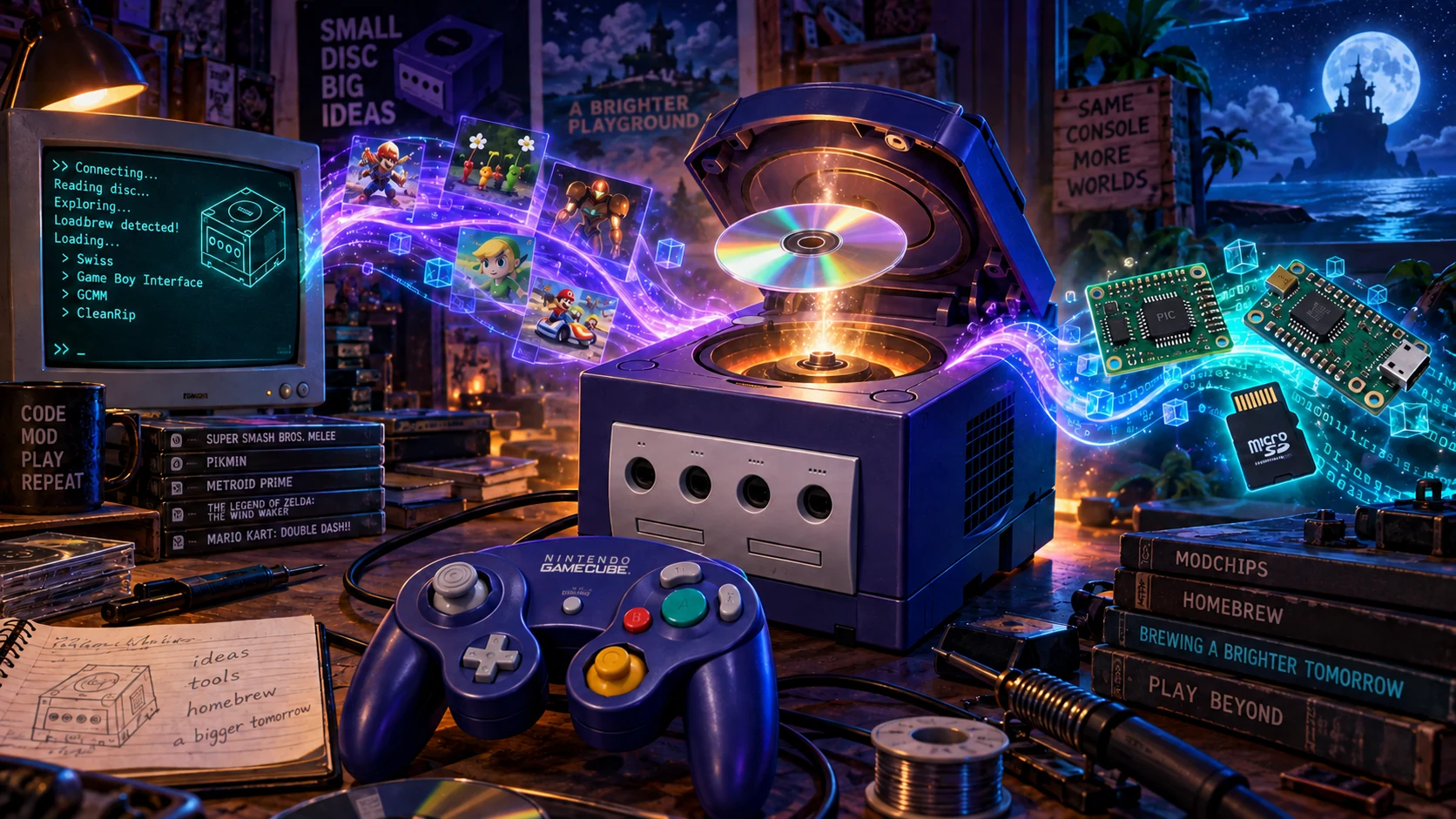
When Nintendo launched the GameCube in Japan on September 14, 2001, it arrived as a compact answer to a disc-based console market increasingly defined by Sony’s PlayStation 2 and Microsoft’s Xbox. Nintendo chose an optical format roughly eight centimeters across rather than the full-size DVDs used by its competitors. A commonly cited single-layer GameCube disc capacity is about 1.46 GB. The small disc made the machine visually distinctive, but its security value came from more than diameter.
Calling the medium a “mini-DVD” is convenient, though incomplete. A consumer could buy an ordinary recordable 8-cm DVD-R and place it beneath the lid, but physical fit did not make it a recognized GameCube disc. Nintendo’s format incorporated authentication information and disc structures ordinary burners could not reproduce. The drive, its controller, the console’s boot software, and regional rules formed a layered system. A recordable disc could be the correct size and still fail before the GameCube treated it as software.
The case created a separate mechanical restriction. The original spindle and lid were built for the smaller medium, so a full-size DVD was not a normal drop-in option without an open-top case, replacement lid, or other physical alteration. That limitation had nothing to do with authentication. The GameCube did not reject full-size discs merely because they were too large, nor did a small disc become legitimate because it fit. The scene’s first serious work began by separating those problems instead of repeating the old myths about a backwards-spinning disc. There is no technical basis for that claim.
- The GameCube disc was roughly 8 cm across and held about 1.46 GB in the commonly cited single-layer configuration.
- Disc diameter, authentication, boot execution, and region control were different problems.
- A small recordable DVD did not become an authorized GameCube disc simply by fitting under the lid.
The hardware underneath the lock
The GameCube’s architecture gave researchers several possible targets. Gekko is the 486 MHz IBM-derived PowerPC processor that executes game and operating-system code. Flipper is Nintendo’s custom graphics and system-support chip, handling the machine’s 3D pipeline and coordinating important memory and peripheral functions. The names sound friendly; the design is a tightly integrated computer with proprietary interfaces between its major subsystems.
The Initial Program Loader, or IPL, is the early boot firmware. It initializes hardware and decides what happens before an ordinary game has taken control. Reaching that stage is valuable because a modified IPL can launch a user-selected program at power-on. An IPL replacement is therefore not the same thing as a drive patch. One changes what the console executes first; the other changes how the optical system responds to discs or commands.
The optical drive has its own controller and communication path. It manages the mechanism and exchanges commands and data with the console, including behavior connected to authentication and media handling. EXI, the External Interface, is a family of Nintendo-specific clocked serial connections. In broad terms it resembles SPI more than USB: a device is selected, and the console exchanges bits at a defined rate. Memory cards use this kind of interface, and the early boot path exposed enough of it for researchers to study the console’s hidden assumptions.
That division of labor explains nearly every later product. A network exploit supplies a temporary payload. Action Replay supplies an accepted first-stage disc. A save exploit uses a retail game as a launcher. Viper, Qoob, PicoBoot, and KunaiGC work at the IPL side. XenoGC works at the drive side. SD Gecko and SD2SP2 provide storage only after software is running. Swiss organizes the resulting environment. None of those jobs should be treated as interchangeable.
- Gekko executes PowerPC code; Flipper combines graphics and system-support functions.
- The IPL is early boot firmware, not the optical drive.
- EXI is a clocked serial interface used by important peripherals and boot hardware.
Phantasy Star Online opens a network door
The first widely useful homebrew route did not require opening the console. It began with Phantasy Star Online Episode I & II and the GameCube Broadband Adapter. The game expected to communicate with a server, and researchers discovered that the network conversation could be redirected toward a computer under the user’s control. The console had already accepted an authentic retail disc; the opportunity was to influence what happened after the game was running.
PSUL and PSOload became associated with that process, although they were related tools in a broader loading chain rather than two perfectly interchangeable names. The Broadband Adapter provided Ethernet access. A computer supplied a replacement server, and network settings or DNS redirection sent the game toward it. The resulting communication allowed a small executable payload to be transferred and run on the GameCube.
This was an elegant answer to the authentication problem because it did not ask an unmodified machine to boot a visibly foreign disc. Phantasy Star Online had already passed Nintendo’s normal launch requirements. The exploit took control later, through a vulnerable network service or protocol behavior. That distinction made the route powerful for developers: a new build could be sent across the network repeatedly without burning a disc for every test.
It was still inconvenient as a living-room solution. Users needed the game, an official Broadband Adapter, a computer configured as a server, and a network arrangement that worked with the particular console revision and software. The payload generally had to be delivered again after a restart. Contemporary material commonly places the technique in the early 2000s, often around 2003, while the exact order of private experiments, public tools, and announcements is less tidy than later timelines suggest. What is certain is its historical role: PSOload made the GameCube a practical network-boot research target before permanent homebrew hardware became common.
- PSUL and PSOload belonged to the early PSO network-loading chain but were not simply one identical tool.
- The Broadband Adapter supplied the network path; the computer supplied the redirected service.
- The method loaded code temporarily and did not replace the GameCube’s power-on boot process.
Action Replay and the bootstrap problem
Datel’s Action Replay supplied another accepted starting point. The GameCube recognized its disc as legitimate software, and the product could apply encrypted cheat codes that altered memory while a game or utility was running. Researchers learned to use that environment for more than changing a character’s inventory or unlocking a hidden option. A small loader could be placed in memory and instructed to hand control to a larger homebrew executable.
The comparison with Game Genie is useful as cultural history, even though the products were not identical. Both belonged to a tradition of externally supplied codes that changed software behavior. Action Replay’s importance on GameCube came from combining an authenticated disc with a programmable code system. The disc got the console past its first barrier; the code mechanism created a path toward user software.
Early work associated with Samson’s Bootloader demonstrated the idea of loading a binary from a memory card or through the Broadband Adapter. But the method exposed a practical obstacle that simplified histories often omit: a stock GameCube did not provide an ordinary computer-style interface for preparing a specially formatted card. Knowing how to read a file was not the same as getting that file onto the card.
The user needed another already-capable console, development hardware, a commercial preparation service, or some other way to write the data in the exact format expected by the loader. This was the bootstrap problem. Action Replay solved the first-launch problem, but it did not magically turn an unmodified GameCube into a general-purpose memory-card writer. The distinction would remain important when save exploits and SD adapters arrived.
- Action Replay supplied an accepted disc and a programmable cheat-code environment.
- Samson’s Bootloader showed how that environment could hand off to homebrew.
- Preparing a memory card was a separate technical problem from reading it.
The 21C3 breakthrough
On December 27, 2004, at the 21st Chaos Communication Congress in Berlin, Felix Domke, Michael Steil, and Rob Reilink presented “GameCube Hacking.” The lecture brought together the major software approaches—PSO, Action Replay, and game exploits—with a hardware approach based on replacing the IPL. The presentation made the GameCube’s early boot path a practical engineering target rather than a mysterious black box.
The work discussed the encrypted IPL image, the console’s serial boot path, and the relationship between Flipper and the data presented during early startup. Some of those explanations were reverse-engineering models inferred from experiments rather than a complete Nintendo schematic. That distinction matters. The researchers had measured behavior and built a workable explanation; later retellings sometimes turned those models into claims of fully documented silicon.
The practical idea was straightforward even if the implementation was not. Replacement hardware could answer the console’s early requests and supply a modified boot image. A programmable logic device and flash memory could cause the GameCube to start a user-controlled loader before an authentic game disc was involved. The presentation explicitly noted that an IPL replacement could boot homebrew quickly while leaving the DVD firmware unmodified, meaning it was not automatically a pirate-game solution.
This separation became the conceptual foundation of the modern scene. Early boot control was one job. Optical authentication was another. The 21C3 research did not reveal one universal key that made every other layer irrelevant. It showed that the console could be understood as a boot ROM, a serial interface, a drive controller, an executable environment, and storage paths that could be attacked independently.
- The 21C3 presentation took place on December 27, 2004.
- It described PSO, Action Replay, save exploits, and IPL replacement as distinct approaches.
- Its technical explanations should be read as reverse-engineering results and models, not as a Nintendo-published hardware schematic.
Viper, Cobra, Qoob, and the commercial boot-chip era
The first commercial IPL boards appeared as the 21C3 research entered public view. Viper GC is generally placed in December 2004, though surviving records do not always distinguish announcement, first shipment, retail availability, and later firmware milestones. Its core function was IPL replacement through programmable hardware and flash memory. The Cobra BIOS supplied a menu and added optical-drive behavior, so a Viper installation could appear to solve several problems at once.
Viper's original flash capacity was 128 KB; the Extreme expanded that to 2 MB. Those figures are also written as 1 Mbit and 16 Mbit respectively, which explains some apparently contradictory old listings. More space meant more room for firmware and resident software. The Extreme's arrival in 2006 extended the idea beyond a minimal entry point: a chip could become a small, reusable homebrew platform rather than simply a switch that changed whether a disc was accepted.
Qoob SX and Qoob Pro followed the same broad opportunity in 2005. They used flash-based boot hardware to intercept or replace the IPL path and store firmware or loader software. The Pro’s larger flash capacity made it more self-contained. Qoob reinforced the lesson that a console could reach user software without waiting for a retail disc each time, while also showing that boot control and recordable-disc support were still separate features.
Qoob Pro likewise offered 2 MB of flash and USB updating, while the smaller SX carried 128 KB and omitted the Pro's USB facility. The SX included a backup read-only BIOS. These differences mattered to someone experimenting with firmware: storage capacity, the route used to rewrite it, and the ability to recover were practical features, not just specifications on a box. A larger flash could keep an application close to the boot process; USB updating reduced dependence on preparing another disc or arranging a network transfer. Programmable boot hardware made the console easier to revisit and change after installation.
The commercial products changed the owner’s experience from “find a launch trick” to “turn on the console and see a menu.” They also made the vocabulary less precise. Product names were used as shorthand for whole installations that might include an IPL board, Cobra or similar firmware, an optical patch, a replacement lid, and a particular loader. The hardware was not one universal modchip category; it was a collection of solutions sold together.
- Viper GC belongs to the December 2004 IPL-replacement era; Viper GC Extreme followed around 2006.
- Qoob SX and Pro belong to the 2005 boot-chip generation.
- Flash capacity affected firmware and loader storage, while drive support came from separate code or hardware behavior.
XenoGC patches the drive
XenoGC represented the other major optical-era strategy. Installed on the optical drive’s logic board, it injected patch code into the drive at runtime. Its documented functions included direct boot of DVD-R and related media, region-free loading, and video-mode options. It was a drivechip, not principally an IPL replacement.
That distinction affected how a console started homebrew. XenoGC could make a burned Swiss disc readable, but it did not require an authentic disc or another exploit to launch Swiss once the burned homebrew disc itself was available. Nor did XenoGC automatically provide the disc-free power-on menu associated with Viper, Qoob, or later IPL hardware. It changed the optical gate; it did not replace the console’s first instructions.
The original drive remained mechanically important. Media quality, the optical pickup, spindle behavior, calibration, drive revision, and patch compatibility all affected results. Audio-streaming games could require special handling because some titles expected data to arrive through the disc system in ways that differed from ordinary data reads. A drive patch could broaden the media the mechanism accepted, but it could not turn a worn pickup into a healthy one.
This is why blanket laser advice was poor technical practice. A failure to read a recordable disc might come from marginal media, an unreliable burn, a damaged or dirty lens, a tired spindle, calibration, a drive patch, or a bad image. Adjusting the laser potentiometer could sometimes be part of diagnosis, but it was never a universal remedy and could shorten the life of an already aging assembly. The period’s most useful work studied drive behavior instead of treating every read error as proof of a weak laser.
- XenoGC was a drive patch, not the same kind of IPL replacement as Viper or Qoob.
- A Xeno-equipped console could boot a burned homebrew disc without implying that an authentic game disc was required.
- Drive reliability depended on media, mechanics, calibration, firmware, and game behavior.
SDload, SD Media Launcher, and storage without a new drive
SDload, released in 2005 and associated with Costis, helped move the scene away from the optical disc as the default delivery medium. An SD Gecko adapter presented an SD card through a GameCube memory-card slot. Software that was already running could read DOL executables and other files from the card. The adapter was a passive interface and storage path, not a self-booting chip.
Datel’s SD Media Launcher packaged an authenticated boot disc with an SD-card arrangement, reducing the amount of specialist preparation required for some users. Its usefulness still depended on the particular adapter, disc, console revision, card, and loader. It did not turn every stock GameCube into a universal SD boot machine. The accepted disc supplied the first stage; the SD interface supplied files after that stage was running.
The original SDload route had a particularly important advantage: it could start from an otherwise unmodified GameCube, an appropriate Action Replay disc, and an SD card prepared on a computer. It did not require a pre-existing exploit save on a proprietary memory card. Its older requirements also explain why modern giant cards can be confusing in an old setup: the classic loader expected standard-capacity SD media and FAT16, and needed an Action Replay version with user-code entry. Later Swiss support for larger cards does not retroactively change what that first-stage loader understands.
The distinction between boot and storage became one of the scene’s most enduring lessons. “Where is the file?” and “how does the console begin executing it?” are different questions. Action Replay, a save exploit, an IPL replacement, or another accepted launch route answered the second. SDload, SD Gecko, and later SD2SP2 answered the first.
The later SD2SP2 adapter follows the same principle through the underside serial port on compatible consoles. It is useful storage for Swiss, applications, and save-management tools, but it is not an IPL device. A console still needs an exploit, Action Replay path, installed boot hardware, or another way to start homebrew before Swiss can mount the card.
- SD Gecko and SD2SP2 are storage adapters, not self-booting chips.
- SD Media Launcher simplified one launch arrangement but did not erase all compatibility or preparation requirements.
- Boot method and storage method should be chosen separately.
Save exploits make the route more accessible
Save exploits shifted the attack from a cheat disc’s code engine to the assumptions built into individual games. A game loads a memory-card save and interprets its contents according to rules written by its programmers. A specially prepared save can redirect execution to a small payload, which then launches Swiss or another DOL executable. The game is the first-stage launcher; the IPL remains untouched.
The maintained GameCube exploit catalog lists representative routes including Twilight Hack for the GameCube release of The Legend of Zelda: Twilight Princess, WWHack for The Wind Waker, ShineHax for Super Mario Sunshine in documented PAL configurations, BMX HAX, Exploit Under Fire for James Bond 007: Agent Under Fire, Splinter Cell and Pandora Tomorrow exploits, Ghost Recon 2, F-Zero HX, Home Bros. for Super Smash Bros. Melee, Animal Crossing, and PokéLoad for Pokémon Colosseum and Pokémon XD. Support depends on region, disc revision, save format, and the menu or in-game action that reaches the vulnerable data.
This chronology should not be simplified into one clean “first exploit” story. Some techniques were discovered early, some were refined later, and some became useful only once Swiss supplied a reliable payload target. Current catalogs are more useful for compatibility than sweeping claims about discovery priority. The names also need careful separation from Wii history. FIX94’s twilight-hack-gc repository describes a GameCube port of the original Twilight Hack, requiring a way to inject a GCI onto a memory card and loading a DOL converted with dol2gci. It should not be casually merged with the famous 2008 Wii exploit.
The card-preparation problem remained. GCMM, originally known as a GameCube/Wii memory-card manager, can back up, restore, and manipulate GameCube memory-card data on a GameCube or Wii. Its release history documents Wii support, SD Gecko support in Wii mode, and GameCube devices including SD2SP2 and GC Loader. It is not a Wii NAND save manager, and it is not itself an IPL modchip.
- GameCube save exploits depend on the exact game, region, revision, and save format.
- FIX94’s Twilight Hack GameCube port should be separated from the famous 2008 Wii exploit.
- GCMM manages GameCube and Wii memory-card data on the relevant hardware; it does not manage Wii NAND saves.
Swiss turns an exploit into a platform
Swiss, associated from its early development with emu_kidid and later with Extrems and many contributors, changed the character of GameCube homebrew. Earlier methods proved that code could run. Swiss made that code useful by providing a file browser, DOL launcher, compatibility settings, video-mode controls, device selection, patches, network functions, and interfaces to a growing collection of storage and drive devices.
Its supported device list has expanded far beyond the early SD Gecko era. The current README names SD cards through SD Gecko and SD2SP2; original discs and recordable optical media; Qoob Pro flash; USB Gecko; WASP and WiiKey Fusion; Broadband Adapter-compatible networking and newer Ethernet controllers; WODE; IDE-EXI, M.2 Loader, and USB Dolphin; GC Loader and CUBEODE; FlippyDrive; KunaiGC flash; and memory-card-emulation devices including FlipperMCE, GCMCE, and MemCard PRO GC. The README also notes that many newer devices and exFAT support depend on libogc2 rather than the older library.
Swiss continues to gain capabilities long after Nintendo stopped developing for the console. Its July 21, 2026 release, v0.6r2092, included changes involving controllers and accessories, regional video behavior, filesystem handling, disc-verification data and networking. That breadth shows how the project has grown: improvements now involve the whole environment surrounding a game, from the input device in a player’s hands to the storage holding its data. Individual hardware combinations can still have unresolved compatibility issues, so a release number alone does not promise perfect behavior.
Swiss is powerful because it exposes compatibility rather than hiding it. A game may boot and still behave differently from a pressed disc because of audio streaming, streaming textures, memory-card timing, video modes, drive commands, or storage latency. SD throughput is not automatically equivalent to optical behavior, and a compatibility patch is not a guarantee that every title behaves identically. The loader is a common meeting point for the ecosystem, but it does not erase the differences between the hardware paths beneath it.
- Swiss requires a way to boot homebrew before it can browse devices.
- Current Swiss support includes GC Loader, CUBEODE, FlippyDrive, KunaiGC flash, and several memory-card-emulation devices.
- As of September 14, 2026, the latest listed tagged release is v0.6r2092.
DOL revisions and the separate video problem
Model numbers matter because the GameCube’s expansion ports changed over its life. Early DOL-001 systems have the digital-video connector, though some late DOL-001 units lack the underside Serial Port 2. DOL-101 systems lack both the digital-video connector and Serial Port 2. Those distinctions affect SD2SP2, internal video hardware, and some installation plans. A DOL-001 is not automatically ideal, and a DOL-101 is not automatically unsuitable; the relevant question is which ports and video path the intended setup requires.
The SD Gecko occupies a memory-card slot. SD2SP2 uses Serial Port 2 where it exists. Neither adapter is a self-booting device. A stock machine still needs a save exploit, Action Replay route, network exploit, IPL replacement, ODE boot path, or another method to execute Swiss. Treating a passive pin adapter as though it contained an active translating boot chip is a category error.
GCVideo belongs to a different branch entirely. It modernizes the video output path on compatible hardware, whether through internal installations or external products built around the project. GCVideo does not boot Swiss, read an SD card, replace the optical drive, or make an exploit unnecessary. A console can have GCVideo without homebrew, homebrew without GCVideo, or both.
This separation is useful when planning a system. Storage, boot, drive behavior, and display output are independent decisions. A person may want a cleaner HDMI signal but continue using original discs. Another may want an optical-drive emulator but keep the original analog video path. A third may need only a save exploit and a memory-card adapter. No one device is mandatory for every GameCube owner.
- DOL-001 may have digital video, but late units can lack Serial Port 2.
- DOL-101 lacks both the digital-video connector and Serial Port 2.
- GCVideo is a video project, not a loader, storage adapter, or ODE.
The Wii-era bridge and the optical-drive transplant period
Nintendo’s Wii, launched in 2006, later made some GameCube card-preparation and homebrew workflows more convenient. That convenience belongs later in the chronology; the Wii was not present during the first GameCube exploits. A Wii could run software capable of writing or managing GameCube memory-card data, but that did not change how the original GameCube’s boot chain worked.
The same period saw experiments with hardware originally designed for other systems. WiiKey Fusion and WASP could be adapted for GameCube optical-drive-emulation projects, while WODE offered another storage-fed drive path. These devices intercepted or replaced portions of the drive interface rather than merely persuading the original mechanism to accept a consumer DVD-R. Their firmware, installation requirements, storage formats, and compatibility differed, even when Swiss supplied the visible menu.
This distinction is the cleanest way to understand the transition. An IPL replacement starts code early. A drive patch changes how the original optical controller behaves. An optical-drive emulator presents disc data without relying on the original laser and spindle. An SD adapter supplies files after software starts. Swiss provides the user-facing environment. A video mod changes the display signal.
The commercial and community scenes often bundled these functions, which made the products appear interchangeable. They were not. A WiiKey Fusion installation could provide a modern disc source but still depend on a separate boot method. A Qoob board could start Swiss but retain the original optical limitations. A network adapter could stream data but could not by itself make a stock GameCube boot unsigned code.
- The Wii’s 2006 launch made later card preparation easier; it was not part of the earliest GameCube exploit era.
- WiiKey Fusion, WASP, and WODE belong to the transplanted or emulated-drive period.
- Boot, storage, drive emulation, and video remained separate layers.
GC Loader, HW1, HW2, and the ODE mainstream
GC Loader made optical-drive replacement comparatively straightforward. Installed in the drive position, it reads GameCube data from an SD card rather than relying on the original mechanical optical assembly. It is an ODE, not simply a boot menu. Swiss may be used as the interface, but the underlying hardware is presenting a replacement drive path.
GC Loader HW1 and HW2 have separate firmware update paths. That distinction matters because the software inside the replacement drive is different from Swiss, the program it may launch. Historical bricking reports illustrate the danger of mixing those layers in a retelling: emu_kidid clarified that the incidents involved GC Loader firmware updates, rather than Swiss independently bricking the hardware. Identifying the board and following its own firmware instructions is more useful than treating every file carrying the GC Loader name as interchangeable.
GC Loader can be attractive when an optical pickup is worn, when mechanical use should be reduced, or when preservation work benefits from convenient access to verified images. It also changes the physical character of the console: the original optical drive is normally removed or bypassed. That is different from FlippyDrive, which retains the OEM drive, and from PicoBoot, which changes early boot while leaving storage to another device.
CUBEODE belongs in the same broad modern comparison but should not be treated as identical to GC Loader. Current Swiss documentation lists CUBEODE as a supported device alongside GC Loader, FlippyDrive, and other storage paths. That establishes software support, not identical hardware architecture or feature parity. The practical ecosystem is defined by combinations: a boot method, an ODE or original drive, Swiss, storage, memory-card handling, and possibly video output.
- GC Loader is an optical-drive replacement, not merely an IPL boot chip.
- HW1 and HW2 have separate firmware paths.
- CUBEODE is a distinct supported device in Swiss and should not be presented as synonymous with GC Loader.
PicoBoot brings IPL replacement to inexpensive hardware
PicoBoot, publicly released in 2022 and built around the Raspberry Pi Pico and RP2040, revived the 2004 IPL-replacement idea with inexpensive, accessible hardware. Its task is to participate in the GameCube’s early boot exchange and launch a user-selected payload, commonly Swiss. It does not replace the optical drive, supply game images by itself, or make an SD2SP2 self-booting.
The project’s importance is architectural as much as financial. Earlier IPL devices required specialized boards, scarce parts, or aging scene hardware. PicoBoot separated the boot payload from the storage device and made the idea legible to a new generation of developers. Once the payload starts, Swiss can use SD Gecko, SD2SP2, network storage, an ODE, or another supported source.
PicoBoot also brought the physical installation back into the foreground. Inexpensive components do not eliminate the need for sound soldering and a reliable connection to the console. Firmware and payload updates can change the boot experience, but an intermittent electrical connection remains an electrical problem. Its appeal is that the essential hardware can be small and affordable while the real user experience continues to improve through software. The design gives a twenty-year-old machine a new starting point without making its original drive redundant.
PicoBoot also preserves the historical distinction between boot and drive. It can make Swiss appear at power-on, but it does not make the original optical mechanism read DVD-R, and it does not provide the complete disc-image path of GC Loader or FlippyDrive. An owner can pair it with an SD adapter, a memory-card emulator, a network device, or a separate ODE. The board opens the early boot door; other components decide what happens afterward.
- PicoBoot is an RP2040-based IPL replacement, introduced in 2022.
- v0.5.0 is listed as the latest release, but affected installations may need the project’s recommended fallback version.
- PicoBoot is not an ODE and does not replace storage hardware.
KunaiGC adds flash, recovery, and a more complete IPL platform
KunaiGC, publicly documented as an open-source IPL modchip, takes the modern boot-board idea further than a minimal payload injector. Its documented features include internal flash storage, configurable boot behavior, button-mapped DOL loading, direct boot into internal Swiss or Game Boy Interface, region-independent disc boot through its built-in Swiss arrangement, an updater, recovery functions, and cubeboot support.
That feature set makes KunaiGC distinct from PicoBoot even though both belong to the IPL family. PicoBoot provides an inexpensive IPL entry point, with payload arrangements depending on firmware and configuration. KunaiGC can make more of the software environment resident in the modchip’s own flash, giving the owner a self-contained Swiss or GBI route and recovery tools if an update goes wrong. It still does not become a full ODE merely because it can boot software or boot discs through Swiss.
KunaiGC also illustrates how contemporary projects acknowledge their inheritance. Its credits point back to tmbinc’s IPL research, the GC-Forever community, Swiss contributors including Extrems and emu_kidid, and the research behind PicoBoot and Shuriken Attack. The current generation is not a clean break from the mid-2000s; it is the result of old reverse engineering becoming open documentation, inexpensive microcontrollers, and maintainable firmware.
The practical lesson is to compare architecture rather than branding. Ask whether a board stores the payload internally, whether it can recover itself, whether it launches Swiss or GBI directly, whether it retains the original drive, and which console revisions it supports. “IPL modchip” identifies the layer, not every behavior within that layer.
- KunaiGC is an open-source IPL modchip with internal flash storage.
- Its documented features include internal Swiss or GBI, configurable boot behavior, button-mapped DOL loading, updater, recovery, and cubeboot support.
- It is not automatically a full optical-drive emulator.
PicoLoader occupies the narrow middle ground
makeo’s PicoLoader uses an RP2040-family design but follows a different boot strategy from PicoBoot. Its official description says that it emulates the disc drive during boot, executes a small homebrew application from flash, and then re-enables the original drive. The project explicitly says it is not a full optical-drive emulator and is intended for small homebrew applications such as Swiss.
That makes PicoLoader neither a conventional IPL replacement nor a GC Loader-style ODE. Its drive-assist mechanism is active during startup, but the original drive remains responsible for later disc operation. To browse files from an SD card, the project documentation points users toward a separate SD Gecko, SD2SP2, or similar adapter.
The distinction is useful for owners who want a modern boot path while retaining the original optical hardware. It also demonstrates why “Pico” is not a feature category. PicoBoot, PicoLoader, and other RP2040 projects may use inexpensive microcontrollers while solving different problems at different points in the boot and drive chain.
In historical terms, PicoLoader is a neat return to the old scene’s modular thinking. It borrows enough of the drive behavior to get a payload started, then gives the original mechanism back its job. That is technically different from permanently replacing the drive, even if the user ultimately sees Swiss on the same screen.
- PicoLoader temporarily emulates or assists the drive during boot.
- It is intended for small homebrew applications from flash, not full disc-image loading.
- It retains the original drive for later operation.
FlippyDrive and cubeboot keep the original drive
FlippyDrive represents a newer ODE philosophy: provide modern storage while retaining the GameCube’s OEM optical drive. Its documentation describes a solderless internal installation in the original drive slot, microSD loading, a preinstalled cubeboot menu patcher, software updates and recovery, and the ability to continue playing physical discs. Its Wi-Fi loading is explicitly described as experimental.
That architecture differs from GC Loader’s more complete drive replacement. FlippyDrive can reduce mechanical use without requiring the owner to discard the original optical assembly. The drive and ODE coexist, and the user can choose physical media or storage-fed software. This makes it attractive for preservation and experimentation, though it does not make every compatibility issue disappear.
Cubeboot belongs to the boot and menu layer supplied with or used by FlippyDrive. Swiss remains a separate loader and utility environment. Cubeboot can provide a convenient startup interface and configure how the device presents software, while Swiss provides the broader file browser, DOL launching, patches, device support, and compatibility controls. The two can appear in one seamless startup flow without being the same program.
As of September 2026, FlippyDrive’s documentation remains explicitly a work in progress. It lists experimental networking and continues to evolve its configuration and compatibility information. The right way to describe the device is therefore precise but qualified: it is a solderless ODE that retains the OEM drive, loads from microSD, uses cubeboot as a preinstalled menu patcher, and offers experimental network paths—not a finished replacement for every other part of the homebrew stack.
- FlippyDrive is a solderless ODE that retains the OEM optical drive.
- Cubeboot is its boot/menu layer; Swiss is a separate loader and utility environment.
- Network loading and some configuration features remain experimental or documentation-dependent.
The current software ecosystem
The value of modern GameCube hardware depends on software that does more than launch game images. Game Boy Interface replaces the official Game Boy Player startup software with a more accurate and configurable program. It requires the physical Game Boy Player accessory; it is not an emulator for a bare GameCube. The boot method launches GBI, but the Player hardware supplies the cartridge interface and Game Boy processing path.
GCMM manages memory-card data on GameCube and Wii. CleanRip creates disc images and supports verification and related data workflows, with exact filesystem, BCA, and verification behavior depending on the build and its supporting databases. It is an application, not a boot exploit. MemCard PRO GC and related memory-card-emulation projects address save storage and per-game memory-card images; they are not universal replacements for an SD game loader.
ETH2GC extends the Broadband Adapter idea with modern Ethernet hardware. It emulates the BBA-style network interface for supported software, but it does not boot a stock GameCube, replace the optical drive, or make every application network-aware. Swiss’s current README lists multiple Ethernet paths, including ENC28J60, W5500, W6100, W6300, and ETH2SP1 arrangements. The old PSO era therefore has a modern echo: network loading remains useful, but it is now one accessory among many.
GCVideo remains a display project. It improves or modernizes video output without touching boot, storage, disc access, or memory cards. Nintendont belongs to the Wii and vWii environment, while Dolphin is host emulation. Both matter to preservation and accessibility, but neither is native GameCube custom firmware. Keeping those categories distinct prevents a useful preservation tool from being misdescribed as a modification installed inside the original console.
- GBI requires the physical Game Boy Player.
- GCMM manages saves; CleanRip dumps discs; memory-card emulators handle saves.
- ETH2GC emulates a network interface; GCVideo handles video output.
- Nintendont is Wii/vWii software, and Dolphin is host emulation.
When the GameCube became a home for older consoles
A loader menu was only the beginning. Once developers could run their own PowerPC programs, the GameCube could also host emulators for earlier machines. This is a different direction from Dolphin: instead of another computer emulating the GameCube, the original GameCube is the computer doing the emulating. That distinction opens up an important part of the homebrew story that gets lost when every discussion stops at disc images.
FCE Ultra GX brought NES and Famicom software into that environment through a port of the FCE Ultra family. Its project still separates GameCube builds from Wii builds, an important detail when selecting software for the original hardware. Features such as configurable controls, save states and Game Genie code support turn the console into a different kind of retro workstation. There is a pleasing historical loop here: the external cheat codes once typed into a cartridge accessory can be interpreted by software running on a Nintendo machine two generations later.
Snes9x GX extends the same idea to the Super Nintendo. The familiar controller, television connection and compact box make the experience approachable, but the work underneath is substantial. An emulator has to reproduce another system's processors and devices while keeping sound, graphics and input synchronized. A port must also integrate file browsing, controller mapping, saving and video output with the host console. Compiling an emulator core is only part of making an application that someone can comfortably use from the sofa.
Genesis Plus GX brings Sega's eight- and sixteen-bit machines into the picture, with GameCube and Wii among its supported targets. Its range includes the Mega Drive/Genesis, Master System and Game Gear. A GameCube controller navigating Sega software is a vivid demonstration of how far the platform moved beyond its original role. These are independent homebrew applications launched after the boot barrier has been crossed; installing a chip does not automatically install or configure them.
Platform-specific limits still matter. A feature advertised for a combined Wii/GameCube project may depend on the Wii's extra memory, interfaces or input devices. Software emulation also differs fundamentally from Game Boy Interface driving the physical Game Boy Player. One reconstructs another machine in software; the other supplies improved control software for an actual Nintendo accessory. Both belong in the GameCube's second life, but they show two very different ways that a homebrew program can expand what an original console does.
The toolchain beneath the tools
A platform survives when developers can still build for it. devkitPPC remains central to compiling PowerPC software for the GameCube and Wii family. Traditional libogc provides the familiar hardware-access and C-library environment used by a large body of homebrew. libogc2 is a distinct successor effort, not merely a renamed libogc release.
The current libogc2 project describes wide-ranging fixes and additions across libogc subsystems, hardware enablement for newer and older accessories, and closer interoperability with Swiss. It is largely API-compatible with libogc 2.1.0 and earlier. Its migration guidance documents changes for GNU Make, CMake, GitHub Actions, and package-based installation, while its associated libdvm work supports storage features including exFAT without requiring every application to rewrite its filesystem code.
This distinction matters to current Swiss development. The Swiss README notes that many newer devices and exFAT support depend on libogc2. Recent Swiss release notes mention adjustments for libogc2, newer Ethernet hardware, memory-card emulation, and device interoperability. Developers are not simply polishing an old menu; they are maintaining a hardware abstraction layer for accessories Nintendo never designed.
The result is a feedback loop. Better libraries make better homebrew. New accessories reveal edge cases in EXI timing, drive commands, video modes, memory cards, and network interfaces. Swiss incorporates that knowledge. CleanRip, GCMM, FlippyDrive, cubeboot, KunaiGC, and other projects can share the same evolving software foundation. The GameCube remains useful because it is now a documented PowerPC target rather than merely a sealed appliance waiting for an exploit.
- devkitPPC remains the primary development toolchain for many GameCube projects.
- libogc2 is largely API-compatible with libogc 2.1.0 and earlier but adds substantial hardware and interoperability work.
- Current Swiss support for many newer devices depends on libogc2.
Homebrew, preservation, and copying are related but not identical
GameCube modding has always had overlapping motives. Drive patches and recordable-media support were attractive to people who wanted to duplicate commercial games. The same engineering also enabled legitimate homebrew development, personal disc dumping, accessibility projects, region preservation, hardware research, and reduced wear on aging optical mechanisms.
Those purposes should be described separately. CleanRip can be used to create and verify an image from a disc a user owns, but that does not authorize distributing the resulting data. An ODE can test software and preserve a drive, but that does not settle the legal status of every image loaded through it. A save exploit can launch an original homebrew program without implying anything about commercial copying.
The technical history does not require a sweeping legal conclusion. Laws differ by jurisdiction and by activity, including circumvention, personal backups, distribution, and commercial use. The useful historical point is narrower: the same opening in Nintendo’s security model could support both lawful experimentation and unauthorized copying. The existence of one use does not erase the other, and neither should be treated as the sole reason the scene mattered.
By the modern era, preservation has become especially concrete. Optical pickups fail, memory cards age, displays change, and some original accessories are difficult to replace. The community’s response has been modular: verified dumps, emulated memory cards, drive replacements, retained OEM drives, better video, network tools, and software that still understands the original hardware. The GameCube is valuable not because every use is identical, but because the platform can support many purposes without pretending they are.
- Homebrew development, personal preservation, personal dumping, and unauthorized distribution are distinct activities.
- Legal treatment varies by jurisdiction and conduct.
- The hardware can support preservation without every use being legally or ethically equivalent.
Why the cube is still worth opening
By September 14, 2026, GameCube modding is best understood as a history of separation. The early optical format combined small media, authentication, region rules, and a mechanical enclosure. PSOload used a network entrance. Action Replay used an accepted disc. Save exploits used game data. The 21C3 presentation showed that the IPL itself could be replaced. Viper, Cobra, Qoob, and XenoGC divided boot control from drive patching. SDload and SD adapters moved storage away from burned discs. Swiss turned those openings into a coherent software environment.
The current generation continues that division. PicoBoot and KunaiGC address IPL boot. PicoLoader uses temporary drive assistance and returns control to the OEM mechanism. GC Loader replaces the drive, with separate HW1 and HW2 firmware paths. CUBEODE is another Swiss-supported ODE path. FlippyDrive retains the original drive while adding microSD loading and cubeboot. SD Gecko and SD2SP2 provide storage but not boot. MemCard PRO GC and Swiss memory-card emulation address saves. GCVideo handles display. GBI, GCMM, CleanRip, ETH2GC, libogc2, and devkitPPC make the resulting machine useful for far more than one loader menu.
That modularity is the community’s real achievement. The GameCube did not become open because someone found a single master key. It became enduring because developers learned which lock each tool opened, documented the limits of each approach, and kept improving the software around original hardware. Extrems, emu_kidid, FIX94, webhdx, makeo, the KunaiGC contributors, the FlippyDrive team, libogc2 maintainers, preservation developers, and countless earlier researchers all occupy different points in that chain.
The little purple cube remains useful because its barriers were mapped carefully enough that new projects can work around them without pretending those barriers never existed. A 2001 console can now boot software from internal flash, browse a modern SD card, retain or replace its optical drive, manage virtual memory cards, output a cleaner video signal, communicate over current network hardware, and still launch the games for which it was built. That is not one jailbreak. It is twenty-five years of accumulated understanding.
- Choose a system around a purpose rather than a fashionable product name.
- Treat boot, storage, drive access, memory cards, networking, and video as separate layers.
- Credit the maintainers and researchers whose continuing work keeps original GameCube hardware practical.
Keep exploring Nintendo hardware and games
Read our Game Genie history, Action Replay history and Nintendo Switch hacking history, or explore the console guide library and game walkthroughs.