The Console Behind the GamePad
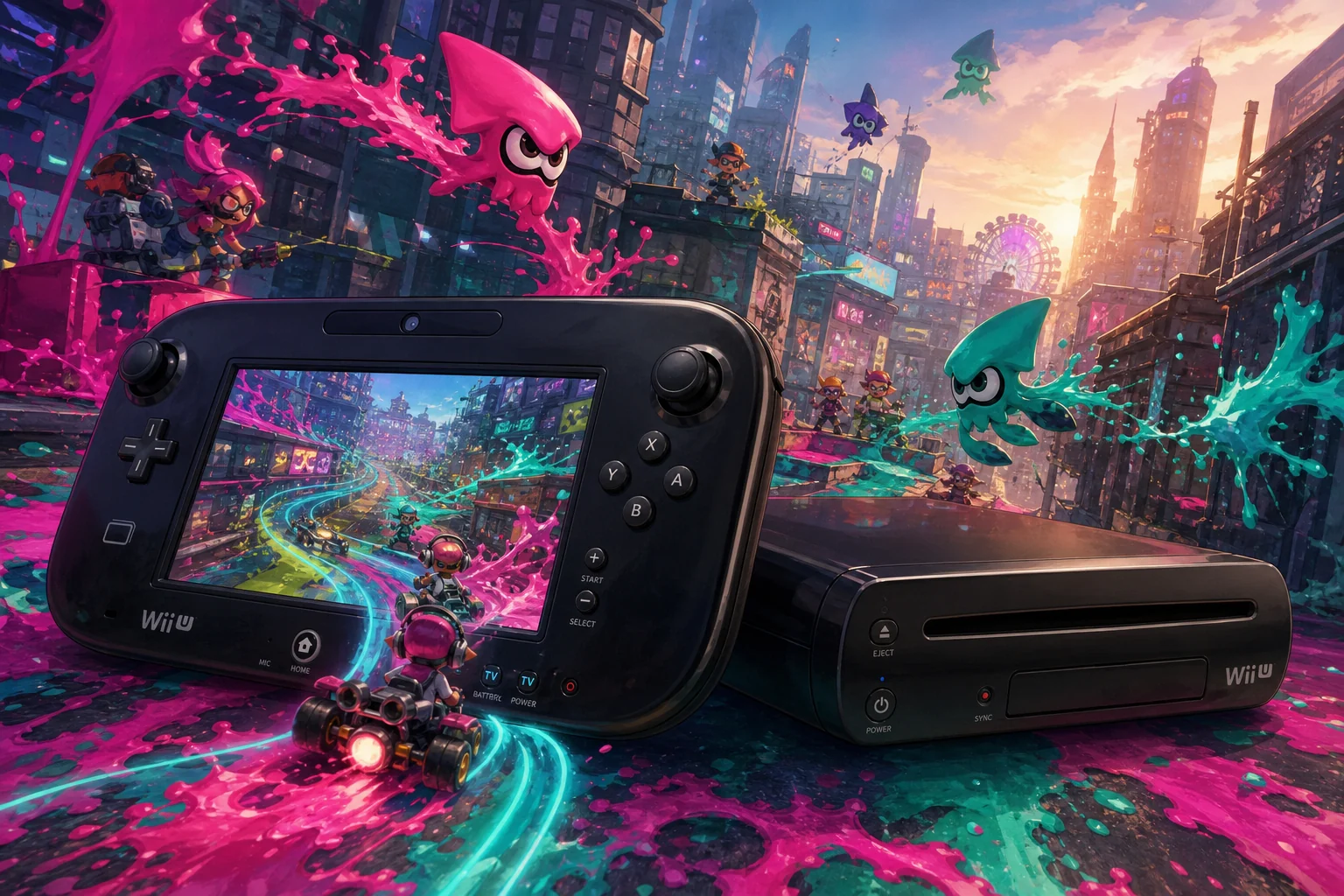
The Wii U’s most revealing feature was not the screen built into its controller. It was the invisible argument between two computers inside the box. One processor handled the software players saw: the Wii U Menu, games, browser and much of the operating system. Another, less visible processor handled security, storage and hardware services. Between them sat a collection of boundaries that made the Wii U unusually interesting to researchers—and unusually difficult to modify cleanly.
Nintendo’s launch specifications described a multi-core IBM Power-based CPU, an AMD Radeon-based graphics processor, internal flash storage, SD-card support and compatibility with Wii discs and accessories. The reverse-engineering community later supplied the useful codenames: Espresso for the PowerPC-based main processor and Starbuck for the ARM-based security and I/O processor. Nintendo did not publish a complete consumer-facing map of this architecture, so those names belong to the technical vocabulary developed by researchers rather than to the launch marketing.
The main software environment became known as Cafe OS. It was where Wii U applications ran, where the browser executed, and where early homebrew experiments first appeared. Starbuck ran software generally called IOSU, which mediated important services such as filesystem access, system management and parts of the console’s security model. A program running in Cafe OS was therefore not automatically in charge of the whole machine. It might be able to execute its own code while remaining unable to alter the services controlled by IOSU.
That distinction explains why “the Wii U was hacked” is too vague to be useful. Code execution means that a researcher has made the console run instructions that Nintendo did not authorize. It does not necessarily mean access to protected storage, title management or signature verification. A kernel exploit goes further by escaping the restrictions imposed on ordinary applications. Even kernel access on the Espresso side did not initially amount to control of Starbuck. Each step crossed a different privilege boundary.
The Wii U also contained a third environment that is easy to misunderstand. Its Wii compatibility feature, usually called vWii, was not simply Wii software placed inside Cafe OS. Selecting Wii Mode launched a distinct environment with its own software and storage area. Nintendo’s documentation treated it as a separate mode: Wii controllers were required for navigation, and although the GamePad could display the video signal, it could not control the Wii Menu or Wii games in the ordinary way.
That separation gave vWii its own aftermarket history. A modification affecting the compatibility environment did not automatically replace Cafe OS or IOSU. Likewise, a Wii exploit or Homebrew Channel installation was not a general Wii U exploit. Even the storage terminology could mislead newcomers. The area associated with vWii, commonly identified as SLCCMPT, was not interchangeable with the Wii U’s main system storage. A backup of one did not constitute a backup of the other.
The Browser Becomes a Door
The first broadly visible Wii U experiments took advantage of a feature Nintendo had added for ordinary users: the Internet Browser. Nintendo’s major 2.0.0 system update, released in November 2012, introduced the browser along with other network functions. Its significance to the modification scene was architectural rather than glamorous. A browser could load specially prepared web content without requiring a modified disc, a hardware probe or a permanently altered system title.
The browser was a large, complicated program processing hostile input by design. That made it a natural target for security research. The libwiiu project documents browser execution in Cafe OS userspace, followed by work on a Cafe OS kernel exploit. Its records describe different vulnerabilities and different firmware coverage rather than one universal trick. Earlier system versions were supported through one use-after-free vulnerability—a bug in which a program continues using a piece of memory after it has been released—while later versions required other memory-corruption bugs. The project also records userland-only support on some later firmware versions.
The technical vocabulary matters here. A browser userland exploit can make code run inside the browser’s ordinary restricted process. A kernel exploit can grant broader control over the Espresso-side operating system. “ROP,” or return-oriented programming, describes a technique for arranging short sequences of existing machine instructions, called gadgets, into a useful chain when directly injecting executable code is restricted. These methods helped researchers turn a browser crash into controlled execution, but they did not magically remove every security wall.
A later project known as JsTypeHax illustrates the collaborative and unstable character of this period. Its documentation records a 5.5.x browser exploit and credits several contributors for the initial exploit, return-oriented-programming work and stability improvements. That is evidence of a chain of research, not evidence that one person was the first Wii U hacker. The public record supports naming projects and documented contributions; it does not support a universally accepted first discoverer.
The browser’s practical importance was also temporary and version-dependent. A vulnerability could work on one firmware revision, fail on another and become unreliable after a timing change or browser update. A repository commit date, a vulnerability disclosure date and the day an ordinary owner could use a public exploit were not necessarily the same. The surviving documentation is strongest on what a project supported and weaker on private discovery dates or the exact sequence in which every technique became public.
This created an unusual early landscape. Researchers could demonstrate code execution, launch small programs or investigate the operating system before they could safely control the console’s storage services. The scene was not climbing a single ladder from “browser trick” to “full jailbreak.” Espresso userspace, the Espresso kernel and Starbuck’s IOSU each represented separate research problems. The gap between them shaped everything that followed.
From Proof of Concept to Loaders
Once browser-launched code could do more than display a technical demonstration, the scene acquired recognizable applications. Cafiine-style tools explored network-based file replacement, allowing a Wii U to request selected files from a computer during execution. The idea was significant because it changed the relationship between the console and its software without requiring a complete replacement loader. Developers could test modified assets or investigate file access while concentrating on one narrow part of the system.
This kind of tool also showed why kernel access mattered. Merely launching a homebrew program was not the same as intercepting the file requests made by a commercial game. A network file server, a client running on the console and a mechanism for redirecting selected accesses all had to cooperate. The result was useful for legitimate experimentation and game modification, while also becoming part of the broader unauthorized-copying ecosystem. Those uses should be distinguished rather than folded into one neutral label.
Loadiine made the transition more visible. Its GX2 interface and loading system presented Wii U software through a replacement path running on the console’s own hardware. GX2 refers to the Wii U’s graphics API and rendering environment; Loadiine was not an emulator pretending to be a Wii U. It used the console’s Cafe OS environment to load software in a way Nintendo had not authorized. That distinction separates it from emulation and from official accessories such as the GamePad or Wii controllers.
The project’s own documentation described launching game backups from an SD card and credited multiple contributors, including Dimok, Cyan, Maschell and n1ghty. It does not establish a universally agreed first release day or a single creator. Loadiine became prominent during 2015, but later repository pages and rewritten documentation are not enough to establish every earlier publication date. A precise chronology would require a surviving contemporaneous announcement rather than an assumption based on a current repository.
Loadiine’s historical role cannot be separated from piracy. Its loader function was technically interesting, and similar mechanisms could support research or personal modifications, but the software was widely associated with unauthorized copies of commercial games. That fact can be described without reproducing copyrighted files, directing readers toward them or turning the account into a preparation guide. The important development was that browser execution had become an application ecosystem: menus, file services and loaders gave the research practical shape.
For users, the difference between a browser payload and a loader was dramatic. A payload was an event, often dependent on a particular browser state and firmware revision. A loader was an environment with expectations about storage, file naming and title behavior. Yet the convenience remained conditional. Early tools depended on the Cafe OS privileges available at that moment, and their capabilities should not be projected backward from later custom firmware. What looked like a single Wii U modding scene was already a stack of partially connected experiments.
The Starbuck Problem
The deeper breakthrough required attention to IOSU. This Starbuck-side software stood between many applications and the functions that made the console a console: storage management, system titles, device services and security decisions. Cafe OS research could make homebrew visible and could alter some application behavior. IOSU research could change the rules under which the system itself operated.
The name iosuhax can obscure that history. The project documentation describes a collection of IOSU patches, not the original vulnerability that necessarily obtained IOSU control. Its listed capabilities included software NAND dumping, redNAND, a remote shell and ARM debugging. In other words, it represented a custom software layer made possible by earlier research. It should not automatically be credited as the discovery of every underlying IOSU exploit.
RedNAND means redirected NAND. NAND is the flash storage technology used for the console’s internal system storage; in a redNAND arrangement, reads and writes intended for that storage are redirected to a separate image, commonly backed by an SD card. The appeal was obvious. Researchers could test system changes against a copy rather than treating the production storage as their only laboratory. System software could be examined, patched and restored with less immediate dependence on the original contents.
Less obvious was the risk. RedNAND was not a universal, unbreakable sandbox. Different implementations could redirect different partitions, arrange caches differently or expect incompatible layouts. The iosuhax documentation warned that incorrect use could brick a Wii U and cautioned against updating either the original system storage or the redirected environment. Later projects likewise recorded incompatibilities among redNAND formats. The name described a general strategy, not one interchangeable disk image.
This was the point at which Wii U modification became more than an argument about launching unsigned applications. “Unsigned” means software that lacks the cryptographic approval Nintendo’s system normally expects. IOSU-level patches could affect the services that enforced or mediated those expectations. They also made possible more serious preservation work: storage dumps, system research, debugging and controlled experimentation with the console’s software architecture. The same privilege could support homebrew development or unauthorized loading, depending on what was done with it.
Mocha and related projects later packaged some of these capabilities into environments that were easier to use than raw research patches. But the chronology matters. A mature custom firmware interface should not be projected backward onto the earliest IOSU work. The early period was defined by fragile privilege escalation, incomplete documentation and storage experiments whose failure modes were still being mapped. Those early discoveries raised a practical question: how could deep access be made convenient without turning every launch into a browser experiment or every mistake into a storage disaster?
A Purchased Title Becomes the Key
The next major change did not begin with a new browser vulnerability. It began with a title Nintendo had sold through the Wii U’s own Virtual Console service. Haxchi used a compatible Nintendo DS Virtual Console game as the point from which modified software could be launched. That choice was technically and socially important: instead of asking the owner to revisit a browser exploit whenever homebrew was needed, Haxchi turned an ordinary menu title into a customized entry point.
The project documentation describes Haxchi as a continuation of smea’s proof-of-concept exploit and credits a wider group of contributors. That record supports a history of collaboration, not a definitive claim about a first discoverer. The exploit depended on the behavior of particular DS Virtual Console titles, whose content could be altered so that launching the title diverted execution toward a selected payload. The resulting experience resembled a channel on the Wii U Menu, but it was not a new hardware feature and it did not rewrite the console’s boot ROM.
That distinction separates Haxchi from the deeper IOSU research discussed earlier. Haxchi supplied a convenient route into software that could then load a custom environment or homebrew. It did not, by itself, make every layer of the Wii U permanently open. Its usefulness came from combining a title-specific exploit with the privileges and loaders that the scene had already developed. In practical terms, the title became a bridge between the ordinary menu and the increasingly sophisticated software stack underneath it.
The dependency was unusually concrete. The compatible DS Virtual Console game had to be installed in the expected location, and the project documentation specified internal storage rather than USB storage for the exploited title. That requirement followed from how the Wii U located and launched the title; it was not an arbitrary preference. A copy moved to a different storage location was not automatically the same launch point, and a replacement title was not automatically equivalent merely because it belonged to the same Virtual Console category.
This also explains why Haxchi was not simply a generic DS emulator exploit. The relevant title supplied a particular code path and title identity, while the Wii U supplied the surrounding execution environment. The exploit’s reliability and compatibility consequently depended on the title, firmware context and Haxchi release. Compatibility lists preserved by the project were historical snapshots, not universal declarations that every DS Virtual Console release would work in every region or software version.
For users, the improvement over the browser period was less about a spectacular new privilege than about predictability. A menu icon was easier to understand than a browser page whose success could depend on firmware revision, cache state or exploit stability. The scene had begun turning a chain of research results into an interface. That interface still relied on a purchased Nintendo title, however, and its apparent permanence remained conditional on the title continuing to exist exactly where the boot and menu software expected it.
When Convenience Moves Into the Boot Path
Coldboot Haxchi, usually abbreviated CBHC, pushed the same idea into a more sensitive part of the system. Ordinary Haxchi was launched by the user from the Wii U Menu. CBHC altered the relationship between the modified DS Virtual Console title and the system’s startup process, making that title part of the route by which patched software was reached during boot. The shared name can obscure the difference: one was a user-invoked title exploit, while the other created a system-level dependency.
The attraction was obvious. A console could start directly into a selected environment instead of requiring the owner to launch Haxchi manually. But the convenience came from changing assumptions made during startup. If the system expected a particular title and that title had been deleted, moved, corrupted or replaced in an incompatible way, the console might fail before the ordinary menu appeared. The project’s source code and historical warnings explicitly described this possibility as a brick risk.
Here, “brick” needs precision. A CBHC failure generally meant that the console could no longer complete its normal boot sequence because the title used as the boot target was unavailable or unsuitable. That was not identical to physically destroying the NAND chip, nor was it the same as every possible form of unrecoverable hardware failure. Some systems could be recovered with appropriate backups, specialist tools or lower-level access; others presented a much more difficult problem. The existence of a recovery path did not make the altered boot dependency harmless.
The warnings were therefore part of CBHC’s technical history, not merely nervous community folklore. The selected title was not to be uninstalled or moved, and the original legitimate title remained significant to the arrangement. Internal-storage placement mattered because the boot process had to find the title at a stage when the normal user-facing menu and its conveniences were not yet available. A user could understand the setup as a shortcut, but the machine experienced it as a modified assumption about what should start first.
This created a sharp contrast with browser-launched homebrew. A browser exploit usually failed by returning to the menu, freezing the browser or requiring another attempt. CBHC could fail earlier, leaving the user without the normal interface needed to correct the mistake. The scene’s software had become easier to enter while becoming less forgiving of changes to the title on which that entry depended. Convenience and resilience were moving in opposite directions.
The distinction also matters when describing persistence. Haxchi could be called persistent in the limited sense that its modified title remained available from the menu after a reboot. CBHC was persistent in a stronger and riskier sense because the modified relationship was involved in the boot path itself. Neither term meant that Nintendo’s immutable boot hardware had been replaced. Both described software arrangements built on top of the console’s existing title and system-management mechanisms.
Firmware Versions Shape the Story
The Wii U’s modification history cannot be detached from Nintendo’s firmware maintenance. The company’s update record gives the firmest chronology available: the browser arrived with the major 2.0.0 update in November 2012; versions including 5.3.2, 5.4.0, 5.5.0 and 5.5.1 followed through the middle of the decade; later maintenance releases continued long after commercial attention had shifted elsewhere. Regional suffixes and release histories differed, so one version number should not be presented as a universal account of every Wii U worldwide.
For researchers, a firmware number was not merely a label in a settings menu. It described which browser behavior, title behavior and system interfaces were present. An exploit could support one revision and fail on another. A kernel technique could remain available while an easier userland route became unstable. Haxchi’s title-based model reduced dependence on repeatedly triggering the browser, but it did not erase the relevance of system-version differences. Project documentation and compatibility notes had to be read in the context of the release for which they were written.
Nintendo’s public update histories generally emphasized stability, usability and system improvements rather than publishing an exploit-by-exploit account. That makes it unsafe to claim that any particular maintenance release was issued solely to defeat a named homebrew project unless a primary Nintendo statement or technical record establishes that connection. The chronology can show that exploit research and official updates coexisted; it cannot automatically turn temporal succession into proof of intent.
Nintendo did warn that unauthorized modifications or unsupported software could cause a system to stop functioning after an update, and that modified or unsupported data might be removed. Such warnings reveal the company’s position toward aftermarket system software, but they are not court findings and should not be inflated into one. They also do not prove that every update specifically targeted CBHC, Haxchi or a particular loader. The more defensible historical observation is that official maintenance and unofficial software occupied competing layers of control over the same storage and title-management systems.
That tension was especially visible with a boot-dependent modification. An ordinary application could sometimes be removed or ignored if an update changed the surrounding environment. A title embedded in startup logic was different: its continued presence was part of the machine’s ability to reach the menu. The very feature that made CBHC feel appliance-like—automatic loading—also made routine housekeeping actions unusually consequential. In this period, the Wii U scene’s practical knowledge included not just how software gained privileges, but which ordinary system operations could invalidate the assumptions those privileges relied upon.
Homebrew Beyond the Loader
It would be misleading to reduce the middle-era Wii U scene to unauthorized game loading. Loadiine gave the period its most controversial public association, but the same access supported a broader collection of experiments and applications. Developers worked on file redirection, network services, storage dumping, debugging and tools for inspecting how Wii U software interacted with Cafe OS. These projects made the console a research subject rather than merely a locked commercial appliance.
Cafiine-style file-serving tools are a useful example. Instead of presenting a complete replacement loader, they explored whether selected files requested during game execution could be supplied from another location. That approach served legitimate game modification and testing, while also being used in the wider copier ecosystem. The technical distinction matters: redirecting a file request, launching a homebrew executable and replacing the title-management rules were different operations with different privilege requirements.
NAND dumping and backup work had a similarly dual character. A dump could support preservation, analysis or recovery research, but it also contained console-specific material that should not be treated as an interchangeable public software package. The separation between Wii U storage and the vWii storage area remained important here. A tool concerned with SLCCMPT and the Wii compatibility environment was not automatically a tool for the Cafe OS-side system storage, and a backup of one domain could not stand in for a backup of the other.
Open-source development also gave the scene a more durable technical vocabulary. Researchers could discuss Espresso-side execution, Starbuck-side services, title signatures and redirected storage as separate problems. That vocabulary helped prevent a common misunderstanding: a successful homebrew demonstration did not necessarily mean that the developer had solved installation, persistence, recovery and compatibility at the same time. A project might offer a loader without a custom firmware layer, a patch without an exploit, or a storage experiment without a safe restoration method.
This division of labor helps explain why no single name cleanly owns the Wii U’s middle history. Browser researchers, kernel researchers, IOSU patch authors, loader developers and application programmers contributed different pieces. Repository credits document some of those relationships, but surviving project pages do not establish every private disclosure, first public demonstration or exact release sequence. The record is strong enough to describe an evolving stack and too incomplete to support a simple hero narrative.
The result was a scene with two faces. On one side, title-based entry and increasingly polished loaders made deep system research accessible to owners who did not need to understand every processor boundary. On the other, the underlying software remained dependent on precise title placement, firmware behavior and storage assumptions. The Wii U had acquired something resembling a custom operating environment, but its route into that environment could still be broken by an apparently ordinary action such as moving or deleting a game.
The Wii U Stops Being a Single Exploit
The modern Wii U scene is best understood as a software ecosystem rather than a succession of replacement jailbreaks. The earlier exploit chain remains an entry point in the background, but users now encounter a set of cooperating layers: a persistent payload loader, an environment selector, runtime modules, plugins and homebrew applications. That vocabulary matters because “custom firmware” can suggest one monolithic replacement for Nintendo’s software, when the current arrangement is closer to a collection of services loaded at different moments.
Tiramisu was the first widely recognizable expression of that consolidation. It gathered a modified Mocha payload, Homebrew Launcher integration and an autoboot menu into an environment selected through EnvironmentLoader. Its historical achievement was organizational as much as technical. Instead of asking users to understand every transition between browser access, kernel privileges and IOSU patches, Tiramisu presented those pieces as a repeatable software path.
By September 2026, however, Tiramisu is archived and Aroma is the actively developed environment. That does not make Tiramisu useless or erase its importance. It means that guides, applications and assumptions written for the older model should not automatically be treated as current. The change is comparable to moving from a collection of individually launched utilities to a small runtime platform: the console can load background services, plugins and ordinary homebrew through a more unified system.
EnvironmentLoader is the hinge between these generations. It selects an environment rather than being the environment itself. PayloadLoader supplies the persistent route by which a payload can be invoked, while EnvironmentLoader decides what that payload should load. Aroma then supplies its own modules and plugin infrastructure. Keeping those roles separate prevents several common historical errors: PayloadLoader is not a boot1 exploit, EnvironmentLoader is not a complete custom firmware, and Aroma is not simply Tiramisu with a new name.
Aroma’s Runtime Model
Aroma changes the experience of homebrew by allowing more software to live alongside the Wii U Menu instead of treating every tool as a separately launched application. Its architecture uses modules and plugins loaded into the Cafe OS runtime. A module can provide system-level support for the environment, while a plugin can hook selected functions or add a service that remains available while another application is running.
The WiiUPluginLoaderBackend is the bridge that makes this possible. It loads the Wii U Plugin System’s components from designated environment storage and manages dependencies such as memory mapping, function patching and notifications. In practical terms, this means a plugin is not merely an executable renamed to fit a folder. It is a component designed for a particular runtime, with expectations about when it is initialized, which functions it can intercept and how it should release its resources.
That distinction produces useful but different categories of software. A screenshot tool may add a small quality-of-life feature. An FTP service may expose a network interface while the console remains in normal operation. A controller compatibility project can translate input before a game sees it. A game-modification framework can redirect selected assets during execution. None of those examples should automatically be described as a full firmware replacement, and their compatibility can differ by title, firmware revision and plugin version.
Aroma’s development history also demonstrates why “latest” is a dangerous word in a fast-moving homebrew ecosystem. Release notes for recent builds record fixes involving Wii U Menu softlocks, plugin unloading, deinitialization I/O and configuration behavior. Those are concrete signs of active maintenance, but they do not certify every third-party plugin. A stable backend can still host an experimental component, and a plugin that works in one game may interfere with another. The platform is maintained; its entire software population is not uniformly validated.
This modularity is especially valuable for preservation. A researcher can use runtime file redirection to study a translation, accessibility patch or fan-maintained texture project without rebuilding an entire title. Controller projects can preserve ways to play after original peripherals become scarce. Network services can help document how software communicates. Such work belongs to the history of homebrew even when it never touches commercial game loading. The same technical flexibility can support infringement, but the existence of that misuse should not obscure the legitimate research enabled by the platform.
From Tiramisu Applications to Aroma Components
The transition between environments creates a compatibility boundary that is easy to miss. A conventional homebrew application is generally a discrete executable: it starts, performs a task and exits or returns to a launcher. An Aroma plugin is loaded into the runtime and may remain active in the background. An application written for the older Homebrew Launcher model is therefore not automatically an Aroma plugin, while a WUPS plugin cannot necessarily be launched like a standalone ELF file.
That distinction affects preservation of older software. Some applications remain useful under the newer environment, but a project’s original assumptions about memory, launch context or available services may no longer hold. Developers may need to port an application, provide a compatibility layer or replace a plugin with a native Aroma component. The correct historical question is not simply whether “homebrew still works,” but which class of homebrew is being discussed and through which loader it enters the system.
Representative projects show the range. Screenshot and notification plugins use Aroma’s resident runtime for small enhancements. Bloopair extends controller possibilities, an important accessibility and preservation contribution for a console whose official input ecosystem was always unusual. SDCafiine demonstrates how runtime file redirection can support legitimate modifications and research. FTPiiU illustrates a background network service, although any discussion of it should remain descriptive rather than becoming a file-transfer tutorial.
The package structure reinforces the layered design. EnvironmentLoader, CustomRPXLoader and the payload used to start the environment are separate components rather than one opaque executable. That arrangement improves maintainability: an environment selector can be updated independently from a plugin backend, and a plugin can be removed without replacing the entire runtime. It also introduces more points where version mismatches can occur. The benefit is flexibility; the cost is that compatibility is now a relationship among components instead of a yes-or-no property of “the hack.”
For readers interested in preservation, this is an important change in emphasis. Earlier Wii U modding often celebrated the moment when an owner could launch unauthorized software. Modern homebrew is more interesting when measured by what it preserves: input methods, translations, debugging tools, file formats, accessibility features, save-management research and online-community infrastructure. The console has become a platform on which software history can continue, not merely a locked box waiting to be opened.
ISFShax Lives Below the Environment
ISFShax belongs to a different layer entirely. It should not be described as “Aroma 2” or as a more powerful version of the same environment. Its developers document it as a coldboot boot1 exploit involving an altered ISFS superblock and a stage-two loader known as minute_minute. The objective is control early in the boot chain, before a normal Cafe OS environment has necessarily become available.
That position changes the problem being solved. Aroma assumes a functioning route into the Wii U’s normal software world and adds extensibility there. ISFShax is concerned with what happens when that route is damaged, unavailable or insufficient for recovery. Its boot process can look for a minute image or firmware image from SD storage, SLC or fallback paths involving IOSU firmware. The system is therefore being asked to boot through a specially constructed storage arrangement rather than merely load another menu plugin.
The altered superblock is central to the design. Boot1 selects the highest-generation structure, while the accompanying IOSU patch helps prevent an unmodified IOSU from crashing when it encounters the arrangement. ISFShax maintains duplicate copies and marks conflicting blocks so ordinary repair behavior is less likely to overwrite the structures required for the recovery path. These mechanisms explain why it is a storage and boot architecture, not a customization of the user interface.
The project documentation is also unusually important for what it does not promise. Its developers state that superblock repair has not been extensively tested. That qualification should remain attached to any discussion of the technology. A lower-level boot route can expand the set of recoverable situations without making every failure safe, automatic or reversible. The presence of a recovery menu does not turn uncertain repair code into a guaranteed service procedure.
minute_minute and Stroopwafel extend this lower-level model. minute_minute handles firmware loading, redNAND support and recovery-oriented behavior; Stroopwafel provides IOSU-side patches and features such as decrypted firmware loading, SEEPROM-write protection, USB filesystem support and redNAND acceleration. Some are explicitly experimental or unstable. Their relationship to Aroma is complementary: Stroopwafel can alter the IOSU side of the machine, while Aroma organizes modules and plugins after the console reaches its runtime environment.
Recovery Has Hard Physical Limits
Modern recovery discussions often use “NAND failure” as though it described one condition. It does not. A Wii U may have corrupted SLC data, damaged vWii-associated storage, MLC filesystem problems, missing console-specific information, a bad backup or physically worn flash memory. Software projects can address some of those cases and offer alternate boot paths for others, but they cannot establish that every failing eMMC chip can be repaired through code.
The Wii U NAND Dumper project reflects this complexity by treating SLC, SLCCMPT, OTP and SEEPROM as distinct dumping targets. That separation is useful for preservation because a dump is not a single undifferentiated “NAND file.” It also clarifies why a backup made from one storage domain cannot substitute for another. A vWii-related image, a Wii U system image and console-unique security data serve different purposes and should not be treated as interchangeable archives.
Recovery projects document similar limits. Restoration through lower-level firmware may require known-good SLC and SLCCMPT backups, suitable MLC data and console-specific material. The documentation records cases in which some sectors failed to program and warns that restoration support may still contain bugs. That evidence supports describing the tools as recovery research, not as a universal unbricking solution.
RedNAND adds another distinction. Redirecting storage operations to an SD-backed image can allow a console to boot or run against an alternate environment, but it does not replace the original eMMC. Different redNAND implementations may use incompatible layouts or cache arrangements. A system that operates from redirected storage may still possess failing internal flash, and a redNAND image that works with one loader may not be suitable for another.
The recovery menu project provides a further boundary: some restoration functions depend on IOSU being operational. If IOSU cannot run, a tool that normally relies on it cannot be assumed to work merely because the console displays a menu. Conversely, ISFShax may provide an earlier route around some ordinary software failures without possessing the information needed to reconstruct missing data. Recovery is therefore a question of which parts of the boot, storage and security chain remain intact, not a binary distinction between hacked and unhacked hardware.
Online Preservation After Nintendo Network
Nintendo’s official Wii U online service ended on April 8, 2024. That shutdown was distinct from the March 2023 closure of new eShop purchases: Nintendo stated that previously acquired software and downloadable content could continue to be redownloaded for a period, and software updates remained available. The distinction matters because online play, purchasing and access to already-owned content were separate services with different historical endpoints.
Pretendo is an independent replacement network, not a resurrection of Nintendo Network. Nintendo warns that unofficial services imitating its network features are unsupported and may carry security risks. Pretendo’s own documentation presents its infrastructure as a community replacement, while Juxtaposition addresses the separate Miiverse experience. Those projects should be credited as preservation and reconstruction efforts without suggesting official endorsement or complete equivalence.
Inkay shows why Aroma’s plugin model matters here. It is an Aroma/WUPS plugin that redirects selected Nintendo Network URLs to Pretendo, including endpoints associated with account settings, IOSU services, eShop-related functions and in-game Miiverse behavior. The changes are applied in memory rather than by permanently rewriting the system software. This is a particularly clear modern example of runtime patching: the console’s behavior is altered while the underlying operating system remains a Nintendo installation.
Inkay’s documentation also records a temporary SSL bypass and warns that it reduces security while active. That warning belongs in the history because it illustrates the tradeoff involved in redirecting a closed platform toward an independently operated service. The feature is not simply “free online.” It involves translating assumptions about servers, certificates, accounts and game-specific protocols, with reliability dependent on both the plugin and the replacement network.
Compatibility should likewise be described narrowly. A network library supporting many protocols does not prove that every Wii U game has a complete replacement service. Individual titles may require separate server work, unusual authentication behavior or features that have not been reconstructed. The preservation achievement is substantial even when incomplete: community infrastructure can keep parts of a discontinued platform usable, but it cannot make the post-shutdown Wii U identical to the console Nintendo operated before 2024.
A Living Archive With Boundaries
By the middle of the 2020s, Wii U modification had become less about finding one final exploit than about maintaining a layered archive of technical knowledge. Aroma gives a functioning console a modular homebrew runtime. Tiramisu preserves the logic of an earlier, consolidated environment. WUPS plugins extend the machine in ways that range from screenshots to accessibility and controller support. Pretendo demonstrates how the same runtime can redirect network behavior toward a community service. ISFShax and its related tools address a lower, more precarious question: whether a console can still boot when ordinary software paths have failed.
Those layers should not be collapsed into one promise. Aroma cannot cure physical flash wear. ISFShax does not automatically provide modern plugins. A redNAND image is not a replacement eMMC. A vWii backup is not a Wii U system backup. A replacement online service is not Nintendo Network. These distinctions are less dramatic than the old language of “unlocking” a console, but they are more useful and more accurate.
The preservation value of the modern scene lies precisely in that accuracy. It records how a proprietary machine was built, how its software boundaries interact and which parts can be extended without pretending that the original hardware has ceased to matter. Homebrew applications, file-format research, runtime debugging, controller projects, recovery tools and independent network services all preserve different pieces of the Wii U experience.
The GamePad was once presented as the console’s defining novelty. In retrospect, the more enduring story may be the community’s attempt to keep the entire layered machine intelligible: Cafe OS above IOSU, Wii compatibility beside Wii U mode, runtime plugins above boot recovery, and official services alongside independent replacements. The Wii U’s modding history ends not with a single victor over Nintendo’s design, but with a working archive of alternatives—fragile in places, inventive in others, and valuable because it makes the console’s complexity visible rather than hiding it behind a menu icon.
Explore more modding histories
Compare these experiments with our original PlayStation modding history, original Xbox modchip and homebrew history and Dreamcast boot discs and homebrew story. Find more long reads in Editorial Spotlight and explore our game walkthrough library.