The Cartridge Was the Doorway
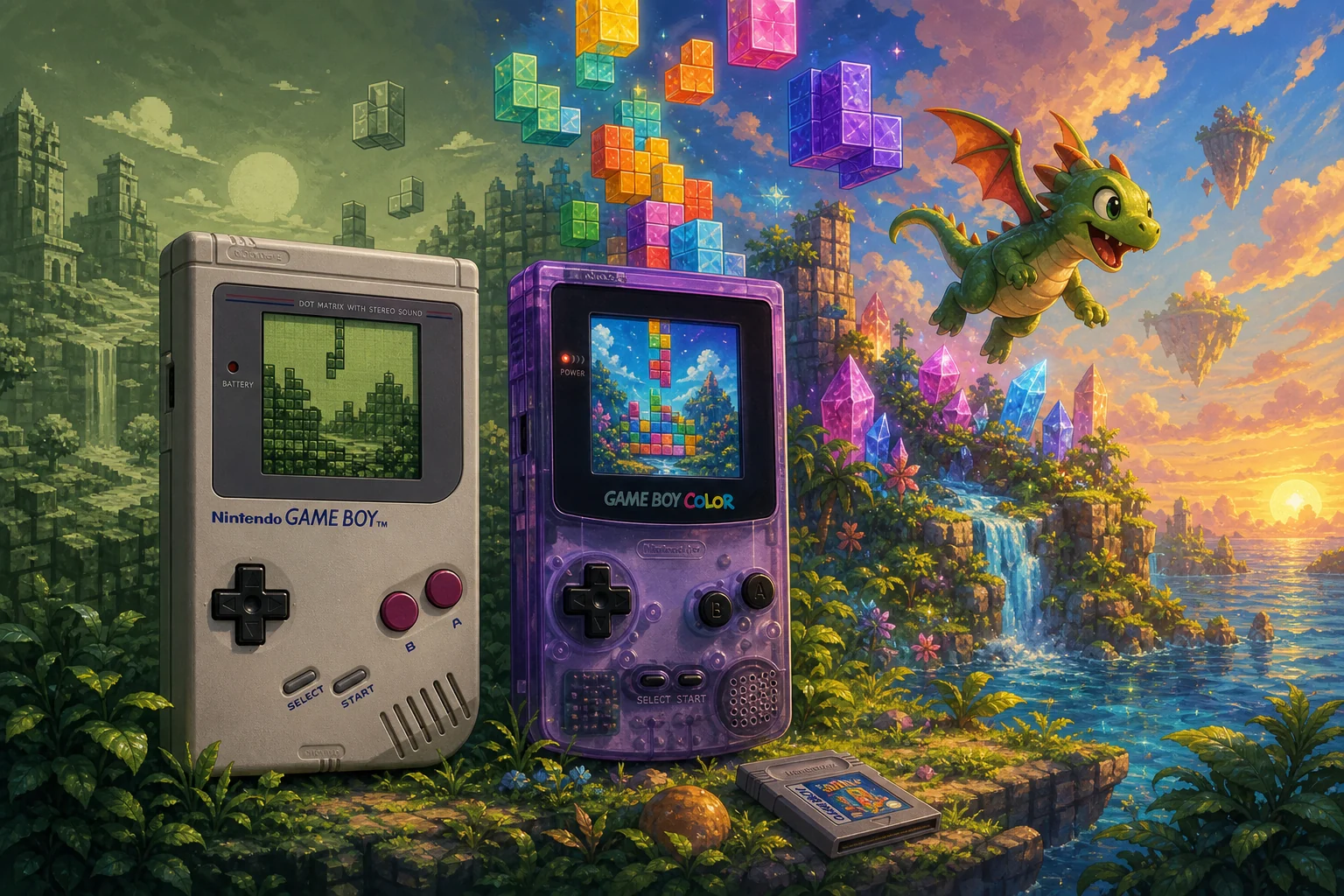
The most revealing place to begin a Game Boy modding history is not inside the gray plastic shell. It is at the edge of the machine, where a cartridge slides into a connector and becomes part of the computer. Nintendo’s handheld was designed around a small, tightly constrained system, but its cartridge bus gave outside hardware a close relationship with the system’s address and data buses. A cartridge could provide more program memory than the Game Boy could see at once, add save memory, keep time, drive a rumble motor or camera, and later imitate much of that behavior through rewritable hardware.
The distinction matters because “modding” describes several different activities. Replacing a DMG-01’s screen modifies the original console. A rewritable development or flash cartridge changes the cartridge-side memory functions without changing the handheld. A cheat device sits between the console and game cartridge and alters selected values while a program runs. A homebrew game is software intended to run on original Nintendo hardware, an aftermarket flash or development cartridge, a reproduction cartridge or an emulator. A factory-original Nintendo cartridge is not ordinarily a writable homebrew medium. These histories overlap, but they are not interchangeable, and the Game Boy’s architecture helps explain why they developed alongside one another.
A Small Computer With a Large Cartridge Problem
The original Game Boy, commonly called the DMG after its DMG-01 model designation, used a custom Sharp processor related to the Z80 family. Its address space was 16 bits wide, allowing the CPU to address 65,536 locations. That sounds generous until the machine’s map is divided among working RAM, video memory, hardware registers, input and display functions. The cartridge receives two important windows: a fixed 16-kilobyte region from $0000 to $3FFF and a second 16-kilobyte region from $4000 to $7FFF whose contents can change.
This arrangement is the foundation of the platform’s aftermarket history. A small game can fit into the visible cartridge space, but a larger one needs a way to exchange different portions of its ROM in and out of the switchable window. The device that handles this job is a Memory Bank Controller, or MBC. It is not an operating system and not a generic expansion processor. It is cartridge-side logic that watches writes on the Game Boy’s bus and interprets them as commands: select another ROM bank, enable external RAM or choose a RAM bank.
MBC1, the earliest widely documented family, illustrates the compromise. Depending on how the cartridge is wired and which mode is selected, some control bits expand the available ROM while others select external RAM banks. Later controllers support different capacities and features. The cartridge header records the type of hardware expected, along with ROM size, RAM size and other identifying information. A replacement cartridge therefore has to reproduce more than the game’s visible data. It must respond correctly when the CPU writes to addresses that appear to be inside ROM, because those writes are actually instructions to the cartridge controller.
That is why a Game Boy copier or development card was fundamentally unlike a later optical-disc modchip. It did not merely persuade the console to accept an unauthorized disc. It had to present cartridge-like memory behavior across the bus. If it supported saves, it also had to reproduce the relevant RAM-enable and bank-selection behavior. Compatibility depended on the mapper, memory capacity and wiring, not simply on whether a file carried a familiar extension.
The Logo at Power-On
Nintendo added a gate before any game could begin. Near the start of a cartridge image is a 48-byte Nintendo logo in the cartridge header. During startup, the Game Boy boot ROM reads that data, transforms or displays it as the familiar animation, and compares it with the representation expected by the boot process. The header also includes a small checksum covering part of the cartridge metadata.
Popular accounts sometimes call this encryption. That is inaccurate. The logo bytes are not concealed by a secret key, and the boot ROM is not conducting a cryptographic exchange with the cartridge. The checksum is arithmetic integrity checking, not encryption either. The mechanism is better understood as a visible logo-and-header test: a cartridge must expose the expected data and satisfy the startup checks before ordinary execution proceeds.
It was still a meaningful obstacle to unlicensed hardware. A malformed logo could stop a cartridge before its program ran, while a manufacturer seeking compatibility had to reproduce Nintendo’s expected header behavior. At the same time, the mechanism was not an unbreakable proof of authorization. A compatible cartridge could contain the expected bytes or arrange its memory response around the boot sequence. Nintendo had attached a brand and compatibility check to the cartridge interface, not created cryptographic authentication.
The Game Boy Color used a related but different boot routine. Its implementation buffered the cartridge logo and compared part of that buffered image, alongside checking the header checksum. The familiar startup presentation concealed meaningful changes beneath the screen; an account of the original DMG boot ROM cannot simply be applied to every later model.
Development Cards Before Modern Flash Carts
These technical constraints made the 1990s Game Boy development ecosystem distinctive. A developer working on original hardware needed a way to move a build from a computer to a cartridge-shaped device, run it on a handheld and preserve data between tests. Bung Enterprises’ GB Xchanger and Doctor GB Card are documented examples of that arrangement. The Xchanger connected to a computer through a 25-pin parallel-port connection, while the rewritable Doctor GB Card was marketed as emulating the ROM and SRAM functions of an ordinary Game Boy cartridge.
The Bung manual presents the products primarily as development equipment. It describes transferring data from a DOS computer, backing data up from the card and using later Windows utilities, while claiming compatibility with Game Boy, Game Boy Pocket and Game Boy Color systems. The same capabilities explain why retrospective accounts sometimes call such products copiers or backup units. Technically, the hardware could move and store cartridge images; historically, its documented developer positioning should not be confused with proof that every purchaser used it for the same purpose.
A September 1999 advertisement in Nuts & Volts shows the Xchanger and rewritable cards on sale by that point, with SRAM and support for several MBC standards among their advertised capabilities. For a hobbyist, this was a bridge between a computer project and a pocket-sized machine that could run it. The parallel cable, programming utility and development cartridge belonged to the same workbench.
Cheat Hardware Took a Different Route
Game Genie belonged to a different branch of the story. Rather than replacing the game’s storage, a cartridge-shaped accessory was placed between the handheld and the original game cartridge. Its codes instructed the device to alter selected values as the program ran. A replacement byte might change the number of lives, health or another game variable, while the original data remained stored on the inserted cartridge. That runtime intervention distinguishes a cheat accessory from a development card or copier, which stores and presents a program image.
The distinction matters when discussing Lewis Galoob Toys v. Nintendo. The litigation concerned the NES Game Genie, not a specific ruling about the Game Boy version. The Ninth Circuit described a device that intercepted a data byte sent from a cartridge to the CPU and temporarily replaced it, without changing the data stored in the cartridge. The court affirmed judgment rejecting Nintendo’s copyright claims as presented, and later proceedings recorded that the appellate judgment stood after further review was denied.
That outcome is narrow historical evidence, not a universal ruling about modification. It concerned temporary runtime alteration and the legal claims before the court. It did not decide the status of unauthorized ROM distribution, every flash cartridge or every form of reverse engineering. Copying a cartridge image and changing a value while an original game runs are technically different acts, even when both products appeared in the same enthusiast market.
Datel's Action Replay and GameShark-branded products occupied another part of the cheat-device market. Their capabilities varied across models and generations, so the familiar brand on the shell did not identify a single universal mechanism. The broader appeal was consistent: owners wanted to inspect or change how a game behaved, from experimenting with values to recovering from a difficult section. Cheat hardware made that sort of intervention accessible without requiring the owner to write a whole game.
The Color Generation Changed the Audience
By the time Nintendo released Game Boy Color in Japan on October 21, 1998, the unofficial scene had acquired a useful foundation. Developers, hobbyists and hardware sellers had learned that the cartridge connector was not a sealed doorway but a compact computer bus with room for memory controllers, battery-backed storage and specialist hardware. The arrival of CGB did not replace that culture; it gave it a second target.
The change was substantial even though the new handheld retained broad compatibility with earlier Game Boy software. CGB added a faster operating mode, additional work RAM, banked video RAM, color palettes and new hardware registers. A program’s intended target should therefore be described precisely: DMG-compatible software runs on the original monochrome hardware; dual-mode software can detect CGB hardware and use optional color or other CGB enhancements; CGB-only software requires CGB-capable hardware. The CGB flag helps identify intended compatibility, but does not prove that a program uses CGB features.
The distinction was visible in unofficial development as much as in commercial software. A program that behaved correctly on a DMG might expose timing assumptions on a CGB running at double speed. A game using the extra video-memory bank could not simply be evaluated as a monochrome title with decorative color added later. Homebrew authors had to decide which machine they were addressing, then make their cartridge header, banking arrangement and software behavior agree with that decision.
The Super Game Boy was a separate target. Its SNES cartridge contained Game Boy system circuitry and bridge hardware for video, controller input and special commands. Games could use that arrangement for borders, palettes and other presentation features, but it was not an early Game Boy Color. Supporting it meant addressing another specific set of capabilities rather than merely switching on CGB mode.
Documentation Became Infrastructure
Pan Docs began in 1995 and grew into a community-maintained technical reference. Memory maps, register descriptions and cartridge behavior accumulated in a place that developers, emulator authors and hardware designers could consult and correct. Knowledge that might otherwise remain scattered across individual experiments became reusable infrastructure.
Nintendo’s Game Boy Programming Manual described the machine from the perspective of an authorized developer, including programming considerations for the handheld and Super Game Boy. Pan Docs represented a different form of knowledge: community reverse engineering and practical observation. The two sources could complement one another, but they were not interchangeable. A community reference might explain a behavior Nintendo’s public manual barely mentioned, while Nintendo’s documentation remained the stronger authority for officially supported development targets.
Pan Docs also gave the cartridge scene a common vocabulary. Terms such as MBC1, MBC3, MBC5, external RAM, bank switching and CGB mode stopped being obscure details confined to individual experiments. They became concepts that could be discussed between programmers, emulator authors and hardware designers. That shared language helped turn isolated tinkering into an ecosystem. A person writing a small game, someone building a cartridge reader and someone implementing an emulator could reason about the same address ranges and control registers.
The technical reference did not make the hardware simple. It made the complexity legible. A cartridge still had to provide the right memory behavior, and a CGB program still had to contend with strict limits on tiles, sprites and working memory. But once those constraints were described in public, they became creative boundaries rather than exclusive knowledge. The Game Boy’s modest hardware encouraged compact experiments precisely because the machine’s rules could be studied and passed on.
Emulation Joined the Development Conversation
The scene eventually moved beyond physical cartridges. Emulators allowed developers to test code without repeatedly transferring it to a handheld, while giving researchers a way to inspect behavior that was difficult to observe directly. BGB became known as a Windows-centered Game Boy emulator and debugger, with tools that can expose registers, memory and execution state. It was not simply a way to play games on a desktop; it became part of the working environment for diagnosing crashes and timing problems.
SameBoy carries that development-oriented approach into a later open-source project. It supports multiple Game Boy-family models, debugging, battery saves, save states and real-time-clock emulation, alongside its own open boot-ROM implementations. Those boot routines are community code rather than redistributed Nintendo firmware. Model selection and inspection tools help a developer investigate behavior instead of simply watching a game fail.
Emulation changed what counted as evidence. A program that worked in one emulator was not automatically correct on a Nintendo handheld. Differences in LCD timing, audio behavior, interrupts, serial communication or cartridge state could remain hidden until the software reached original hardware. Conversely, hardware alone could make bugs difficult to isolate. A debugger could show a memory write or execution path that was almost impossible to identify from a flickering screen.
The practical result was a two-way relationship. Original systems remained important references for display response, sound, controls, link communication and cartridge power behavior. Emulators provided inspection, repeatability and model selection. Neither side replaced the other, and neither should be described as a perfect substitute for every preservation purpose.
Small Releases, Real Preservation
The homebrew record resists the idea that unofficial software was merely commercial copying in disguise. Independent authors made games, demos, music tools and technical showcases for original Game Boy hardware. The gbdev Homebrew Hub’s database uses distinct typetags including “game,” “homebrew,” “demo,” “hackrom” and “music,” a taxonomy that keeps original projects, demonstrations and fan modifications from collapsing into one category.
The gbdev ecosystem includes projects as varied as Geometrix, µCity, 2048-gb, GB303 and GBVideoPlayer. Games sit alongside experiments in graphics, sound and video. Their significance lies partly in their scale: a solo author can treat the Game Boy as a constrained design medium, building something around its limits rather than imitating a larger platform.
Legitimate preservation depends on permission as well as technical survival. An authorized-distribution collection can record creator approval for free release, while a commercial cartridge image or fan patch requires different treatment. A freely available file is not necessarily public domain, and “homebrew” is not a synonym for any unofficial image.
Physical cartridges add another layer. A homebrew cartridge can be a collectible edition, test medium or presentation format, but it is not necessarily the definitive form. A cartridge may fail, a battery may age and a reproduction board may not reproduce every hardware feature used by the software. Keeping source, build information and permissions alongside a playable release gives future researchers more ways to understand the work.
The Modern Game Boy Is a Stack, Not a Single Machine
Today’s Game Boy scene is best understood as a stack of related targets. The DMG-01, Game Boy Pocket, Game Boy Light and Game Boy Color are original Nintendo systems with different electrical and display characteristics. An aftermarket IPS screen changes one of those machines; an EverDrive or EZ Flash Junior changes the cartridge side; SameBoy and BGB reproduce the platform in software; Analogue Pocket and MiSTer use FPGA hardware; and a modern FPGBC is a replacement system assembled around programmable logic. All may be used to play the same homebrew, but they do not preserve the same physical experience or impose identical compatibility demands.
The New Toolchain Opens the Door Wider
Modern Game Boy development rests on complementary projects rather than one official replacement for Nintendo’s development environment. Pan Docs is a community-maintained technical reference describing memory maps, registers, cartridge controllers and model differences. RGBDS provides a Game Boy-specific assembler, linker, graphics converter and header-fixing workflow. Its tools expose the machine directly, but RGBDS is not itself a complete hardware specification; its documentation points developers toward references such as Pan Docs for that knowledge.
GBDK-2020 provides a C-oriented layer built around SDCC, with libraries, examples, banking support and utilities for producing images intended for real hardware or emulators. It lowers the first barrier without removing the need to understand banks, tiles and hardware limits. RGBDS gives an author precise control over code and data placement; GBDK makes it easier to prototype game logic and interface behavior. Both ultimately target the same limited processor, graphics system and cartridge arrangement.
GB Studio extends that accessibility further. Its visual workflow lets creators begin with scenes, actors and events instead of a blank assembly file. The project builds on a specialized engine and the GBDK ecosystem. Artists and designers can make an initial game without learning every register first, then investigate the underlying limits when a larger project demands it.
Modern tools also make reproducibility more plausible. A project can retain source, graphics assets, build configuration and metadata instead of preserving only a finished cartridge image. A playable file is an outcome; a documented build is a more durable explanation of how that outcome came to exist.
Flash Cartridges Reproduce Cartridge Behavior
Modern flash cartridges put large collections of development builds within easy reach. A menu and removable storage replace the repeated computer-to-cartridge programming cycle of older equipment. Behind that convenience, the cartridge still has to implement the banking and save behavior the program expects. Different products make different choices about which features to support.
The EZ Flash Junior manufacturer currently advertises compatibility with Game Boy, Game Boy Pocket, Game Boy Color and Game Boy Advance or Advance SP systems, along with support for MBC1, MBC2, MBC3, MBC5, MBC1M and MBC30 mapper types, real-time-clock functions, FAT32 cards and replaceable-battery hardware. Those are manufacturer specifications, not independent measurements. Firmware and kernel versions can affect behavior, including RTC handling, so the claims should remain attached to the named product and version context.
Krikzz's EverDrive GB family offers another established approach to that problem. Different models emphasize different feature sets, so a product name alone is not a complete specification. A developer may care most about quick testing; a player may prioritize save handling; a musician may need behavior suited to a particular sequencer. The useful comparison begins with the intended application rather than an abstract winner.
Saving Is Not the Same as Preserving
Battery-backed cartridge RAM creates one of the Game Boy’s most visible preservation problems. When the battery no longer maintains the memory, a save can vanish even though the program ROM remains readable. A cartridge with a real-time clock adds another dependency: timekeeping registers and save data may share a power strategy while still failing in different ways. The result is that “the game still works” is not a sufficient preservation test.
Emulator save states complicate the vocabulary further. A battery save represents the game’s intended persistent data. A save state captures a broader snapshot of the machine, potentially including CPU registers, working RAM, video state and timing position. MiSTer’s documented save states are core snapshots with implementation-specific limitations, not transparent archival equivalents of cartridge saves. SameBoy and other emulators likewise treat save states separately from battery-save and RTC support.
That difference is visible when moving progress between systems. A game's ordinary save can be portable in ways that an emulator's whole-machine snapshot is not. Keeping the two clearly named prevents a convenient resume file from being mistaken for the only copy of a long-running adventure. Clock-based games add a further reason to record what was exported: their passage of time may be stored separately from the player's progress.
Screens Change the Machine’s Visual Contract
The most visible modern modification is the replacement display. IPS, OLED and AMOLED kits can make a DMG, Pocket or Color dramatically easier to use, but they are not interchangeable upgrades. A kit may require a particular motherboard revision, ribbon cable, shell, front lens or power arrangement. Manufacturers such as FunnyPlaying and Hispeedido separate products for DMG, Pocket or Light, and CGB systems for good reason: the physical assemblies and electrical assumptions differ.
An IPS panel can offer brightness controls, integer scaling, simulated pixel grids, palette choices and a larger viewing area. An OLED panel changes contrast and black levels again. Those features are useful design choices, but they are not properties of Nintendo’s original picture pipeline. Frame blending or a “retro pixel” effect is signal processing performed by the replacement controller, not an exact restoration of the old passive-matrix LCD.
Power claims remain product specifications, not universal battery-life results. A manufacturer’s stated display wattage is not an independent runtime measurement. Runtime depends on the console’s condition, brightness, speaker use, cartridge behavior, battery chemistry and any charging or amplifier board added during the modification. A Pocket display kit cannot be assumed to behave like a DMG kit, and a CGB OLED installation cannot be generalized to every Color motherboard.
Audio and power modifications create their own choices. A speaker replacement addresses a different problem from an amplifier, and a charging board changes the power system rather than the graphics. A successful build depends on how those choices fit together inside an aging handheld. More new parts do not automatically make a better instrument or a more comfortable gaming machine.
FPGA Brings Accuracy Without Originality
FPGA systems occupy a useful middle ground and should be named accurately. FunnyPlaying’s FPGBC is a replacement console that uses programmable logic to simulate Game Boy hardware and accepts hardware cartridges, according to the manufacturer. The same product material warns that some non-original cartridges may not function properly and that some flash or burning cartridges are unsupported. It is therefore not a universal cartridge platform and not a DMG or CGB motherboard with a replacement screen.
Analogue Pocket likewise uses modern FPGA hardware while offering display modes modeled on Game Boy, Game Boy Color and Game Boy Advance presentation. MiSTer’s Game Boy core can provide DMG, CGB and Super Game Boy-related functions, RTC support, link-port support requiring the documented adapter configuration, and save states. Those snapshots should be understood as core- or emulator-style states with known implementation limitations, not as universally transparent archival formats.
These systems have different controllers, firmware, video paths, power systems and cartridge interfaces from Nintendo’s handhelds. “Hardware-accurate” describes an engineering goal, not an identity claim. A researcher studying original LCD response, cartridge electrical behavior, speaker output or battery aging needs original hardware. A developer investigating timing, taking repeatable snapshots or testing several model configurations may prefer an FPGA or emulator. Preservation improves when those roles remain complementary.
More Than Memory: Cartridges as Peripheral Platforms
The cartridge bus became historically important not only because it held larger ROMs, but because individual games could turn the cartridge into a specialized hardware product. Rumble cartridges added an actuator, camera cartridges added a sensor and image-processing path, and clock-equipped cartridges made elapsed time part of the software’s world. These were not interchangeable accessories on a universal expansion standard. Each design combined a particular controller, memory arrangement and peripheral with software written to expect it.
These unusual cartridges also offer creative targets for homebrew. A camera brings images from the real world into a tiny tile-based display. A clock makes the machine respond to time outside a play session. Rumble gives a small program a physical output. The connector's potential was broader than a place to store another level.
Little Sound Dj Turns the Handheld Into an Instrument
Little Sound Dj, usually shortened to LSDj, is a Game Boy music sequencer rather than a game. It works with the system's four sound channels and offers facilities including waveform synthesis, sample playback and synchronization. On original hardware it can run from a suitable reprogrammable cartridge; it is also usable through emulation. The project remains distributed by its creator with documentation for musicians who want to build complete pieces around the handheld's sound.
The musical attraction is almost the reverse of a hardware upgrade. Instead of concealing the machine's limitations, a composer makes them audible. A small number of voices forces decisions about which line carries the melody, where percussion belongs and how a sound changes over time. The recognizable electronic character becomes the reason to use the Game Boy rather than a defect to remove.
A sequencer also changes the meaning of the buttons and display. The D-pad becomes a way to edit a composition, and a pattern grid replaces a scrolling level. A device sold to play somebody else's work becomes a tool for making original work. That transformation is one of the clearest examples of homebrew's value: the hardware gains a use that has little to do with copying a commercial game.
For a musician, reliability can matter more than maximum brightness or a decorative shell. A performance tool needs dependable controls, predictable power and a setup that behaves consistently. The same modification fashionable in a gaming build may be less useful in a musical one. The scene's variety follows from people asking different things of the same small computer.
Nanoloop Builds a Different Musical Interface
Oliver Wittchow's Nanoloop offers another approach to Game Boy music. Nanoloop one is a sequencer and synthesizer cartridge using the original models' four-channel sound hardware. Its current cartridge design includes a mini-jack data connection for synchronization, file transfer and software updates. The familiar cartridge shape becomes a musical accessory with connections and behavior beyond those of an ordinary game.
Its importance alongside LSDj is that there is more than one way to make a limited machine creative. An interface can encourage patterns, repetition and experimentation without reproducing the workflow of a desktop music application. The small display is a design constraint, but it can also focus the player on a compact set of musical relationships.
This makes the Game Boy's unofficial history broader than a chronology of loaders. Two people can use the same console for very different ends: one wants an accurate platform for a new puzzle game, another wants a distinctive synthesizer. The cartridge bus and programmable software allow both. A thriving scene is visible not only in how many titles it can launch, but in how many kinds of activity it supports.
The Game Boy Camera Keeps Finding New Subjects
The Game Boy Camera provides a particularly playful meeting of old hardware and new software. Untoxa's Photo! project expands access to the camera sensor's parameters and improves aspects of the interface and printing workflow. It supplies Game Boy and Game Boy Color builds, with additional features depending on the target. Its hardware requirements include a suitable reflashable camera cartridge; it is not simply an application that gives a normal flash cartridge a camera.
The result invites a different kind of photography. With so little resolution and a tiny tonal range, a composition has to survive radical simplification. A face, a building or a cloud becomes an arrangement of large shapes and patterned pixels. Better control can help the photographer explore that character, rather than attempting to turn the device into a modern phone camera.
Photo!'s work also demonstrates why keeping an accessory alive can be more interesting than preserving only its original software. The physical sensor still sets hard limits, yet a different interface can expose choices that make it more useful. Homebrew does not have to pretend the hardware is contemporary. It can make an old device easier to explore on its own terms.
USB Readers Replace the Parallel-Port Workbench
Modern cartridge readers bring the development-card story forward into the USB era. InsideGadgets' GBxCart RW is one example, while Lesserkuma's FlashGBX software supports several reader and writer devices. Its documented functions include handling cartridge save data, reading program data, writing supported flash cartridges and extracting Game Boy Camera pictures. The computer-side program and the reader hardware perform different parts of the job.
This gives an old cartridge more than one path back into active use. A developer can move an original build to a compatible board, a photographer can retrieve pictures, and an owner can retain save data before it disappears with an aging battery. Those are distinct operations with different targets, even though the same desktop application may present them together.
The shift from the old parallel-port setup is practical as well as technological. Current operating systems and USB connections make it easier to fit the equipment into an ordinary workspace. Clear reporting and repeatable transfers matter because the reader is often being asked to handle something personally valuable: a photograph, a childhood save or a new game under development.
A careful record can make that work useful years later. Naming a file after its game is a start, but noting the cartridge revision, reader and date helps explain where it came from. A second read that matches the first is more informative than a single apparently successful progress bar. These habits connect the homebrew workbench with preservation without turning every hobbyist into a museum technician.
A New Game Can Begin With a Single Room
GB Studio's appeal is easiest to understand at the scale of a first project. A creator can draw a room, place a character and make an interaction happen. That small loop turns an idea into something playable quickly. The learning process can then expand toward animation, dialogue, music and transitions rather than beginning with every detail of the processor.
Accessible tools do not erase the platform's artistic demands. A background must remain readable on a small display. An important object needs to stand apart from nearby tiles. Dialogue has little space to waste. A scene that looks attractive in a large editor window may feel crowded on a handheld. Those constraints can improve a project by forcing its most important information to become clear.
They also make the Game Boy an appealing place for short, complete work. A small puzzle, a compact adventure or an interactive story can feel at home without competing with the scale of a modern commercial release. Finishing such a project teaches a different lesson from endlessly expanding an ambitious prototype: a limited machine rewards deliberate scope.
This is where the long history of documentation, programmers and cartridge hardware becomes visible to a new generation. A creator need not rebuild all of that infrastructure to use it. The first room on the screen rests on decades of shared tools, and the next finished game becomes another reason for somebody to keep a Game Boy close at hand.
A Living Platform With a Layered Past
The Game Boy remains fertile because its limits are concrete enough to study and its cartridge boundary is expressive enough to extend. Developers can make new work with modern tools, researchers can compare emulation against original machines, and preservationists can retain source, permissions, hardware context and executable builds together.
That history is not one story of a console being “unlocked.” It is the interaction of a visible startup check, a bank-switched cartridge bus, unofficial development hardware, runtime cheat devices, homebrew and carefully distinguished modern reproductions. Keeping those layers separate makes the platform’s survival more intelligible—and more honest.
Explore more modding histories
Compare these experiments with our original PlayStation modding history, original Xbox modchip and homebrew history and Dreamcast boot discs and homebrew story. Find more long reads in Editorial Spotlight and explore our game walkthrough library.