The Console That Kept Its Secrets in Two Places
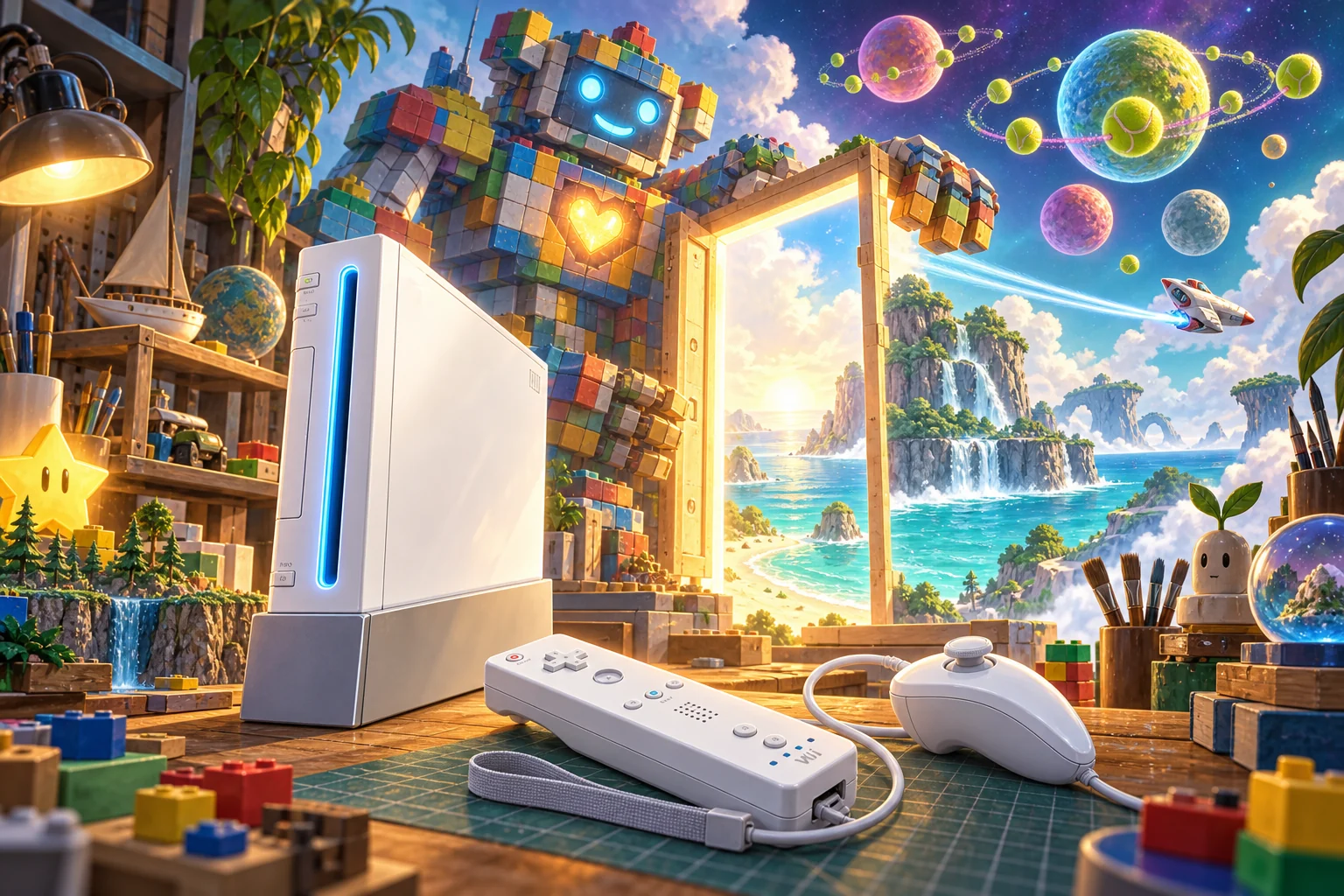
The Wii looked like a friendly white appliance, but its security model was divided between two processors that did not share the same job. On the front, the Broadway processor ran game code and the System Menu—the familiar interface of channels, settings and disc launching. Inside the Hollywood package, a separate ARM processor called Starlet handled the less visible services that made the machine function: storage, disc access, networking, USB devices and security checks. Nintendo called the software running on Starlet IOS, using the name for a family of system modules rather than one single operating system.
That split shaped almost every important event in the Wii’s modding history. A modification could interfere with the optical drive without changing the System Menu. A save-file exploit could obtain PowerPC code execution without granting control of the privileged IOS layer. A low-level recovery project could run before either of them. Calling all three things a “softmod” erases the very architecture that made the Wii such an interesting target.
The original console also carried an official feature that later discussions often confuse with modification: GameCube compatibility. The first retail Wii model, RVL-001, included controller ports and memory-card slots, and could run GameCube software through Nintendo’s own backward-compatibility design. That was not emulation in the modern sense and not an aftermarket hack. Later models made the distinction unavoidable. The RVL-101 Family Edition removed those physical interfaces and GameCube disc support, while the Wii mini, RVL-201, omitted the same compatibility. A Wii’s shell color or production folklore is a weaker guide than its model number.
A Chain of Trust, Not One Firmware File
The phrase “Wii firmware” is convenient but technically misleading. The visible System Menu was a PowerPC title running on Broadway. IOS versions ran on Starlet and supplied privileged services to that title and to games. Updating the menu could alter the interface, title-launch rules or save-file checks, while updating IOS could change the security environment beneath it. The two layers were related, but they were not interchangeable components of one monolithic firmware image.
The boot sequence added another distinction. Boot0, stored in read-only mask ROM inside Hollywood, loaded boot1 from NAND flash. Boot1 authenticated and loaded boot2; boot2 then loaded IOS and launched the System Menu or another title through the Wii’s title-launch process. NAND is the Wii’s persistent flash storage: it holds system software, saves and configuration data, but it is not simply an SD card hidden inside the machine. Damage to different parts of that chain had very different consequences.
Nintendo’s security model used cryptographic signatures to establish whether software had been authorized, while AES encryption protected important stored data. RSA signatures, certificates, console-specific secrets and boot-chain information all played distinct roles. There was no universal “Wii key” that opened every lock. Nintendo’s signing secrets were different from the keys associated with a particular console’s encrypted NAND, and a diagnostic key dump was not the same thing as possession of Nintendo’s private signing infrastructure.
The so-called Trucha, or fakesigning, bug was a flaw in early IOS signature validation, as described by contemporary reverse-engineering documentation rather than by Nintendo’s public terminology. The technical account concerns a mistaken comparison of binary signature or hash data, allowing specially constructed content to pass a check that should have required Nintendo authorization. That opening affected only the vulnerable validation paths; it was not a magical command to run arbitrary programs everywhere. Custom channels, patched system components and other experiments still depended on the particular IOS and title-launch circumstances involved. Nintendo subsequently closed relevant paths in stages.
The First Battle Happened at the Disc Drive
Before software exploits became approachable to ordinary Wii owners, the most visible modifications were hardware products installed around the optical drive. Wiinja, Wiikey and CycloWiz belonged to this early drivechip wave. These small boards interacted with the drive’s communication and authentication behavior, attempting to alter what the console accepted from an optical disc. They did not replace IOS, rewrite the System Menu or automatically create a homebrew launcher. Their position in the machine was narrower and more physical: they attacked the boundary between the drive and the rest of the console.
The product literature from the period advertised a mixture of region-related functions, direct boot behavior, upgrade options and support for homebrew or copied discs. Those advertisements document what manufacturers and sellers promised, not independent proof that every feature worked equally well. The market was also associated with piracy, particularly copied game discs, so its history needs to be described without turning period product claims into recommendations or reproducing material that would facilitate infringement.
Hardware revisions quickly made the idea of a universal Wii modchip untenable. Early products were associated with DMS, D2A and D2B drive families. Later consoles introduced D2C and subsequent revisions, changing the electrical and authentication environment. Products such as D2CKey, D2Pro, Argon and Wasabi emerged in a market increasingly divided by drive-controller family. A board designed around one generation could not simply be assumed to work in another because two consoles looked identical from the outside.
The exact ranking of the early products remains less secure than popular retrospectives suggest. Surviving reseller pages describe Wiinja as the first publicly released Wii drivechip, while later scene histories place Wiinja, CycloWiz and Wiikey among the prominent 2007 products. The available evidence does not establish every public launch date or prove claims that one product was definitively first or first to offer upgrades. It is more accurate to call them the first widely visible generation of Wii drivechips and to preserve uncertainty around their precise order.
The drivechip era nevertheless established an enduring pattern. Wii modification was not one problem but a series of trust boundaries. Hardware could influence disc authentication; software bugs could affect signature validation; later exploits could provide an entry point through a game or menu feature. Each route had its own requirements and limitations. The fact that some users employed a drivechip to launch a modified disc did not mean the chip itself had become a replacement operating system.
Team Twiizers Finds a Door in a Save File
The decisive change came when the route into Wii homebrew moved from a soldering iron to a game save. The Twilight Hack exploited the Wii version of The Legend of Zelda: Twilight Princess. A specially prepared save caused the game to load executable data from an SD card, creating a software-only route to code execution. Team Twiizers became the project name most closely associated with the exploit and the early Wii homebrew effort, although the surviving record does not justify inventing a single first hacker or reducing a collaborative project to one person.
The exploit’s importance was practical as much as technical. Opening a console and modifying a drive required hardware knowledge and, often, permanent alteration. A game-save entry point made experimentation accessible to people who owned the right game, a compatible system-menu revision and an SD card. Yet it was still only an entry point. Code execution inside a game did not automatically grant unrestricted control over Starlet, install a persistent channel or make every IOS version accept custom software.
That distinction explains why the signing bug mattered. The exploit could provide an initial foothold on the Broadway side, but installing or launching persistent software involved IOS and title-management rules. Researchers therefore had to understand both processors and the handoff between them. The Wii was not merely “running unsigned code”; it was being approached one layer at a time.
HackMii announced the first public Homebrew Channel version on May 24, 2008. Its release material distinguished Twilight Hack beta versions according to System Menu compatibility, showing that the exploit was never a universal key for every Wii. Nintendo’s support history dates Wii Menu 3.3 to June 17, 2008 and says that it checked for and removed unauthorized save-file modifications. HackMii’s technical report from June 16 additionally described changes to the IOS signing path and related exploit routes; that low-level account comes from reverse engineering, not Nintendo’s public update notice.
The response produced the first conspicuous cat-and-mouse cycle. Team Twiizers revised the exploit after Nintendo’s changes, while Nintendo’s public description remained focused on unauthorized save data rather than explaining the vulnerability. The update did not mean that every existing homebrew application stopped working. It changed particular routes into the system and particular validation behavior. Homebrew already launched through an independent channel was not the same problem as newly installing a fake-signed system title.
The Channel Becomes an Environment
The Homebrew Channel changed the Wii’s daily software experience by giving independently developed programs a recognizable place in the console’s interface. Instead of treating every experiment as a temporary demonstration launched from a particular game, users could browse applications arranged on removable storage and return to the System Menu when finished. The practical achievement was organizational: homebrew became something a household could revisit, update and explore over time.
Applications normally followed the channel’s expected directory conventions on SD or USB media, allowing developers to distribute a program with its executable, metadata and supporting files together. The channel could display application names and icons, making a collection of small utilities feel less like a laboratory file system and more like a console library. That presentation helped broaden the audience beyond people interested in exploit mechanics. A user might encounter a media player, game, emulator or diagnostic tool without needing to understand how the original entry point had worked.
The channel launched applications from removable storage through the Wii’s ordinary software environment. It did not, by itself, grant every program unrestricted access to NAND, USB devices, the disc drive or other privileged services. Applications needing broader capabilities depended on the IOS version and on any additional system components available to them. In practice, this meant that a program’s visible presence in the channel said little about the permissions it possessed after launch.
The channel also made failure and recovery more legible. Returning to the System Menu, restarting an application and organizing programs were ordinary interface actions rather than separate exploit procedures. Those conveniences did not amount to early-boot protection, however. A damaged System Menu, unsuitable IOS or failed installation could still prevent normal startup, which is why BootMii and later boot-time tools occupied a different part of the Wii’s modification history.
The result was a durable application environment rather than a replacement operating system. The Homebrew Channel did not erase Nintendo’s title system or turn the Wii into a general-purpose computer, but it gave developers a stable audience and gave users a consistent way to discover unofficial software. That shift helped move the scene’s center of gravity from proving that code could run to deciding what useful, creative or preservation-minded software should run next.
BootMii Reaches Earlier Than the Menu
BootMii addressed a different problem from the Homebrew Channel. Where the channel provided a user-facing launcher, BootMii aimed at low-level diagnostics, NAND backup and recovery. Its significance came from when it could run. A program launched through the System Menu depended on enough of the ordinary boot chain remaining healthy. A program installed in the boot2 position could execute earlier, before the System Menu and before normal IOS-dependent recovery paths.
That distinction produced two forms of BootMii. BootMii as boot2 replaced boot2’s ELF loader while preserving the original boot2 payload, allowing BootMii code to run before the System Menu on consoles whose boot1 accepted the modified boot2. The loader could also fall back to the original boot2 path. BootMii as IOS ran later, within the Wii’s ordinary software environment. It could still provide useful functionality, but it was launched through the normal chain and could not offer the same protection against a damaged System Menu or a failure that prevented IOS-launched software from starting. “BootMii installed” was therefore never a sufficient description of what a particular console could do.
Availability depended primarily on the boot1 generation inside the console, not simply on its displayed System Menu version or purchase date. Nintendo corrected boot1 in later production, closing the route needed for modified boot2 execution. Contemporary HackMii reporting offered estimates about how common the newer boot1 was among tested consoles, but those figures were samples rather than a universal manufacturing cutoff. Serial-number folklore and exterior appearance could not establish the boot-chain revision with certainty.
BootMii also brought the Wii’s cryptographic architecture into everyday discussion. Its tools could save console-specific key material and assist with NAND backups, but a file such as keys.bin was not Nintendo’s private signing key. It represented per-console information useful for understanding or restoring encrypted data. The distinction between diagnostic material, console secrets and Nintendo-controlled signing credentials was fundamental—and one reason the technical history cannot be reduced to the claim that someone simply “found the Wii’s keys.”
The IOS Problem Becomes the Real Problem
Early descriptions of Wii hacking often centered on Broadway because that was where visible game code ran. The harder engineering challenge was IOS. Starlet’s ARM-side software controlled services that ordinary applications could request but not freely redefine, including NAND access, disc operations, device communication and title management. A homebrew developer who could execute PowerPC code still had to work within the permissions and interfaces exposed by the IOS version underneath it.
This was the significance of the STM release exploit documented by HackMii in January 2010. STM was an IOS module responsible for functions including the power and reset buttons, fan control, the front-slot LED and idle or WiiConnect24 behavior. Its event-hook bug provided Starlet-side code execution. It was not principally a system-memory-management exploit. The episode showed how researchers had moved below the visible menu and toward the privileged ARM environment that sat beneath it.
The technical shift also explains why later compatibility reports became so specific. A program might run on one IOS and fail on another. An update could leave the System Menu looking familiar while changing the services available to applications. Conversely, an exploit might provide code execution without supplying the permissions needed for installation or recovery. The Wii therefore produced a vocabulary of IOS versions, title slots, signatures and runtime behavior that was unfamiliar to users who had approached modification through optical-drive hardware.
This work was collaborative rather than the product of one concealed master key. HackMii posts, reverse-engineering presentations and project repositories show overlapping contributions from people working under names such as marcan, bushing, segher and dhewg, alongside the wider Team Twiizers identity. Comex, giantpune and Fullmetal5 would later become associated with individual exploit projects, but their names should remain attached to documented work rather than being used to construct a single “first hacker” narrative. The public record supports a cumulative history of analysis, testing and repair.
The HackMii Installer Standardizes Deployment
As new entry points appeared, the Twilight Hack ceased to be the scene’s only prominent installation route, while the HackMii Installer remained useful as a common deployment layer. Its historical importance was organizational: it allowed changing exploit mechanisms to feed a familiar installation process without requiring developers to redefine the applications and recovery tools that followed.
That arrangement gave the Wii scene a degree of continuity. A save exploit, a malformed System Menu banner, a Message Board trigger or another entry point could differ substantially in its technical surface, yet the resulting user experience could converge on the same established software environment. The installer therefore acted as a bridge between short-lived vulnerabilities and longer-lived projects. It reduced the extent to which each new exploit had to become an entirely new ecosystem.
The installer also helped keep the Homebrew Channel and BootMii conceptually adjacent without making them identical. The Homebrew Channel served ordinary application launching; BootMii addressed diagnostics, NAND backup and, where the console’s boot1 permitted it, earlier execution. The installer could manage these components in a coordinated setting, but their different boot positions and recovery capabilities remained meaningful. A common installer did not make every Wii equally capable of early-boot recovery.
This standardization mattered as Nintendo’s updates changed the available routes into the system. When one exploit became incompatible with a newer menu or title revision, developers could concentrate on finding another entry point while preserving the surrounding application culture. The installer’s value was consequently less about a particular exploit than about decoupling entry-point research from the maintenance of the software users wanted to run afterward.
That decoupling also encouraged clearer project boundaries. An exploit author could focus on code execution; launcher developers could focus on application discovery and media handling; recovery developers could investigate boot timing and NAND behavior. The Wii’s homebrew history became cumulative rather than reset by every update. Its technical layers still depended on one another, but they no longer had to be reinvented as a single indivisible package.
Homebrew as Development, Not Just Access
Once the Homebrew Channel was available, the Wii became a practical target for software authors who had no relationship with Nintendo’s licensed development system. Independent application distribution let developers iterate in public: a utility could be revised, a demonstration could be expanded and an original game could acquire new features without requiring a new console modification for every release.
The range of work mattered. Some projects recreated familiar utilities; others explored graphics, sound, input devices and network functions. Developers treated the Wii Remote, Balance Board and other peripherals as programming interfaces rather than merely accessories for Nintendo’s commercial games. Emulators brought older computer and console software into a living-room setting, while original experiments tested what could be done with the Wii’s unusual combination of motion input, television output and modest hardware.
This environment also supported preservation-oriented work. A homebrew application could inspect a storage format, provide a modern interface for an older program or help researchers compare behavior across hardware revisions. Such projects did not need to defeat disc authentication or distribute commercial software. The same independent channel could host a game written from scratch, a translation tool, an accessibility aid or an emulator, with each project carrying different rights and preservation questions.
The release of the Twilight Hack source code on May 26, 2009 symbolized a movement toward reproducible research. Technically minded readers could examine how the save-file route worked rather than treating it as an unexplained artifact. Source publication did not make every exploit compatible with every console, nor did it remove the need to understand system revisions. Its value was educational and historical: a famous entry point became material that could be studied, compared and improved upon.
The development culture also separated legitimate homebrew from copied commercial media. The same software environment could host an original game, a utility, an emulator or a preservation tool, while other users employed related infrastructure with unauthorized game copies. The launcher itself does not determine the status of the material it starts. That distinction matters because the Wii’s most durable contribution was not merely that it exposed a security boundary; it gave independent creators a platform on which new software could continue to exist.
Nintendo’s Updates Create a Moving Target
Nintendo’s update strategy shaped the social rhythm of the scene. A system update could alter the System Menu, replace IOS modules or add checks against unauthorized channels and save data. In response, homebrew developers had to determine which parts of the existing environment still worked, which installation paths had closed and whether a new exploit was necessary. The result was not a clean sequence in which every Nintendo update destroyed everything that came before it. It was a shifting set of compatibilities.
The public documentation around Wii updates shows the difference between user-facing and reverse-engineered accounts. Nintendo’s notices explained what owners would experience, such as checks for unauthorized save data or channels. HackMii and other researchers documented the technical consequences for signing validation, exploit behavior and IOS compatibility. Those accounts served different purposes and should not be merged into a single claim about what Nintendo itself disclosed.
This pattern continued as the Wii matured. Researchers increasingly looked for vulnerabilities in applications that Nintendo had not designed as modification gateways, while Nintendo’s engineers hardened the paths that led from those applications to unauthorized titles. The contest was therefore less like a battle over one permanent “jailbreak” and more like repeated negotiation with a layered operating environment. A save parser, banner handler or system application could be the weak link at one moment, then become irrelevant after a software revision.
The industry response is best described through these documented technical changes rather than exaggerated claims about a single crackdown. Nintendo patched signing behavior, changed save-file handling and revised boot components. The homebrew community responded with revised launchers, new research and clearer separation between entry points and installed software. That exchange produced the Wii’s characteristic middle period: the machine was no longer defined only by drivechips, but it still had not become the mature software ecosystem later associated with loaders, game patching and online replacement services.
The Wii’s Second Life Begins After the Exploit
By the time the Wii’s original security contest had settled into a familiar vocabulary, the more consequential question had changed. The issue was no longer simply how to make code run. It was what a modified Wii should become once that possibility existed. Modern Wii software is best understood as a stack of specialized projects: boot-time utilities, custom IOS components, application launchers, compatibility layers, patching frameworks and replacement online services. They may appear together in a user’s menu, but they do not perform the same job and should not be treated as one package.
That distinction matters especially in preservation. A console can retain its original disc hardware, run fan-made software from removable storage, apply a translation while reading an untouched retail disc, or reproduce a discontinued online service. Those are different relationships with the original software. Some preserve the behavior of Nintendo’s hardware; others replace part of the software environment; still others create new experiences that never existed in the commercial release. The modern Wii scene is interesting precisely because it supports all of these approaches at once.
The Last Major Entry Points
After the Twilight Hack had become history, later exploits shifted attention toward ordinary Wii features that Nintendo never intended as homebrew launchers. Bannerbomb used malformed channel-banner handling in the System Menu and became an important bridge for consoles that no longer matched Twilight Hack requirements. Its compatibility was version-dependent: the original release covered System Menu versions through 4.1, a later variant targeted 4.2, and System Menu 4.3 blocked that route. The sequence demonstrates why a Wii update did not simply make homebrew impossible. It closed one doorway while researchers found another.
LetterBomb was publicly announced by HackMii on August 9, 2011, for System Menu 4.3. A message was constructed using information specific to the console, including its Wi-Fi MAC address, and delivered through the Wii Message Board’s normal message-handling system. The important historical change was not merely convenience. LetterBomb removed the requirement for an exploitable retail game at a time when many owners had already updated their consoles or no longer possessed the titles associated with earlier exploits.
LetterBomb’s history also resists a tidy invention myth. The contemporary announcement acknowledged that giantpune had developed a similar, unreleased exploit. Wilbrand subsequently occupied related territory but was documented as a distinct Message Board exploit family, with broader coverage reaching System Menu versions from 3.0 through 4.3. The two projects shared an application surface, not necessarily an identical implementation or development history. They should remain separate even when later guides present them beside one another as alternative entry points.
str2hax moved the trigger somewhere else entirely: the Wii’s End User License Agreement application, reached through a controlled DNS response. Its significance was architectural rather than theatrical. The exploit showed that a network-dependent system application could become an entry point without a game disc, an altered save or an SD-card message. It did not turn the Wii into a permanently exposed remote-execution device. The console still had to reach the relevant application, accept the altered response and operate within the limitations of the network being used. Networks that reject custom DNS behavior can prevent the route from functioning.
These projects are now primarily historical infrastructure. Their value lies in documenting how the community adapted to changing system software and in keeping aging hardware usable for legitimate homebrew. They should not be presented as interchangeable “softmod methods,” because their triggers, compatibility ranges and dependencies differ. In modern preservation work, that distinction helps owners choose an appropriate path without confusing an exploit with the applications installed afterward.
Priiloader and the Space Before the Menu
Priiloader occupies an unusual middle position in the modern Wii stack. It loads before the System Menu but after the earliest boot components, allowing it to redirect startup, launch selected titles and apply specific System Menu patches. Its practical importance grew because the Wii’s ordinary menu became a bottleneck for maintenance: a bad banner, an unwanted update prompt or a menu setting that no longer suited a preservation setup could all be handled before the familiar interface appeared.
The project’s own documentation is notably careful about its limits. Priiloader can help with certain user-level System Menu failures, but it cannot rescue a console whose System Menu IOS has been damaged. That boundary separates it from the earliest boot recovery capabilities discussed earlier. Calling Priiloader universal “brick protection” is therefore misleading. It is a boot-time launcher and patch framework, not an all-purpose substitute for a sound NAND backup or a functioning lower boot chain.
In current use, Priiloader is as much a quality-of-life tool as a recovery measure. It can provide direct access to homebrew, alter selected System Menu behavior and support a Wiimmfi-related patch. Region and update-blocking options are often discussed together, although most of its hacks affect the menu rather than individual games. The distinction is easy to miss when a single configuration screen presents them side by side. A menu patch is not automatically a game compatibility fix, and a service redirection is not the same thing as changing the console’s region.
The repository lists original Wii hardware, Wii U’s vWii environment and the Wii mini as supported targets, but hardware and environment differences mean that individual hacks and recovery behaviors do not map one-for-one from an original Wii. Features dependent on GameCube ports, particular boot arrangements or original-Wii system behavior may be unavailable or constrained on vWii and Wii mini. Those targets must therefore be treated as related but distinct environments.
Custom IOS Turns Storage Into a Platform
The loader era depended on a different kind of software component: custom IOS, usually abbreviated cIOS. A cIOS is a modified IOS title installed so applications can request services or device access that ordinary Nintendo modules do not provide in the same way. It is not a replacement operating system, and it is not a universal requirement for Wii homebrew. Its importance lies in supporting particular storage, compatibility and game-launch workflows.
The d2x project became a major reference point for this layer. Its documentation describes cIOS as a software foundation used by loaders and other applications that need services beyond the ordinary Nintendo environment. That description should not be generalized into a claim that every homebrew program depends on cIOS. Many applications can run through standard IOS services, while others require particular IOS behavior, storage access or title-launch support.
The distinction between an original Wii and Wii U’s vWii mode is especially important here. The two environments resemble one another from a user’s perspective, but their title layouts, system software and risks are not interchangeable. A cIOS arrangement documented for one target cannot be assumed to apply unchanged to the other. Modern project documentation therefore identifies the hardware or environment before discussing compatibility, installation or recovery behavior.
USB Loader GX and WiiFlow sit above cIOS as application front ends. Their repositories and release histories document project-reported work on SD and partition handling, video options, GameCube-loader integration, emulated-NAND behavior and compatibility fixes; those records do not establish universal compatibility across titles, consoles, storage devices or settings. A release note demonstrates that developers addressed a problem or added a feature in the project’s intended environment, not that every combination of hardware and software will behave identically.
These loaders also expose the Wii’s preservation tension. They can organize legally dumped personal media, launch original homebrew, support fan-made software and provide a convenient research environment for software no longer sold digitally. The same infrastructure has also been used to distribute unauthorized copies. The application’s ability to read storage does not decide the legal or historical status of the material placed there. A careful account can acknowledge that dual use without reducing the entire loader ecosystem to piracy or pretending that “backup loader” is automatically a preservation term.
Nintendont Preserves a Different Console Inside the Wii
Nintendont is an unofficial Wii homebrew loader and software reimplementation that runs GameCube software on Wii hardware and on Wii U’s vWii. It is not Dolphin running on a Wii, and it is not simply Nintendo’s original GameCube mode exposed through a new menu. Nintendont uses the Wii family’s hardware while implementing functions such as storage loading, memory-card emulation, controller support, video options and selected networking behavior. It should not be described as a general GameCube emulator in the Dolphin sense.
That distinction becomes especially important across Wii models. An original RVL-001 can read GameCube discs and accept the official GameCube controller and memory card through Nintendo’s physical interfaces. Nintendo’s official GameCube mode uses that backward-compatibility hardware path. A later RVL-101 or RVL-201 lacks those native interfaces and disc support. Nintendont can provide software alternatives for some of the missing functions, but that does not restore the original hardware experience or make those models natively GameCube-compatible. A USB controller, emulated memory card and software loader are replacements with their own compatibility boundaries.
The relationship with USB Loader GX or WiiFlow is therefore one of orchestration. A front end may present a GameCube title and pass launch settings onward, while Nintendont performs the compatibility work. Dolphin belongs to a different category: it emulates GameCube and Wii hardware on another host platform, with the host’s processor and graphics hardware carrying the emulation burden. Nintendont instead runs on the Wii family itself. The two projects may serve similar preservation goals, but they make different tradeoffs in accuracy, convenience, performance and hardware dependence.
For preservationists, those tradeoffs are meaningful. Native or near-native Wii execution retains the character of the original living-room machine, including its display paths and controller possibilities. Emulation on a modern computer can offer stronger debugging, higher resolutions and easier archival testing. Neither approach automatically supersedes the other. Nintendont preserves access through the original console ecosystem; Dolphin preserves a flexible, independently testable software representation. Treating them as rivals misses the fact that archives often need both.
Riivolution Keeps the Disc in the Conversation
Riivolution offers a notably different preservation model from storage-based loaders. It is an on-the-fly patching framework that redirects selected game files while a retail disc is running. An XML description tells the framework which files to replace and where to find the alternatives. The original disc remains the launch source, while translations, accessibility changes, bug fixes, texture work and new levels are supplied by the patch layer.
That arrangement matters because it avoids treating every modification as a rewritten game image. A fan translation or accessibility patch can be maintained as a separate project, with the original release preserved alongside the changes. If the patch is removed, the disc’s unmodified files remain available. The approach also makes experimentation easier: a creator can revise a replacement asset without rebuilding an entire disc image, provided the game’s file paths and runtime expectations remain compatible.
Reggie! Level Editor’s work with New Super Mario Bros. Wii provides a concrete example. Custom levels can be developed and loaded through Riivolution while the player uses an original disc. This turns the Wii from a closed commercial endpoint into a platform for new design, without confusing fan-made content with Nintendo-authored content. It is a useful model of preservation as continued use rather than mere storage.
Riivolution still has limits. A patch is tied to the game’s internal file structure, version and often region. Memory constraints, loading behavior and differences between disc releases can affect results. A patch that works against an original disc is not automatically valid for a converted image, and an XML configuration is not a universal mod manager. Its value comes from precise redirection, not from making every game freely interchangeable.
An Online Afterlife With Boundaries
Nintendo Wi-Fi Connection, the service used by many Wii and DS games, ended on May 20, 2014. That shutdown concerned the online functionality of games using that service; it did not mean that every Wii network-related service disappeared at the same moment. Wii services such as the Wii Shop Channel continued at that time under separate arrangements. Keeping those categories distinct prevents a broad shutdown date from being mistaken for the end of every Nintendo-operated Wii function.
Wiimmfi is best described as a replacement service ecosystem, not Nintendo’s original network restored and not a Nintendo-operated feature. It recreates enough of the expected service behavior for supported games, allowing parts of the Wii’s online history to remain playable after Nintendo Wi-Fi Connection disappeared.
Different Wii tools reach that replacement service through different layers. Priiloader can apply a System Menu-level Wiimmfi patch. USB Loader GX includes Wiimmfi-related launch behavior. Riivolution-based projects can combine online patches with custom content. These routes share an objective but are not technically identical. One acts before ordinary game launching, another within a loader, and another through file redirection. A working method for one title does not establish universal support for every game.
The service’s continued operation is historically significant because it preserves more than matchmaking. Depending on the title, online infrastructure can include rankings, downloadable data, profiles, chat or other game-specific services. Support remains title-dependent, and old account behavior can differ from the Nintendo era. It is therefore inaccurate to say that every Wii online function has returned. The more defensible claim is that a maintained community infrastructure keeps selected experiences available under new administration and new technical conditions.
This is preservation with an unavoidable layer of substitution. A museum can preserve a disc, a console and a network protocol, yet the original commercial service may still be gone. Wiimmfi does not erase that loss. It documents how communities reconstruct enough of a vanished system to make historical software meaningful again, while also creating a new social and technical context around it.
What the Modern Wii Actually Preserves
The modern Wii is not preserved by one magical installation or one definitive application. Its continued usefulness comes from the interaction of modest, specialized tools. Entry points make old hardware accessible to homebrew. Priiloader offers a layer of startup control. cIOS supports particular storage and loading workflows. USB Loader GX and WiiFlow organize applications and software. Nintendont extends GameCube access through a software compatibility layer. Riivolution lets original discs coexist with translations and new content. Wiimmfi demonstrates that an online game can have a community-maintained afterlife without regaining Nintendo’s original service.
Those layers also carry different risks and different historical meanings. A menu patch is not a bootloader. A front end is not a compatibility engine. A GameCube loader is not Dolphin. A replacement server is not Nintendo Network. A late Wii model that runs a software workaround is not physically equivalent to an RVL-001. Keeping those distinctions visible prevents the modern scene from becoming another vague story about “unlocking” a console.
The Wii’s most lasting achievement as a modding platform may therefore be less dramatic than its famous exploits. It became a durable meeting point between original hardware, unofficial software, fan development and preservation research. Some projects keep a disc playable; some make a discontinued service reachable; some provide new levels for an old game; and some simply give developers a place to experiment with controllers, graphics and sound. The result is not a replacement for Nintendo’s history, but a layered record of how that history can continue to be used.
A Wii sitting on a shelf is an artifact. A Wii still running original software, fan-made levels, accessibility patches or carefully maintained homebrew is also an active research object. Its preservation value lies in both conditions. The machine shows what Nintendo built, while its unofficial software records what later communities learned to add without pretending that additions and originals are the same thing. That tension—between fidelity and reinvention—is what gives the Wii’s modern modding history its final shape.
Explore more modding histories
Compare these experiments with our original PlayStation modding history, original Xbox modchip and homebrew history and Dreamcast boot discs and homebrew story. Find more long reads in Editorial Spotlight and explore our game walkthrough library.