The Cartridge Console That Invited Investigation
By the middle of the 1990s, backup hardware had become one of the most revealing ways to understand a console. A cartridge copier was not merely a dubious accessory sold through specialist advertisements. It was also a build-loading and testing aid, a storage system and, for technically minded owners, a window into the assumptions built into a machine’s software and bus. On the Nintendo 64, that window opened beneath the console rather than through a conventional top-loading cartridge adapter, helping create an aftermarket unlike the copier scenes surrounding Nintendo’s earlier systems.
The timing was significant. Nintendo launched the N64 in Japan on June 23, 1996, followed by its North American launch on September 29. The machine arrived with a reputation for powerful three-dimensional graphics, but its architecture was less immediately approachable than the cartridge systems that came before it. The central processor was a 64-bit NEC VR4300, while graphics and audio work were handled by the Reality Co-Processor. That co-processor contained the Reality Signal Processor, a programmable vector unit, and the Reality Display Processor, which rasterized and blended graphics into a framebuffer in RDRAM. The Video Interface then read that framebuffer to produce the display signal.
A more important distinction was where the machine kept its working data. The N64 did not separate a generous pool of general memory from a dedicated video memory bank in the familiar modern sense. Its four megabytes of RDRAM were shared by the CPU, the RSP and the RDP. Programs, geometry, audio data, textures, frame buffers and temporary working data all competed for the same volatile pool. The official Expansion Pak doubled that capacity to eight megabytes, but it was not a storage cartridge or a place to preserve software when the power was off. It was additional working memory, available only to games designed to use it.
That arrangement shaped both commercial games and unofficial hardware. A copier could supply a large ROM image, but it could not magically give the console more working memory. A development device might hold a program in internal DRAM or on a disc while the N64 still had to execute it within its ordinary four- or eight-megabyte environment. In other words, the size of a backup medium and the resources available to the running game were separate questions. The distinction was easy to miss in advertisements, where storage capacity sounded like the same thing as capability.
A Boot Sequence With Several Gatekeepers
Startup depended on code and security hardware in both the console and cartridge. The PIF is the console peripheral interface and contains its earliest boot code. The reverse-engineered boot sequence distinguishes IPL1 in PIF ROM, IPL2 copying the cartridge IPL3 into RSP data memory and requesting verification, and IPL3 running to initialize hardware and check the initial game-ROM region before transferring control. These stages are related, but they are not one checksum performed by one chip.
This matters because a cartridge image could be present and still fail before the game began. The checks were not all testing the same bytes for the same reason, and later software could perform additional checks of its own. Describing the system as having “a checksum” makes a complicated chain sound like a single password. It is more accurate to think of the boot process as a conversation among the console’s PIF, the cartridge’s CIC security device and the boot code contained in the game image.
The CIC was the cartridge-side participant in that conversation. Different CIC-NUS families supplied different boot parameters and challenge-response behavior, while the PIF handled the console-side logic. The 6102 and 6105 families are especially important in the historical record, but neither should be treated as a universal label for every N64 security behavior. Later reverse engineering has shown that games including Jet Force Gemini and Banjo-Tooie used additional checks associated with the 6105 family. Those findings demonstrate that passing the initial start-up exchange did not necessarily guarantee that a device would behave correctly later in the game.
That layered design explains why unofficial hardware became increasingly conditional. A device might imitate an expected cartridge security family well enough to begin loading software, yet encounter a failure when the game asked for a later response. Community researchers have documented those behaviors after the fact, but they are analyses rather than Nintendo’s own terminology. The historical point is broader than any particular challenge: N64 compatibility depended on timing, boot code, cartridge behavior and game-specific assumptions, not simply on whether a copier had enough memory to contain a ROM image.
Regions Were Mechanical, Electrical and Software Differences
The cartridge shell was the most visible regional barrier. Keying and molding differed between major markets, making some cartridges physically awkward or impossible to insert into a console without an adapter or alteration. But the plastic was only the outer layer of the problem. NTSC and PAL systems used different video timing, and their cartridge and PIF arrangements belonged to related but distinct regional families. The 61xx designations are associated primarily with NTSC material, while PAL systems used corresponding 71xx variants.
The N64 therefore did not have a single replaceable “region chip” in the later, simpler sense. The console’s PIF, the cartridge CIC, the IPL boot code, the video standard and the game’s own expectations could all matter. A cartridge that physically fitted might still meet a boot or timing incompatibility. Conversely, a device that handled one part of the regional problem did not automatically make every Japanese, North American and European title interchangeable.
This is why the N64’s aftermarket modifications should not be explained using assumptions borrowed from PlayStation modding. The relevant boundaries were distributed across the console and cartridge. A region solution could involve mechanical accommodation, cartridge-side behavior, console-side behavior or some combination, with different consequences for the original hardware. The machine’s architecture made the distinction technically meaningful rather than merely inconvenient.
Three Copiers, Three Physical Ideas
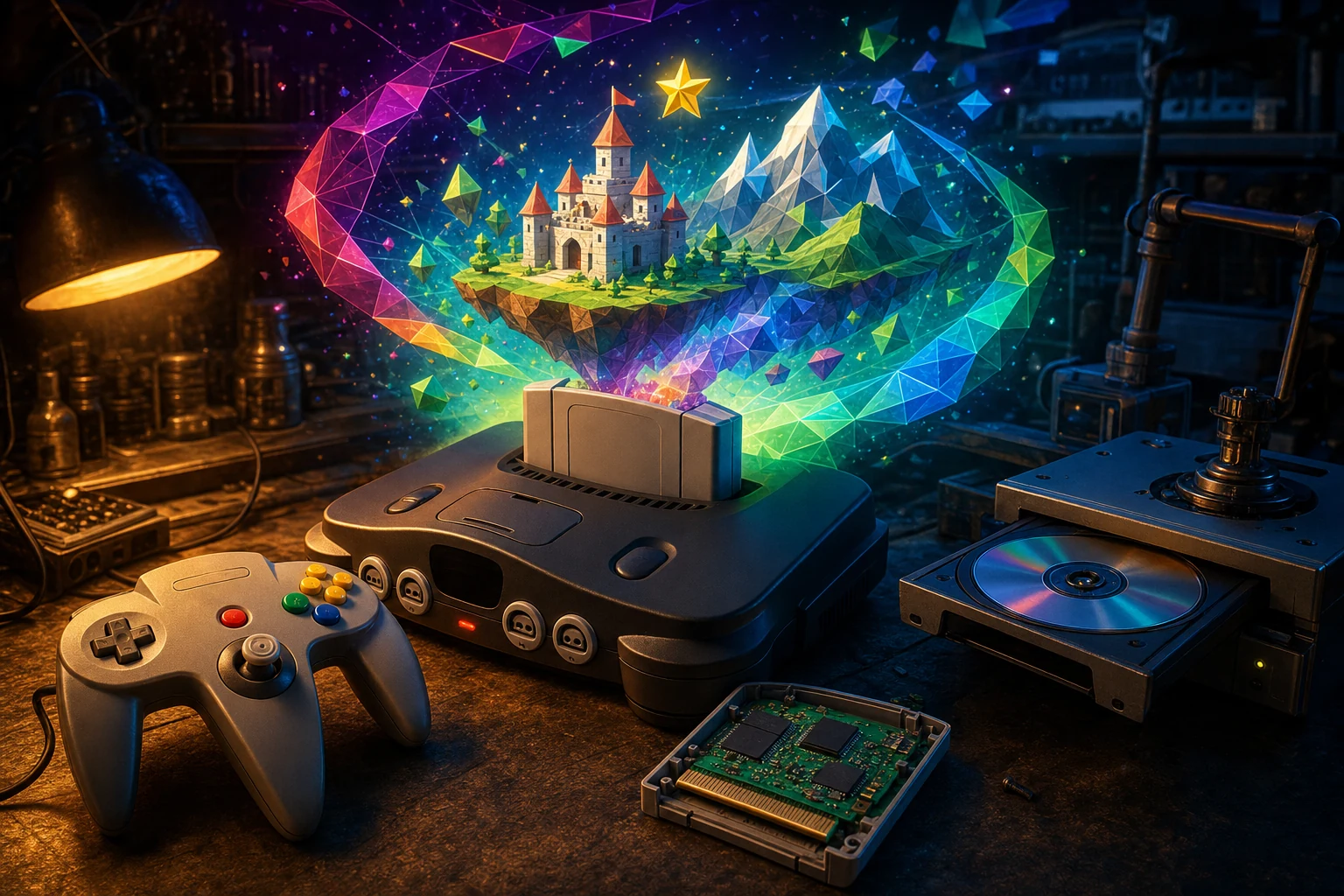
Bung Enterprises’ Doctor V64 made the most striking use of the N64’s underside expansion connector. The unit sat beneath the console and used that path to reach the cartridge bus, while its own CD drive, internal DRAM and computer interface provided a way to store and load software. The design looked less like a replacement cartridge than a second layer beneath the console: the N64 remained on top, and the V64 supplied the storage and emulation functions below it. Its manual presented development and authorized software work as an intended use, even though the same capabilities plainly made it useful for copying and playing unauthorized games.
The V64’s physical arrangement also exposed a technical limitation. Access to the cartridge bus did not eliminate the need for the console and cartridge-side security functions to agree during startup. Exact behavior varied across revisions and accessories, so it is misleading to describe every Doctor V64 as having one fixed wiring arrangement or identical compatibility. The later Doctor V64 Jr. belonged to the same broad family in a smaller, cheaper form, but a definitive launch date is not established by the primary material presently available.
Harrison Electronics’ Mr. Backup Z64 took a visibly different approach. Instead of hanging underneath the console, it occupied the normal cartridge slot from above and offered its own cartridge pass-through. Its Zip drive and LCD gave it the appearance of a self-contained computer peripheral, with cartridge management and backup functions built into the top-mounted enclosure. That arrangement simplified the visual relationship between the copier and the console, but it also meant the Z64 became part of the ordinary cartridge path rather than an accessory attached through the underside connector.
The CD64 represented another CD-based family. It occupied the same general position beneath the console as the Doctor V64, using the underside expansion route for unofficial cartridge-emulation and development functions, but it was not a Doctor V64 in a different shell. Surviving evidence is stronger for its general purpose than for every detail of its corporate chronology, so precise claims about its manufacturer and first availability require care. The important distinction is physical and historical: the CD64 was an aftermarket copier or development accessory, not Nintendo’s 64DD drive.
That distinction matters because the 64DD used the same general underside location for an entirely different reason. Nintendo’s authorized peripheral used proprietary magnetic disks, a writable area, a non-writable ROM area and a real-time clock. Its disks were not CDs, and its software model was not an unofficial extension of the copier market. Nintendo documentation gives a disk capacity of approximately 64.45 megabytes, with about 38.44 megabytes writable, while the required Expansion Pak brought the console to eight megabytes of RDRAM. The 64DD expanded Nintendo’s approved storage and software model; a V64 or CD64 created an unofficial route into cartridge-based loading.
The contrast also clarifies the role of RAM. Doctor V64 internal DRAM, Z64 storage and 64DD disk capacity concerned how data could be held or delivered. None of those figures replaced the N64’s shared RDRAM pool. The Expansion Pak’s extra four megabytes could support larger frame buffers, higher-resolution modes or more demanding software, but it could not preserve a game image like a disk, cartridge ROM or Zip disk. On this machine, “more storage” and “more memory” described different engineering problems.
Developers, Owners and Nintendo’s Courtroom Response
For developers, this overlapping hardware could be genuinely useful. A small studio could transfer builds, test software on an original console and avoid the expense or scarcity of official development equipment. The N64’s programming manuals had already made the R4300, RSP, RDP, memory system and task model legible to licensed developers. Unofficial hardware extended that practical access beyond Nintendo’s formal development environment. It did not make the devices equivalent to an official development station, but it offered a cheaper route to experimentation and testing.
For owners, the same functions had another obvious attraction: a copied game could be stored on a disc or removable medium and loaded through the console. That dual-use quality is central to the history. The hardware was not invented solely for piracy, nor was its development framing enough to erase the way it was marketed and used. A Doctor V64 in the hands of a legitimate programmer, a copier used for preservation and a device used to distribute unauthorized commercial software could be physically identical while belonging to different practices.
Nintendo’s lawsuit against Bung provides the clearest documented legal outcome for this period. Nintendo of America sued Bung Enterprises in federal court in 1997 over the manufacture, marketing, sale and distribution of video-game copying devices. The litigation concerned the broader Bung product family, including the Doctor V64, rather than a dispute over one individual owner’s use of a machine. Contemporary public reporting confirms the filing, while the later court record supplies the more important procedural detail.
The United States case ended in a default judgment rather than a contested trial verdict establishing every allegation after a full merits hearing. The judgment awarded Nintendo $7,480,980, plus interest and costs, and included an injunction. The subsequent Hong Kong proceedings recognized and enforced that U.S. judgment. The Hong Kong judgment records an earlier attempt to set aside the default subject to conditions, followed by a later judgment after those conditions were not met. That sequence is more precise than the simplified claim that Nintendo merely “won a piracy lawsuit.”
The records establish litigation, injunction, default judgment and enforcement. They do not establish a negotiated settlement terminating the case, so the outcome should not be described as one. Nor should the Bung proceedings be merged casually with other contemporaneous disputes involving different companies. Nintendo’s response was aimed at the commercial copier ecosystem, while the technical story remained more complicated: the same exposed cartridge bus that enabled legitimate low-cost development also enabled mass duplication. That tension is what made the N64 backup scene historically important—and legally vulnerable—without making every device or every user identical.
Licensed Tools and the Reverse-Engineering Alternative
Nintendo’s official development environment addressed the N64 from the inside out. Its manuals documented the VR4300 processor, the RSP and RDP task model, shared RDRAM, controller communication and the construction of cartridge images. Libraries such as libultra provided established interfaces for threads, audio, graphics, input and operating-system services, while tools such as makerom assembled the files expected by the console. Licensed developers also had supported loading and debugging hardware. Those tools belonged to the professional development environment rather than the aftermarket copier market.
That environment should not be conflated with a copier. An official development station could provide controlled loading, debugging and profiling as part of a commercial production pipeline. An unofficial device could offer some of the same practical benefits at lower cost, but its legal status, documentation and reliability were different. The overlap was real: both categories could place an experimental build on original hardware. Their intended users and relationships with Nintendo were not the same.
Reverse engineering proceeded along another route. Community researchers examined boot behavior, disassembled IPL stages, documented PIF and CIC interactions and tested how different cartridges responded under unusual conditions. This work was not simply a cheaper version of Nintendo’s official SDK. It attempted to reconstruct behavior that Nintendo had supplied as part of a proprietary development system. The resulting knowledge made new tools possible, but it also left uncertainty around undocumented hardware quirks and revision-specific behavior.
The modern distinction is visible in the 64drive, EverDrive and open-hardware cartridge families. A development-oriented device such as the 64drive treats rapid host transfer, debug communication and target-side interaction as central features. A consumer flashcart emphasizes storage, selection and broad software deployment. An EverDrive can be useful for testing homebrew on an original console, but that does not automatically make it a substitute for a licensed debugger or a cartridge designed around continuous USB development. Transfer speed, save handling, reset behavior and diagnostic facilities all affect the workflow.
From Boot Replacements to Open Cartridges
The evolution from copier hardware to modern cartridges can be read as a shift in emphasis. Early devices made unofficial loading possible through optical discs, Zip disks or internal memory. Later projects made the cartridge itself programmable and increasingly transparent. The 64drive connected the console to a host computer as a development target. EverDrive made removable storage and save-device configuration convenient for owners and testers. SummerCart64 turned much of that functionality into an inspectable open-hardware platform.
UltraCIC belongs to this cartridge-side progression. It addresses the CIC function that an unofficial or development cartridge must provide when communicating with the console. UltraPIF, by contrast, is a console-side replacement project. It revisits the PIF-NUS, whose responsibilities extend beyond the cartridge security exchange to boot coordination, controller communication and related system behavior. Calling both projects “region mods” hides the difference in what is being replaced. One changes the cartridge’s answer; the other implements a console subsystem.
That distinction matters for preservation. A removable development cartridge leaves the original motherboard’s PIF in place and presents a new external device. A replacement PIF changes the console’s internal control boundary and may introduce new clock or region behavior. Neither approach should be assumed to reproduce every original timing condition. Region handling remains connected to video standards, boot arrangements and game assumptions, not merely to a menu setting.
Libdragon Opens the Development Door
The most consequential change in modern N64 development may be software rather than hardware. Nintendo’s original SDK exposed the machine through proprietary libraries and tools. Libdragon offers an openly maintained alternative built around modern GCC and Newlib, with interfaces for controllers, save memory, debugging, compression, graphics and an open boot path. Stable and preview branches can expose different APIs, so developers need to match their examples and libraries to the selected toolchain. It does not recreate Nintendo’s entire commercial development environment, nor does it remove the N64’s constraints. It makes those constraints accessible without requiring the original proprietary toolchain.
That difference changed who could attempt a serious project. A developer can compile a program, load it through a development cartridge, test it in an emulator and then run it on original hardware while retaining access to source code and build tools. The workflow resembles contemporary software development, but the target remains an unusual 1990s machine. Memory must still be divided among code, display lists, textures, audio and frame buffers. The RSP and RDP still require work to be organized in the forms they understand.
Tiny3D builds on that foundation by supplying a more approachable native 3D pipeline for libdragon. It is not a modern PC renderer transplanted unchanged onto the N64. It gives developers tools and abstractions for meshes, materials, scenes and related asset work while ultimately producing commands suited to the RSP and RDP environment. That middle layer matters because programming close to the hardware can be educational and powerful while still being too laborious for a complete game made by a small team.
The N64brew Game Jam projects show the result in concrete form. The 2024 collection assembled multiple minigames into one ROM and documented practical concerns such as runtime-loaded modules, asset organization, memory cleanup and ROM-space limits. Those are production problems: contributors had to make independent content coexist within one cartridge image and one shared memory environment. The 2025 AsteRisk project used libdragon and Tiny3D for a 3D game with music, multiple video modes and Rumble Pak support. Such projects are not merely demonstrations that a polygon can appear on screen; they are new software designed around the console’s real interfaces.
Portal64 offers a contrasting lesson. James Lambert’s ambitious demake demonstrated what a modern game concept could look like on original N64 hardware, but its reliance on Nintendo’s proprietary libraries became part of the project’s later distribution controversy. The technical achievement and the SDK problem were separate issues. A program can run convincingly on an N64 while still depending on software components that cannot be redistributed as freely as its creator would like. Libdragon’s importance is therefore practical as well as ideological: it gives new projects a more clearly shareable foundation.
Debugging Across Three Machines
Modern N64 development usually involves three testing environments: an emulator, an original console and a cartridge interface that connects the two worlds. Each reveals different failures. An emulator can offer rapid builds, repeatable states and inspection tools. Original hardware reveals real cartridge-bus timing, controller behavior, RDRAM behavior and the physical video path. A development cartridge supplies the bridge, moving a build to the console and, in some designs, returning debug information to the host computer.
This division makes emulator selection a technical decision rather than a popularity contest. A mature general-purpose emulator may run commercial games exceptionally well while mishandling a newly written program that uses a rarely exercised RSP, RDP or timing behavior. Libdragon’s documentation points developers toward Ares because it emphasizes accurate modeling of advanced system behavior. That recommendation does not make Ares the ideal choice for every player; it reflects the needs of developers testing software that may stress parts of the machine older games left quiet.
A bug found only on original hardware may involve a real timing assumption, a save-device difference, a cartridge implementation or a controller accessory. A bug found only in one emulator may expose an emulation gap instead. Testing on an EverDrive can establish that a program works through a common consumer cartridge, while testing through a 64drive or SummerCart64 may add host communication and debugging possibilities. None of these results automatically proves compatibility with every cartridge, save technology or region.
The same layered method applies to 64DD preservation and homebrew. A disk-oriented behavior may work in an emulator but fail with an actual drive. A program may fit in a development cartridge’s SDRAM yet exceed the working memory available to the console. A game may display correctly through an emulator while revealing different filtering or timing on an original video path. Debugging the N64 therefore means locating the failing boundary instead of treating “the N64” as one undifferentiated device.
An Open Cartridge for a Closed Bus
SummerCart64 represents one of the clearest changes in the modern N64 scene: the cartridge is no longer merely a storage product assembled by an opaque manufacturer. The project associated with Polprzewodnikowy publishes its hardware, firmware, software and documentation, allowing developers and preservationists to inspect how a contemporary cartridge presents memory and peripherals to the original console. Its openness does not make the cartridge identical to Nintendo’s own development equipment, but it turns the cartridge bus into something a community can study, modify and improve collectively.
The design combines several jobs that were once distributed across separate categories of hardware. Its SDRAM can present a program to the N64, while flash storage, SD access and USB provide ways to retain and transfer data. It also documents emulation for EEPROM, SRAM and FlashRAM save technologies, automatic save writeback, a real-time clock, a debug terminal and programmable CIC behavior. That collection makes SummerCart64 useful for homebrew iteration as well as preservation testing. The important change is not simply capacity. It is the ability to move between a computer, removable storage and original N64 hardware without treating the console as an impenetrable black box.
USB development is particularly significant. A traditional menu-driven flashcart is optimized around selecting an already prepared image. A development-oriented cartridge instead shortens the distance between a source-code change and a test on real hardware. Debug output can travel back to the host, and the cartridge can present the build without requiring a developer to repeatedly prepare physical media. That is closer to a modern development peripheral than to the optical copiers of the 1990s, even though both ultimately place software on the N64’s cartridge bus.
The project’s open status also makes its limitations easier to state. Published hardware and firmware can document intended behavior, but they cannot guarantee that every unusual commercial cartridge, obscure save arrangement or timing-sensitive program will behave exactly as it would on Nintendo hardware. Different cartridges may make different assumptions about bus timing, save commands, reset behavior or CIC responses. SummerCart64 is therefore best understood as an extensible implementation of the cartridge interface, not as a universal replacement for every development system and every original cartridge.
What “64DD Support” Actually Means
SummerCart64 implements cartridge-based 64DD emulation. Its documented controls cover disk images, direct IPL boot modes, disk state, drive-type selection and delivery of disk blocks through USB or SD storage. That is a concrete drive-emulation feature, not merely a way to place a large cartridge image in memory. The software sees an implementation of the disk environment while the physical data comes from modern storage.
It does not contain a magnetic-disk mechanism or read original 64DD media. Disk-image preservation and physical-disk preservation therefore remain different activities. Firmware, menu support, disk-image format and the selected mode also matter; support for a documented feature is not a promise that every undocumented timing detail has been reproduced.
Nintendo introduced the 64DD in Japan in 1999, alongside the Randnet service initiative. Its magnetic disks and the Expansion Pak solved different problems: disks retained software and writable data, while the Pak expanded volatile system memory. A disk-oriented program can still require the extra RDRAM when its storage is supplied through cartridge-based emulation. The modern cartridge changes how disk data arrives, rather than quietly increasing the original console’s working memory.
This gives the modern scene a useful bridge between rare hardware and accessible development. Researchers can compare an emulated disk environment with an original drive, test software against both and investigate differences. SummerCart64’s published interfaces make those experiments inspectable, while original disks and working drives retain evidence that a digital image alone cannot preserve.
Three Ways to Improve the Picture
Modern N64 video modifications solve different problems at different points in the signal chain. N64RGB, UltraHDMI, N64Digital and RetroGEM should therefore not be grouped together as interchangeable “HDMI mods.” Some recover or generate RGB from the console’s digital video data. Others process that data internally and output HDMI. Product families, board revisions and installation requirements vary, and the motherboard revision remains important because Nintendo did not use one identical video circuit across the entire N64 production run.
Tim Worthington is the documented creator associated with the original N64RGB work, which provides RGB output from the original console through additional video circuitry. Later open projects, including Rugby64 associated with wurthless elektroniks, address particular board families and video paths. These projects are concerned with the console’s signal conversion and output hardware. They do not replace the R4300 processor or the Reality Co-Processor, and they do not cause a game to render more geometry or texture detail.
The word “RGB” can also conceal several engineering differences. Some N64 revisions already expose a useful digital or analogue path that can be amplified or routed to a suitable cable. Other revisions require additional logic to reconstruct the desired signal. A board that accepts one installation method cannot be assumed to accept another. The result may be a cleaner, more compatible analogue feed, but the game’s framebuffer and Video Interface settings remain the source of the image.
UltraHDMI, developed by Retroactive, approaches the console as an internal digital-video processing target. Its documentation describes progressive and interlaced handling, scaling, configurable processing and display-oriented features such as scanline effects. Because the device works inside the console before the signal reaches a television, it can avoid some of the compromises associated with carrying the original analogue output through an external converter. It still processes the image the N64 produced. Scaling a low-resolution framebuffer into a sharp HDMI signal is not the same as making the game render at a higher internal resolution.
PixelFX’s N64Digital belongs to the same broad internal digital-video category, but it is a distinct product with its own hardware, installation constraints and feature history. It should not be presented as an UltraHDMI revision or as a generic name for every digital-output modification. RetroGEM is a later PixelFX product-family name within that company’s video-mod ecosystem; the exact capabilities and availability of a particular RetroGEM board depend on the documented model and revision. A product page can establish what a board is designed to do, but not necessarily that every similarly named kit remains available or compatible with every motherboard.
The practical boundary is straightforward. An internal digital board captures or processes the console’s existing video information. An external scaler receives the signal after it leaves the console. A software patch may alter a game’s field of view, framebuffer settings or texture assets. These are three different interventions. A sharper television image, reduced blur or integer scaling can make original graphics easier to see, but none should be described as a new high-resolution render unless the software and hardware genuinely produce one.
The Controller Is More Than Its Shell
The N64 controller’s analogue stick presents another preservation problem because its original sensing system is optical and mechanical. Movement operates a gear-driven mechanism in relation to optical sensors, rather than simply changing the resistance of a conventional pair of potentiometers. The stick’s feel therefore depends on the shape and wear of the bowl, gears, centering mechanism and optical parts. Looseness or inaccurate centering can result from mechanical wear, not just from an electronic component becoming noisy.
That architecture explains why replacement sticks are not automatically equivalent. A replacement may reproduce the original optical arrangement, use revised plastics, or translate a different sensor technology into the N64’s expected controller responses. Hall-effect and potentiometer-based alternatives can reduce particular forms of wear, but they may also change travel, centering, calibration and response curves. “New” does not necessarily mean “identical,” and a player’s preferred replacement can depend on whether the goal is original feel, durability, accuracy or accessibility.
The controller port is a Joybus connection, and that bus reaches more than the analogue stick. Controller Paks, Rumble Paks and other accessories communicate through the same general peripheral relationship. Projects such as usb64 exploit that boundary by allowing modern USB input and accessory behavior to be translated into the protocols expected by an N64. The console continues to believe it is communicating with a compatible controller or Pak; the adapter performs the interpretation.
This is different from emulating the whole console. A USB adapter does not reproduce the N64’s CPU, RSP, RDP or cartridge bus. It replaces or translates one peripheral endpoint. That distinction matters when judging compatibility. A modern controller may offer additional buttons or a different sensor, but the adapter must still convert its behavior into the limited reports that an original game understands. Likewise, rumble and memory-card functions need their own protocol handling rather than appearing automatically because a USB cable is present.
Preserving Saves at the Correct Boundary
Save preservation has also moved beyond the original battery-dependent assumptions. Cartridge saves and Controller Pak data are separate systems. A game may store progress in EEPROM, SRAM or FlashRAM on the cartridge, while a Controller Pak is an external Joybus peripheral with its own memory and retention behavior. A flashcart that emulates one category does not automatically preserve the other.
Modern cartridge projects can translate cartridge save operations into files on flash or SD storage, but the game still expects a particular memory protocol. EEPROM is not interchangeable with SRAM simply because both retain a small amount of data. FlashRAM has its own command and erase behavior. A successful save implementation must reproduce what the software expects before converting the resulting data into a modern persistent format.
Controller Pak replacements address a different failure point. The CPAK2040 project, associated with an RP2040-based design, uses nonvolatile flash-backed storage and can expose multiple virtual Pak images. FRAM modifications take another route by replacing battery-dependent volatile memory with ferroelectric RAM. Both approaches preserve the Joybus-facing role of the Controller Pak while changing how its contents survive power loss. They are not cartridge save fixes and should not be described as such. In CPAK2040 designs, working SRAM and persistent flash are separate: recent changes can be buffered before flash writeback. Removing power too soon can therefore lose recent data; nonvolatile storage does not mean every write is instantly durable.
This separation is valuable for ownership as well as preservation. A collector can keep an original cartridge visually and electrically intact while using a modern Pak to protect saved data. A developer can test a game’s cartridge save behavior on a flashcart while separately testing Controller Pak operations on original or replacement hardware. The N64’s “save system” is not one device, and modern replacements are most reliable when they respect those boundaries.
Original Console, FPGA Recreation or Emulator
Modern hardware gives owners several legitimate ways to experience and develop for the N64, but each option answers a different question. Original hardware preserves Nintendo’s actual motherboard, R4300, RCP, cartridge interface, controller ports and video path. It also preserves aging capacitors, worn connectors, regional differences and revision-specific behavior. An internal video board or a replacement Pak can improve usability without changing the fact that the console remains an original N64 at its core.
An emulator models the machine in software. It can provide rapid iteration, save states, debugging tools, flexible scaling and convenient controller mapping. Those advantages are particularly useful when developing with libdragon or investigating a new program. But an emulator’s behavior depends on its implementation. A highly compatible emulator may be excellent for commercial games while still missing an unusual timing interaction used by new homebrew. An accuracy-focused project such as Ares may reveal behavior that a faster emulator masks, while demanding more computing resources or offering fewer conveniences.
An FPGA recreation occupies another position. Analogue’s Analogue3D is presented as a new FPGA-based N64 platform with original-style controller connections, cartridge support and modern video output. It is not an upgraded N64 motherboard and should not be described as one. Its hardware implements a model of the platform in programmable logic. That can provide low-latency output and a carefully designed compatibility target, but it remains a separate implementation whose behavior should be evaluated on its own terms.
For development, the strongest workflow may involve all three. An emulator provides speed and repeatability. A flashcart or open development cartridge transfers the build to a real console. Original hardware exposes physical timing, controller behavior and video characteristics. An FPGA system can offer a convenient modern platform for comparison, but it cannot by itself establish how an original N64 behaves in every undocumented corner. Testing across implementations helps identify whether a failure belongs to the game, the cartridge, the emulator or the target hardware.
Ownership as an Active Practice
The modern N64 community treats ownership as more than possession of a working console. It includes preserving a cartridge’s save data, maintaining controllers, documenting motherboard revisions, sharing open hardware, building legitimate homebrew and keeping software usable as displays and computers change. Those activities are connected by the console’s interfaces, but they are not the same modification.
A video board may make a console easier to connect to a current television while leaving its rendering limits untouched. A Controller Pak replacement may protect saved games without altering the cartridge. SummerCart64 may make development and preservation more accessible without replacing the N64’s processor or turning a 64DD disk into an ordinary ROM. An emulator may make a library convenient to study while remaining distinct from an original console. Clear ownership culture depends on naming those differences rather than promising a single perfect upgrade.
The legacy of N64 modding is consequently broader than the old copier market. The cartridge bus that once supported questionable commercial devices now supports open development hardware. The Joybus that connected an unusual optical controller now supports preservation-oriented Paks and translated modern inputs. The video path that produced soft analogue images now feeds carefully engineered digital processors. And the proprietary development environment that limited access has been complemented by openly maintained tools and new games made for original hardware.
None of this removes the N64’s constraints. Its shared RDRAM is still limited, its graphics processors still demand specialized work, its boot and peripheral behavior still require care, and its controller remains unlike the simple pads of many other consoles. Modern projects are successful not because they erase those characteristics, but because they expose them clearly enough for owners and developers to work within them. The machine survives as both an artifact and an active platform because its boundaries have become understandable, testable and, in selected places, openly reimplemented.
More console modding histories
Follow the earlier generations in our original PlayStation modding history and PlayStation 2 homebrew and modchip history. Compare Sony’s evolving security with the original Xbox modding scene and the Dreamcast’s boot discs, homebrew and online revival. Find more long reads in Editorial Spotlight.
Continue the Nintendo series: NES Unlocked: The Lockout War, Disk Copiers and the Homebrew Revival · SNES Unlocked: Floppy-Disk Copiers, SuperCIC and the Flash-Cart Revolution.