Before the Modchip: How the Famicom and NES Became Two Different Hacking Problems
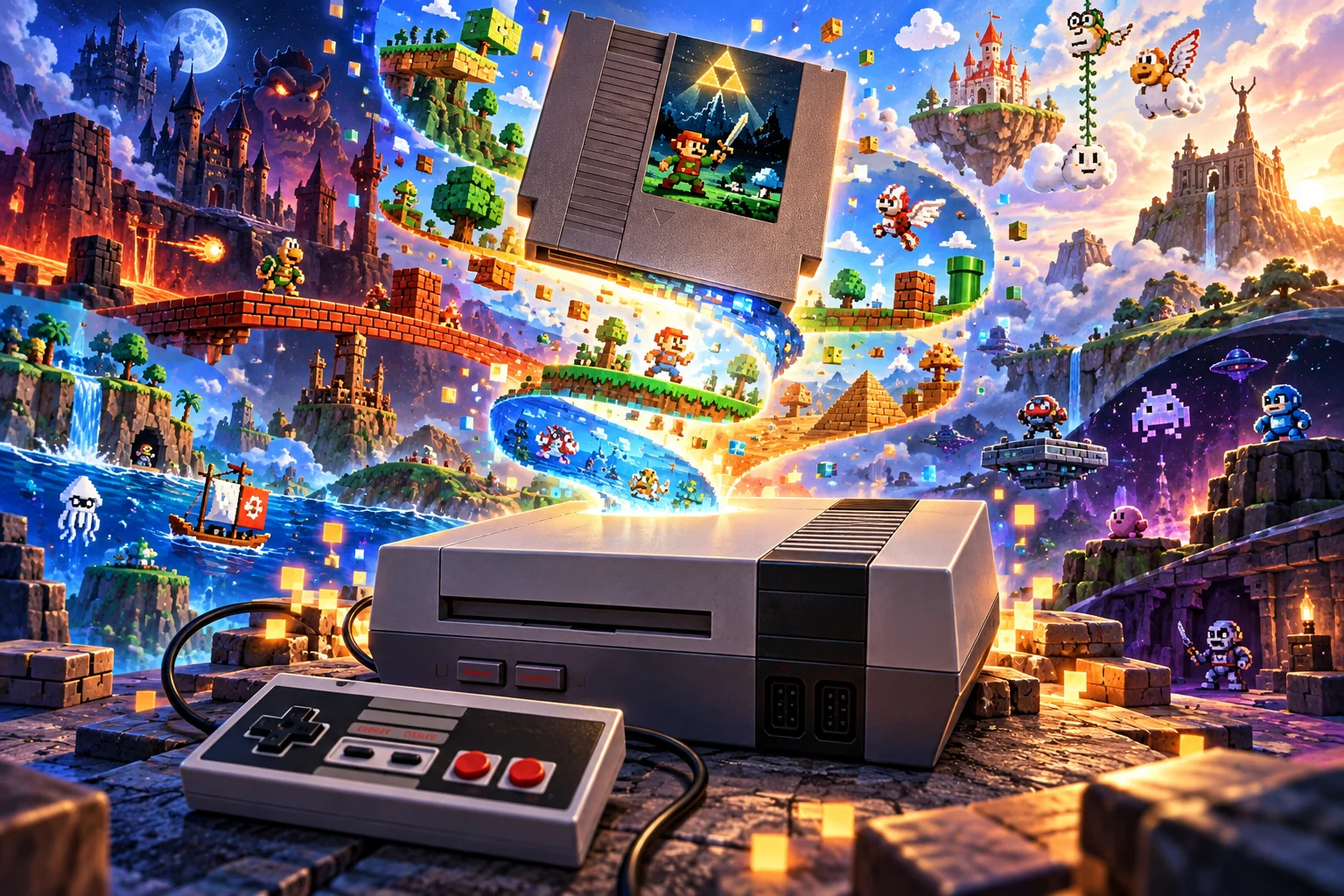
A cartridge clicks into place. The television fills with color, a title screen appears, and the machine seems to disappear behind the game. But the cartridge was never merely a container for software. In Nintendo’s eight-bit systems, it could supply memory, redirect addresses, generate interrupts, add sound, preserve saved games, and—on the American console—take part in a security handshake before the game was allowed to run.
The history of NES modification begins with a distinction that later retellings often flatten. Nintendo released the Family Computer, or Famicom, in Japan in July 1983. The American Nintendo Entertainment System followed in 1985 after Nintendo redesigned the case, changed the cartridge format, and added a lockout system absent from the original Japanese machine. Related hardware did not mean identical engineering problems.
For a Japanese Famicom owner, the central challenge was making a cartridge communicate correctly with the console’s buses. For the owner of an early American front-loader, there was an additional question: could the cartridge persuade the console that it belonged there? That difference shaped the careers of unlicensed publishers, the design of cartridge boards, and the courtroom history surrounding Nintendo’s attempt to control its platform.
One family, two cartridge ecosystems
The Famicom used a 60-pin cartridge interface. The American NES used a 72-pin Game Pak connector. The change was not simply a mechanical revision. The two interfaces exposed different signal arrangements and therefore different possibilities for cartridge designers.
The Japanese connector carried CPU and picture-processing signals, cartridge interrupt capability, and a two-way audio path. That audio connection allowed some Famicom cartridges to contribute additional sound channels to the console’s output. The ordinary American NES connector did not provide the same direct cartridge-audio route. A Famicom board with expansion sound could therefore fit inside an NES conversion cartridge and still fail to reproduce its extra channels without additional electrical work.
The NES connector also incorporated contacts associated with its security system and exposed expansion signals in a different arrangement. The NES had a bottom expansion connector; the original Famicom instead provided a 15-pin peripheral expansion port. On an NES-001, expansion contacts can be used to route additional cartridge audio with suitable wiring and mixing circuitry, but this is not the same automatic audio path offered by a Famicom cartridge slot. Adapters could translate enough of the important bus signals to make many games practical, but they did not make the machines electrically identical.
The physical connector added another complication. The Famicom used familiar 2.54-millimeter spacing, while the NES edge connector used a slightly narrower pitch. A Famicom-to-NES adapter consequently had to solve both mating and signal-assignment problems. The adapter found inside many converted cartridges was evidence of partial compatibility, not proof that every Japanese board could be transferred unchanged.
This is why a Famicom cartridge might work in an American console while losing its expansion audio, why some boards required extra wiring, and why Famicom-only cartridge families should not be casually described as ordinary NES cartridges. The machines shared a broad programming model, but they offered different electrical environments.
The computer inside the cartridge slot
The NES’s 2A03 processor combined a 6502-derived central processor with Nintendo’s audio processing unit. The picture-processing unit, or PPU, was a separate chip. That division is important: the CPU and PPU communicated through registers, but they did not share one flat pool of memory.
The console contained only a small amount of internal working RAM for the CPU and dedicated video RAM for the PPU. Background layouts were described by name tables, while graphic patterns normally came from character ROM or character RAM supplied by the cartridge. A basic cartridge could present fixed program and graphics memory. Larger or more ambitious games needed additional logic.
That logic is usually called a mapper. A mapper was not an emulator and not a replacement processor. It was circuitry on the cartridge that watched addresses and read or write signals, then selected which physical memory bank appeared at a particular CPU or PPU address. A write to a designated address might switch a program bank; another register might change the graphics bank or the way background memory was mirrored.
Early boards could accomplish this with counters, latches, and decoding logic. Later Nintendo Memory Management Controllers integrated more functions and added capabilities such as battery-backed RAM control, scanline interrupts, finer graphics banking, or extra sound channels. The program running on the console knew how to communicate with those cartridge registers because the board designer had assigned them particular addresses.
The distinction matters when describing early modification. Replacing a ROM chip, adding RAM, designing a new mapper, converting a cartridge board, and loading a program into a copier’s RAM were all different activities. They might all be described loosely as putting software on a cartridge, but they operated at different layers of the machine.
The PPU imposed its own constraints. A cartridge could use character RAM instead of character ROM, allowing the CPU to upload graphics during play, but that required suitable memory and timing. A large amount of program ROM did not automatically make a board suitable for a game. The graphics arrangement, bank-switching behavior, interrupts, save memory, and audio path could matter just as much.
That architecture made the cartridge a participant in the computer. It was storage in the simplest case, but it could also be a memory controller, graphics manager, interrupt source, sound generator, or battery-backed workspace. The earliest Famicom modification culture grew from understanding those roles rather than from defeating a single lock.
The disk system changes the meaning of removable software
Nintendo released the Family Computer Disk System in Japan on February 21, 1986. The authorized expansion consisted of a disk drive, a RAM Adapter plugged into the Famicom’s cartridge connector, and a cable linking the adapter to the drive. The arrangement changed the meaning of a game cartridge without turning the Famicom into a conventional home computer.
The FDS used modified QuickDisk media. The disk supplied data, while the RAM Adapter provided the working memory and interface through which the Famicom executed the software. Nintendo also operated retail Disk Writers that could rewrite certain disks, making the system an official example of removable and, within limits, replaceable software storage. The RAM Adapter supplied 32 KiB of program RAM and 8 KiB of character RAM, alongside the disk interface and additional sound hardware.
The disk system was not simply a cartridge with a floppy attached. Its RAM arrangement, controller, BIOS routines, loading behavior, and disk timing formed a specific platform. A cartridge using bank-switched ROM, battery memory, scanline interrupts, or expansion audio could not be reduced to the same architecture merely because both systems moved data into RAM.
The FDS also became a target for unofficial backup and copier hardware. Devices sold under names such as Game Doctor and Super Magic Card appeared in different forms, from RAM cartridges loaded by external media to adapters associated with other formats. Surviving documentation is uneven, and similar product names did not necessarily indicate a single manufacturer or a universal design.
Some of these devices were used for development or personal preservation; the same class of hardware could also duplicate commercial software. The historical distinction is worth preserving without turning the account into an installation guide. A copier moved the experimenter’s problem away from soldering a ROM to a cartridge board and toward managing a loader, disk format, RAM cartridge, and the mapper behaviors the device could reproduce.
Capacity was never the same as compatibility. A copier with enough storage might load a straightforward cartridge image but fail when software depended on a more elaborate mapper, battery-backed memory, unusual interrupts, or expansion audio. A large RAM cartridge could hold data without reproducing the hardware behavior that made the original board function.
The American NES adds a lock and key
Nintendo’s front-loading American console introduced the 10NES security arrangement, commonly identified by its CIC, or Checking Integrated Circuit. The control deck contained one part of the system and licensed cartridges contained a corresponding device. During startup, the two exchanged a proprietary signal sequence. If the exchange did not settle correctly, the console repeatedly reset instead of reaching a stable game state.
The CIC did not examine a game’s graphics, publisher, or copyright status. It authenticated a narrow electrical relationship between the console and cartridge. That was enough to make Nintendo’s licensing system part of the cartridge interface. A publisher could write a perfectly ordinary program and still face a separate hardware problem: getting the console to accept the board.
The familiar blinking screen is therefore an incomplete diagnosis. A failed security exchange can produce repeated resets, but so can poor cartridge contact, a damaged edge connector, reset-line trouble, clock or power faults, and other failures. The front-loader’s blinking behavior became associated with the CIC because of its purpose, not because every blinking console had the same defect.
The later NES-101 top-loader complicates the story. It retained the 72-pin NES cartridge format but omitted the front-loader’s CIC arrangement. In historical terms, the Japanese Famicom, the original American front-loader, and the top-loader are three related cartridge environments—not interchangeable examples of one security architecture.
Unlicensed developers and the road around Nintendo
American unlicensed publishers faced several choices. They could seek a Nintendo license, use a licensed cartridge as an electrical bridge, design circuitry that avoided the authentication behavior, or challenge Nintendo’s control in court. Color Dreams, Camerica, and Tengen are often grouped together as companies that simply “cracked the NES,” but their hardware strategies and commercial circumstances were not identical.
Color Dreams developed boards using discrete logic, bank switching, and circuitry intended to overcome the CIC problem without using Nintendo’s licensed cartridge key. The important historical point is that the lockout was an electrical and timing problem that could be addressed by cartridge design. Defeating the CIC did not automatically provide a mapper, expansion sound, or universal compatibility; it solved one layer of the problem.
Camerica and Codemasters pursued their own unlicensed products, including the Aladdin Deck Enhancer ecosystem. Surviving technical records describe countermeasure circuits associated with unlicensed boards, but they do not justify assigning one universal method to every Camerica cartridge. The commercial strategy, board design, and compatibility claims varied.
Nintendo’s control also operated outside the circuit board. Licensed manufacturing and retail relationships gave the company leverage over stores and consumers. An unlicensed cartridge could be electrically functional yet commercially difficult to distribute. The history was therefore an interaction between engineering, manufacturing, branding, and access to retail channels.
Tengen’s Rabbit and what the court decided
Atari Games’ Tengen subsidiary became the most famous American challenger to Nintendo’s lockout system. The legal chronology is more precise than the shorthand that Atari simply “cracked” the NES. Atari engineers studied 10NES chips in their lawful possession. The Federal Circuit recognized that reverse engineering object code to understand unprotected ideas and processes could qualify as fair use.
The problem was the source code. Tengen obtained a copy of the 10NES source code from the Copyright Office after its lawyers supplied false information to the Copyright Office to secure a copy. The court treated copying based on that source differently from the independent examination of chips. It concluded that the resulting Rabbit program contained similarities beyond what was necessary to accommodate the programming environment or embody the unprotected method of the security system.
The 1992 Federal Circuit decision in Atari Games Corp. v. Nintendo of America affirmed a preliminary injunction on a likelihood-of-success analysis; it was not a final trial judgment. It was therefore not a blanket ruling that all reverse engineering of a security chip was unlawful. Nor did it hold that every program communicating with 10NES necessarily infringed. The court separated lawful study of object code from copying tainted by improperly obtained source code and from copying protected expression beyond what interoperability required.
Rabbit became the commercial embodiment of that dispute. It allowed Tengen cartridges to operate with the NES without using Nintendo’s authorized cartridge key. The legal vulnerability arose not simply from the functional result, but from how the program had been obtained and what the court found in the implementation.
The case is often confused with Lewis Galoob Toys v. Nintendo, the separate Game Genie lawsuit. Game Genie was an accessory that temporarily altered data values while a game ran. The Ninth Circuit held in 1992 that the device did not infringe Nintendo’s copyrights under the facts before it, emphasizing that it did not permanently alter the cartridge or contain a fixed reproduction of the game’s audiovisual output.
Rabbit was a cartridge-side replacement for authentication behavior. Game Genie was a play-time alteration accessory. Neither decision created a general rule for copiers, multicarts, reproduction boards, or every other form of modification. Their importance lies in showing that different technical layers reached different legal conclusions.
Copiers, Disks, and the Limits of RAM
The FDS also provided a model that unofficial manufacturers could imitate or repurpose. During the late 1980s and early 1990s, Japanese-market copier devices appeared under names such as Game Doctor and Super Magic Card. Their documentation and hardware varied considerably, and similar product names did not always indicate a common manufacturer or identical design. Some units loaded software from disk into a RAM cartridge; others used formats related to, but not interchangeable with, Nintendo’s FDS format.
These devices are best understood as historical computer peripherals rather than as magical universal cartridges. A copier had to load data, organize it in memory, and present that memory to the Famicom in a form the program expected. A large advertised capacity described how much data the device could store, not how faithfully it reproduced every original cartridge board. The distinction became decisive as commercial games grew more sophisticated.
A simple cartridge might place fixed program ROM and graphics ROM on the bus. Larger games needed a mapper, meaning cartridge hardware that selected different physical memory banks in response to writes from the CPU. Some mappers switched 16-kilobyte or 8-kilobyte program regions independently. Others changed graphics banks, controlled nametable mirroring, supplied battery-backed RAM, or generated interrupts synchronized with the picture processor. A copier that could imitate only a straightforward bank-switching scheme could not automatically reproduce all of those behaviors.
RAM capacity created another limit. A copier might have enough memory to hold a game’s total data but lack the registers, address decoding, interrupt behavior, or graphics-bank logic required to run it. A cartridge using character RAM needed the CPU to upload graphics into that memory. A title relying on scanline interrupts needed more than a storage area. A board with additional audio required an electrical path and sound hardware that an ordinary RAM cartridge might not possess. In other words, copying bytes and reproducing a cartridge were separate engineering problems.
The same distinction applied to unofficial multicarts. A multicart could contain several small programs and switch between them with discrete logic or a custom controller. That did not make it a general development platform. Its fixed board layout, menu program, memory sizes, and bank registers determined what it could run. The history of these products is valuable precisely because it shows manufacturers adapting the cartridge bus to new purposes, not because it demonstrates that all Famicom software shared one interchangeable format.
Boards Before Silicon Became a Hobby Language
For experimenters, the cartridge board was the most accessible part of the machine. A board could contain ROM chips, RAM, counters, latches, address decoders, and, in more advanced designs, a Nintendo memory-management controller or another custom mapper. The console supplied the CPU and picture processor, but the cartridge could decide which program, graphics, or registers appeared at a given address.
This made early NES and Famicom experimentation feel closer to home-computer hardware hacking than to modern software modification. A hobbyist did not necessarily begin with a development kit or a public software interface. They studied pinouts, memory maps, timing diagrams, cartridge boards, service information, and whatever technical observations circulated among enthusiasts. The work might involve replacing a ROM, adapting a board for a different memory arrangement, or designing logic that exposed a new bank of data. Each project had to respect the original buses and electrical timing.
The wider era supplied useful conceptual neighbors. Commodore, Atari, Amstrad, and other home computers had accustomed a generation of users to floppy drives, memory expansions, cartridge ports, and software distributed outside a console manufacturer’s retail channel. Home computers were not identical to the Famicom or NES, but their culture made it less mysterious to regard a machine as a collection of buses and peripherals. Floppy disks were media, not software itself; memory could be expanded; and a program’s success depended on the hardware that loaded and presented it.
That perspective helps explain why copier history crossed paths with home-computer history without becoming the same thing. A disk image, a floppy format, a RAM loader, and a console cartridge each occupied different layers. One device might use a home-computer floppy drive to store console software, but the resulting system still needed console-specific loading code and cartridge behavior. The storage medium could be borrowed while the execution environment remained distinctly Famicom or NES.
The American NES added another obstacle to this otherwise legible bus. The front-loading console used the 10NES lock-and-key system, with a CIC in the control deck and a corresponding device in licensed cartridges. The Japanese Famicom did not have that same console-side lockout arrangement. Consequently, an American cartridge project had to consider both memory mapping and authentication behavior, while a Famicom project could focus more directly on the cartridge interface. The top-loading NES later removed the front-loader’s CIC arrangement, making it a related but separate environment rather than proof that all NES models behaved alike.
From Technical Notes to a Development Culture
Much of the modern understanding of these machines grew from shared technical documentation rather than from one decisive discovery. NESdev became an important meeting place for register descriptions, mapper notes, timing investigations, test programs, file-format explanations, and discussions of behavior that commercial manuals had never needed to explain publicly. Its value was cumulative: one person documented a bus detail, another tested it on hardware, and later developers used the result to build tools or correct an emulator.
The 6502-derived CPU, the separate PPU, the audio processing unit, controller ports, cartridge bus, and Famicom Disk System each required different knowledge. A developer writing a game had to understand that the CPU’s 2 kilobytes of internal work RAM were not the same as the PPU’s video memory, and that graphics data, nametables, palettes, sprites, and program code moved through different constraints. The machine could be programmed in C with tools such as cc65, but C did not remove those constraints. Linker configuration, memory placement, startup code, interrupt routines, and assembly were still part of serious development.
Open-source libraries made the knowledge more approachable. NES-specific support for cc65, together with libraries such as neslib, provided reusable routines for controller input, palettes, sprites, nametables, scrolling, sound, and bank selection. These tools did not transform the NES into a modern SDK-driven platform. They packaged difficult lessons into conventions so that a new developer could spend more time designing a game and less time rebuilding the same initialization code.
Higher-level environments broadened the audience further. NESmaker offered editors, modules, tutorials, and a workflow aimed at creators who might not begin with 6502 assembly or linker scripts. That approach involved tradeoffs: a framework could accelerate production while imposing assumptions about memory, graphics, and game structure. Yet the result belonged to the same development history. The original NES had always depended on specialized tools and teams with divided responsibilities; homebrew simply recreated that production culture with public software and much smaller groups.
Emulators as Laboratories
An emulator became more than a way to play an old game once it acquired a debugger. FCEUX, for example, can expose CPU registers, disassembly, memory, breakpoints, PPU state, and symbolic information. A developer can pause execution at a particular instruction, inspect why a sprite failed to appear, and determine whether the error lies in game logic, timing, memory placement, or an incorrect assumption about the hardware.
Mesen and Nintendulator represent related but distinct approaches to the same need. Detailed emulation can provide visibility into machine state, while accuracy-focused emulation can reveal whether a program depends on behavior that simpler software models overlook. This makes emulators laboratories for historical hardware. They allow rapid iteration, repeatable tests, and controlled comparisons that would be difficult to perform on a living console.
They are not, however, interchangeable with original hardware. An emulator may be forgiving about uninitialized memory, open-bus behavior, mapper timing, sprite limits, or audio mixing. Another emulator may model those details differently. A program can therefore appear correct in one environment and fail in another without either result immediately proving which implementation is wrong. File metadata matters as well: an iNES or NES 2.0 header describes the mapper and memory arrangement an image expects, but the header does not create the corresponding physical circuit.
This is why serious development moves between environments. The emulator is efficient for iteration and debugging. A hardware test can reveal timing, electrical, audio, peripheral, and mapper behavior that software models may simplify. The two methods complement one another. Neither should be treated as a universal authority detached from the other.
New Games Under Old Rules
Modern homebrew demonstrates what these accumulated tools made possible. Battle Kid: Fortress of Peril showed that a new commercial-style platform game could be designed for the NES long after Nintendo’s retail era had ended. Its significance is historical as much as technical: the console had become a viable target for original development rather than merely a platform for reproducing old software.
Morphcat Games’ Micro Mages offered a different demonstration. Designed from scratch for the NES, it supported up to four players and treated the platform’s limitations as part of its identity. Four-player support made the controller architecture, sprite budget, CPU scheduling, and adapter requirements visible to the player. The game’s compact cartridge target also reflected deliberate optimization rather than an assumption that modern storage would erase the machine’s limits.
These projects show why “homebrew” is a broader category than hobbyist assembly experiments. A developer may write low-level routines by hand, use C and established libraries, work inside a higher-level creation tool, or combine all three. The final result can still be an original game designed for the behavior of Nintendo’s hardware. Legitimate homebrew distribution also belongs to a different history from commercial copying: an author can release an original ROM with a physical cartridge or authorized digital sale without reproducing somebody else’s commercial software.
Testing on original hardware remains important because the NES is not just a graphics specification. A game may depend on exact CPU and PPU timing, the number of sprites visible on a scanline, the limited work available during vertical blanking, controller polling, mapper interrupts, cartridge audio, or save-memory behavior. An emulator can help identify a programming mistake, but only a physical target can fully expose the interaction among an original console, cartridge board, display chain, controllers, and regional timing.
That final test is especially important for new cartridges using unusual memory or mapper behavior. A game that works in a desktop debugger may encounter different reset states, bus behavior, audio routing, or peripheral timing on an actual Famicom or NES. Conversely, a physical failure can reveal a problem in the board or test setup rather than in the game itself. Good development therefore treats emulation, debugging, and original-hardware testing as separate instruments with overlapping responsibilities.
By this point, the NES was no longer merely a closed appliance with a licensed cartridge attached. Its history had produced a layered technical culture: official disk hardware, unofficial RAM loaders, mapper research, home-computer influence, open documentation, debuggers, compilers, libraries, and original new games. The important breakthrough was not one copier or one famous hacker. It was the gradual realization that the cartridge bus, memory map, video system, and timing rules were understandable enough to become a shared development language.
A Cartridge That Became a Programmable Platform
The modern flash cartridge is the clearest descendant of the NES’s original cartridge architecture. It does not merely store a large collection of software in one place. It must reproduce the behavior of many different cartridge boards, each with its own memory arrangement, bank-switching registers, interrupt behavior, save hardware, and sometimes additional sound circuitry. The challenge is not capacity alone. A device may contain enough flash memory for a large library and still lack the hardware needed to make a particular game behave correctly.
The RetroUSB PowerPak and the EverDrive N8 family combine programmable cartridge hardware, removable storage and menu software, but they are different designs. PowerPak uses CompactFlash cards; the N8 Pro uses microSD storage. Their firmware, mapper implementations and save features must be assessed separately. Their mapper support acts as a compatibility layer: when a game expects the behavior of a particular Nintendo or third-party board, the cartridge attempts to present an equivalent set of registers and memory responses. That makes these products programmable cartridge substitutes rather than universal NES replacements.
The distinction matters for both old software and new games. A title using a conventional fixed-memory board presents a relatively straightforward target. A game using MMC3-style bank switching, battery-backed RAM, scanline interrupts, or unusual expansion audio asks much more of the cartridge. Some behaviors can be modeled digitally; others depend on analog mixing, exact timing, or physical connections that differ between the Famicom and the American NES. Compatibility claims therefore mean little without identifying the mapper, memory type, region, audio requirements, and peripheral assumptions involved.
The PowerPak’s mapper updates and the EverDrive N8 Pro’s documented save and cartridge functions show how support has expanded over time, but neither product should be treated as a perfect substitute for every original board. Obscure mappers, unusual protection behavior, special audio, and edge cases in reset or save timing may remain incomplete or behave differently. This is not a failure of imagination. It is the unavoidable cost of translating a diverse collection of physical circuits into one reusable cartridge.
The Famicom Disk System Finds a Modern Storage Layer
The Family Computer Disk System presents a different problem because its software was designed around a RAM Adapter and a separate disk drive. The adapter plugs into the Famicom’s cartridge connector and supplies the memory and system interface; the drive provides the removable medium. A modern drive emulator can replace the drive’s storage and signaling role without replacing the complete FDS architecture.
FDSStick and FDSKey are useful examples of this distinction. They can present disk data from modern storage to an original RAM Adapter, allowing the Famicom to continue performing the parts of the system that belong to the console and adapter. They are not ordinary cartridges, and they are not automatically complete Famicom Disk System replacements. Their operation depends on the surrounding Famicom hardware, the RAM Adapter, the disk-system software environment, and the expected exchange between drive and adapter.
That arrangement also explains why FDS preservation cannot be reduced to copying files. Disk software may depend on writable save data, disk-side order, BIOS behavior, expansion audio, and the timing of the drive protocol. A software emulator or FPGA core can integrate these functions internally. A small physical drive emulator generally does not; it substitutes for one component in a chain.
The distinction is historically valuable because the FDS was an authorized Nintendo expansion, while later storage devices are modern preservation and convenience tools. Both use removable data, but they do not occupy the same place in the system. The original FDS made the Famicom a disk-based platform through a specific RAM and drive architecture. A contemporary accessory makes that architecture easier to keep alive without pretending that a microSD card is itself an FDS disk.
Rebuilding the Lockout Chip
The NES’s CIC adds another layer to modern replacement work. In a front-loading American NES, the console and cartridge exchange signals through related security devices before the machine settles into normal operation. A replacement must reproduce the relevant timing and regional behavior closely enough for the console and cartridge to recognize one another. It does not need to contain Nintendo’s original silicon, but it does need to behave as the expected electrical partner.
AVR-CIC projects demonstrate how an obsolete custom chip can be reimplemented on a readily available microcontroller. The preservation value is straightforward: if original CIC parts become scarce or fail, a documented replacement can reproduce the startup relationship without changing the game program. Such a device belongs to the category of aftermarket hardware replacement, not software emulation. The console still runs its original CPU, PPU, audio unit, and cartridge logic.
Ciclone represents a related replacement approach associated with RetroZone. The details of a replacement’s seed, regional target, and implementation matter, since “CIC replacement” is a functional description rather than a guarantee that every design is identical. The front-loader, top-loader, and Japanese Famicom also remain distinct environments. A top-loader omitted the front-loader’s same lockout arrangement, while the Famicom never used the American console’s CIC system in the first place.
This history is easy to flatten into the phrase “unlocking the NES,” but that wording hides the engineering boundary. Replacing or reproducing a CIC changes authentication behavior. It does not provide a mapper, add Famicom expansion audio, repair a damaged connector, or convert a cartridge into a disk system. Modern CIC work is best understood as preservation of one narrow electrical function.
Video Mods Preserve the Console Behind the Picture
NESRGB and Hi-Def NES address another weakness of aging original hardware: the video path. The original console was designed to generate a television signal suited to the displays of its era. Modern screens may handle that signal poorly, and years of use can leave analog components, connectors, and video circuitry outside their original performance.
NESRGB taps the original console’s video-generation path and supplies a cleaner RGB-oriented output. The game still runs on the original CPU and PPU. The cartridge still supplies its mapper and memory behavior. The modification changes how the picture is extracted and delivered, not the identity of the machine producing it. That makes NESRGB an aftermarket video modification rather than an emulator or replacement console.
Hi-Def NES takes a more extensive route, adding digital video output and processing around the original system. Even when a mod board contains substantial digital logic, the distinction remains important: the original console continues to execute the program and coordinate with the cartridge. A digital output board is not automatically an FPGA recreation of the NES.
Expansion audio makes this boundary especially visible. Famicom cartridges using VRC6, VRC7, Namco 163, MMC5, Sunsoft 5B, or other sound hardware depend on a cartridge-to-console audio path that ordinary American NES cartridges did not expose in the same way. A video modification alone cannot guarantee that those channels will be heard correctly. The cartridge, console wiring, mixer, and output circuit must all accommodate them. Likewise, a flash cartridge may reproduce a mapper’s banking while omitting or approximating its sound. Video, cartridge logic, and audio are separate preservation problems.
Controllers, Connectors, and the Quiet Work of Keeping a NES Alive
The most visible NES failures are not always the most interesting. Controllers, cartridge connectors, power circuits, and display outputs age together, but each belongs to a different layer of the machine. The controller is a serial input device with a simple protocol; a damaged button membrane, worn cable, or unreliable connector can make a perfectly healthy console appear to have a software problem. Four-player Famicom and NES arrangements add further differences in adapters, expansion connections, and game expectations.
The cartridge connector is both an electrical interface and a mechanical assembly. Repeated insertion can reduce contact reliability, while contamination, worn cartridge edges, damaged traces, or pressure from the front-loading mechanism can produce intermittent behavior. Replacing a connector may improve one failure mode without correcting a damaged board or unstable power circuit. A blinking screen is similarly not a universal diagnosis: poor contact, reset trouble, clock faults, power problems, and CIC behavior can produce overlapping symptoms.
Maintenance is therefore best treated as system assessment rather than a single ritual. The relevant questions are which regional motherboard is present, whether its regulated power is stable, whether the connector and cartridge edges are mechanically sound, whether the video path is healthy, and whether an accessory is asking the console to perform a function it was never designed to provide. North American NTSC systems, Japanese Famicoms, PAL machines, and Dendy-derived hardware differ in timing, video generation, connectors, and software assumptions.
The same caution applies to voltage. The external supply, internal regulation, cartridge signals, controller ports, and expansion interfaces are not one undifferentiated electrical system. A replacement part that tolerates a broad input range may still be inappropriate for a particular board revision. Good maintenance documentation identifies the machine, revision, signal, and measurement point instead of offering one universal value or one cure for every aging console.
OpenTendo and the FPGA Question
OpenTendo helps clarify what it means to reproduce an NES. It is an open hardware recreation of the front-loading motherboard, expressed through schematics, board files, manufacturing data, and a bill of materials. Its purpose is to make the original board architecture inspectable and reproducible, not to implement the NES inside programmable logic. The project supplies a PCB design rather than a complete populated console: suitable processing chips and the other board components are still needed. The project’s separation from NESRGB and Hi-Def NES is significant: video modifications can be added as separate choices rather than being confused with the motherboard itself.
An FPGA system takes a different route. Instead of placing original-style CPU and PPU chips on a recreated board, it represents their behavior in configurable digital logic. Analogue’s Nt mini and the MiSTer NES core belong to this category, although they differ in cartridge interfaces, controllers and video options. The Nt mini accepts physical cartridges; a standard MiSTer setup loads game data rather than providing an original cartridge slot. Cartridge compatibility describes the external relationship; it does not prove that original Nintendo chips are operating inside.
MiSTer’s NES implementation is especially revealing because one FPGA platform can model NES and Famicom behavior, FDS functions, multiple mappers, peripherals, and expansion-audio families. That flexibility is a major advantage, but it is also why MiSTer should not be described as an original-hardware modification. It is a modern hardware implementation whose behavior is generated by a loaded core.
Neither approach wins every argument about preservation. OpenTendo preserves the organization of a physical motherboard and offers a path around damaged or unavailable original boards. FPGA systems offer portability, clean output, broad configuration, and the ability to model systems whose original components are difficult to maintain. A modded original NES preserves the original processing chips while changing output or replacing a failing part. Software emulation preserves behavior through programs running on another computer. These are different kinds of fidelity, not competing labels for one thing.
Saving Cartridges and Making New Games
A modern cartridge also has to preserve the player’s work. Battery-backed saves, nonvolatile memory, flash storage, and cartridge firmware each handle persistence differently. The important question is not simply whether a cartridge “supports saves,” but how save data is exposed, when it is written, how it survives power loss, and whether the original game expects a particular memory chip or write sequence. A flash cartridge can imitate the visible result while using a different internal process from the original board.
Homebrew developers must make the same decision at the design stage. A new game can target a simple mapper and modest memory arrangement, or it can deliberately use a more capable board with bank switching, persistent storage, extra audio, or new mapper logic. The latter can expand what the NES can do, but it also narrows the set of physical cartridges and FPGA cores that will support it accurately. The software is new; the hardware contract still matters.
That is why modern games such as Battle Kid and Micro Mages are more than nostalgic exercises. They treat the NES as a living target with real constraints: limited graphics memory, restricted sprite capacity, narrow blanking-time budgets, controller protocols, sound channels, and cartridge memory. A legitimate physical release can be designed, tested, and sold for original consoles while remaining distinct from the old copier market. The game’s ROM is part of an authorized creative product, not a reproduction of someone else’s commercial software.
The development path may cross emulators, debuggers, flash cartridges, FPGA cores, and original consoles, but the final work still has to decide what machine it owns. A developer choosing a mapper is choosing a memory architecture. A player choosing a flash cartridge is choosing a compatibility layer. A preservationist choosing OpenTendo is preserving board topology; choosing MiSTer is preserving behavior through programmable logic; choosing an original console is accepting the duties of age and maintenance along with the character of the original chips.
That may be the most enduring lesson of the NES after Nintendo: ownership is not limited to possessing the gray plastic shell. It can mean understanding the bus, documenting the timing, repairing the connector, recreating the motherboard, writing a new game, or building a replacement for a chip no longer made. The machine belongs to its owner physically, but its possibilities belong to a larger community of shared knowledge. Every modern cartridge, disk adapter, video board, FPGA core, and homebrew release negotiates that relationship anew—keeping enough of the old machine intact to make the past playable, while adding enough understanding to let it become something new.
More console modding histories
Follow the earlier generations in our original PlayStation modding history and PlayStation 2 homebrew and modchip history. Compare Sony’s evolving security with the original Xbox modding scene and the Dreamcast’s boot discs, homebrew and online revival. Find more long reads in Editorial Spotlight.