When the Cartridge Met the Floppy Disk
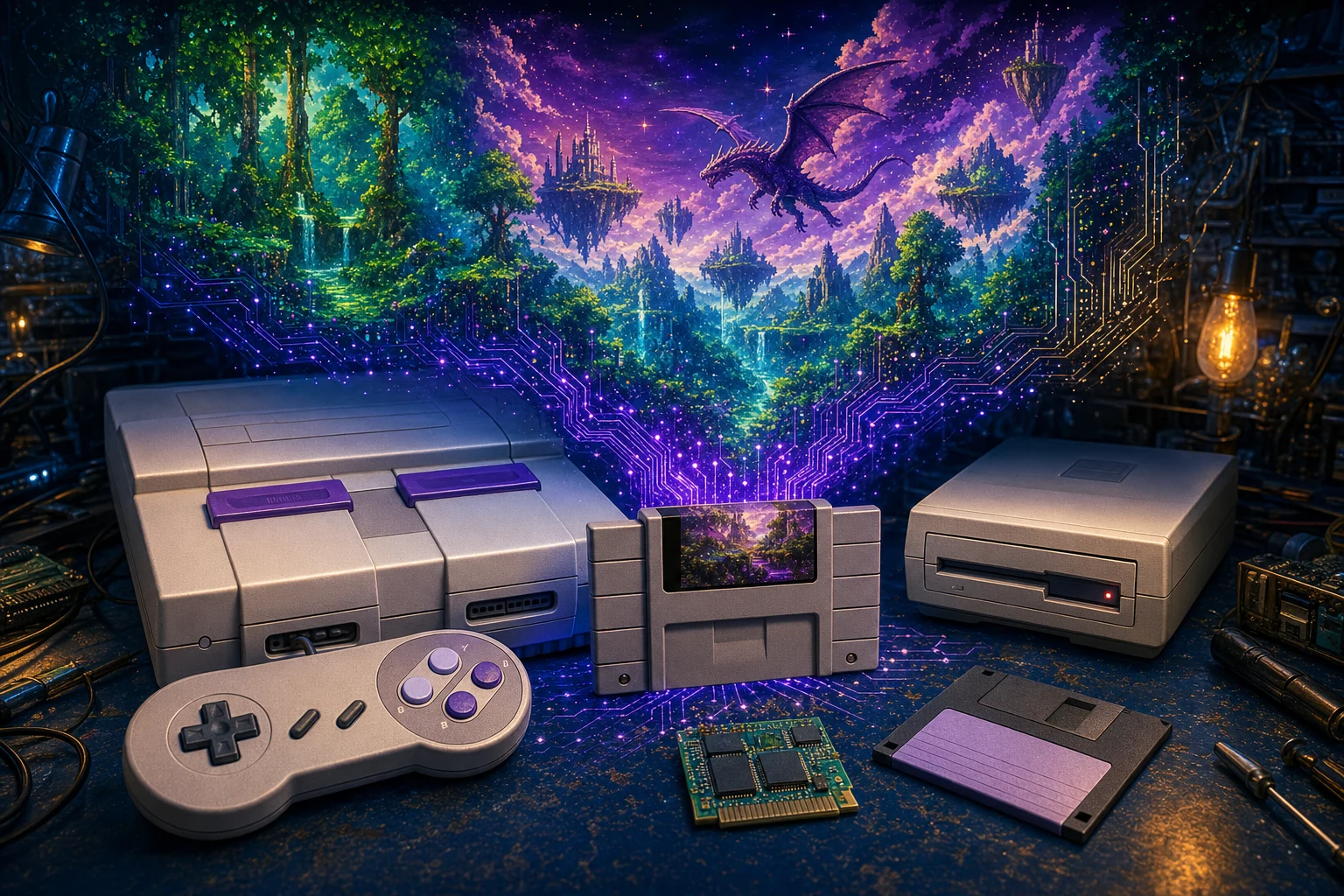
For a player in the early 1990s, the Super Nintendo cartridge looked like a sealed object. It was a plastic shell containing a game, pushed into a slot and removed when the session ended. Behind that simple ritual, however, the cartridge was already a small computer system: memory chips, address wiring, save RAM, and sometimes an additional processor sat between the console and the software. The copier era began when aftermarket manufacturers treated that connector not as a one-way doorway but as an invitation.
The result was a family of machines with names such as Super Wild Card and Game Doctor SF. They attached to the console’s cartridge interface and added their own memory, firmware, floppy drive and computer connection. Their historical importance was not just that they could load software from disks. They made the SNES cartridge portable in a new sense: something that could be copied into working memory, rearranged into a device-specific format and taken back out again.
That portability came with serious limits. A floppy disk had far less capacity than the larger cartridges appearing late in the Super Nintendo’s life. The copier had to divide data into blocks, remember which memory map it represented and preserve save data separately. A unit that advertised 28 megabits of DRAM was describing roughly 3.5 megabytes of raw memory, not 28 megabytes. Period specifications routinely used megabits, while cartridge backup RAM was likewise described in kilobits. A 256-kilobit save configuration amounted to 32 kilobytes, a distinction that matters when comparing period advertisements with later file sizes.
The ordinary workflow was therefore a sequence of constrained transfers rather than a single magical duplication. A copier’s internal memory received data through its cartridge-facing hardware or its computer interface. Its firmware then treated that data according to the expected mapping and memory size. Floppy disks stored portions of the result, while battery-backed memory could retain save information. On a later session, the machine reconstructed a usable cartridge-like image in its DRAM before presenting it to the SNES. The important historical point is that the device was interpreting and organizing data, not simply acting as a transparent replacement for Nintendo’s manufacturing process.
Descriptions of that process should also avoid treating every early image file as a universal standard. Front Fareast Industrial Corporation’s Super Wild Card documentation describes a copier header, block organization, mapping flags and SRAM-size information. Bung’s Game Doctor family used its own header conventions and memory assumptions. A 512-byte copier header was external metadata generated for a particular device’s loading system; it was not the same thing as the internal internal ROM header stored within a commercial cartridge image. Some tools and later preservation programs remove, retain or reinterpret that external material depending on the task. The messy result reflects hardware history, not careless modern file management.
A Console Built in Layers
To understand why these machines were difficult to reproduce, it helps to discard the shorthand that the SNES was simply a “16-bit console.” Its Ricoh 5A22 main processor coordinated with a pair of picture-processing units, an audio subsystem and whatever additional hardware a cartridge supplied. The 5A22 belonged to the 65C816 family and handled program execution, system communication and operations such as multiplication and division. The PPU pair generated tile graphics, sprites, scrolling, windows, color effects and the distinctive Mode 7 transformations. Sound ran on a separate Sony subsystem: the SPC700 executed audio code while the S-DSP handled sample playback, envelopes, mixing and echo.
That division mattered at the cartridge connector. A plain game might expose ROM and battery-backed SRAM to the console’s bus. Another might add a DSP chip, Super FX processor, SA-1 or a different enhancement device. The cartridge header recorded information about mapping, ROM and RAM sizes, country, checksum and chipset. It was a description of expected hardware, not a general encryption system. The console was not waiting for a secret code hidden inside every game so much as expecting the right electrical arrangement to answer at the right addresses and times.
LoROM and HiROM were two major arrangements for presenting cartridge memory to the 5A22. LoROM organized conventional 32-kilobyte banks into a layout in which the processor encountered ROM in the upper portion of banks. HiROM exposed 64-kilobyte banks through a more linear arrangement. ExHiROM extended that idea for larger cartridges. These names describe address decoding and wiring choices, not different kinds of software compression. A copier with the wrong assumptions could load data and still fail because the processor was asking the wrong physical memory location.
That is why a copier’s mapping flag was more than a filing label. The device had to know how to make its DRAM answer like the original cartridge. It also had to expose the right amount of save memory and, where applicable, interpret a device-specific header. A file with an added 512-byte copier header could therefore be perfectly useful to one loading ecosystem and confusing to another. Later preservation tools that distinguish headered from unheadered files are dealing with the accumulated habits of these machines, not correcting a single universal format.
The picture becomes more complicated when the cartridge contains an enhancement processor. A copier supplying ordinary ROM and RAM could not automatically behave like a cartridge carrying Super FX, SA-1, DSP or another specialized chip. The console’s own S-DSP was not one of those cartridge DSPs; it worked alongside the SPC700-based S-SMP audio CPU inside the console. This distinction is easy to flatten in a retrospective, but it explains many reports of partial compatibility. The copier could reproduce the memory map of a title while lacking the separate computation or timing behavior that made the original cartridge function.
Region Was Never One Problem
The most visible SNES differences were regional. Japanese Super Famicom cartridges used a different shell from North American cartridges, and the console slot’s plastic keying made some imports physically awkward or impossible to insert. PAL systems added another layer of difference. Yet mechanical fit was only the first barrier. The console and many cartridges also carried region-specific CIC devices, which performed a lockout handshake. Software could conduct its own checks, and the video hardware still had to operate at an appropriate timing standard.
That separation explains the appeal and the limitations of the early region modification. A mechanical alteration could make a cartridge fit. A CIC-related modification could address the lockout exchange. A separate 50/60-hertz modification could alter timing or video-mode selection. None of those changes automatically performed the others’ jobs. A console that accepted an import could still display it with the wrong timing, run at an unintended frame rate or fail a software check. “Region-free” was therefore never a synonym for universal compatibility.
The familiar 50/60-hertz switch belonged to this early, piecemeal phase. It changed the selected operating mode through the console’s timing circuitry, but it did not by itself replace the CIC. Conversely, defeating the CIC did not transform a PAL clock and video system into a complete NTSC equivalent. The distinction was especially important for games that assumed a particular regional status or for hardware whose board revision implemented the timing signals differently.
The Manufacturers Behind the Machines
Front Fareast Industrial Corporation’s Super Wild Card is a documented example because surviving technical material identifies the company and describes the device’s major components. Its architecture included dynamic RAM, battery-backed SRAM, firmware ROM, a floppy interface and a parallel-port connection for a computer. The Super Wild Card DX documentation described 8-kilobyte program blocks, mapping indicators, SRAM-size flags and a 512-byte copier header. Those details reveal a product designed around the practical problems of moving cartridge data through a small, proprietary computer.
Bung’s Game Doctor SF family occupied a different ecosystem. SF3, SF6 and SF7 used their own header structure and DRAM-bank conventions. That does not make one family a counterfeit version of the other; it means that each manufacturer built a loading environment with its own assumptions. Treating every file later encountered with an “.smc” extension as one universal format erases that history. The extension became a convenient modern label, while the original devices could disagree about headers, interleaving, mapping and memory organization.
Super Pro Fighter and Super UFO add further branches to the period hardware landscape. Their names should not be treated as specifications: memory capacity, drive arrangements, firmware and supported cartridge behavior varied between models. Identifying a surviving unit means examining its board, casing and documentation together rather than assigning the capabilities of an entire product family to one machine.
Availability also varied by market. These were aftermarket products moving through specialist importers, mail-order advertisements and computer-oriented channels rather than Nintendo’s official retail network. Exact first-sale dates and distribution routes are difficult to establish from later recollection alone. What can be said confidently is that the machines belonged to a period when a floppy drive, a parallel port and a proprietary memory format were plausible consumer-facing features. Their limitations were part of the sales pitch: capacity, memory size and compatibility were things a buyer had to compare model by model.
The ordinary user experience was consequently closer to operating a small peripheral computer than to inserting a modern flash cartridge. Disk space had to be managed. Data could be split across multiple disks or blocks. The copier’s menu and firmware determined what it recognized. Save memory had its own flags and persistence requirements. A successful transfer still depended on the target title using a cartridge arrangement the copier could represent. The workflow’s friction is historically important: it explains why the devices encouraged experimentation while never becoming transparent substitutes for every commercial cartridge.
Nintendo’s Rewritable Alternative
The unofficial copier story sits beside an authorized Nintendo history that used some of the same broad ideas—rewritable storage and distributed software—under very different conditions. The Satellaview and BS-X system connected to the Super Famicom expansion port, used a dedicated BS-X cartridge and stored downloaded material on a removable Memory Pack. Nintendo Power’s SF Memory service likewise offered official cartridges rewritten at authorized kiosks. These systems were not pirate copiers, even though later preservation work may involve cartridge readers, emulation or flash hardware.
The contrast is revealing. Nintendo’s services controlled the storage format, distribution channel and supported hardware. The aftermarket copier placed those decisions closer to the user, but had to solve them with limited DRAM, floppy capacity and manufacturer-specific firmware. One system was a managed publishing service; the other was a general-purpose aftermarket appliance. Both demonstrate that the SNES cartridge was more than a read-only plastic package, but they belong to different legal, commercial and technical histories.
That distinction also clarifies the narrow relevance of the Game Genie litigation. In Lewis Galoob Toys v. Nintendo of America, the Ninth Circuit considered a cartridge-interposed device that temporarily altered gameplay while the original software was running. The decision concerned that form of modification, not a blanket ruling on floppy copiers, ROM distribution or every hardware alteration. It is useful historical context precisely because it shows that different technologies raised different legal questions.
By the time enthusiasts began reconstructing old images, the original copier ecosystem had left behind layers of metadata, incompatible conventions and uncertain provenance. Recovering a game could involve determining whether an external header belonged to the copier, identifying the intended LoROM or HiROM arrangement, accounting for save memory and checking whether the title depended on an enhancement chip. Preservation was therefore not merely a matter of transferring bytes. It was an attempt to reconstruct the relationship between software, mapping and hardware that the original cartridge had embodied.
The Cartridge Could Be a Second Computer
The limits of the floppy copier became clearest when a cartridge stopped being merely memory. Nintendo’s enhancement processors turned the cartridge into a second computer attached to the Super Nintendo’s bus. A title using a plain ROM-and-SRAM arrangement asked the copier to reproduce a relatively understandable set of electrical responses. A title using Super FX, SA-1, a DSP-series chip, S-DD1 or another specialized device asked it to reproduce computation, registers, timing and sometimes unusual data handling as well.
Super FX was not simply extra storage. It was a cartridge-side processor used for geometry, object manipulation and other workloads that the console’s main processor could not comfortably perform at the same speed. The SA-1 went further in a different direction, combining additional processing power with memory-management and timing behavior that commercial software could address directly. The DSP family handled specialized calculations in particular games. These chips were not interchangeable, and none should be confused with the SNES’s own S-DSP, the audio processor responsible for sample playback, envelopes, mixing and echo.
A copier with DRAM could make a block of ROM data available to the console, but that did not create the missing silicon. Its memory could answer an address that once led to a cartridge ROM chip; it could not automatically answer as a Super FX processor when the game wrote to an enhancement register. Nor could a general copier assume that the timing of an ordinary memory access matched the response of a dedicated chip. This is why statements that a copier “supported SNES games” require qualification. Such machines supported particular cartridge arrangements, not an abstract catalogue of every game released for the system.
The distinction also explains why the internal cartridge header mattered without being a security code. Its map-mode, ROM-size, RAM-size and chipset fields helped describe the hardware arrangement expected by the program. A copier could use that information when preparing its memory image, but a header flag did not supply an implementation of the device it named. Reconstructing a game that depended on an enhancement processor required either the original cartridge hardware, a compatible reproduction of that hardware, or later software and programmable-logic work capable of modelling it. The floppy machine itself generally supplied none of those things.
Capacity created a second obstacle. A copier’s advertised DRAM figure described how much data it could hold, while the cartridge’s enhancement chip described what the data could do. A machine might have enough memory for a particular image and still be unable to run it because the image expected a processor that was absent. Conversely, a title with modest ROM capacity could be difficult if its cartridge-side device used registers or timing conventions the copier did not understand. Storage size and compatibility were therefore separate measurements, just as mapping and region lockout had been separate problems.
From Copier Images to Preservation Evidence
That distinction is especially important when studying early dumps. A file that works in one period copier format is not automatically a canonical representation of the original cartridge. Data may have been split, reordered, interleaved or combined with metadata before reaching a disk. Modern preservation tools can identify likely LoROM, HiROM and ExHiROM arrangements, inspect checksums and compare known internal headers, but reconstruction still depends on evidence. Later file extensions do not reveal which physical device first produced an image.
Emulation changed the preservation question by moving some of the missing cartridge logic into software. An emulator can model a DSP, Super FX or SA-1 more flexibly than a floppy copier could reproduce it in hardware. That does not make every emulator equally accurate. The quality of a preservation model depends on documented behavior, testing against original software and hardware, and attention to timing rather than merely producing a recognizable picture. A game that reaches its title screen is not necessarily a faithful reproduction of the machine that ran it.
Modern debugger documentation made those differences visible. Mesen’s SNES tools expose memory, registers, graphics data, breakpoints, traces and event timing in a way that lets developers inspect the machine while a program runs. A programmer can follow a DMA transfer into video memory, watch a tile become corrupted, or determine whether a frame’s logic finishes before the vertical-blank interval closes. The value is not only convenience. It converts behavior that was once inferred from a television image into evidence that can be measured.
Snes9x supplies another set of low-level inspection facilities in its source, including tracing and debugger support. Its debugger is a compile-time facility with a comparatively rough interface, rather than a polished tool guaranteed in every end-user build. That distinction matters to developers choosing a workflow: the existence of tracing code does not mean every downloaded emulator exposes an integrated debugging environment. These instruments complement original-hardware testing, where actual bus, video and cartridge behavior can expose assumptions that a software model tolerates.
New Software, Modified Software and Recovered Software
The same tools support several kinds of work that should not be collapsed into one category. An original program written for the SNES is homebrew: new software authored for the platform, whether it is distributed as a digital build, a physical release or a development project. A ROM hack modifies an existing game’s code, maps, mechanics or assets. A translation changes language presentation and may require new fonts, expanded text routines or altered code. A preservation dump attempts to represent software that already existed on an original cartridge. These activities can share assemblers, emulators and testing hardware while having different creative histories.
Open development kits such as PVSnesLib lowered the barrier to creating new programs without removing the console’s technical constraints. A developer can work in C for ordinary game logic and use assembly where precise control is needed, while libraries help manage sprites, backgrounds, input and sound. Underneath that convenience remain banked memory, PPU registers, DMA limits, the separate SPC700 audio system and the need to schedule work around the frame. The toolchain makes the architecture approachable; it does not turn the SNES into a modern general-purpose computer.
That distinction can be seen in legitimate new games. Super Boss Gaiden is an original homebrew project rather than a recovered Nintendo title or a language patch. Dottie Flowers likewise demonstrates that contemporary authors can design new stages, rules and presentation for SNES-compatible hardware. Its existence matters historically because the console is being used as a medium, not merely as a container for software from the 1990s. A new game may deliberately imitate period techniques, but imitation does not make it an original Nintendo release.
A translation has a different relationship to history. A translated role-playing game can represent substantial engineering: text expansion, font design, pointer changes, altered menus and testing across hardware. Yet it remains a modified version of an existing work. A ROM hack may be similarly ambitious while retaining more of the original program’s structure. Calling either project “homebrew” without qualification obscures the labor involved and the distinction between new authorship and transformation of an existing game.
Real hardware provides an important final check for all of them. An emulator can reveal logic errors and make debugging practical, but an original Super Nintendo can expose differences in timing, video memory transfers, controller behavior or cartridge response. A title that works on a development machine may still need adjustment before it behaves consistently on the console for which it was written. Preservation therefore has two directions: emulation and documentation help keep old software understandable, while real hardware tests whether the reconstructed behavior belongs to the original machine rather than only to a convenient modern environment.
SuperCIC Joined Lockout and Timing
A console-side SuperCIC replaces the lockout-control logic and can coordinate region and video-mode selection. It does not by itself generate both regional master-clock frequencies: switching those requires a dual-frequency oscillator or comparable clock circuit. A cartridge-side SuperCIC key supplies the cartridge partner in the exchange; it does not install timing circuitry inside the console.
Other projects add functions around that foundation. In-game reset circuitry, often called uIGR, lets controller combinations request resets or other supported actions. Region-patch circuitry addresses software-visible regional information, including reads of the PPU status register at $213F. A dual-frequency oscillator addresses the clock source. Combining these functions on one board does not make every function an inherent feature of the CIC itself.
The next refinement concerned clock stability and the demands of modern displays. Original SNES video timing includes a historical irregularity in which a scanline can be shortened during a non-visible portion of the signal. CRT televisions generally accommodated this behavior because they were designed around the era’s timing conventions. Some later scalers and analog-to-digital converters are less forgiving. They may interpret the small timing variation as instability, producing sync drops, image shifts or other display problems.
De-jitter circuits address that interface problem by altering the clock behavior so the shortened line is removed or regularized. The result is easier for some modern equipment to process, but it is not simply a restoration of an untouched console’s signal. The circuit pauses the clock for a small number of cycles, introducing a different, controlled variation in timing. The change is minor compared with the differences between individual consoles and between 50- and 60-hertz systems, yet it remains a technical alteration rather than a claim that the original timing never existed.
This progression—from a switch, to programmable CIC coordination, to clock de-jitter—shows how modding matured from solving an immediate barrier to managing interactions among several systems. The early modification asked whether an import could start. Later engineering asked whether its software checks, frame rhythm, clock source and modern display chain would all agree. SuperCIC did not erase the distinction between those layers; it made the distinction easier to control. De-jitter extended that work beyond cartridge acceptance and into the electrical relationship between an original console and contemporary video equipment.
A Cartridge That Became Programmable
The modern flashcart did not replace the Super Nintendo. It changed what could sit at the end of its cartridge bus. That difference separates the FXPAK Pro lineage from a software emulator and from FPGA consoles such as the Super Nt or MiSTer. Inside an original SNES, the Ricoh processor, PPU pair, sound hardware, clocking and video output remain in service. The cartridge supplies storage and, in more advanced designs, programmable logic that can respond like several kinds of enhancement hardware. The result is an original console with a sophisticated replacement cartridge, not a new console pretending to be an old one.
The sd2snes project established the important technical step. Its purpose was not merely to put more games on a memory card than a period copier could hold. Its FPGA could implement cartridge-side behavior for selected devices, including several DSP chips, Super FX, SA-1 and the community-created MSU1 specification. Support has never meant that every enhancement chip is reproduced perfectly or that every imaginable cartridge is covered. The project’s own compatibility documentation distinguishes implemented, incomplete and impractical cores. That qualification is central: FPGA capacity and firmware design determine which cartridge behaviors can be recreated.
The commercial FXPAK Pro is a commercial continuation of that programmable-cartridge approach. It can present ordinary ROM and save memory, reproduce enhancement logic supported by its installed firmware and cores, and manage data arriving from an SD card. Support must be checked against that specific combination rather than assumed for every cartridge processor. Calling it “emulation” is not entirely wrong, since its FPGA models hardware behavior, but the word can obscure the arrangement. The SNES is still executing the game through its original CPU and PPU. The cartridge is providing a more capable electrical partner than a simple ROM adapter could provide.
A basic SNES flashcart without enhancement-processor implementations belongs in a different category. It is principally a storage-and-mapping device for conventional cartridge images, with save support for the types of memory it is designed to reproduce. That design does not imply recreation of Super FX, SA-1, DSP or other specialized chips. Named commercial families, including Super EverDrive, contain different models, so support must be checked for the exact hardware version. The comparison is not a ranking of good and bad products. It is a reminder that “flashcart” describes a family of designs. One model may behave much like a rewritable ROM cartridge; another may function as a programmable cartridge computer.
This distinction also explains why compatibility updates can be substantial engineering work. Firmware changes affecting bus sampling, enhancement-chip timing, buffering or optional, restricted save-state features are not cosmetic menu revisions. A game can load correctly and still fail later because a register response arrives at the wrong time, an FPGA core samples the bus incorrectly or an SD access interrupts a stream. The original cartridge’s apparent simplicity concealed a carefully timed conversation between console and expansion hardware. Modern flashcarts have to reconstruct that conversation in real time.
The Expansion That Never Shipped
MSU1 is the clearest example of modern SNES engineering creating a new historical layer. Conceived by byuu for the higan and bsnes ecosystem, it was not a Nintendo prototype, a late commercial cartridge chip or an overlooked CD accessory. It is a community-defined expansion specification: a way to give SNES software access to large external data and streamed PCM audio while leaving the console’s normal rendering and input systems in place.
Its audio capability is why MSU1 enhancements can sound so different from ordinary cartridge releases. A compatible program can call for external music tracks while the SNES continues to run its game logic and generate its usual sound effects through the SPC700 and S-DSP. That arrangement is not equivalent to adding a CD drive to the console. The music files reside in modern storage, and the cartridge-side hardware streams them according to the MSU1 design. The original audio subsystem has not vanished; the game is combining it with a new source of data.
MSU1 can also stream general data, including material that software transfers into video memory or color memory. This has encouraged ambitious demonstrations involving animated sequences and enhanced presentations. Yet the device does not give the SNES a modern framebuffer or replace the PPU. The incoming material must still be organized into tiles, palettes and other forms the original graphics hardware can consume. Video demonstrations may appear dramatically more elaborate because storage and delivery constraints have been relaxed, but the console remains bounded by VRAM capacity, DMA bandwidth, scanline timing and its established graphics modes.
The distinction matters when describing fan conversions. An MSU1 audio project is not a recovered Nintendo CD release. A homebrew game designed around streamed music is new software using a community expansion. A modified commercial game with new tracks is an enhancement of an existing work. Those projects may be technically impressive without acquiring an original Nintendo provenance they do not possess.
Physical support also introduces limits that emulation can hide. An emulator can schedule MSU1 reads within software and whatever host storage it uses. A flashcart must share its SD interface between audio, data and save operations. Access delay matters more than a card’s headline transfer rate: a card that is fast in a general-purpose device may still pause long enough to produce a glitch when a game requests audio and video data together. The flashcart therefore needs buffering and firmware designed around the access pattern, not merely a large storage capacity.
MSU1’s enduring importance is conceptual. It shows that a retro platform can acquire a stable, documented expansion without being mistaken for a different platform. Developers can target a specification in emulators and on compatible cartridges, while readers can still identify which part belongs to the original console and which part is modern invention. That honesty makes the experiment more interesting, not less.
Sharper Pictures Without a New Console
Video modifications require the same separation of layers. The term 1CHIP identifies later boards that consolidate the main CPU and picture-processing logic. Earlier multi-chip systems use separate processing packages, while SNES Mini and Super Famicom Jr. revisions introduce further output-circuit differences. These are hardware distinctions, not universal grades of quality. Many 1CHIP systems produce a sharper RGB image than typical earlier multi-chip examples, but age, board revision, analog circuitry and individual condition all affect the result. A 1CHIP label is not a guarantee that a console is electrically healthy or visually flawless.
The familiar softness of many earlier multi-chip systems comes from the original RGB path and its amplification characteristics. An RGB bypass can route or amplify a cleaner signal around part of that path. Current documented bypass designs are revision-specific: boards intended for 1CHIP-01 and -02, 1CHIP-03, the SNES Mini or Super Famicom Jr., and earlier three-chip systems are not automatically interchangeable. The mod improves the analog output path; it does not turn the motherboard into a 1CHIP design or alter the PPU’s rendering behavior.
The Edge-Enhancer approach for 2CHIP consoles illustrates a related but distinct intervention. Its purpose is to recover and process the video signal in a way that reduces familiar artifacts and brings the image closer to the visual character associated with later boards. That can address vertical bars, softness or noise in particular installations, but it remains an analog correction circuit. It should not be presented as a universal treatment for every revision, every cable or every display.
Maintenance is part of this discussion because an aging original console can be blamed for problems caused by degraded components, poor connections or an unsuitable display chain. Capacitors can lose performance, and replacing failed or degraded parts may restore stable operation. A recap, however, is not automatically an image upgrade. It cannot substitute for diagnosing the motherboard revision, sync configuration, cable, encoder path or scaler. Nor does a newly installed component make an original console equivalent to a modern digital recreation.
HDMI boards belong to yet another category. Depending on the design, one may digitize the console’s existing video, process it more actively or combine both approaches. The installation requirements and behavior vary by board and motherboard revision. HDMI output can make an original SNES convenient for modern displays, but the board is intervening in the video chain rather than replacing the entire console architecture. A clean digital picture does not by itself reveal how much of the original timing and signal path remains.
This is why comparisons with an FPGA console must remain precise. A Super Nt accepts original cartridges while recreating the console’s functions in new programmable hardware. MiSTer runs a SNES core as one system among many on an FPGA platform. Neither retains the exact CPU, PPU, analog encoder and board-level behavior of a modified Nintendo console. An RGB-bypassed SNES, an HDMI-modded SNES, a Super Nt and a MiSTer may all provide excellent play, but they preserve different portions of the original machine.
Preservation Includes the Save
The quietest challenge for modern cartridge hardware is often not loading a game but retaining what happens after the power is switched off. Original cartridges commonly used battery-backed SRAM. Its capacity was part of the cartridge design, and its battery supplied the electrical continuity needed to preserve a save when the console was off. When that battery fails, the save can disappear even though the game ROM remains perfectly readable.
The sd2snes/FXPAK family can meet the same software expectation by monitoring cartridge save RAM and writing its contents to SD storage. Other flashcarts use different memory hardware and write policies. On this particular design, the distinction becomes important when a game uses save RAM as working memory or when a streaming feature also needs access to the card.
On sd2snes/FXPAK, ordinary SRAM saving and MSU1 autosaving have distinct firmware controls. Some MSU1 projects use SRAM as working memory, complicating automatic save detection. Reset-time saving and the option to disable MSU1 autosaving therefore matter, and the correct behavior depends on the firmware and game. Separate MSU1 busy-flag or streaming bugs are compatibility issues rather than a universal explanation for save policy. Save states are different again: they capture broader machine state and have game- and core-specific restrictions.
Maintenance therefore has two goals. It keeps original hardware operating and it records the behavior that hardware was meant to preserve. A cartridge reader can help archive save data before a failing battery becomes a crisis; a replacement battery or professionally maintained board can keep the original arrangement functioning. A modern FPGA cartridge can make a library convenient and reduce wear on rare originals, but it does not erase the preservation value of the original PCB, memory chips, labels and documented revision.
A Platform Still Capable of New Work
This is the enduring achievement of the modern scene. The FXPAK Pro does not make every cartridge chip universal; MSU1 does not turn the console into a CD system; an RGB bypass does not create a 1CHIP board; a recap does not cure every video fault; and an FPGA console does not become an original Nintendo motherboard by accepting its cartridges. Those boundaries are not pedantry. They tell us what has been preserved, what has been reconstructed and what has been newly invented.
The Super Nintendo’s afterlife is therefore not a single upgrade path. It is a set of carefully layered relationships: original silicon with a programmable cartridge, original video with a revised analog path, old software with new data, new software with old constraints, and modern hardware reproducing a historical design. The console remains compelling because each layer can be changed without making the others disappear. Its future is not secured by pretending that every replacement is identical to the past, but by understanding exactly which parts of that past are being carried forward.
More console modding histories
Follow the earlier generations in our original PlayStation modding history and PlayStation 2 homebrew and modchip history. Compare Sony’s evolving security with the original Xbox modding scene and the Dreamcast’s boot discs, homebrew and online revival. Find more long reads in Editorial Spotlight.