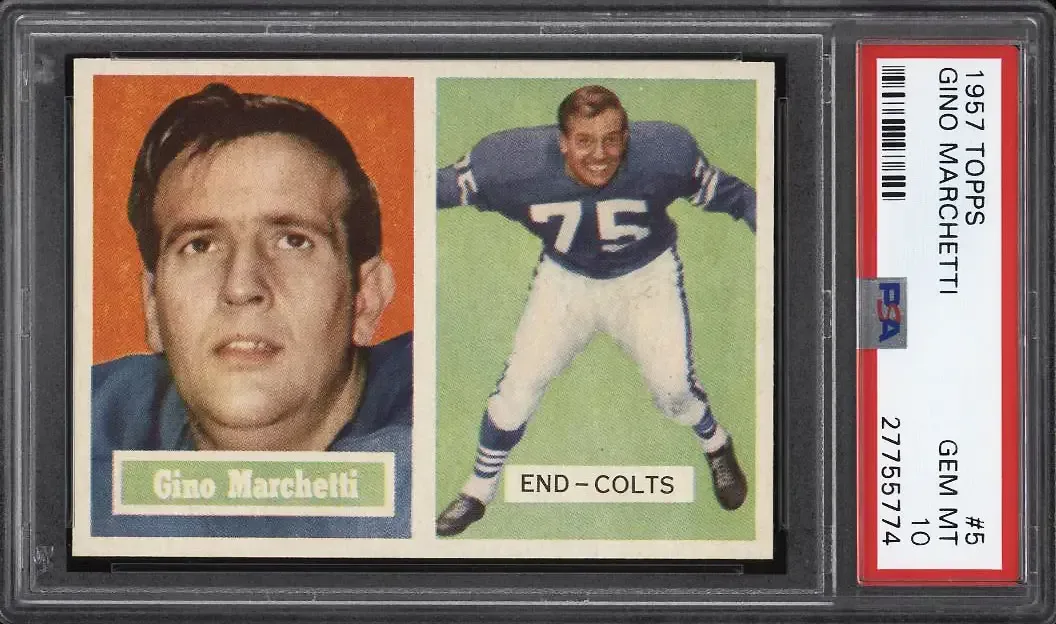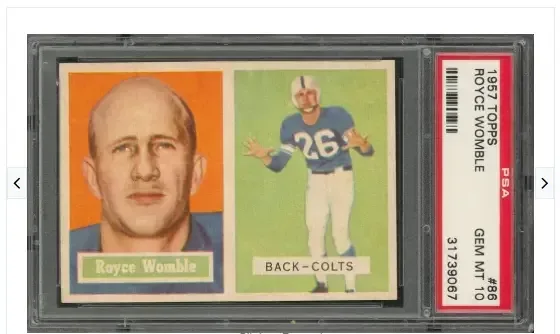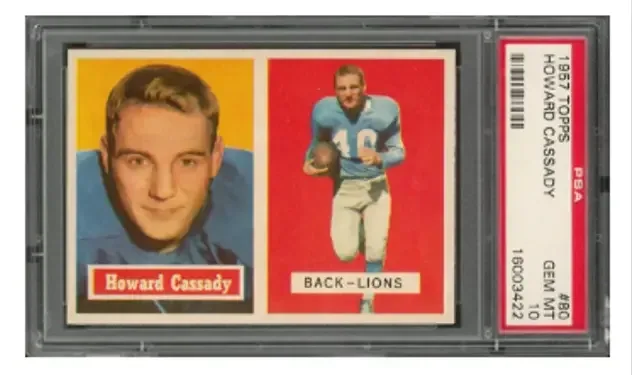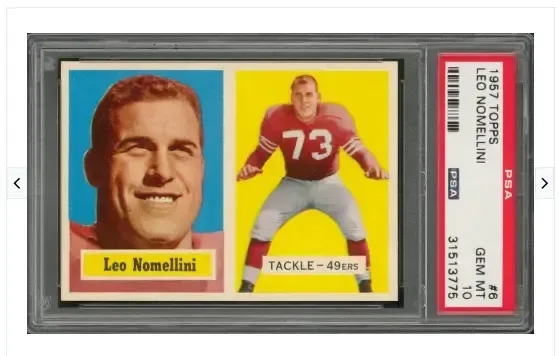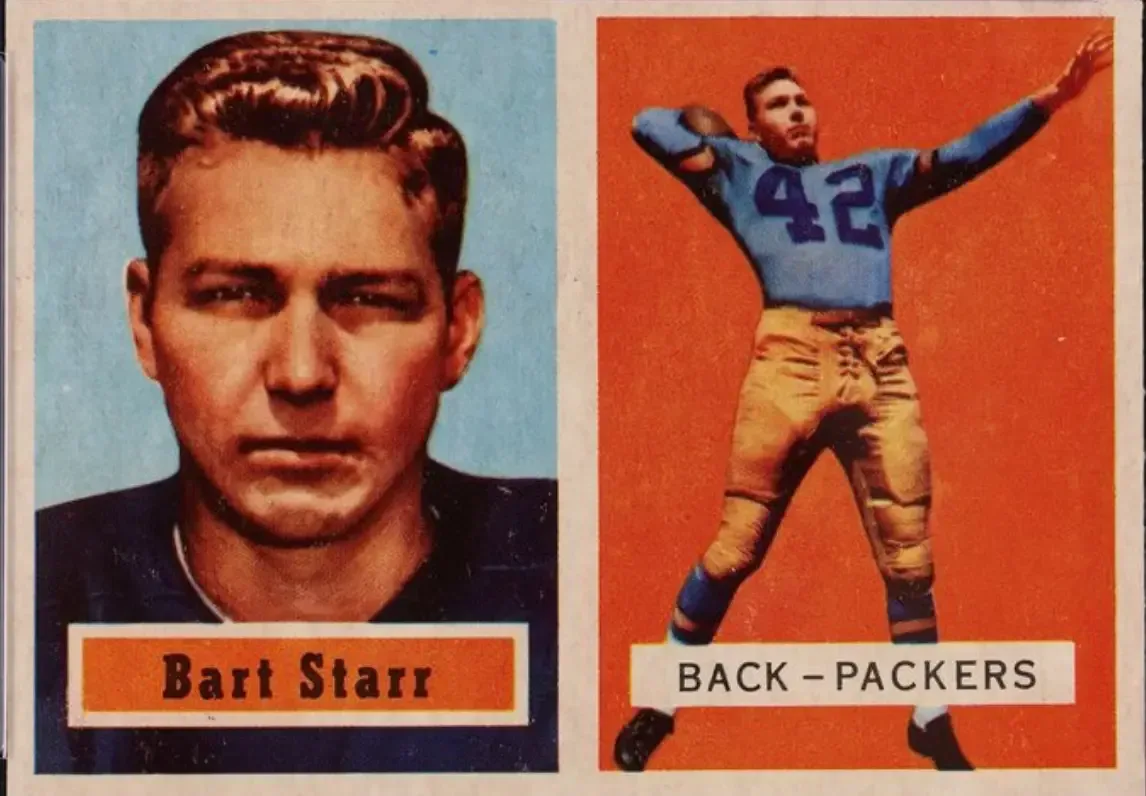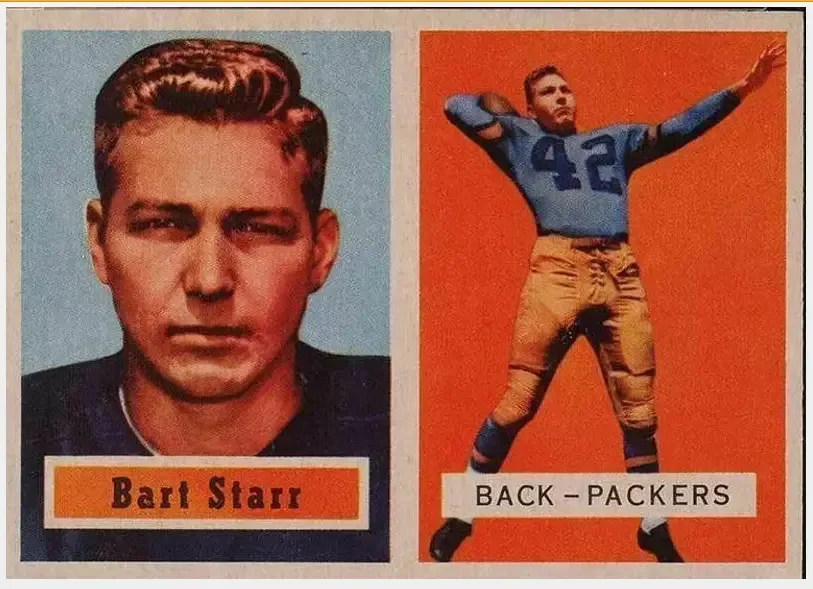
The 1957 Topps Football set has plenty of obvious reasons to attract vintage-card collectors: a distinctive horizontal design, two player images on each card and a rookie class that includes Bart Starr. Yet four cards outside that headline rookie conversation underline a central reality of the vintage market: extraordinary condition can matter as much as, and sometimes more than, a player’s name recognition.
Gino Marchetti, Royce Womble, Howard Cassady and Leo Nomellini each have a 1957 Topps card with just one PSA 10 recorded in the provided population figures. Their raw examples generally trade in the single- or low-double-digit range, while the best documented public sales of the PSA 10 copies range from $2,520 to $6,800. That does not make every copy a four-figure card. It does show how sharply the market can separate an ordinary surviving example from one that has reached the hobby’s highest widely recognized condition grade.
For collectors weighing these cards, the important story is not simply that PSA 10 examples are scarce. It is that scarcity sits beside a comparatively substantial number of PSA 8s and a much thinner layer of PSA 9s. The result is a steep condition ladder: the cards can be attainable raw, more challenging at strong graded levels and exceptionally difficult at the very top.
What PSA 10 and population counts mean
PSA 10, often termed Gem Mint, is the top numerical grade on PSA’s standard 1-to-10 scale. A grade represents the authentication and condition assessment of a specific submitted card; it is not a guarantee that every card of the same issue looks identical or will sell for the same amount.
For more context, explore Amazon’s October Device Wave Brings Android Tablets, Fresh Kindles, Ring Gear and a Faster Fire TV Stick.
A population count is the number of cards that a grading service has recorded at each grade. In this group, the supplied figures list one PSA 10 apiece. The figures also show materially more cards at PSA 8 than PSA 9, emphasizing how rarely these particular 1957 Topps issues have reached the sharpest condition tiers.
That distinction is useful because scarcity is not the same thing as demand. A population report speaks to graded supply, while a public sale records what a buyer paid for a particular card at a particular moment. Together, they help explain the size of the premium, but neither should be read as a universal price guide. Eye appeal, registration quality, centering, the venue and the number of active bidders can all affect an individual sale.
Gino Marchetti No. 5: the highest reported sale of the four
Indianapolis Colts great Gino Marchetti’s No. 5 is the priciest of these four on the reported top-sale figures. Raw copies generally sell for about $6 to $15. The supplied graded population includes one PSA 10, 16 PSA 9s and 155 PSA 8s.
Related coverage includes Four 1957 Topps Football PSA 10s Show the Set’s Extreme Condition Premium.
The highest reported public sale for the lone PSA 10 was $6,800 on September 23, 2018, through Fanatics Weekly. Put beside the raw range, that result illustrates the condition premium in unusually direct terms. Even a raw card near the high end of its cited range is playing in a completely different financial bracket from the one-card PSA 10 population.
The population structure is significant here. Sixteen PSA 9s are scarce compared with 155 PSA 8s, but there is still a defined route for a collector who wants a high-grade example without chasing the unique PSA 10. Once a collector wants the top-certified copy, however, there is no comparable substitute within that specific grade.
Royce Womble No. 86: a dramatic gap from a low-cost raw card
Royce Womble’s Indianapolis Colts card may be the clearest demonstration that the premium is driven by elite condition rather than raw-card price alone. Raw copies generally sell for roughly $2 to $5. The reported PSA population is one PSA 10, 21 PSA 9s and 167 PSA 8s.
The highest public sale cited for its PSA 10 is $5,400, recorded on October 28, 2018, through Goldin. The contrast is striking: a card that can be inexpensive in ungraded form has commanded thousands of dollars in its sole PSA 10 example.
There is a practical collecting lesson in that contrast. A low raw price should not be mistaken for evidence that a top-grade copy will be affordable. In vintage collecting, it can instead mean the card is easy to find in circulated or imperfect condition while truly exceptional survivors are rare. Womble’s 21 PSA 9s offer more high-grade supply than the Marchetti card, but the jump from 21 to one remains an enormous narrowing of the field.
Howard Cassady No. 80: scarce at the top, with a different sale level
Detroit Lions player Howard Cassady’s No. 80 has a raw range of about $8 to $15 in the supplied market snapshot. Its reported population is one PSA 10, 16 PSA 9s and 137 PSA 8s. Those counts broadly resemble Marchetti’s card, particularly at the two top grades, but the recorded PSA 10 result is lower.
The highest cited public sale for the Cassady PSA 10 was $2,880 on October 28, 2018, through Goldin. It remains a substantial leap from the stated raw range, even if it is well below the top sale noted for Marchetti.
This is a valuable reminder that a one-of-one PSA 10 designation does not establish a fixed market hierarchy by itself. The grade creates rarity at that level; buyers still decide how much they value the player, card and opportunity when one reaches the market. A single historic sale should therefore be treated as an important data point, not a standing offer or a prediction for a future auction.
Leo Nomellini No. 6: another one-card PSA 10 population
San Francisco 49ers player Leo Nomellini’s No. 6 also stands alone at PSA 10 in the stated count. The same figures show 12 PSA 9s and 135 PSA 8s. Among these four, Nomellini has the fewest reported PSA 9s, making the progression from strong high grade to Gem Mint especially narrow.
Raw copies generally sell in an $8 to $20 range. The reported high public sale for the PSA 10 was $2,520 on October 28, 2018, through Goldin. That spread again demonstrates that the story is less about the baseline cost of owning the card and more about the rarity of owning a copy certified at the highest grade.
Collectors interested in the card without the singular PSA 10 chase have clearer decisions to make: pursue a raw example for the set or player, seek a PSA 8 as a more established graded tier, or treat the much smaller PSA 9 population as the high-grade target. Those are different collecting goals, and the reported figures make clear why their prices need not move in lockstep.
Reading the four cards as a condition-rarity case study
Across all four issues, the counts tell a consistent story:
- Each card has one PSA 10.
- PSA 9 populations range from 12 to 21.
- PSA 8 populations range from 135 to 167.
- Reported top PSA 10 sales range from $2,520 to $6,800.
- The stated raw-card ranges run from $2 to $20.
Those numbers should not be collapsed into a simple formula. The Marchetti sale does not prove that every card with one PSA 10 should bring a similar amount, and the 2018 transactions do not establish present-day pricing. What they do show is the scale of the premium buyers have previously attached to the most difficult condition target in this 1957 Topps group.
They also help separate two ways of collecting the same issue. A set builder may prioritize completeness and visual consistency, making lower-grade or raw copies sensible. A player collector may target a favorite name at a preferred budget. A condition-focused collector is chasing a different commodity altogether: a vintage card that survived well enough to earn an elite grade, with very few direct alternatives available.
Practical takeaways for collectors
For anyone evaluating vintage football cards, these four examples support a few disciplined habits.
- Identify the exact grade under discussion. “High grade” can cover a broad range. Here, PSA 8, PSA 9 and PSA 10 have sharply different population counts.
- Keep raw and graded markets separate. A raw sale range is helpful for an entry-level copy, but it is not a shortcut for estimating a unique PSA 10.
- Use historical public sales carefully. The documented sales are from 2018. They show that buyers paid those amounts then, not that the cards will necessarily sell for the same figures now.
- Consider the next-best available grade. If a PSA 10 population is one, PSA 9 may be the more realistic top-end target. Even that tier is limited on all four cards.
- Buy the collecting objective, not just the label. Whether the aim is a 1957 Topps run, a Colts grouping, a Lions or 49ers card, or an elite registry-grade copy will meaningfully change the right card to pursue.
The 1957 Topps Football set remains compelling because it supports all of those approaches. Its design and rookie content can draw attention to the issue, but Marchetti, Womble, Cassady and Nomellini show why condition specialists keep studying its less celebrated names. At the top of the grading scale, the scarce survivor can become the centerpiece.
For more coverage of market-facing hobby stories, visit this related look at 1957 Topps Football PSA 10 rarities.