Bart Starr’s place in football history gives his vintage cards an unusually direct connection to the sport’s formative championship years. He led the Green Bay Packers to two Super Bowl victories, earned MVP honors in both Super Bowl I and Super Bowl II, and was the NFL’s Most Valuable Player in 1966. His five NFL championships also bridge two eras: three came before the Super Bowl, while two led to the Packers representing the NFL in the title game before the AFL-NFL merger ahead of the 1970 season.
That résumé is the backdrop for five particularly notable Starr cards. They do not all occupy the same niche. One is a rookie card, one was hand-cut from a magazine, and one is a scarcely encountered 3D prototype rather than a broadly issued mainstream release. The available high-grade population figures and recorded sales show why card identity and condition need to be considered together rather than treated as interchangeable measures of value.
A note on the terminology: PSA 10 and PSA 9 are stated grade levels, while the population is the number of examples recorded at that grade. “PSA Authentic,” as used for the 1968 prototype below, identifies a different designation from a numerical grade. A low population figure can make a particular high-grade or authenticated example noteworthy, but it is not a guarantee that every copy will command the same result. The sale prices here are reported high-water marks for specific cards, at specific times.
5. 1961 Fleer Wallet Pictures Bart Starr
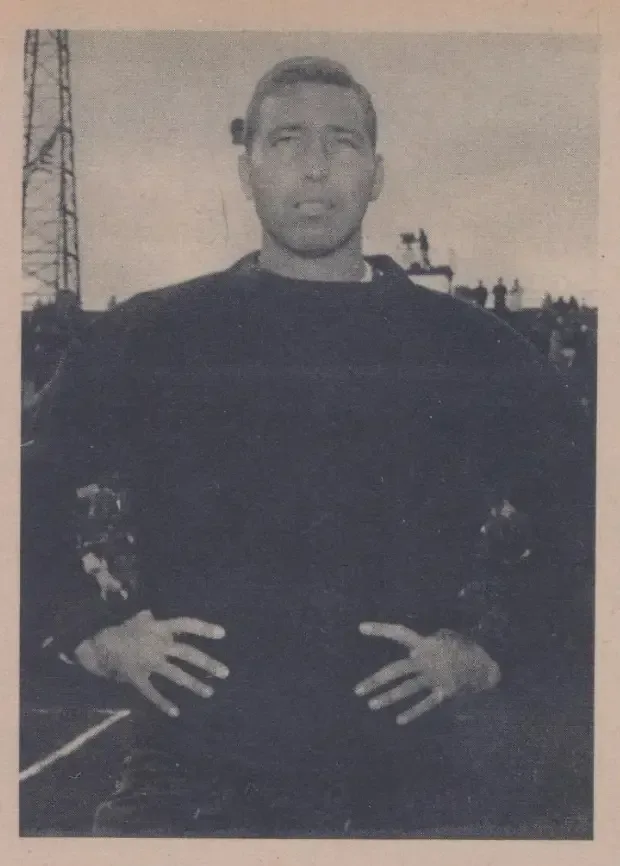
The 1961 Fleer Wallet Pictures entry is the most structurally unusual card in this group. Rather than being presented as an ordinary, pack-issued card in the supplied information, it was hand-cut from Complete Sports Pro-Football Illustrated. That origin matters. Hand-cut pieces invite collectors to look closely at the edges and overall presentation, because the item began as part of a magazine format rather than a conventional standalone card.
The available top sale is a PSA 10 that sold for $10,000 through eBay on July 21, 2026. The reported population at that level is one, with eight PSA 9 examples. For a Starr collector, the appeal is twofold: it represents a less routine format in his card history, and it ties to the quarterback’s five NFL championships.
Its position at No. 5 is not an argument that it lacks importance. Instead, it illustrates how a collectible can be compelling because of its production format and scarcity at top grades even when the recorded peak sale is below the more celebrated rookie and prototype entries on this list.
4. 1958 Topps Bart Starr #66
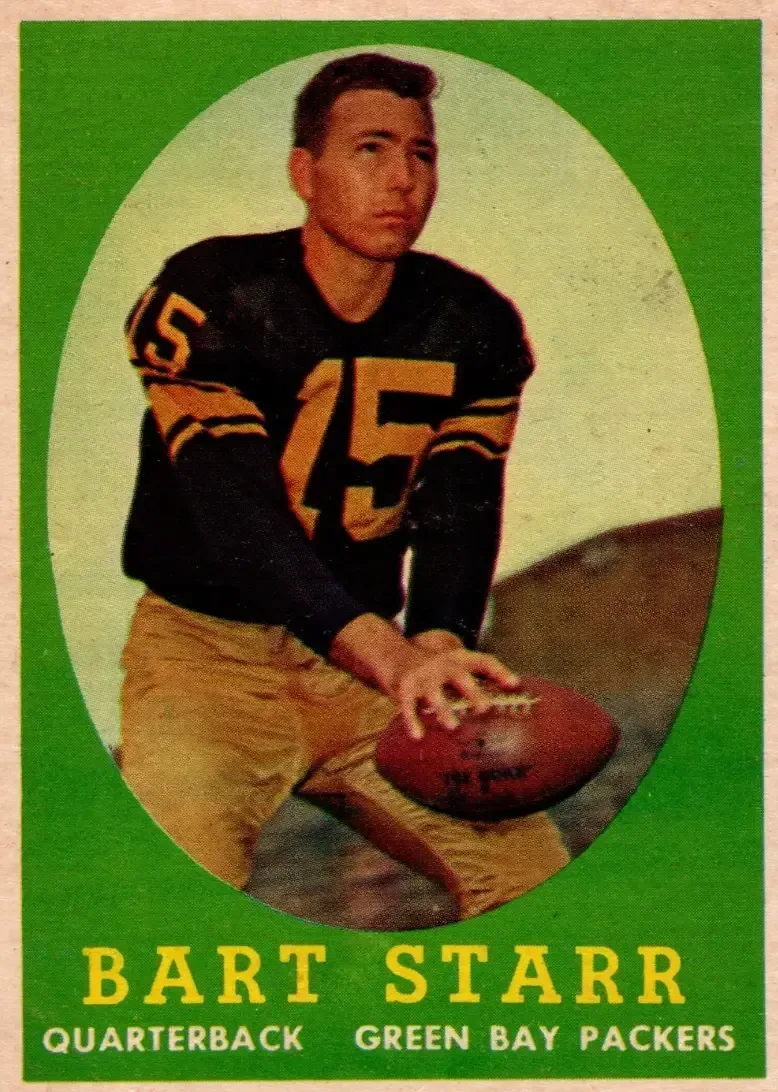
The 1958 Topps Bart Starr #66 is a classic early-career issue with a design that visually suits its Packers subject: Starr’s photograph is surrounded by green, while his name appears in yellow. In a list that includes a hand-cut magazine piece and a prototype, this is the cleanest example of a traditional vintage football-card presentation.
Its historical association is Starr’s accuracy. He led the league in completion percentage four times: 1962, 1966, 1968 and 1969. Those seasons underscore why his cards remain linked not only to team championships and Super Bowl accomplishments, but also to his individual performance as a quarterback.
Related coverage includes Bart Starr’s 5 Key Vintage Football Cards, Ranked.
A PSA 10 copy sold for $24,060 through Heritage Auctions on August 19, 2017. There is one PSA 10 in the stated population and six PSA 9s. Those figures clarify what the sale represents: a result for an exceptionally graded copy, not a blanket price for every 1958 Topps #66. For anyone evaluating a vintage Starr card, that distinction is essential. The card’s year and player are only part of the description; the stated grade is part of the specific sale record as well.
3. 1959 Topps Bart Starr #23
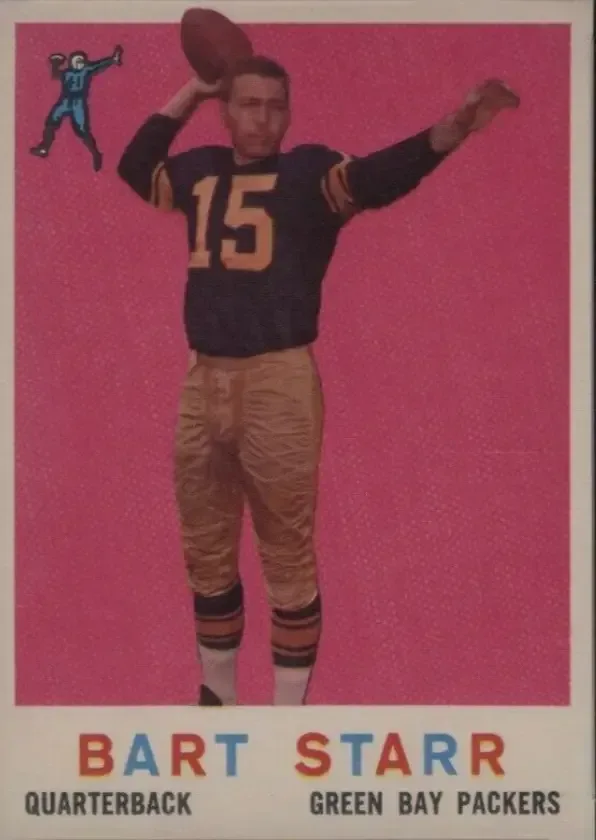
The 1959 Topps Bart Starr #23 takes a more colorful route. It places Starr on a pink background, with his name rendered in alternating blue and red lettering. That makes it a visually distinct follow-up to the green-and-yellow treatment on the 1958 Topps issue, even though both cards belong to the same vintage Topps run of Starr collectibles.
The card is paired here with Starr’s three second-team All-Pro selections. It is a reminder that the quarterback’s collecting profile reaches beyond a single rookie-card narrative. His career includes league honors, championships and the first two Super Bowl MVP awards, providing several meaningful lenses through which collectors can approach a run of cards.
The reported top sale is $40,000 for a PSA 10, sold through eBay on July 12, 2023. Three PSA 10 copies are recorded in the stated population. That is more than the single PSA 10 reported for the 1958 Topps and 1961 Fleer Wallet Pictures cards, but it does not make the 1959 card any less significant. In fact, it provides a useful caution against reducing the hobby to one number. A card’s design, player context, grade, available population information and the circumstances of a particular sale all contribute to the picture.
2. 1968 Topps Visual Panographics 3D Prototype Bart Starr
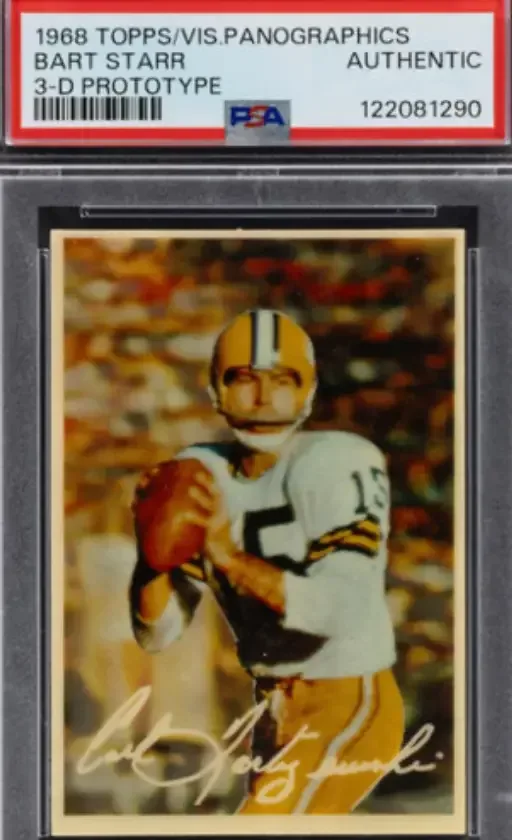
The 1968 Topps Visual Panographics 3D Prototype Bart Starr is the list’s curiosity piece—and arguably its strongest lesson in why vintage collecting categories are not always straightforward. These prototype cards were created in collaboration with Visual Panographics Inc. and were not made widely available. Their 3D presentation also separates them from the standard flat-card design language represented by the 1958 and 1959 Topps issues.
“Prototype” is the key word. As presented here, it describes an item outside a widely available release. That status helps explain why the card is treated as an important part of collectible-card history and why it should not be casually compared with a regular-issue base card. The broader Visual Panographics group is also known for strong auction interest, including the Brooks Robinson version.
Only two copies carry the reported PSA Authentic population designation. One sold for $40,260 through Heritage Auctions on October 25, 2025. Although that peak is slightly above the stated sale for the 1959 Topps PSA 10, the labels are not identical: the 1959 record is for a PSA 10, whereas this prototype record is for PSA Authentic. The two figures are valuable market references, but they describe differently designated examples.
Starr’s two Super Bowl MVPs make the prototype an especially evocative match for the beginning of the Super Bowl era. He was the MVP of the first two Super Bowls ever played, and the card’s unusual format gives collectors a different route into that same legacy. It is not simply a later-year Starr card; it is a scarce production experiment attached to one of the era’s defining quarterbacks.
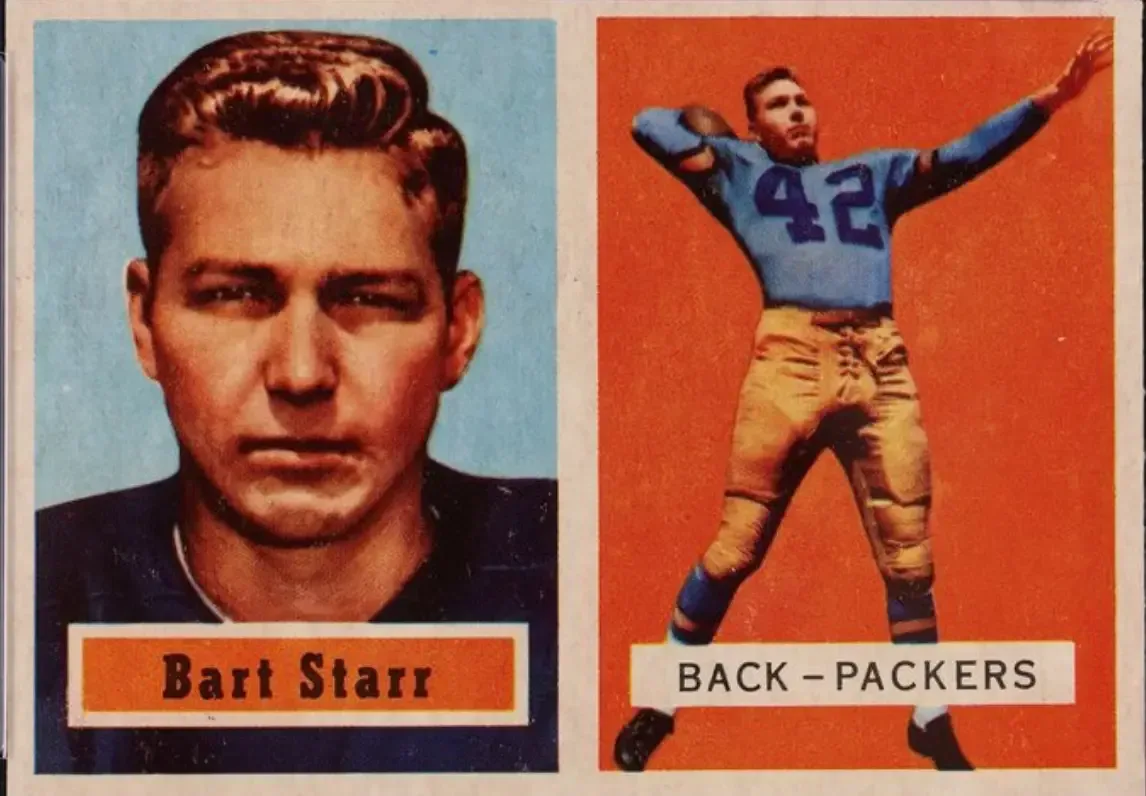
1. 1957 Topps Bart Starr #119
The 1957 Topps Bart Starr #119 earns the top spot because it is Starr’s rookie card. For vintage sports cards, a rookie designation often becomes the central organizing point of a player collection, and that is plainly the case here. It is the card most directly associated with the start of Starr’s cardboard career and remains the group’s strongest recorded sale by a wide margin.
A PSA 9 example sold for $288,000 through Heritage Auctions on February 24, 2017. The stated population includes no PSA 10 copies and three PSA 9 copies. Those details give the result useful context: the reported record was achieved by one of only three examples listed at PSA 9, in a card with zero PSA 10s recorded in the provided population figures.
The 1957 Topps design also has the appeal of a late-1950s football card, but the rookie status and high-grade scarcity are what push it ahead of the field. Its placement is further linked to Starr’s 1966 NFL MVP award, an individual honor that complements the championships and Super Bowl recognition that define the rest of the list.
How to Read the Five Cards as a Starr Collection
Taken together, these cards offer five different collecting stories. The 1957 Topps #119 is the rookie-card centerpiece. The 1958 and 1959 Topps cards provide consecutive, visually distinct vintage issues tied to Starr’s accuracy and All-Pro recognition. The 1961 Fleer Wallet Pictures card introduces a hand-cut magazine format. The 1968 Visual Panographics piece represents a scarce prototype with 3D presentation and a PSA Authentic designation.
- For rookie-card significance: 1957 Topps #119 is the defining choice, with a reported PSA 9 sale of $288,000 and no stated PSA 10s.
- For classic Topps design: the 1958 #66 and 1959 #23 offer two very different visual treatments of Starr.
- For format novelty: the 1961 Fleer Wallet Pictures was hand-cut from a magazine.
- For unusual scarcity: the 1968 3D prototype was not widely available and has a reported PSA Authentic population of two.
The broader practical takeaway is to match the record to the exact card and certification details being discussed. A $288,000 PSA 9 rookie-card result, a $40,260 PSA Authentic prototype result and a $40,000 PSA 10 regular-issue result are all meaningful, yet they are not interchangeable benchmarks. The distinction between a numerical grade and an authentication designation is particularly important in this group.
Starr’s cards also show why sports-card collecting can reward more than a chase for one expensive rookie. A collection built around his career can connect the five championships, four completion-percentage titles, three second-team All-Pro selections, 1966 MVP award and back-to-back Super Bowl MVPs to materially different artifacts. For a look at how exceptional-card sale headlines can shape interest across other hobby segments, see this report on a Pokémon-only week of major card sales.
For Starr, however, the hierarchy remains clear. The 1957 Topps rookie is the flagship. The prototype is the rare-format intrigue. The 1958 and 1959 Topps cards are traditional vintage touchstones, and the Fleer Wallet Pictures card preserves a magazine-origin oddity. Each one marks a different way that a quarterback from football’s early Super Bowl years can be remembered in cardboard.