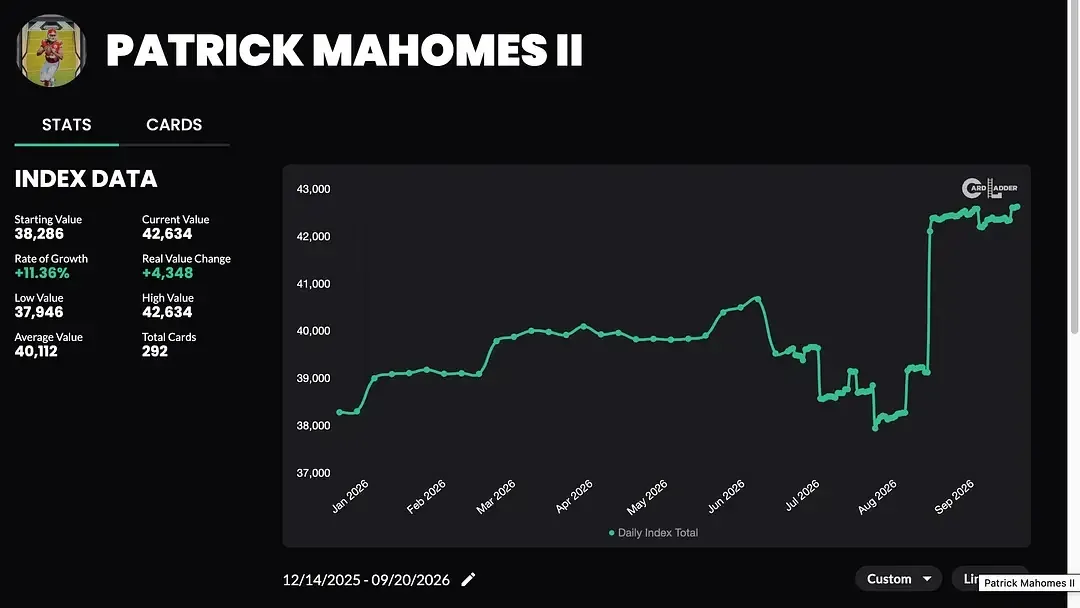
Patrick Mahomes and Tom Brady make for an irresistible sports-card comparison: two quarterbacks with extraordinary early championship résumés, each facing a major knee injury at age 31. But the numbers attached to their cards do not tell the same kind of story. They cannot, because the hobby surrounding each player was radically different.
Mahomes is entering his 10th NFL season and ninth as a starter with five Super Bowl appearances, three championships, three Super Bowl MVP awards and two regular-season MVP awards. Brady, at the comparable age, had three championships, two Super Bowl MVPs and one regular-season MVP. Both had already accomplished enough to make collectors consider legacy, not merely rookie-year potential.
The meaningful split is what the market was willing—and able—to price in at those moments. Brady’s major cards were valued mainly against accomplishments already on the board. Mahomes’ rookie-card market developed during a modern collecting boom, with far more graded copies, a much larger menu of parallel versions, and a market culture more accustomed to speculating on what an elite player could achieve next.
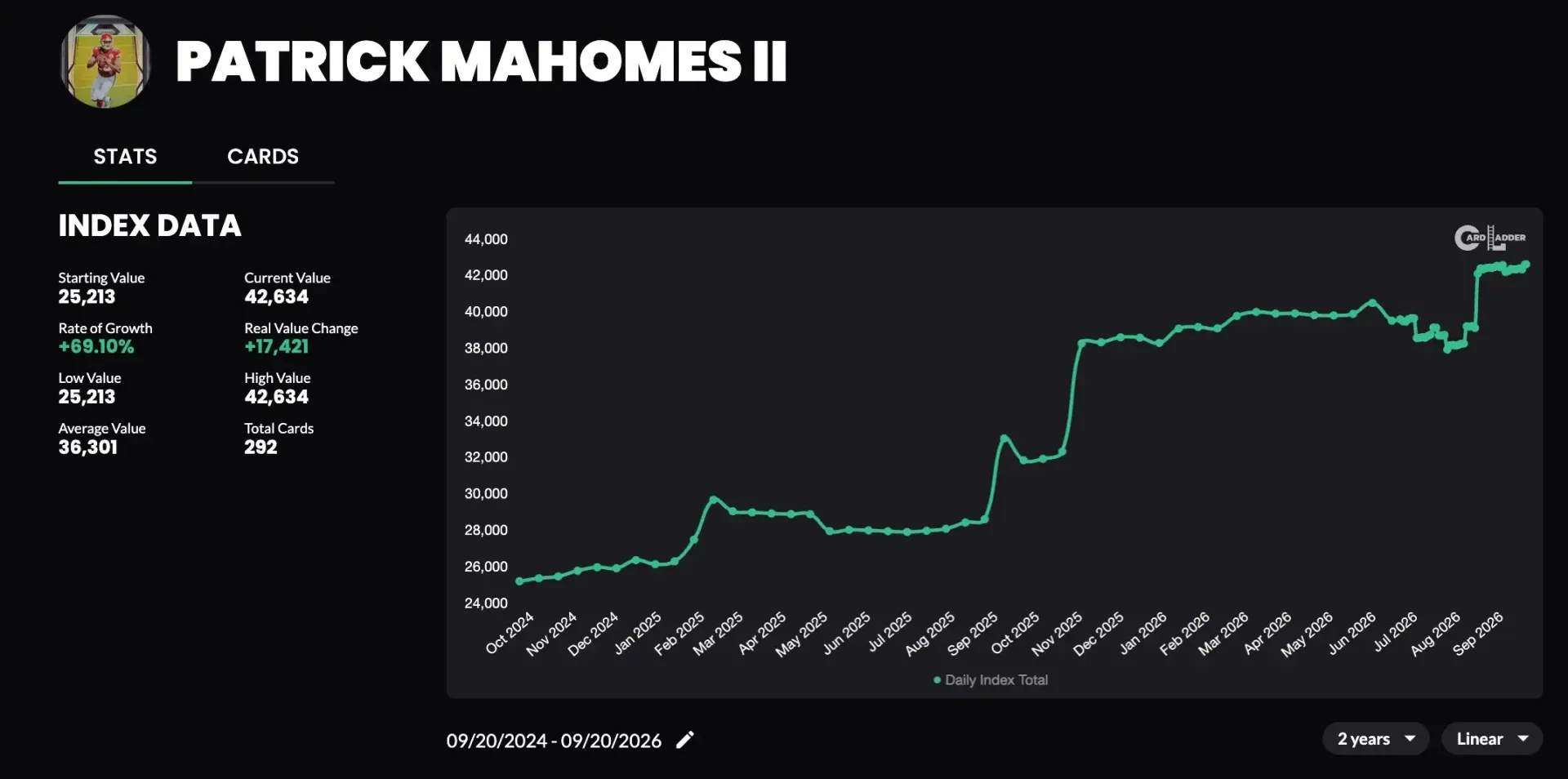
That distinction matters when interpreting the latest performance of Mahomes cards. A tracked Mahomes index has gained 11.36% since his December 2025 injury. On its own, that is positive movement. Yet the broader football index rose 38.73% over the same span. Mahomes has not been abandoned; he simply has not matched the pace of the wider football-card market.
A positive return can still signal relative caution
Card collectors often look first at whether a player’s market is up or down. That is useful, but incomplete. Relative performance asks a more revealing question: did a player’s cards keep up with comparable parts of the market?
Here, Mahomes’ 11.36% increase trails the football index by 27.37 percentage points. That does not prove that collectors have reached a verdict on his long-term standing. It does show that the market’s enthusiasm has been more restrained than the headline gain might suggest.
The timing offers a plausible explanation. Mahomes suffered torn ACL and LCL ligaments against the Chargers in December, an injury that coincided with Kansas City missing the playoffs for the first time since 2014. A major injury introduces uncertainty into any player-led market: recovery, return to form, team results and the possibility that a once-linear legacy case becomes less predictable. Card prices can reflect all of those concerns before a collector has a definitive answer to any one of them.
It is important not to turn an index into a diagnosis. An index tracks a selected group of sales and is useful for observing direction, but it is not a guarantee of what every Mahomes card has done. Individual cards can behave very differently based on grade, scarcity, condition, the type of card and how often one actually changes hands.
What “priced in” means for a player card
In collecting, a card is often described as being priced in when its current value already reflects expectations for future achievements. For Mahomes, that expectation is not just that he will remain a successful quarterback. It is that he could add championships and strengthen an all-time-great case.
That creates a difficult balance. Future upside can support demand, but the more future glory a buyer assumes at today’s price, the less room there may be for value to rise merely because that success was expected. Conversely, a severe injury can force the market to reassess the confidence it had placed in that projected future.
The current index gap is consistent with a market that still values Mahomes highly while accounting for that risk. It is not the same as saying collectors believe his career achievements no longer matter. Rather, the data suggests that football-card buyers have been more eager elsewhere during this period.
Why Brady’s age-31 prices are not a clean benchmark
Brady’s cards at age 31 existed in a markedly different ecosystem. Breaking culture was not yet a defining force in the way it is now. “Breaking” refers to a group purchase arrangement in which participants buy spots tied to teams, players or other outcomes and receive cards pulled from sealed product. The format can create rapid attention around new releases and particular players, but it was not a comparable market factor for Brady in 2008.
There was also less grading volume and less parallel saturation. A parallel is a variation of a card that differs from the standard version, often through color, serial numbering, finish or another design change. Parallels can be scarce and desirable, but a large number of variations also gives collectors many different ways to pursue the same player. Modern Mahomes collectors are navigating that wider supply of choices, along with a much larger population of professionally graded cards.
Brady’s 2000 Contenders Rookie Ticket autograph illustrates the scale of the difference. Today, a high-grade example can sell for more than $1 million and is among the hobby’s most liquid major cards. In card-market language, liquidity means a card can be bought or sold with comparatively active demand and observable pricing. At age 31 in 2008, the highest cited sale for that Brady card was $4,778.
That contrast should not be reduced to a simple claim that Brady was undervalued or that Mahomes is overvalued. The two cards passed through different eras of collector participation, grading, supply visibility and market infrastructure. A dollar figure from 2008 is not a direct ruler for a modern card market.
Still, Brady’s later career supplies an instructive legacy pattern. His most significant values rose after age 31 as he added four more Super Bowl wins. Collectors were able to react to accomplishments as they arrived, particularly once he surpassed Joe Montana in Super Bowl victories and the greatest-of-all-time discussion shifted sharply in his favor.
Mahomes’ cards present the inverse question: how much of a potential future title run had already been incorporated into pricing before it happened? His modern rookie cards were issued and graded during the hobby’s largest boom, making that question especially important.
The accessible rookie card remains active
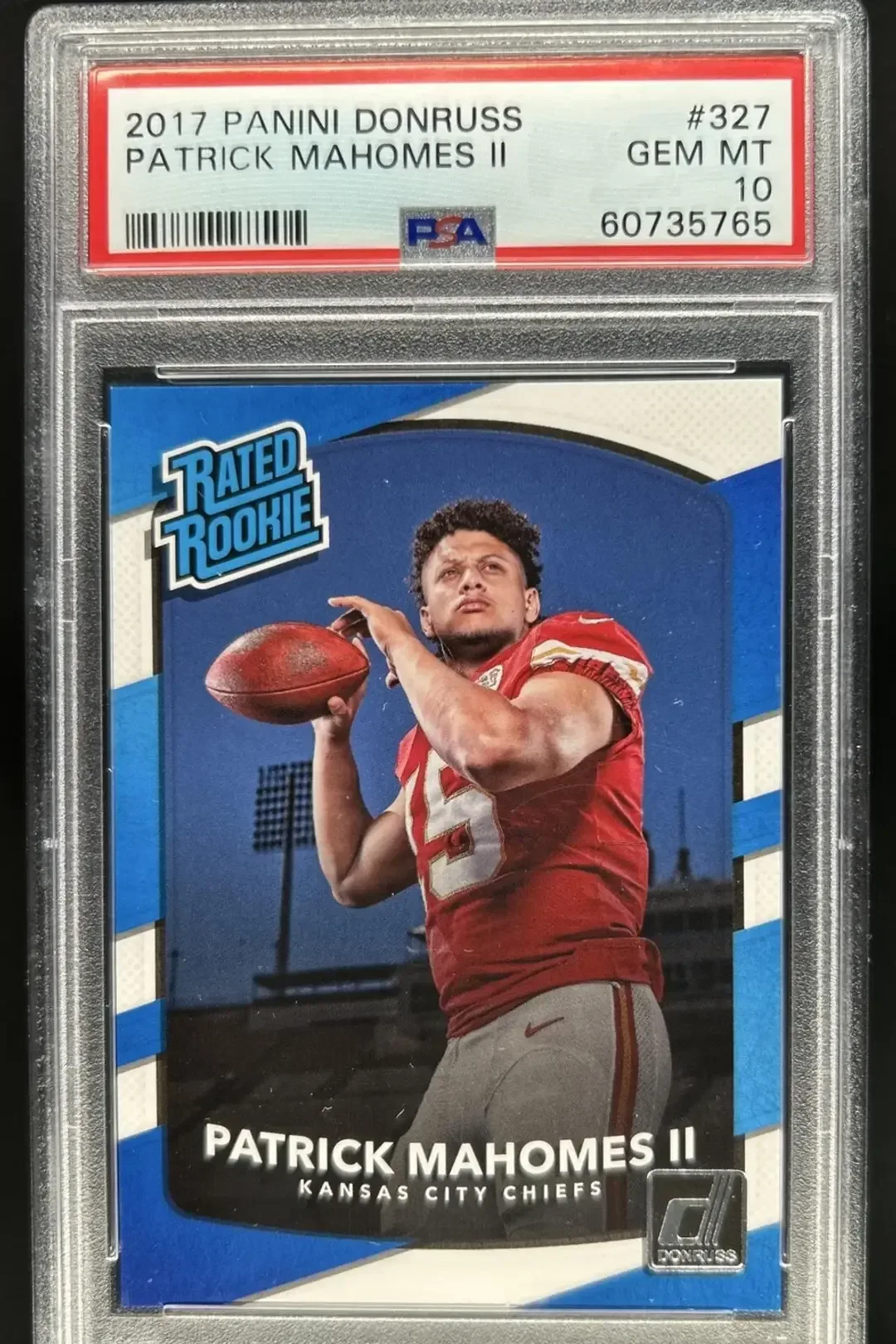
Despite the cautious relative performance, Mahomes cards are still trading. During the most recent week in the available sales data, 764 Mahomes cards sold. His most frequently sold rookie card was the 2017 Donruss Rated Rookie #327, averaging $393.
That detail is useful because it shifts attention away from only the headline-making premium cards. A 2000 Contenders Rookie Ticket autograph and a 2017 Donruss Rated Rookie serve different corners of the market. The former is an autograph-centered, elite legacy card; the latter is a recognizable mainstream rookie-card issue with greater accessibility. Sales of an actively traded card can provide a better window into routine collector interest than a rare trophy card that only appears at auction occasionally.
But an average sale price needs careful handling. It is a snapshot, not a permanent value. In particular, a graded-card price must be compared against the same grade, because condition is a major part of the product. Professional grading evaluates a card’s physical state and places it in a labeled holder; cards with different grades should not be treated as interchangeable just because they share a card number.
- For collectors: Decide whether the appeal is Mahomes’ career, a specific rookie design, a grade, or a scarce variation. Those are separate collecting goals.
- For buyers tracking value: Compare like with like: the same card, grade and, where relevant, parallel or autograph version.
- For sellers: Recent comparable sales are more useful than a single old high sale or a broad player index.
- For everyone: Treat broad market gains and player-specific gains as different signals. Mahomes rising while football rises faster is not the same as Mahomes leading the market.
What collectors should watch next
The key issue is no longer whether Mahomes has an established résumé. He clearly does. The market question is how it re-prices the uncertainty introduced by injury against the possibility of more postseason success.
On the available figures, the answer is nuanced: Mahomes’ tracked cards have appreciated since December, while the broader football market has climbed much faster. That suggests a discount for risk rather than an outright rejection of his long-term appeal. Further strong play could change the confidence calculation, but it would not erase the structural differences between his card market and Brady’s.
Collectors comparing the two should therefore resist the temptation to use Brady’s eventual trajectory as a promise. Brady’s later achievements unquestionably helped reinforce the biggest cards in his market. Mahomes may add to his own case, but modern supply, grading populations, parallel variety and early speculation mean the path from on-field greatness to card-price movement is less straightforward.
For a wider look at current football-card movement beyond established stars, see the latest NFL rookie card watch. Mahomes remains one of the hobby’s central names, but the latest index numbers make clear that being central to the conversation is not automatically the same as leading the market.