Five high-end football cards changed hands between September 15 and September 18, 2026, producing a leaderboard that mixes retired icons, a contemporary quarterback centerpiece and a 1-of-1 from a recent No. 1 overall pick. At the summit sits a 2021 Panini Absolute Kaboom! Tom Brady Gold /10 graded BGS 9, sold for $93,750 on September 17.
The five reported transactions range from $39,809 to $93,750. That is a substantial gap, but the list has a clear shared language: deliberately limited cards, recognizable premium brands, player-specific significance, and professional grading or authentication. Three different eras are represented, from Walter Payton’s 1976 rookie card to Caleb Williams’ 2024 one-of-one, showing how the market can place vintage, modern and retired-player material in the same weekly conversation.
The five sales at a glance
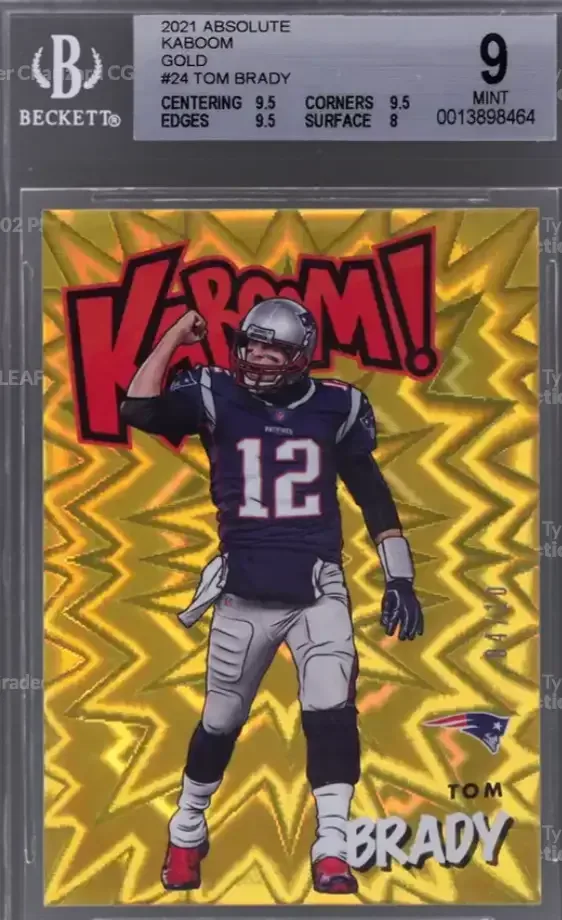
- 2021 Panini Absolute Kaboom! Tom Brady Gold /10, BGS 9 — $93,750, September 17.
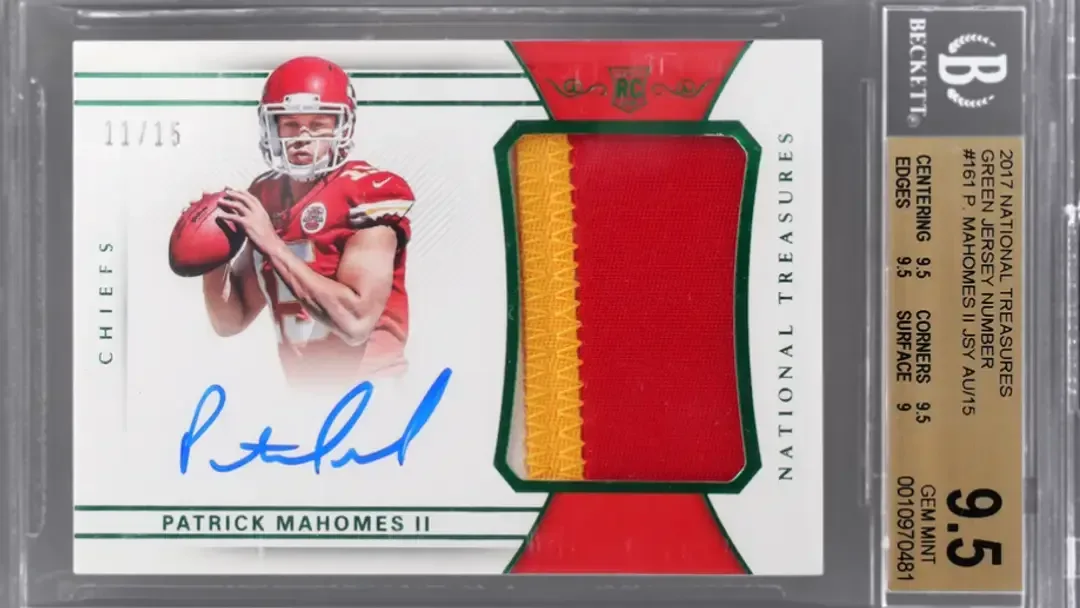
- 2017 National Treasures Patrick Mahomes Jersey Number Auto /15, BGS 9.5 — $90,000, September 17.
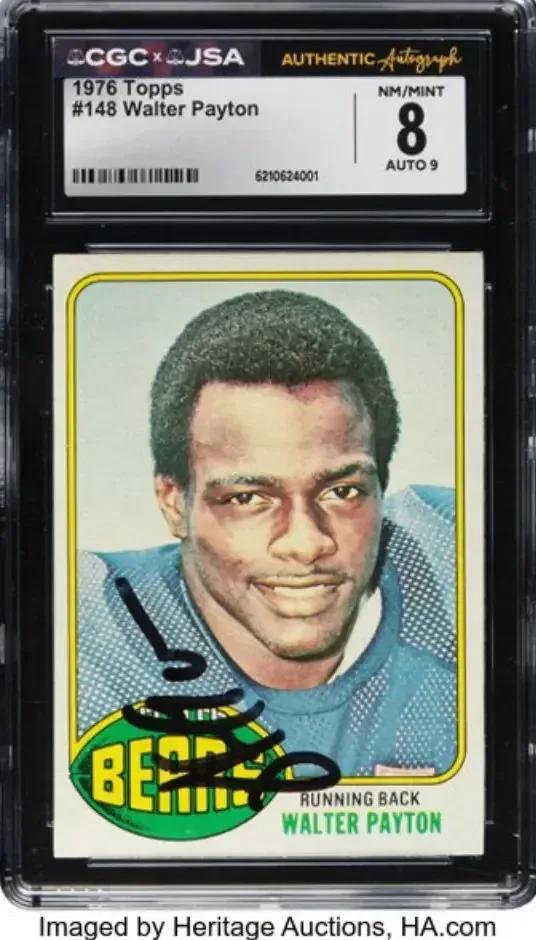
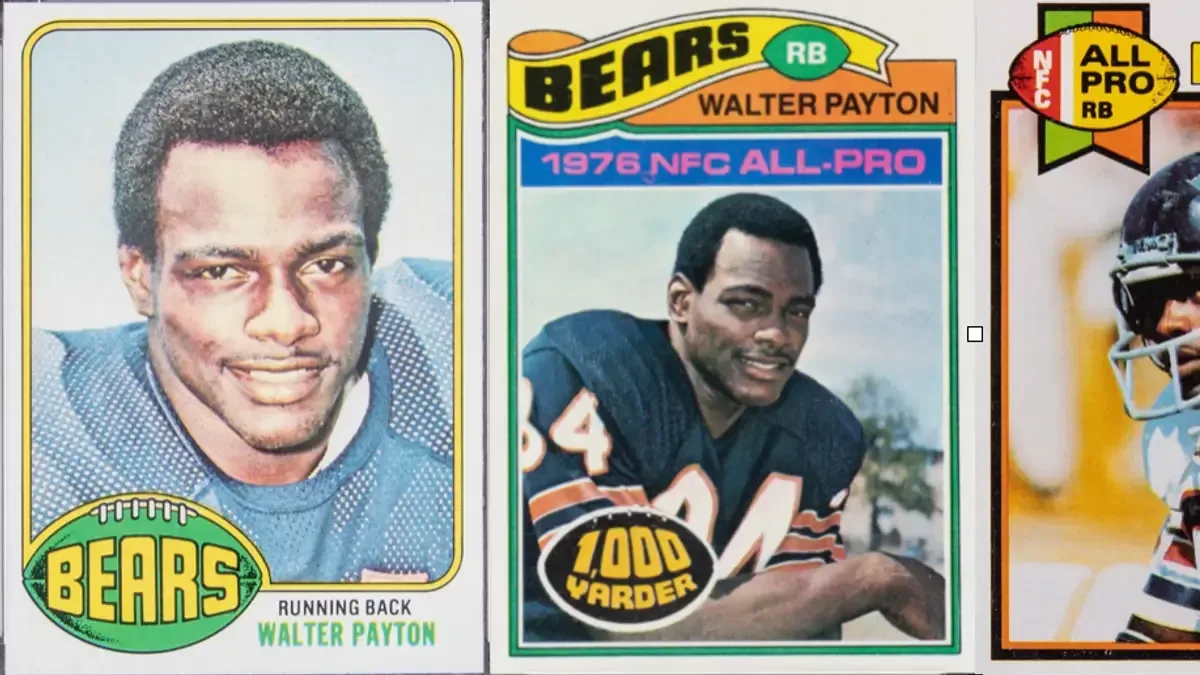
- 1976 Topps Walter Payton #148, CGC 8 / Auto 9 — $73,200, September 18.
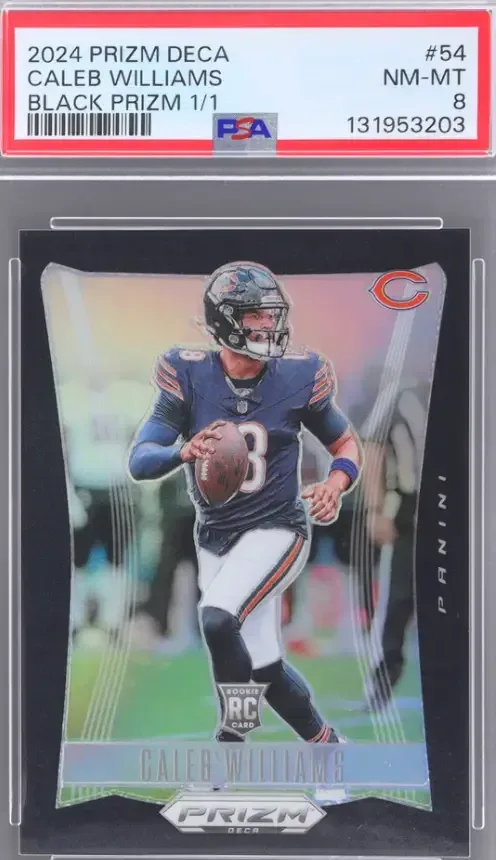
- 2024 Panini Prizm Deca Caleb Williams Black Prizm 1-of-1, PSA 8 — $70,125.60, September 17.
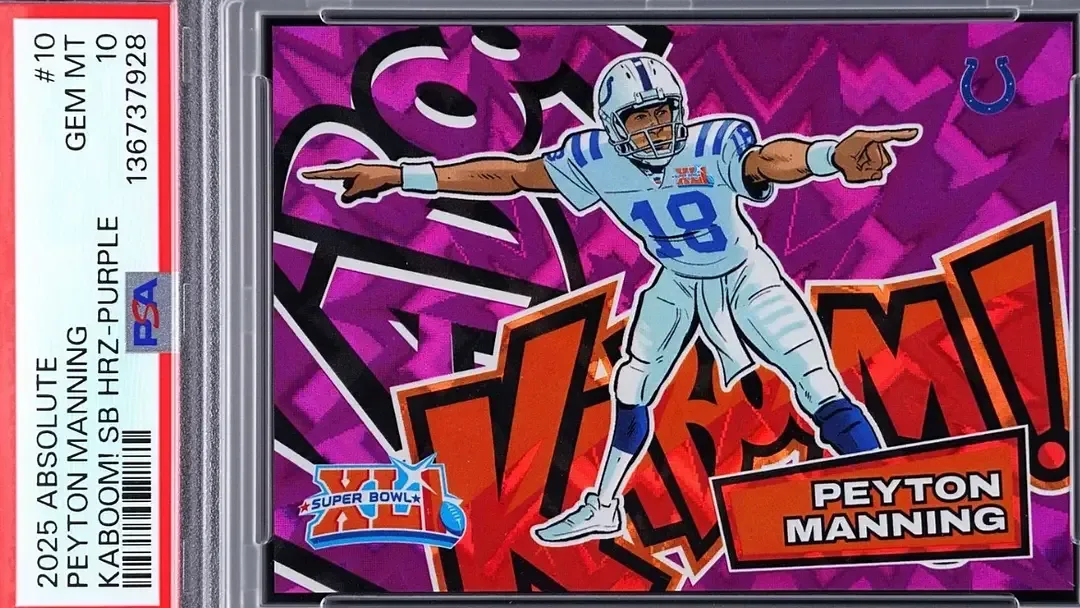
- 2025 Absolute Kaboom! Peyton Manning Super Bowl Horizontal Purple, PSA 10 — $39,809, September 15.
1. Tom Brady’s Kaboom! Gold /10 takes first place
The Brady card is a Gold parallel from the 2021 Panini Absolute Kaboom! line, serial-numbered to 10 copies and graded BGS 9. Its $93,750 sale made it the week’s highest reported result.
“/10” means the card is numbered to a stated production run of 10. That is different from a card merely described as scarce: the serial numbering gives collectors a direct limit to evaluate. It does not establish that all 10 copies remain available, graded or even known publicly, but it sets the intended ceiling for the parallel.
The result also underscores the appeal of a premium Brady insert rather than a conventional rookie-card format. Brady retired after finishing his playing career with the Tampa Bay Buccaneers, following his New England Patriots tenure. His broader profile extends beyond the field through broadcasting, business interests and team ownership stakes, but this sale is fundamentally a market result for a low-numbered card carrying one of football’s most enduring names.
A BGS 9 is a high grade, though it is not the company’s highest possible assessment. In a market where the exact card, serial number, grade and sale venue all matter, the $93,750 figure should be read as a documented transaction for this particular copy—not a blanket price for every Brady Kaboom! or every Gold parallel.
2. Patrick Mahomes’ jersey-numbered rookie auto reaches $90,000
Just $3,750 behind Brady, a 2017 National Treasures Green Jersey Number Auto Patrick Mahomes II /15 in BGS 9.5 sold for $90,000 on September 17. The card is a rookie-year issue and has a print run matching Mahomes’ No. 15 jersey number.
Its design combines three features that collectors often identify directly from the card description: a tricolor patch in Kansas City Chiefs colors, an autograph in blue ink, and a serial-number limit of 15. The “Jersey Number” designation here has a literal numerical hook: the card is limited to the same number Mahomes wears.
Related coverage includes Tom Brady Kaboom! Gold Tops a $93,750 Week for Football Cards.
An autograph card includes the player’s signature, while a patch card incorporates a piece of uniform material. This card is described as having both, alongside the rookie-year connection. Those traits do not make every example equivalent; grade and condition remain part of the individual card’s identity. Here, BGS 9.5 is the strongest grade among the five leading sales.
Mahomes is the only player in the top two whose card is tied to a rookie season and a current playing career. That places the $90,000 transaction beside two distinct collecting propositions: a retired great’s low-numbered premium insert at No. 1, and a historically important signed rookie at No. 3.
3. Walter Payton’s signed 1976 Topps rookie remains in demand
The No. 3 sale is a 1976 Topps Walter Payton #148 rookie card, graded CGC 8 with an Auto 9, which sold for $73,200 on September 18. Payton spent his 13-year NFL career with the Chicago Bears and was a perennial All-Pro running back.
This listing separates two assessments: the card itself received a CGC 8, while the signature earned an Auto 9. That distinction matters. Card grading evaluates the physical collectible, whereas an autograph grade concerns the quality of the signature. A dual notation communicates more detail than a single overall number, particularly for a vintage card that has also been signed.
The $73,200 sale was not the only notable Payton transaction that day. Another signed Payton rookie card sold for $64,050 on September 18. While the weekly ranking avoids filling multiple slots with versions of the same card, the second result is meaningful context: it indicates that Payton’s signed rookie material generated multiple major sales during the same window.
Payton’s entry differs sharply from the modern, serial-numbered cards around it. A 1976 base rookie does not need a printed “/10” or “1/1” designation to carry significance. Its appeal is built around rookie-card status, the player’s legacy, vintage condition and, for these examples, the addition of an authenticated and graded signature.
4. Caleb Williams’ Black Prizm 1-of-1 sells for $70,125.60
A 2024 Panini Prizm Deca Caleb Williams Black Prizm 1-of-1 graded PSA 8 brought $70,125.60 on September 17. Williams was selected first overall by the Chicago Bears in the 2024 NFL Draft, and the card is described as one of his top licensed cards from that rookie year.
A 1-of-1, often called a one-of-one, is a card with a stated print run of one for that precise parallel. In this case, “Black Prizm” identifies the specific one-of-one parallel, not every Caleb Williams card or every Prizm Deca issue. That exactness is central to interpreting the price: a different Williams rookie, a different parallel or a different grade is a different collectible.
The PSA 8 grade is lower than several grades elsewhere in the top five, yet the card still exceeded $70,000. The practical lesson is not that condition has stopped mattering. Rather, it shows that grading is only one part of a card’s market identity. Player, rookie-year status, license, brand, parallel and declared uniqueness can all be visible variables before a buyer even gets to the grade.
It is also the list’s clearest example of a card whose appeal is attached to present-day potential as well as its physical rarity. The sales group otherwise leans heavily toward established legends, with only Mahomes and Williams representing more recent playing eras.
5. Peyton Manning’s Super Bowl Kaboom! Purple closes at $39,809
The fifth spot belongs to a 2025 Absolute Kaboom! Super Bowl Horizontal Purple Peyton Manning PSA 10, which sold for $39,809 on September 15. The card honors Manning’s Super Bowl XLI victory and MVP performance with the Indianapolis Colts in 2007. He later won a second Super Bowl with the Denver Broncos and ended his NFL career in 2016.
This is the only card in the five with a reported PSA 10 population of 10. Population, or “pop,” is the count of copies a grading company has assigned a particular grade. It is useful information, but it is not the same thing as the total number printed. The supplied population figure says 10 examples have been graded PSA 10; it does not say how many Purple cards exist overall, how many have been submitted, or how many may be held privately.
A PSA 10 is the top numeric grade on PSA’s standard 10-point scale. The result therefore pairs a perfect-grade example with a Super Bowl-specific design and an iconic retired quarterback. At $39,809, it sits well below Brady’s Gold /10 but remains a major sale in a list where every card crossed the $39,000 threshold.
What the week says—and what it does not
The five results make a strong case for reading card descriptions closely. Terms such as Gold /10, Jersey Number Auto /15, 1-of-1, PSA 10 population and Auto 9 may look like catalog shorthand, but each tells a buyer something distinct about production, subject matter, condition or authentication.
- Serial number: a stated cap on that card’s parallel, such as 10, 15 or one copy.
- Parallel: a variation of a card design; Gold, Purple and Black Prizm identify specific versions in this group.
- Rookie card: a card from a player’s rookie year; both the Mahomes and Williams entries carry that connection.
- Grade: a third-party condition assessment attached to the individual submitted card.
- Population: the number of examples a grading company has recorded at a particular grade, not automatically the full print run.
There are limits to the conclusions a five-sale snapshot can support. These results do not establish an average market price for any player, set or parallel. They are individual sales of unusually specified cards, and several are explicitly scarce by serial number or have an additional autograph or memorabilia component. The Payton example also demonstrates why duplication should be considered carefully: a second $64,050 signed rookie transaction is relevant, but does not mean every Payton rookie should be valued around either reported figure.
The practical takeaway for collectors is to compare like with like. Check the exact year, set, player, parallel, serial-numbering, grade and autograph notation before treating any headline price as a comp. That attention to detail is every bit as important with a 1976 signed rookie as it is with a Black Prizm one-of-one.
Football’s visual culture reaches beyond cards, too: custom on-field design remains part of the broader collector conversation, as seen in Quincy Williams’ Travis Scott Air Max 1-inspired Browns cleats. In this week’s card results, however, the determining details are more compact: a printed number, a grade label, a signature, a patch and five names with enormous football followings.