Tom Brady and Patrick Mahomes did not merely lead a recent slate of major football-card transactions. They filled it completely. The five highest reported sales in the period all belonged to the two quarterbacks, combining for $1.104 million in realized prices. Brady accounted for three of the five positions, while Mahomes claimed the other two.
That concentration is the story. The group spans rookie-year cards, later-career premium releases, autographs, memorabilia patches, a short-print insert and multiple grading outcomes. In other words, it was not one isolated card type dragging two names to the top. Buyers pursued several versions of Brady and Mahomes across different products and scarcity levels.
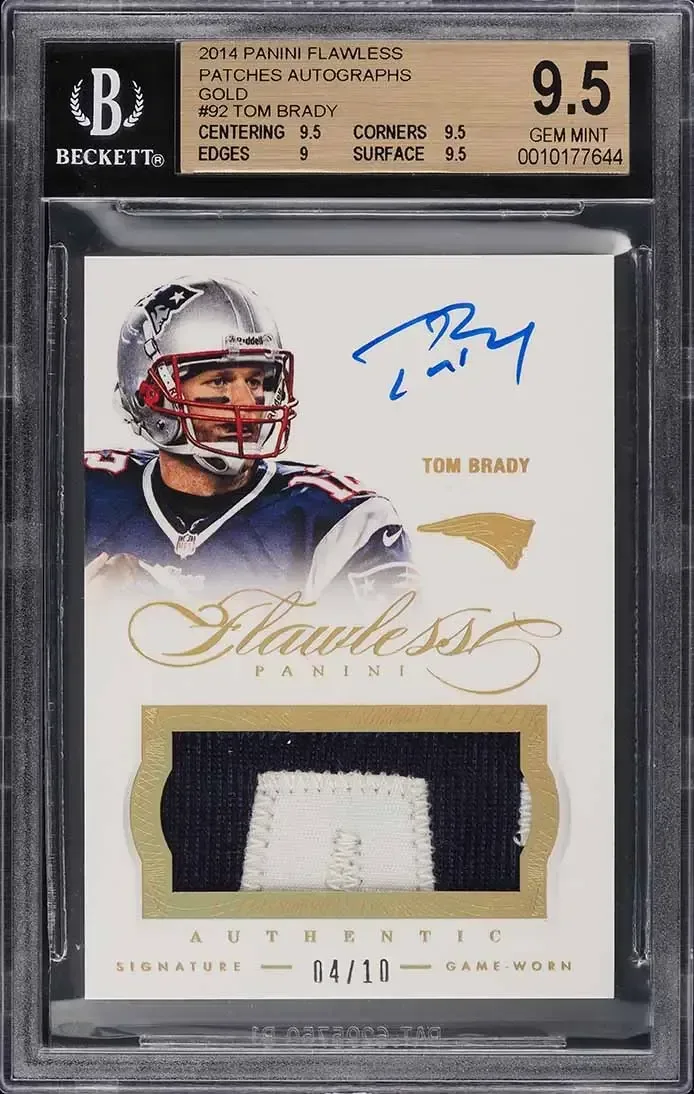
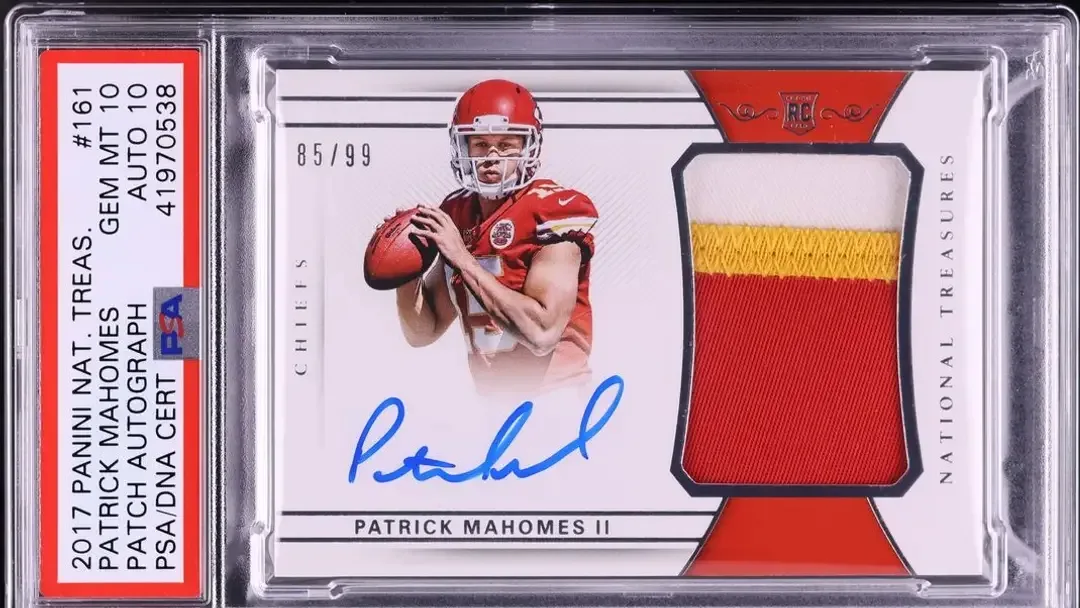
The headline result was a 2014 Panini Flawless Gold Tom Brady patch autograph, numbered to 10 and graded BGS 9.5, which sold for $300,000 on October 23. Close behind was a 2017 Panini National Treasures Patrick Mahomes rookie patch autograph numbered to 99, graded PSA 10, at $264,000 the same day.
For collectors, the more revealing detail may be how much the list rewards combinations of player stature, rarity, card format and condition—while also showing that a famous issue can retain substantial value even when its certification carries a major caveat.
The five reported sales
- 2014 Panini Flawless Gold Patch Auto /10 Tom Brady, BGS 9.5 — $300,000. Sold October 23. The card includes Brady’s autograph and a game-worn patch, with a print run capped at 10 copies.
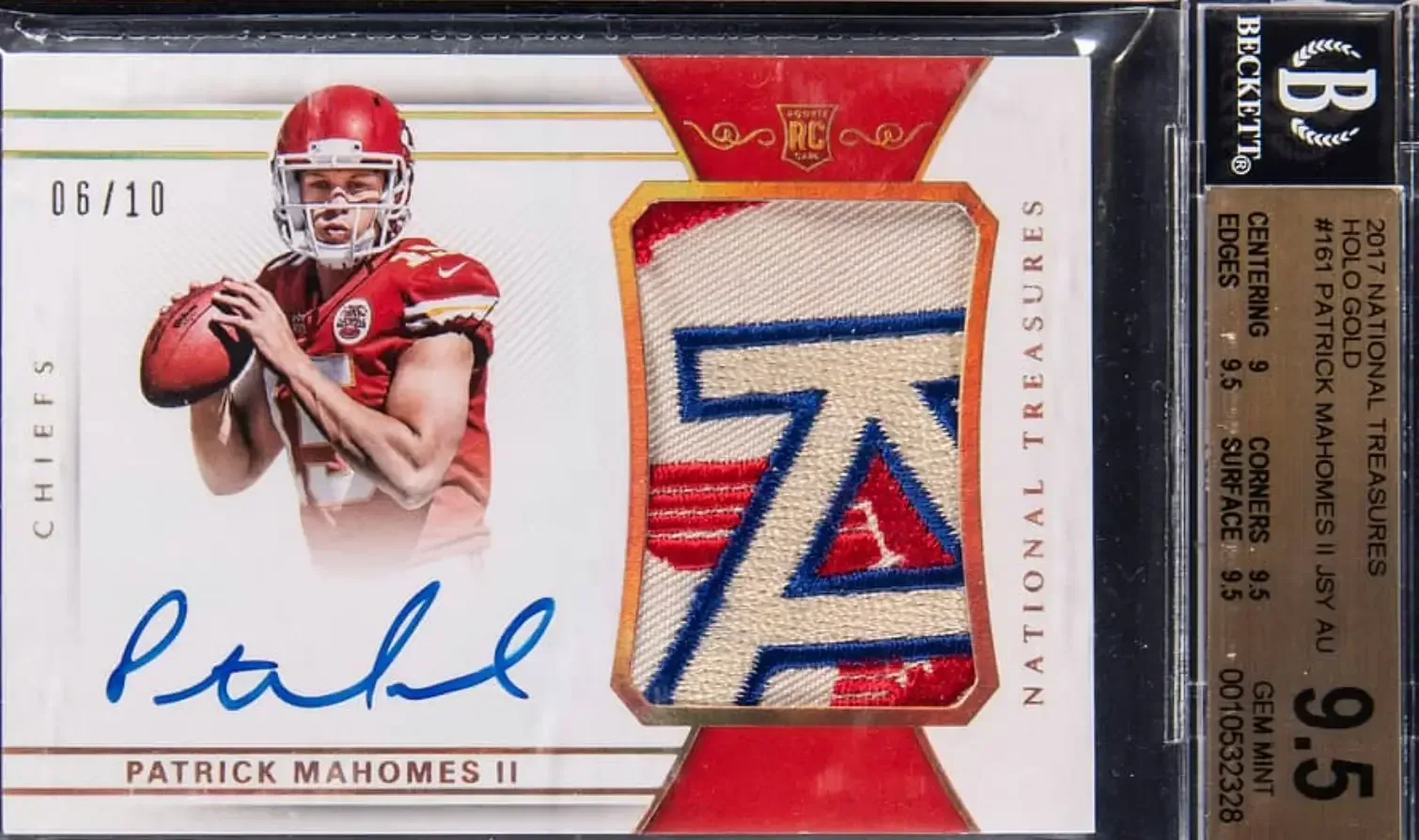
- 2017 Panini National Treasures Patch Auto /99 Patrick Mahomes, PSA 10 — $264,000. Sold October 23. This Mahomes rookie card pairs a blue autograph with a tricolor jersey patch.
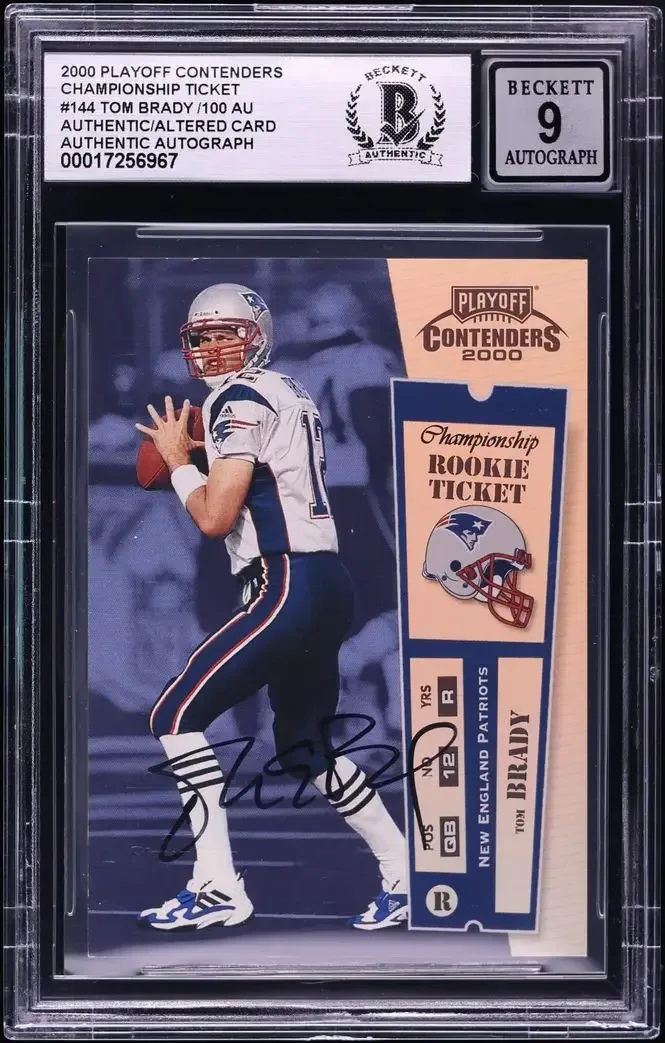
- 2000 Playoff Contenders Championship Ticket Auto /100 Tom Brady, BGS Authentic/Altered, Auto 9 — $198,000. Sold October 23. Its grade designation is especially important: the card was certified as altered, while its autograph received a 9 grade.
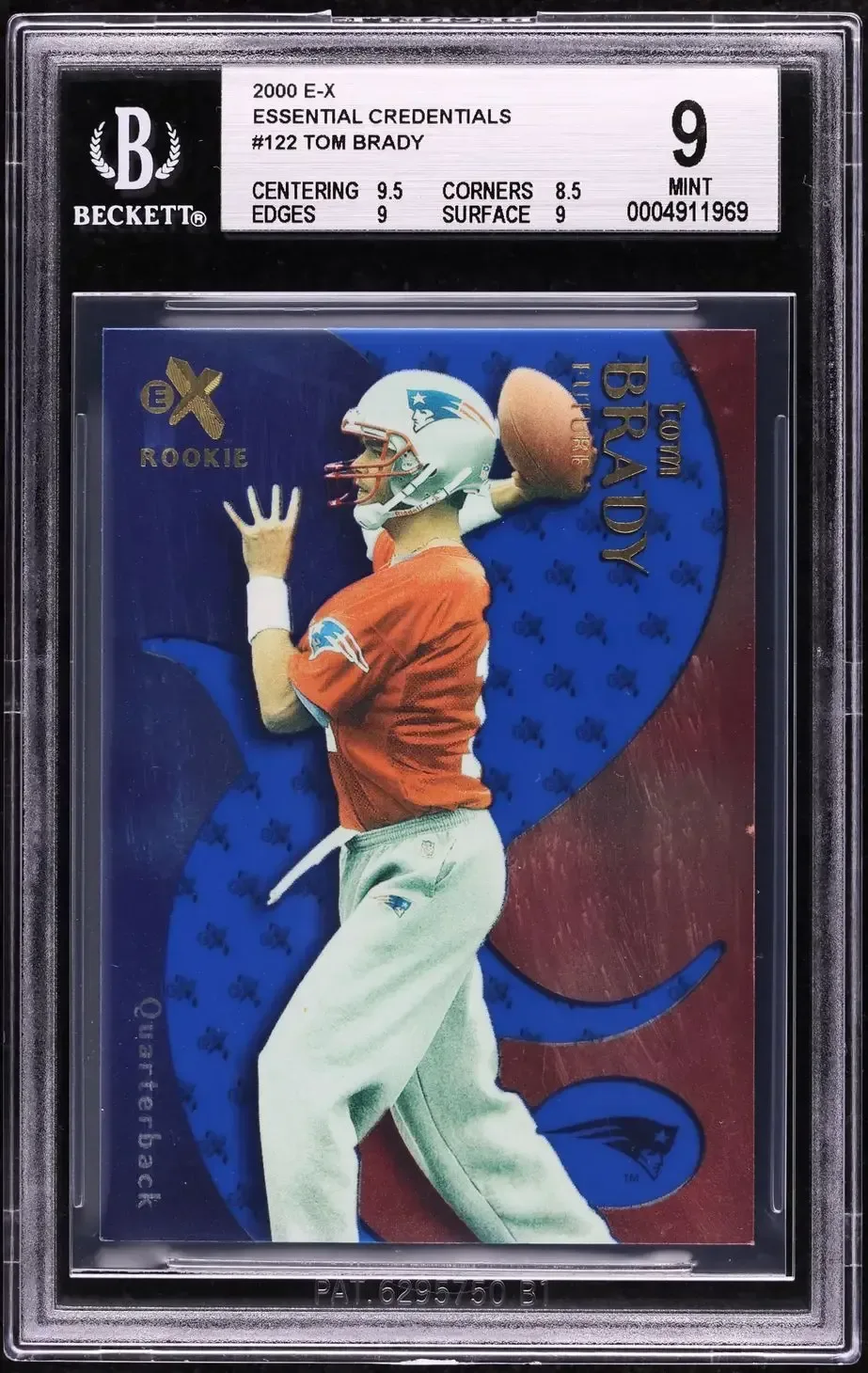
- 2000 Fleer E-X Essential Credentials Future /25 Tom Brady, PSA 9 — $186,000. Sold October 23. It is a low-numbered Brady rookie card from the 2000 Fleer E-X release.
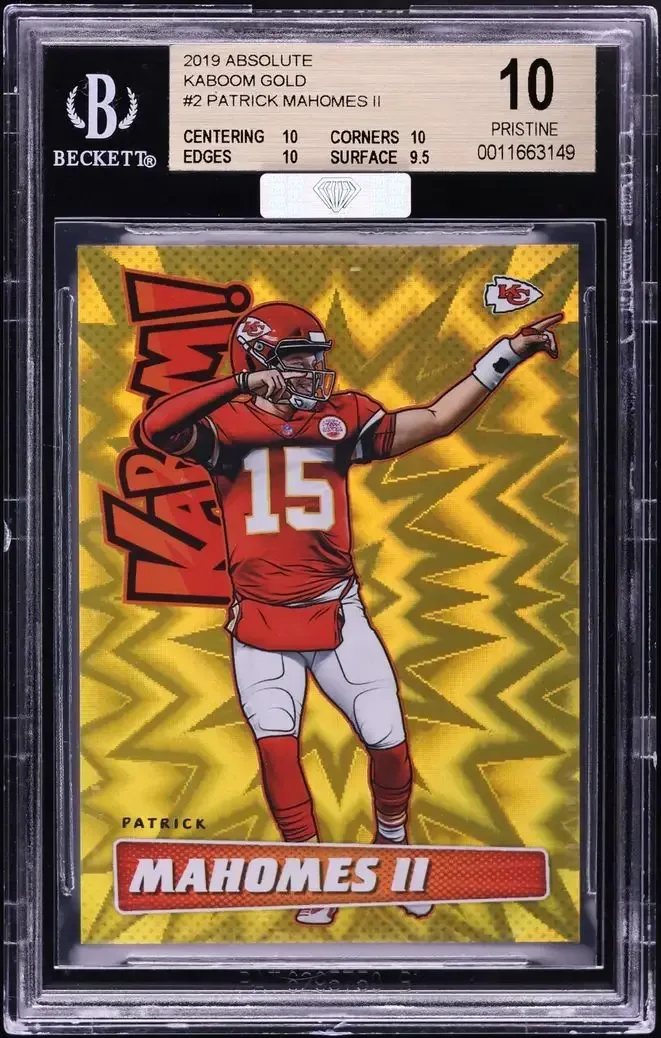
- 2019 Absolute Kaboom! Gold /10 Patrick Mahomes, BGS 10 — $156,000. Sold October 23. The short-printed Gold Kaboom! comes from the season that culminated in Mahomes’ first Super Bowl victory, Super Bowl LIV.
An additional 2000 Playoff Contenders Brady parallel—non-numbered and graded BGS 9.5 with an Auto 10—sold for $180,000 on October 23. It falls just outside the five-card rundown above but reinforces how deeply demand ran for that specific Brady rookie-card family.
Why these cards, not just these players?
Brady and Mahomes are the common thread, but each card brings more than a recognizable name. The entries repeatedly stack collector-facing attributes: limited numbering, rookie-card status, on-card or card-signed autographs, incorporated jersey material, prominent product lines and high third-party grades.
A serial number such as /10, /25, /99 or /100 indicates a stated limitation for that version of a card. It does not automatically make every copy equally desirable, but it gives a buyer a concrete measure of how few examples were issued in that parallel. The $300,000 Brady Flawless and $156,000 Mahomes Kaboom! are both limited to 10, the tightest stated runs among the five.
Patch autograph, often abbreviated as “RPA” when it is a rookie patch autograph, describes a card that combines a signature and a piece of jersey material. The Brady Flawless leader has an autograph and game-worn patch; the Mahomes National Treasures card has an autograph and tricolor jersey patch. These are not plain base cards. Their physical components give collectors multiple reasons to focus on one item.
Related coverage includes Brady and Mahomes Own the Week’s Biggest Football Card Sales.
Rookie card is also doing heavy lifting. Brady’s 2000 Fleer E-X Essential Credentials and 2000 Playoff Contenders Championship Ticket are described as rookie cards, as is the 2017 National Treasures Mahomes. Rookie-year issues are tied to a player’s arrival in the hobby, making them natural targets for collectors building a player-focused collection or pursuing high-end key cards.
Then there is the product identity. “Kaboom!” identifies a distinctive insert line rather than a normal base-card designation. “Gold” specifies the version, and the Mahomes example’s /10 numbering establishes its limited production. “Essential Credentials Future,” “Championship Ticket,” “National Treasures” and “Flawless” likewise identify particular card lines or subsets. Collectors should read the full card name rather than treating the player, year and manufacturer as enough information: different inserts and parallels from the same release can be materially different cards.
Brady’s three-card showing includes an important warning label
The $198,000 Brady Championship Ticket Auto offers the week’s clearest reminder that the exact wording on a grading label matters. Its BGS designation was Authentic/Altered, and the autograph was graded 9. That is not the same as a conventional numerical card grade. An “altered” designation signals that the grader identified an alteration, a disclosure that should be central—not peripheral—to any discussion of the sale.
Yet the card still brought nearly $200,000. That outcome speaks to the standing of the 2000 Playoff Contenders Championship Ticket Brady issue, especially in a limited /100 format with an autograph. It should not be read as evidence that alterations are irrelevant. The same reporting notes that an unaltered PSA 8 copy sold for $854,000 on October 17, a dramatic difference that illustrates why label language, grade and condition status cannot be skipped when comparing public sales.
There is another useful comparison inside the same card family. A non-numbered Brady parallel graded BGS 9.5 with an Auto 10 sold for $180,000 on October 23. It was not the same version as the altered /100 Championship Ticket, and the two holders communicate different information. The results are close enough to make the point: a card’s exact parallel, numbering, authentication status and autograph grade all belong in the description before a collector tries to draw a pricing conclusion.
The practical takeaway is simple. A listing title that only says “Brady Contenders auto” leaves out the details that shape the transaction. Buyers comparing examples should identify the edition, whether it is numbered, the card’s certification wording, the grade assigned to the card itself, and—when applicable—the separate grade assigned to the autograph.
Mahomes shows two different routes to a six-figure card
Mahomes’ two cards offer an instructive contrast. The 2017 National Treasures Patch Auto /99 reached $264,000 with a PSA 10 grade, a rookie-card identity, an autograph and a tricolor patch. It is a high-end rookie-format card built around several tangible collecting features at once.
The 2019 Absolute Kaboom! Gold /10, meanwhile, sold for $156,000. It is not presented here as a rookie card; its appeal comes from a different recipe: a named insert, Gold parallel treatment, a ten-copy limitation and a BGS 10 grade. It also comes from the 2019 season, when Mahomes won his first Super Bowl in Super Bowl LIV.
That contrast matters because it discourages a one-rule reading of premium-card demand. The biggest sale in a player’s market does not have to be a rookie card, and the most compelling card does not have to contain a patch or autograph. Collectors are often evaluating the whole configuration: player, issue, rarity, visual identity, grade and any signature or memorabilia element.
What the $1.104 million total does—and does not—say
Adding the five reported prices yields $1.104 million. That is a striking concentration of money around two quarterbacks over a short reporting window. Brady’s three cards totaled $684,000, while Mahomes’ two totaled $420,000.
It is reasonable to say the results demonstrate strong demand for high-end examples connected to both players during this specific set of sales. It would be a stretch, however, to treat five results as a complete price guide for all Brady or Mahomes cards. The list is made up of unusually scarce and premium pieces, several with autographs or patches, and every listed sale has a specific grading context.
That distinction is useful for anyone watching the sports-card market. A six-figure sale for a BGS 10 Gold /10 insert or a PSA 10 rookie patch autograph is evidence about that particular tier. It does not establish the value of a more common version, an ungraded copy, a different parallel or a card with a different certification designation.
For collectors who enjoy comparing how limited variants shape demand across card types, Joking Joystick’s trading-card coverage also follows specific issues and character-driven releases beyond football.
A checklist for reading blockbuster football-card results
- Match the exact card: Confirm year, manufacturer, set, insert or parallel, and serial-numbered version. “Gold /10” is not interchangeable with another Kaboom! or another Gold card.
- Read the entire grading label: Note the grading company, numerical grade, qualifiers and whether the autograph has a separate grade. “Authentic/Altered” must not be compared casually with a standard numeric grade.
- Identify the card’s components: An autograph, patch and rookie-card designation each describe different aspects of the collectible. A card may have one, several or none.
- Keep sale comparisons narrow: The $854,000 unaltered Brady PSA 8 and the $198,000 altered Brady example demonstrate why a shared player and set name are not enough for a direct comparison.
- Treat a weekly leaderboard as a snapshot: These results identify notable transactions, not a universal value for every card bearing Brady’s or Mahomes’ name.
For this particular run of transactions, the market’s preference was unmistakable: Brady’s legacy cards and Mahomes’ premium issues supplied every spot at the top. But the details underneath that headline are where the real collector lesson sits. Scarcity mattered. Rookie status mattered. Patches and autographs mattered. Grades mattered. And, in Brady’s altered Championship Ticket sale, the label’s qualifier mattered enough that it should be the first thing a prospective buyer notices.