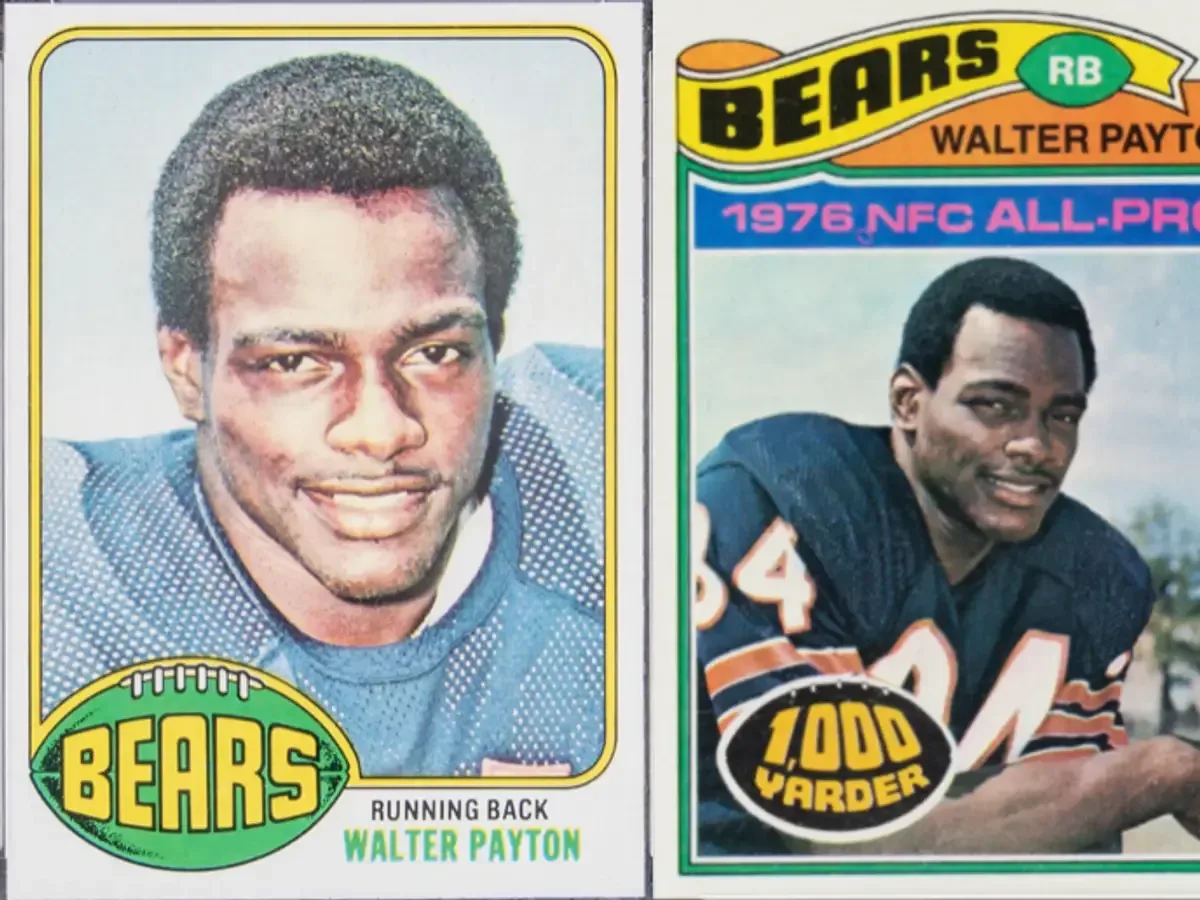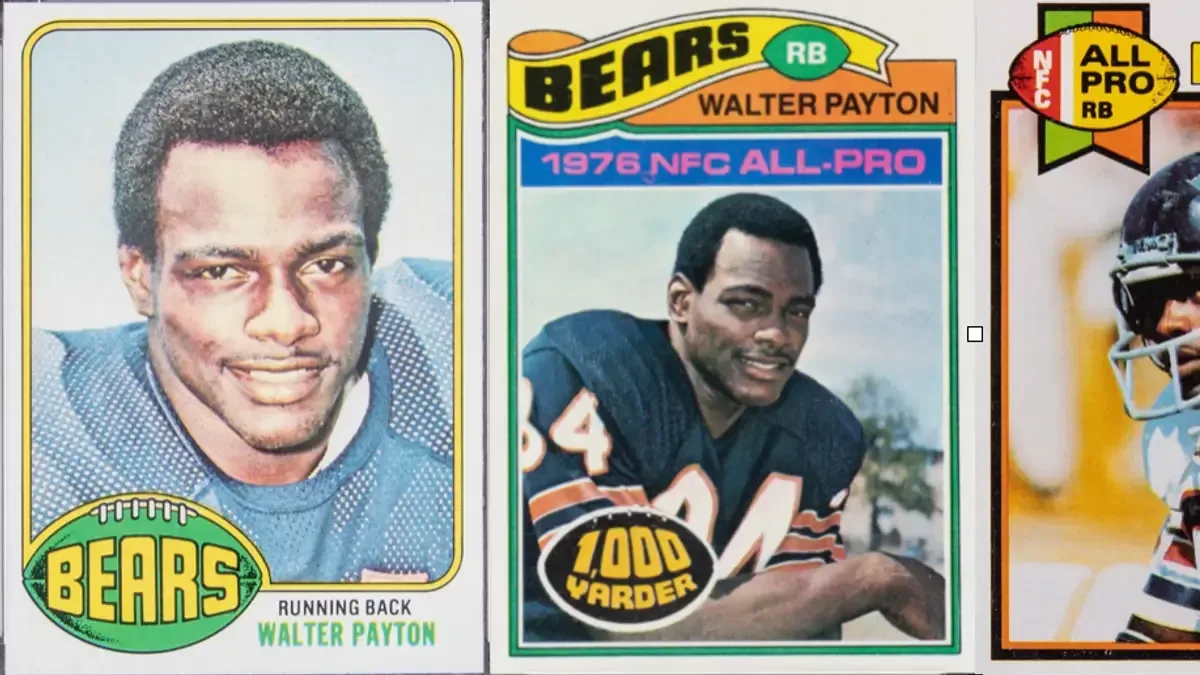
Walter Payton’s place in football-card collecting begins with a straightforward fact: his 1976 Topps #148 is the essential rookie card. But a serious Payton run does not stop at one card. His principal Topps issues from 1976 through 1981 create a compact vintage sequence that tracks an extraordinary period of recognition, from rookie-year achievements to an MVP season and the lasting iconography of Chicago’s No. 34.
For collectors, the appeal is not merely that every card bears a famous name. The group offers distinct collecting lanes. A buyer can pursue the flagship rookie in an attainable mid-grade example, target high-grade copies of the later annual issues, build the complete 1976–81 Topps stretch, or enter the much narrower signed-card market. The available recorded sales also make one principle unmistakable: a card’s year, grade, autograph and population can change its value dramatically.
Payton was known as “Sweetness,” and his legacy reaches beyond the field. The NFL’s Walter Payton Man of the Year Award recognizes a player who represents humanitarian values away from the game. That continuing association adds real meaning to the card run: these are pieces tied to both a celebrated running back and an enduring standard of off-field recognition.
The core Walter Payton Topps cards
1976 Topps #148: the foundational rookie card
The 1976 Topps Walter Payton #148 is the centerpiece. As Payton’s sought-after rookie card, it anchors nearly every serious discussion of his vintage cards, and the reported transactions show how strongly collectors separate examples by condition and authentication.
An SGC Gold Label Pristine 100 copy sold for $228,000 on February 26, 2021. A PSA 10 reached $124,230 on March 8, 2021, while another PSA 10 sale was recorded at $98,405.20 on August 6, 2026. At a notably different entry point, a PSA 7 sold for $888 on September 15, 2026. Those figures should not be read as a permanent price guide; they are specific completed sales of specific copies. They do, however, clearly illustrate how condition can alter the market conversation around the same 1976 card.
In grading language, a PSA 10 is a Gem Mint assessment, while a PSA 7 is a Near Mint grade. Population, often shortened to “pop,” is the number of examples a grading company has assigned a particular grade. The reported PSA 10 population for Payton’s rookie is 56. That is a useful data point, but it is not a total count of all surviving cards, nor does it include examples graded by every other company or cards that remain ungraded.
For a collector focused on the rookie alone, the practical decision is to establish a condition goal before shopping. Chasing the numerical high end is a different project from finding a presentable authenticated example at a lower grade. The reported PSA 7 transaction demonstrates that the same key rookie can be approached without treating a PSA 10 as the only legitimate destination.
1976 Topps #148 PSA 7/Auto 10: the elite signed version
A signed rookie card is a separate category from an unsigned rookie, especially when the autograph itself has been graded. The reported top sale for a 1976 Topps Payton #148 graded PSA 7 with an Auto 10 was $280,600 on March 2, 2026. The copy was identified as a population-two card.
Related coverage includes Six Walter Payton Cards That Define a Legendary Football Collection.
The dual notation matters. PSA 7/Auto 10 means the card and the signature receive separate evaluations: the card is graded 7, while the autograph is judged 10. It does not mean the cardboard is a PSA 10. That distinction is crucial when comparing signed cards against unsigned Gem Mint copies, because each sale represents a different mix of card condition, autograph quality and scarcity.
The $280,600 result exceeded the cited sales for the pristine and PSA 10 unsigned versions, underlining the premium that can attach to a rare, highly graded autograph on the key rookie. It also shows why collectors should avoid compressing all versions of “the Payton rookie” into one price expectation. An unsigned PSA 7, an unsigned PSA 10 and a PSA 7/Auto 10 are materially different collectibles.
1977 Topps #360: a second-season snapshot
Payton’s 1977 Topps #360 represents his sophomore NFL season and references accomplishments from his rookie campaign, including 1,000-plus rushing yards and 1976 All-Pro recognition. Its reported PSA 10 population is 13, lower than the cited PSA 10 population for the 1976 rookie card. A PSA 10 copy sold for $31,200 on April 25, 2022.
The 1977 issue offers an instructive reminder that “rookie” and “scarce at the top grade” are not interchangeable ideas. The rookie is the central career card, but this second-year issue has a much smaller cited PSA 10 population. Collectors weighing the two must decide which attribute matters most to their collection: rookie-card status, high-grade scarcity, design preference or the narrative of Payton’s early achievements.
1978 Topps #200: MVP recognition in the set
The 1978 Topps #200 uses the set’s colored team-name frame around the player. The card highlights Payton’s 1977 All-Pro season, when he was also named NFL MVP by the Associated Press. That printed career context gives the card a strong place in a Payton collection: it ties the card directly to a major honor rather than functioning only as another annual base issue.
A PSA 10 sold for $11,750 on June 11, 2026, and the reported PSA 10 population is 25. In this small run of Payton cards, the 1978 issue is an appealing middle ground. It has direct MVP-era significance, a visibly recognizable set treatment and a cited top-grade population that remains limited without being as low as the 1977 card’s 13.
1979 Topps #480: a battle-worn visual
The 1979 Topps Walter Payton #480 draws attention to scuffs and scratches visible on his helmet. That detail gives the card a different visual energy from a clean posed image: it evokes the hard, repetitive work expected of an NFL running back. A PSA 10 example sold for $11,285 on April 26, 2025, with a reported PSA 10 population of 19.
The numbers place it in an interesting position alongside the 1978 issue. Its cited PSA 10 population is smaller, at 19 versus 25, yet the reported top sale is slightly lower. That is not a contradiction. A single sale is not a complete market model. Sale date, individual-copy appeal, the bidding field and other unprovided factors can all affect results. Population is valuable context, but it is only one input in determining what a specific card may command.
1981 Topps #400: the final card in this compact run
The 1981 Topps #400 is the only card here from the 1980s. It shows Payton in a white Chicago Bears No. 34 jersey. Payton was the final Bear to wear 34; the club retired the number in his honor in 1988.
A PSA 10 copy sold for $9,975 on July 16, 2025, and the reported PSA 10 population is 30. As the latest card in this six-card overview, it can work as a natural endpoint for collectors assembling a concise Topps display. The visual link to retired No. 34 gives it a commemorative quality even though the retirement came later.
How the cards compare at the PSA 10 level
Using the reported PSA 10 populations, the later Topps cards can be ordered by cited top-grade scarcity:
- 1977 Topps #360: 13 PSA 10s reported.
- 1979 Topps #480: 19 PSA 10s reported.
- 1978 Topps #200: 25 PSA 10s reported.
- 1981 Topps #400: 30 PSA 10s reported.
- 1976 Topps #148: 56 PSA 10s reported.
That ordering is useful for understanding graded scarcity, not for declaring an automatic value hierarchy. The rookie has the largest reported PSA 10 population in this group but remains the defining card because rookie status has unique importance. Conversely, the 1977 card’s lower reported population does not erase the rookie card’s central role. Collectibility is a combination of career significance, issue status, demand, grade and the particulars of the individual copy.
Practical collecting considerations
Collectors looking at vintage football cards should keep the label details in view. First, distinguish the grade of the card from the grade of the autograph when a signed example is involved. Second, treat population figures as a snapshot from one grader at one grade, not as a census of the hobby. Third, use individual sale records as reference points rather than promises of a future result.
Condition also starts before a card is submitted or sold. Whether a collection holds sports cards, games or other paper-based media, careful storage is part of preserving long-term appeal. The same broad preservation mindset appears in this guide to keeping older cassette tapes away from damaging storage conditions. Vintage collectibles do not become easier to replace simply because they have survived for decades.
For most collectors, the strongest way to approach Payton is to choose a clear lane rather than chase every variation of value at once:
- Rookie-first: prioritize 1976 Topps #148 at a grade that matches the budget.
- High-grade annual run: pursue the 1976, 1977, 1978, 1979 and 1981 Topps cards in consistent certified condition.
- Career-story run: pair the rookie, the 1977 sophomore card, the MVP-referencing 1978 card and the No. 34 1981 card.
- Autograph-focused: recognize that a graded signature places the signed rookie in a substantially different scarcity and price tier.
Payton’s major Topps cards are compelling precisely because they can support all of those approaches. The 1976 rookie remains the foundation; the 1977 through 1981 issues add scarcity, season-specific recognition and memorable Bears imagery; and the PSA 7/Auto 10 rookie shows the upper boundary created when the hobby’s most important attributes converge on one card.