Joe Namath’s place in football folklore reaches well beyond the stat line. “Broadway Joe” is inseparable from Super Bowl III, where he guaranteed an upset victory before earning the game’s MVP award. That larger-than-life reputation carries into the vintage-card market, where his Topps run offers a compact snapshot of his playing-era image: sharp portraiture, bold color choices, sideline photography and, at the top, an unmistakable rookie card.
The five cards below are ranked by the supplied record sale figures, not by an assertion that one copy will always be worth more than another. That distinction matters. Vintage-card prices are closely tied to condition, the grading company and the particular grade assigned. A record for a PSA 10, for example, should not be treated as a guide price for an ungraded copy or even for another graded example with wear, off-centering or surface issues.
All five are Topps Joe Namath cards from 1965 through 1971. Their recorded top sales range from $46,800 to $264,000, and the supplied PSA population figures underscore why elite-condition copies command such attention.
5. 1968 Topps Joe Namath #65 — $46,800
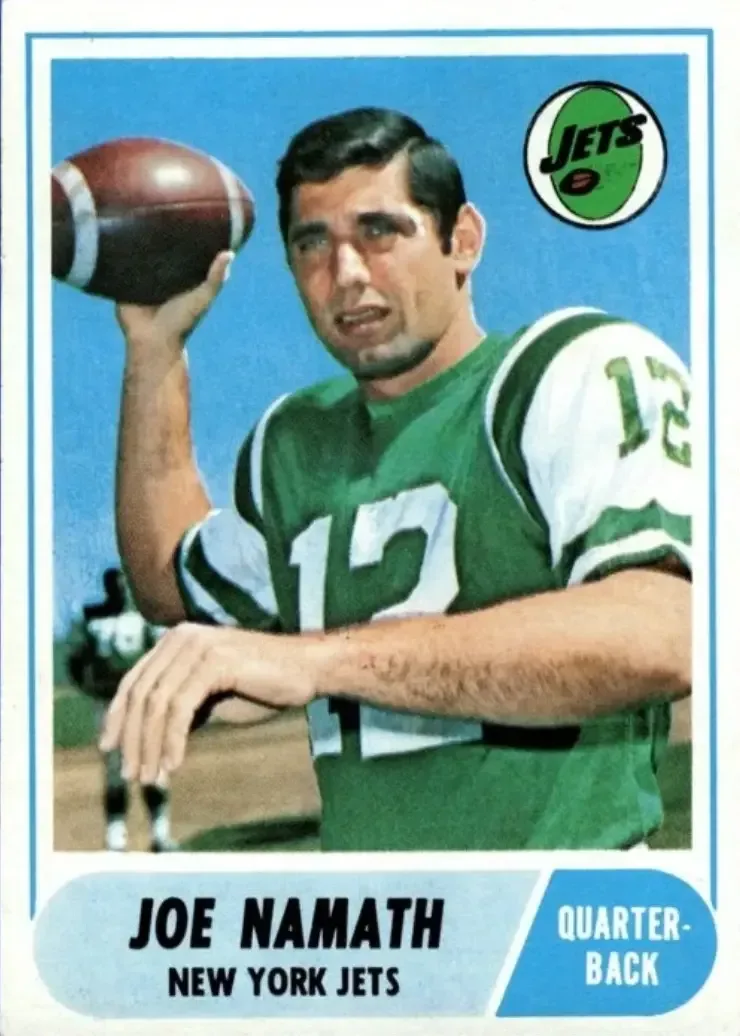
The 1968 Topps Joe Namath #65 recorded a top sale of $46,800 for a PSA 10 on January 27, 2023. The supplied PSA 10 population is three.
Visually, the card goes for a clean, classic quarterback presentation. Namath is pictured in a traditional QB pose, with his carefully parted hair contributing to the polished “Broadway Joe” image collectors associate with him. It is a relatively straightforward composition among this group, but that simplicity is part of its appeal: the subject is immediately clear and the card is firmly rooted in its late-1960s football-card era.
A PSA 10 is a gem-mint grade assigned by Professional Sports Authenticator. The population figure does not describe the total number of copies in existence; it describes how many PSA-graded examples sit at that specific grade in the supplied data. Three PSA 10s therefore signals rarity at the highest reported grade, rather than a definitive census of every 1968 Namath #65 ever printed.
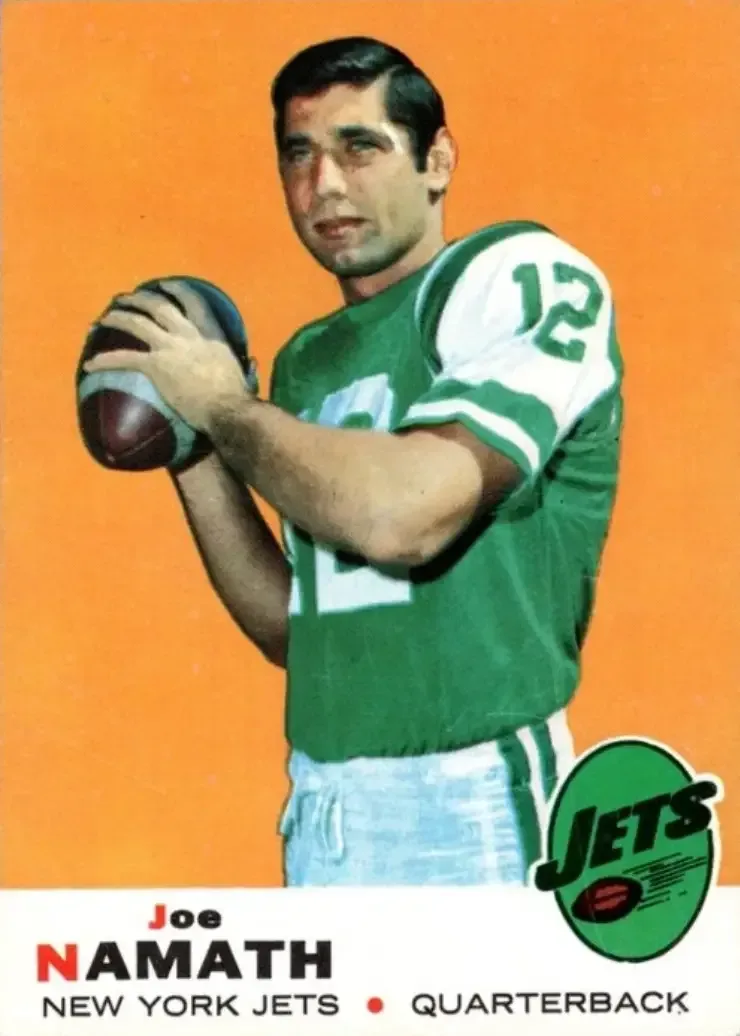
4. 1969 Topps Joe Namath #100 — $51,148
The 1969 Topps Football Joe Namath #100 moved slightly ahead of its 1968 counterpart on the supplied sale record: a PSA 10 realized $51,148 on August 16, 2025. Its PSA 10 population is also three.
This is the orange-background Namath card, distinguished by a two-color name treatment in black and red. Orange dominates the visual field, making the design particularly easy to identify at a glance. In a hobby built partly on memorability, strong color blocking can make a card feel more iconic even before condition and scarcity enter the equation.
Related coverage includes Top 3 Most Valuable Joe Namath Football Cards Collectors Chase.
The sale comparison between the 1968 and 1969 cards is useful but narrow. Each figure reflects one top-end PSA 10 transaction at a particular time. The $4,348 gap does not establish a permanent hierarchy for every grade. It does show that these adjacent years both have meaningful demand when an exceptionally preserved example reaches the market.
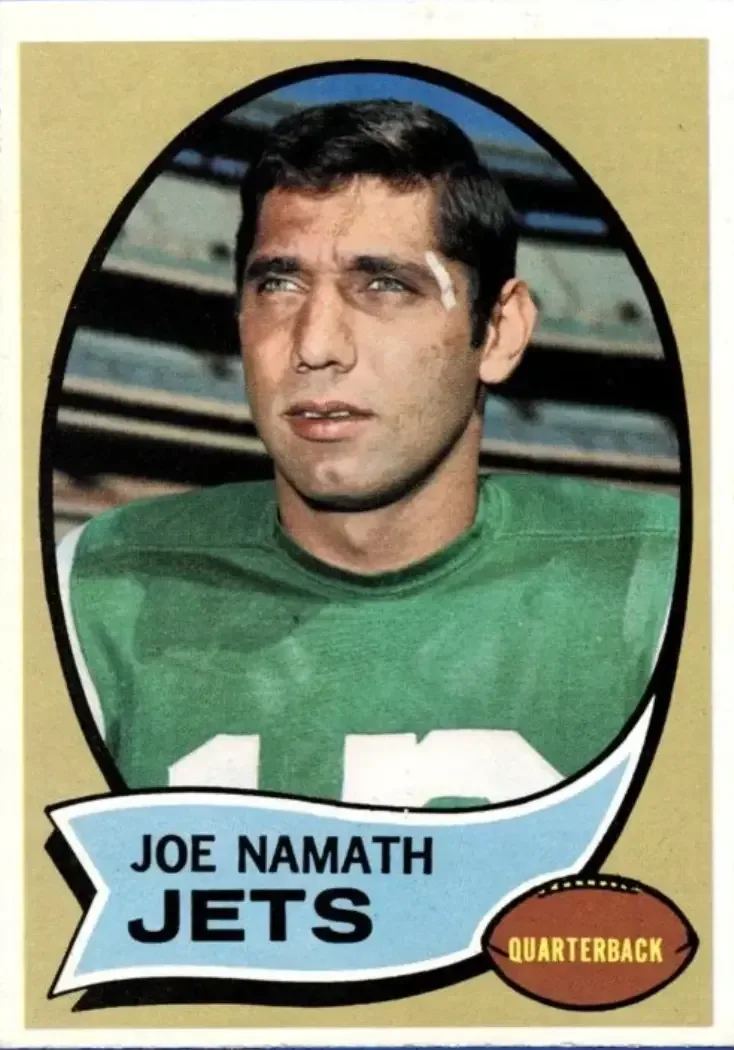
3. 1970 Topps Joe Namath #150 — $90,000
The 1970 Topps Joe Namath #150 has the group’s most striking top-grade scarcity figure: the supplied PSA 10 population is one. That sole PSA 10 sold for $90,000 on July 21, 2021.
Rather than an action-oriented quarterback image, the card places Namath on the sideline, with stadium levels behind him. He is shown wearing a facial bandage, a detail that fits the public image of a player widely associated with wraps, bandages and injury-related gear. It gives the card a more candid, specific personality than a standard posed portrait.
For collectors, a population of one is an important piece of context, but it is not a promise of future value. It means the supplied grading data identifies only one copy at PSA 10. That individual card’s $90,000 result remains a historical sale, not a current appraisal. If it reappeared, the eventual price could be higher or lower depending on bidder interest, timing and the broader market.
Still, the record illustrates how quickly vintage football-card economics can change at the top level. A desirable Hall of Fame-level subject is one thing; an example with no known equal at its grade is another. The intersection of those two factors is where headline results tend to happen.
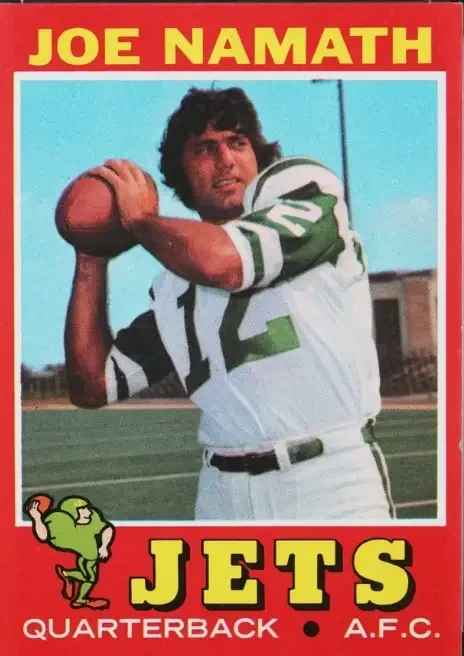
2. 1971 Topps Joe Namath #250 — $94,007
The 1971 Topps Joe Namath #250 recorded a top sale of $94,007 for a PSA 9 on August 16, 2025. The supplied PSA 9 population is three.
That result is noteworthy because it is a PSA 9 sale, rather than a PSA 10 sale. In grading terminology, PSA 9 is mint, one step below gem mint. The comparison is a reminder that grade labels alone cannot settle value across different cards. Set design, collector preference, supply at high grades and the card’s place within a player’s run all contribute to what bidders will pay.
The 1971 Topps set is remembered for its strong design, including a small illustrated football player with outsized shoulder pads. On Namath’s card, that period styling gives the issue a distinct identity within a sequence otherwise dominated by photographic presentations. It is one reason collectors may approach the card as both a Namath piece and a representative example of a beloved vintage football set.
The same auction date produced the listed $51,148 result for the 1969 Topps PSA 10. The much higher number attached to this PSA 9 1971 issue neatly demonstrates why collectors should compare like with like wherever possible: year, card number, grade and sales date are all essential context.
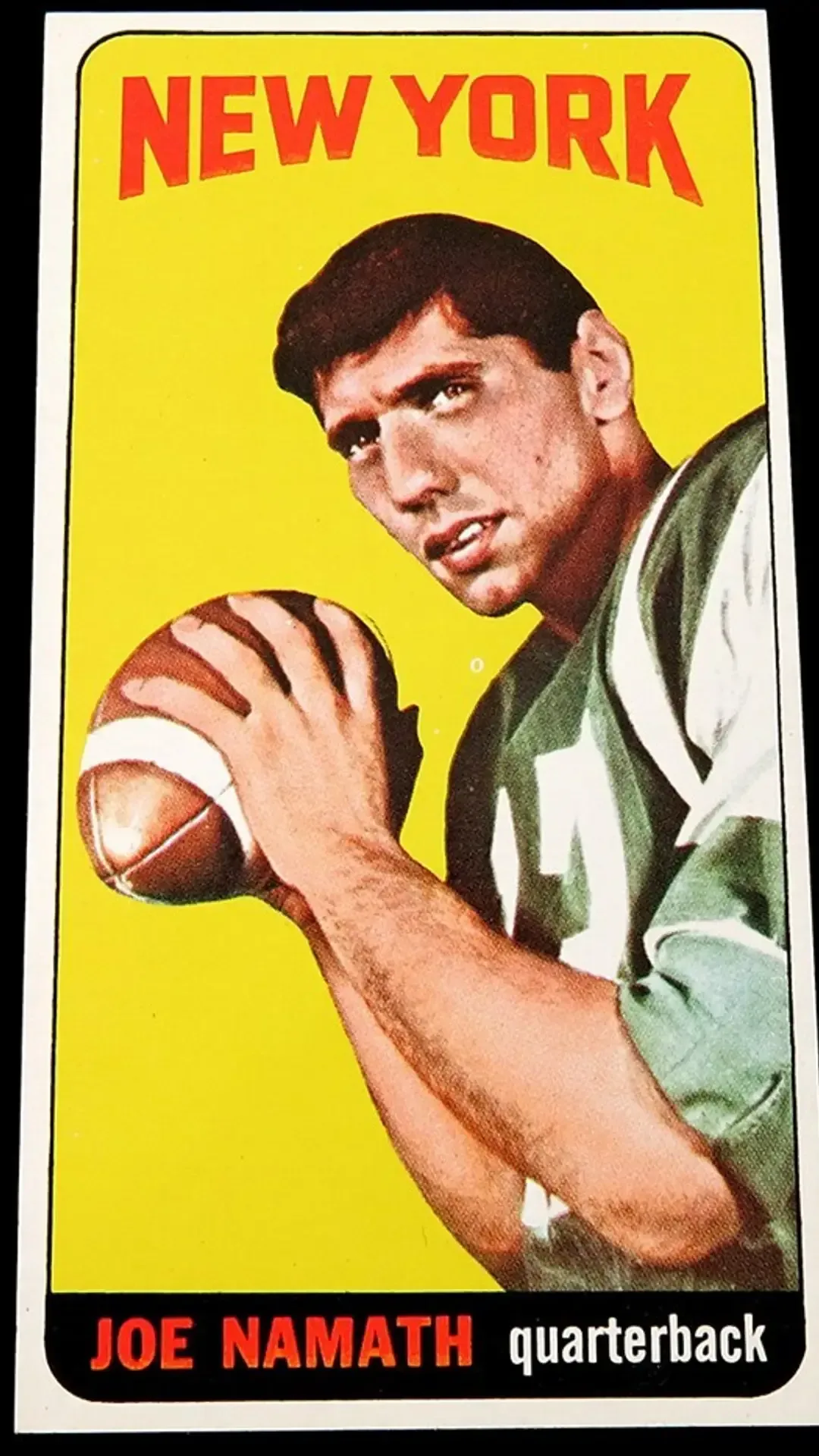
1. 1965 Topps Joe Namath #122 rookie card — $264,000
The leading card in this group is the 1965 Topps Joe Namath #122 rookie card. A PSA 9 sold for $264,000 on February 23, 2018. The supplied PSA 9 population is five.
The card is instantly recognizable for its vivid yellow background and Namath’s green jersey. The color combination makes the rookie stand apart from the later cards in this list, while the rookie designation gives it an extra layer of importance for player collectors. Rookie cards are generally the first standard-issue cards associated with a player’s professional collecting legacy, which helps explain why they so often serve as the centerpiece of a vintage run.
Its record is not merely the highest here; it is dramatically higher. The $264,000 sale is $169,993 above the 1971 Topps #250’s listed high sale. That spread should not be oversimplified into one cause, but the rookie-card status is clearly central to the card’s significance. The PSA 9 grade and limited supplied population at that grade add still more context.
What the five-card list says about collecting Namath
Namath’s Topps cards offer several legitimate entry points into vintage football collecting. The 1965 rookie is the obvious focal point for collectors pursuing the most prestigious card, while the later issues show how a player’s visual identity developed from season to season. The 1968 and 1969 cards lean on crisp portrait design; the 1970 issue captures a more personal sideline moment; and the 1971 card is closely tied to the distinctive personality of its set.
For anyone evaluating a copy, the practical lesson is to read the sale result precisely. Identify the year and card number, verify the grading company and grade, and note the transaction date. A reported record price is evidence of what one exceptional card sold for at one point in time—not a blanket valuation for every version. Population counts can help explain high-grade scarcity, but they are not total print-run numbers or guarantees of demand.
That careful approach is especially valuable with vintage sports cards, where condition can transform the conversation. Namath’s five headline cards remain compelling because they pair that condition-sensitive market with one of football’s most durable personalities. For a look at how a major modern wrestling moment can bring fresh attention to a player’s cards, see Penta’s Topps NOW chase and card-market attention.