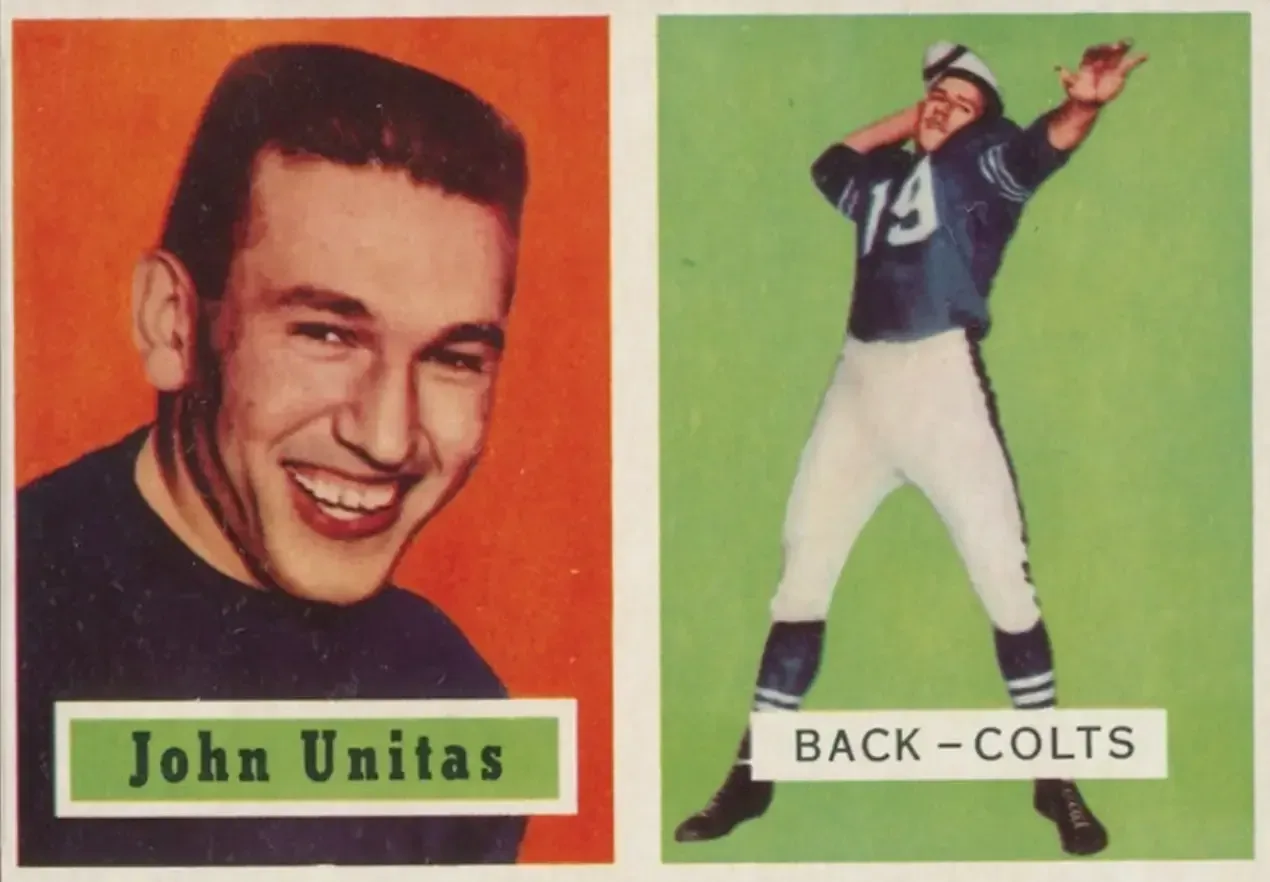
Johnny Unitas remains one of football’s defining quarterback figures, remembered for a hurry-up approach and the kind of downfield throws that helped make him a model for the modern position. He also won Super Bowl V with the Baltimore Colts. In vintage football cards, however, the story is not simply that every Unitas card commands the same attention. A group of reported high-dollar sales shows a pronounced hierarchy: his 1957 Topps rookie card stands in a tier of its own, while four later issues have each reached five-figure results in high grade.
The five cards below are ranked by the reported sale prices supplied for specific copies, rather than presented as fixed current values. That distinction matters. A card’s sale record describes one transaction involving one grade at one point in time; it does not guarantee what another copy will sell for. Even within this short list, the grades differ, with the 1962 Topps example cited at PSA 8.5 while the other highlighted sales are PSA 9 copies.
The reported Unitas sale leaderboard
- 1957 Topps John Unitas #138, PSA 9 — $167,300 on November 16, 2016
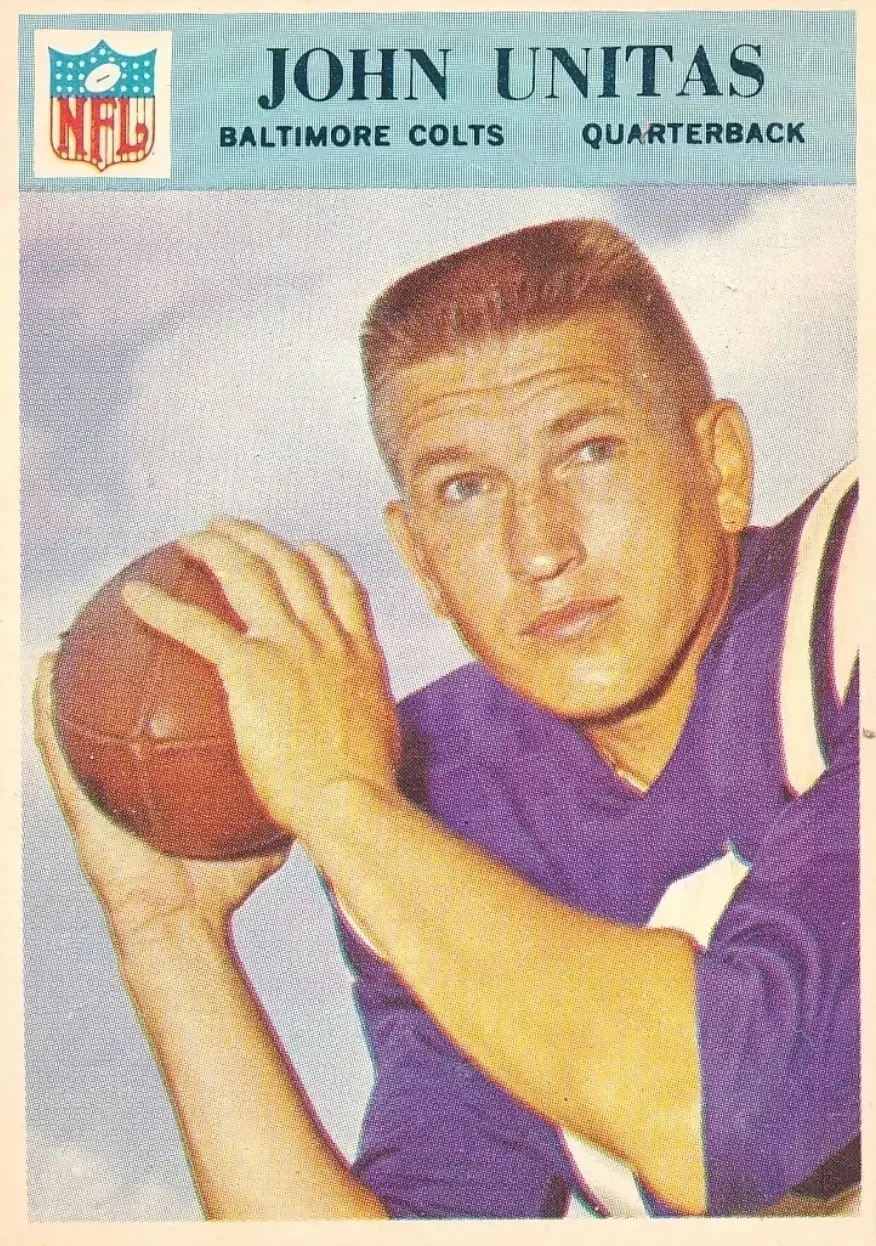
- 1966 Philadelphia John Unitas #24, PSA 9 — $29,280 on September 18, 2026
- 1963 Topps John Unitas #1, PSA 9 — $27,799 on May 6, 2017
- 1962 Topps John Unitas #1, PSA 8.5 — $21,433 on August 31, 2025
- 1959 Topps Johnny Unitas #1, PSA 9 — $20,400 on December 4, 2024
The immediate takeaway is the gulf between first and second place. The reported $167,300 result for the 1957 rookie is more than five times the cited $29,280 result for the 1966 Philadelphia card. The remaining four cards sit in a comparatively tight band, from $20,400 to $29,280. That does not make those later cards interchangeable; their grades, surviving populations, issue identity and visual appeal all differ. But it does underline the added importance collectors place on a player’s rookie card, especially when the player is as historically prominent as Unitas.
1. 1957 Topps John Unitas #138: the rookie-card premium
The 1957 Topps John Unitas #138 is the pivotal card in this group. A PSA 9 copy reportedly sold for $167,300 on November 16, 2016. The cited PSA 9 population is nine, meaning nine examples had received that particular grade in the referenced population figure.
“Rookie card” is a collecting term for a player’s earliest widely recognized card issue. The designation carries major weight because it connects the object most directly with the beginning of a professional legacy. In Unitas’ case, it combines that status with a player regarded as an all-time great quarterback. The available description also gives the card a clear visual identity: a youthful portrait is placed on the left, while an action image of Unitas throwing in his No. 19 Colts uniform appears on the right.
Condition is fundamental to why the sale result is so far beyond the rest of the list. PSA 9 is a near-mint to mint grade, and vintage cards can be especially sensitive to corners, edges, surface wear, centering and print quality. A card can remain historically important in lower condition, but the best-preserved examples are competing in a much smaller pool. The cited population of nine PSA 9 examples does not measure every copy that exists; it specifically measures cards graded at that level in the supplied figure. Still, it is a useful indication of how hard it can be to locate a top-graded version.
2. 1966 Philadelphia John Unitas #24: a later issue with elite-grade scarcity
The 1966 Philadelphia John Unitas #24 takes second place in the reported-sale ranking. A PSA 9 copy sold for $29,280 on September 18, 2026, with a cited PSA 9 population of four. The description of the card focuses on an intense quarterback pose, with Unitas looking downfield; it is an image that suits a collector’s memory of a passer known for command and aggression.
Its placement is instructive. It is not Unitas’ rookie card, yet the reported price surpasses the other later Topps cards in this selection. The cited population is especially small at the PSA 9 level: four copies. That does not prove population alone determined the price, nor does it establish a universal price for every grade. It does show why collectors should not reduce vintage-card demand to player fame and year alone. The condition ceiling for a particular issue can become a substantial part of the story.
For a collector comparing examples, “population” should be read carefully. A grading-company population count tells readers how many submitted cards received a given grade, not how many ungraded cards are in attics, collections or future submissions. It is evidence of graded scarcity, not a complete census of all surviving cards. A low count may draw attention, but it is most useful when considered alongside the card’s grade, the player, the issue and actual completed sales.
3. 1963 Topps John Unitas #1: an unusually direct game-day composition
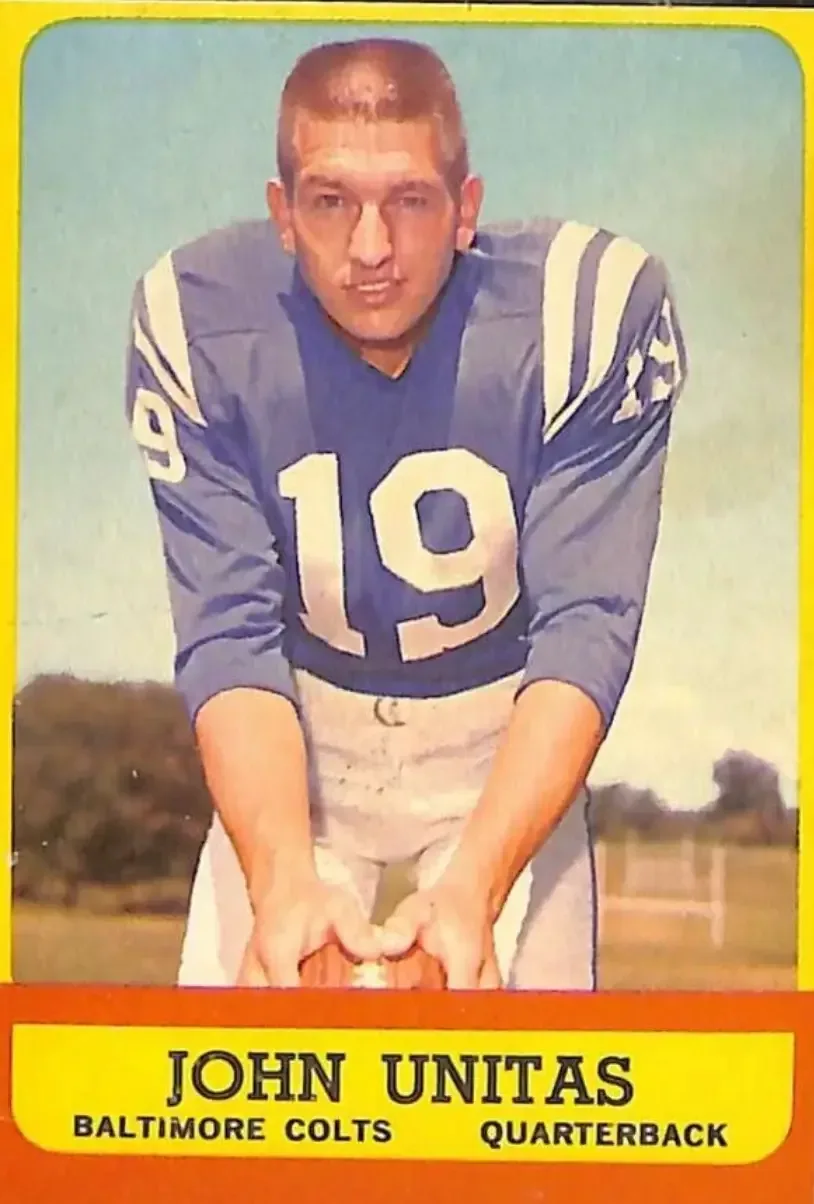
The 1963 Topps John Unitas #1 reached a reported $27,799 for a PSA 9 on May 6, 2017. Its cited PSA 9 population is four, matching the figure supplied for the 1966 Philadelphia card. In the provided description, the camera angle is straight on, creating the feeling of looking back at the quarterback from the center’s perspective before a snap.
That composition gives the card a different appeal from a standard posed portrait. Sports cards are historical objects, but they are also images, and image selection can influence why a particular issue stays memorable. Here, the point of view puts the viewer close to the action without requiring any extra narrative around the card. The design reinforces the quarterback’s centrality: the eye is drawn directly to Unitas as the play is about to begin.
The $27,799 reported result is also a reminder that sale dates matter when comparing records. The 1963 price was achieved in 2017, years before several of the other reported transactions. A ranked list can accurately arrange supplied sale results, but it should not be mistaken for a synchronized snapshot of the market on one day. Anyone trying to assess a specific card should separate historical record prices from recent comparable sales of similarly graded copies.
4. 1962 Topps John Unitas #1: the grade changes the comparison
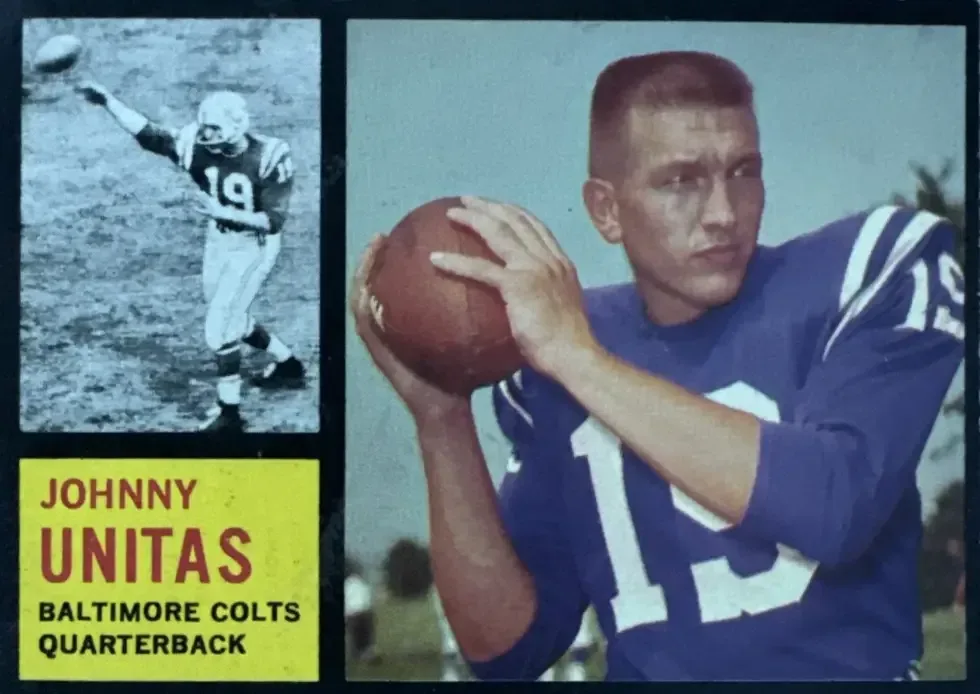
The 1962 Topps John Unitas #1 reportedly sold for $21,433 on August 31, 2025. Unlike the other examples in this five-card group, the cited sale was for a PSA 8.5, with a supplied population of two at that grade. The number makes the card fourth in this particular ranking, but the half-point difference is important enough that it should be kept front and center.
Card grades are not merely decorative labels. The numeric grade identifies the evaluator’s assessment of condition, and buyers often segment sales by grade when making comparisons. It would be misleading to treat a PSA 8.5 price as directly equivalent to a PSA 9 price. The cards are close in condition, but they are not the same grade, and price differences can be material in vintage collecting.
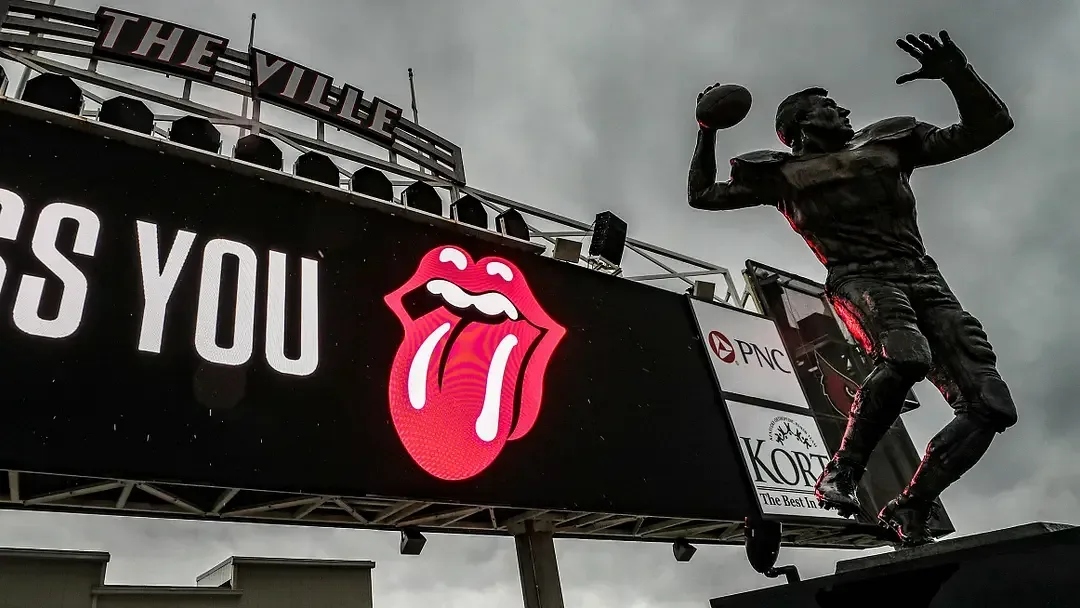
This issue also carries a connection to Unitas’ college background. He played at the University of Louisville, where “Unitas We Stand...” became a rallying cry for the Cardinals football program. That context does not change the card’s physical characteristics, but it broadens why the player remains meaningful to collectors: the appeal spans his college association, his Colts career and a reputation built around persistence as well as quarterback play.
For newcomers, the practical lesson is simple: match the exact card, grade and sale date before using any price as a benchmark. “1962 Topps Unitas” alone is not enough information to make a sound comparison. Card number, the grading label, condition and the timing of the transaction are all part of the record.
5. 1959 Topps Johnny Unitas #1: a name variation and a distinct visual detail
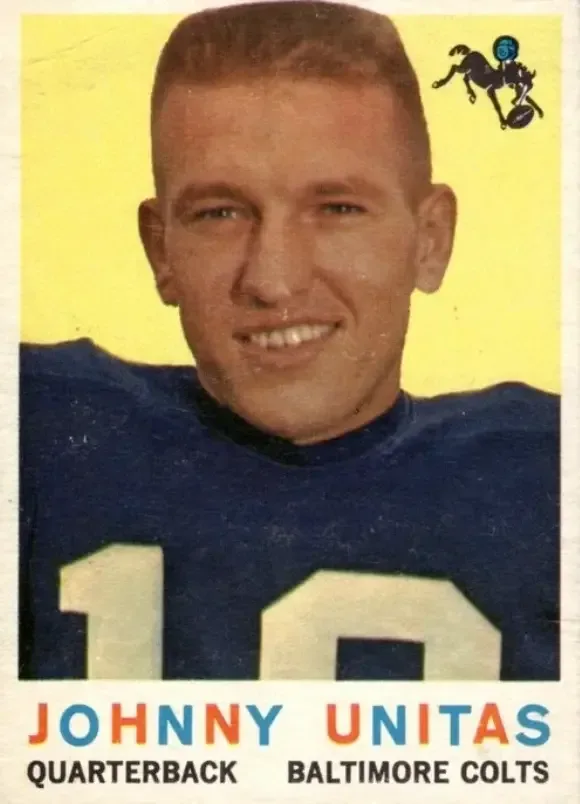
The fifth entry is the 1959 Topps Johnny Unitas #1. A PSA 9 copy reportedly sold for $20,400 on December 4, 2024, and the cited PSA 9 population is 13. In contrast with the “John Unitas” naming used on the 1962, 1963 and 1966 cards in this list, this issue uses “Johnny.” That small naming detail provides an easy collecting thread across the run of cards.
The card is also noted for alternating colors in the player-name treatment. Details like typography and layout may sound secondary beside a five-figure sale, but visual differences help collectors identify issues quickly and can be a real part of an item’s charm. Vintage-card collecting is not only a contest of population figures and auction totals; the design is part of the artifact.
Its cited PSA 9 population of 13 is higher than the figures supplied for the 1962, 1963 and 1966 entries, although each card remains a different issue with its own demand. It would be a mistake to turn those counts into a rigid price formula. The 1959 card’s $20,400 reported result is a record for a particular PSA 9 example, not a declaration that every high-grade copy must trade at that number.
What the five sales actually show
This small set of results makes three evidence-based points. First, the 1957 Topps #138 rookie card has an enormous reported lead over the other four cards. Second, later Unitas issues can still command substantial five-figure prices in strong condition. Third, grade-specific population figures provide helpful context but cannot replace a careful look at the exact transaction.
There is another useful collector habit in the list: preserve the wording around uncertainty. These are reported top-sale figures for named copies, not appraisals and not predictions. Vintage markets can move, and no two physical cards are perfectly alike. Centering, corners, edges and surface condition can create meaningful differences even among cards sharing a year, number and grading-company label.
Unitas’ cards are particularly compelling because the cardboard captures more than statistics. The 1957 rookie presents a young player through both portrait and throwing imagery; the 1963 issue uses a center-facing viewpoint; the 1966 Philadelphia card emphasizes the quarterback stance; and the 1959 card offers a memorable name-and-color treatment. For collectors interested in another visual branch of the hobby, our coverage of artist portfolio reviews in Marvel trading cards explores how artwork and presentation can shape the appeal of cards beyond the athletes or characters depicted.
For Unitas collectors, the hierarchy is clear without overreaching: the 1957 Topps rookie is the centerpiece, while the 1959 Topps, 1962 Topps, 1963 Topps and 1966 Philadelphia cards offer separate, high-grade routes into a major quarterback’s vintage catalog.