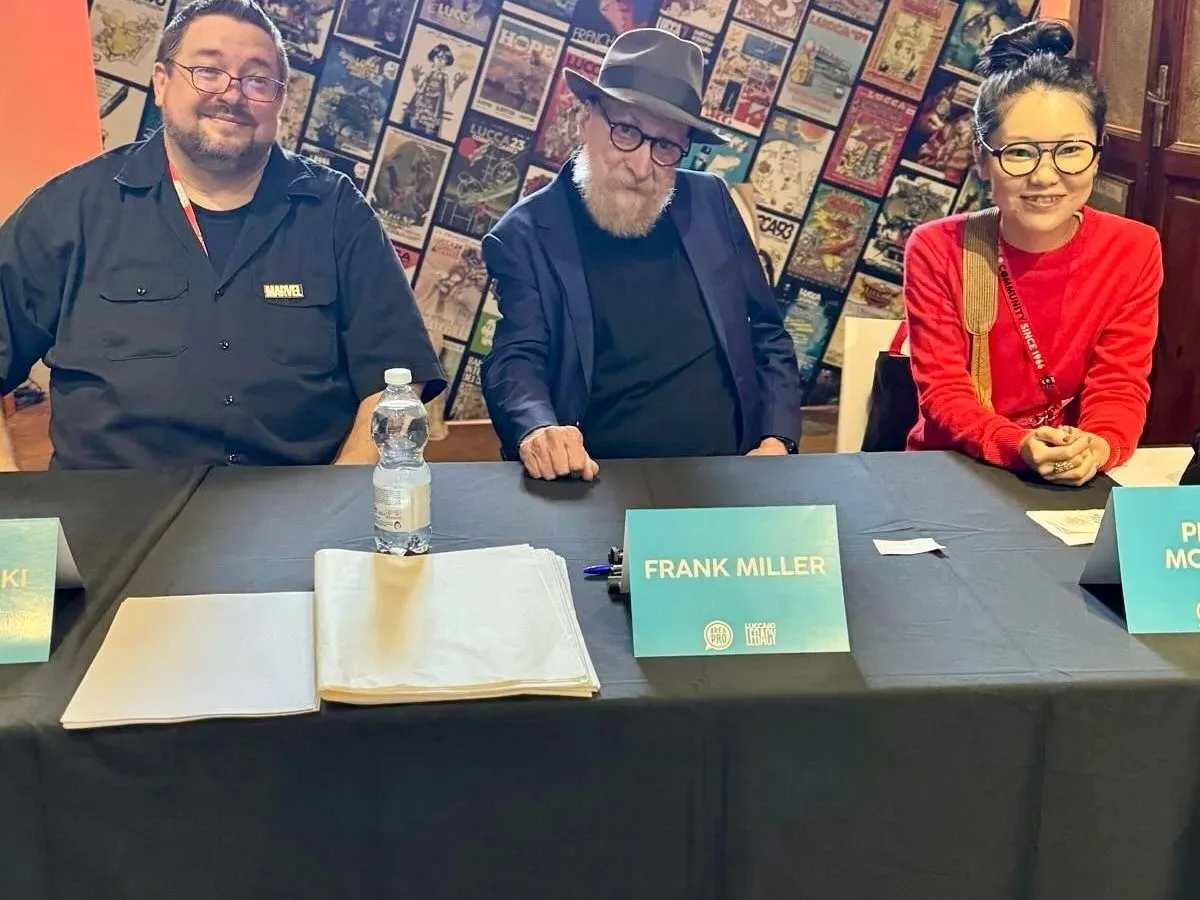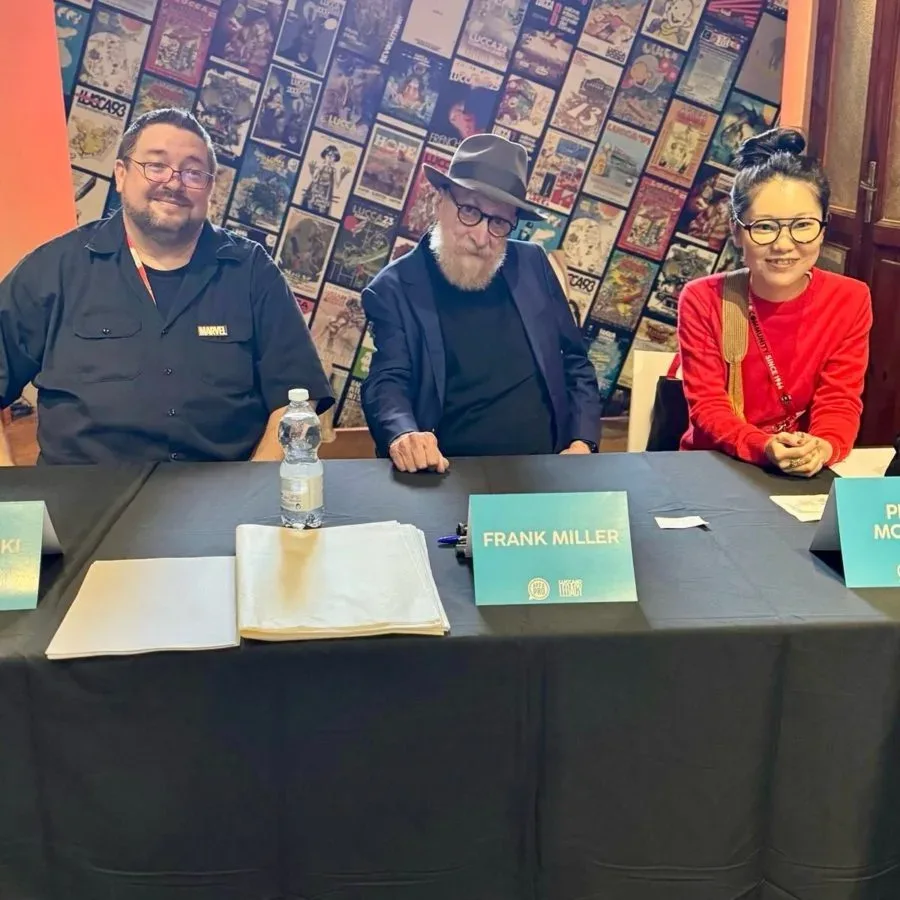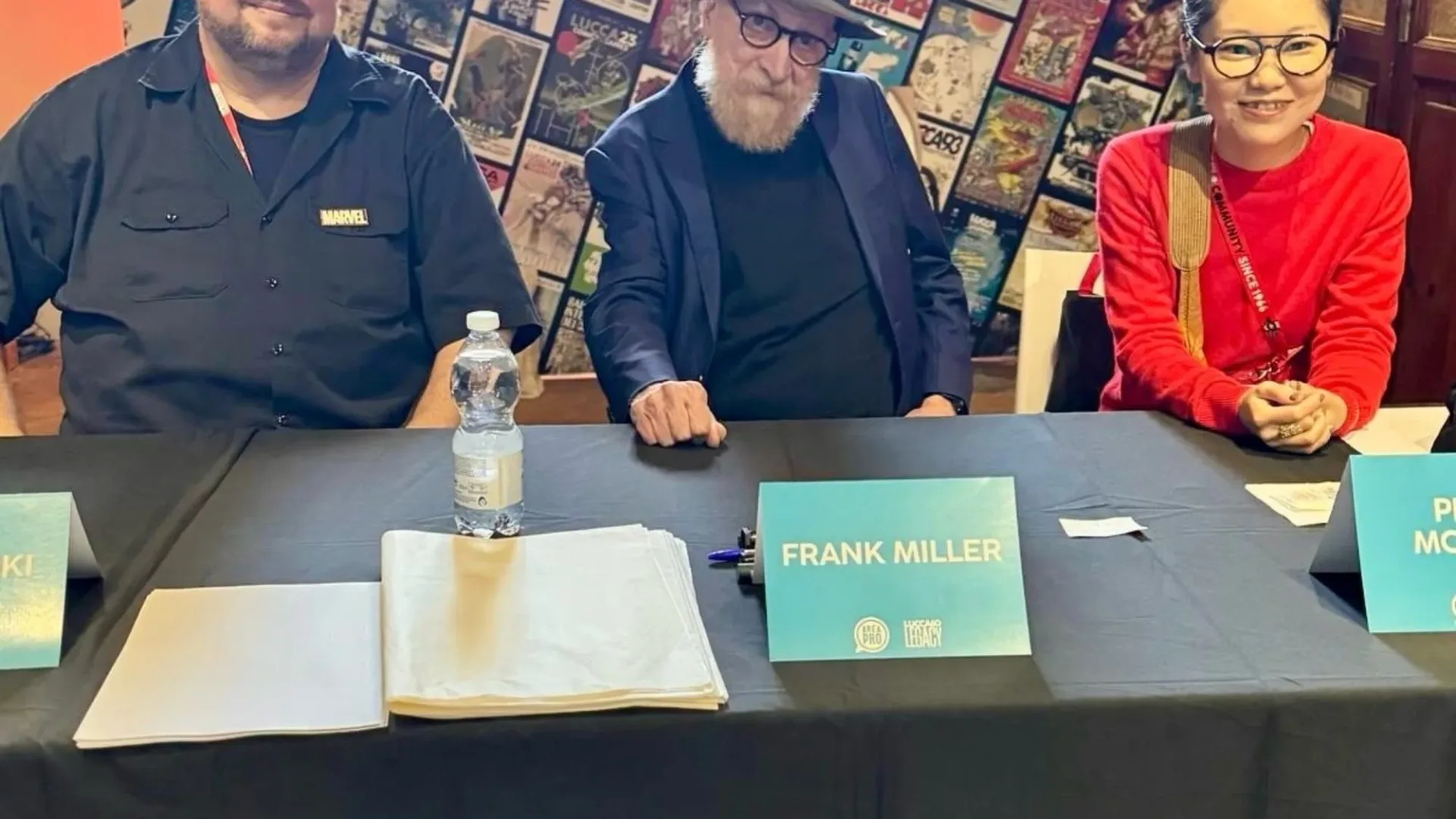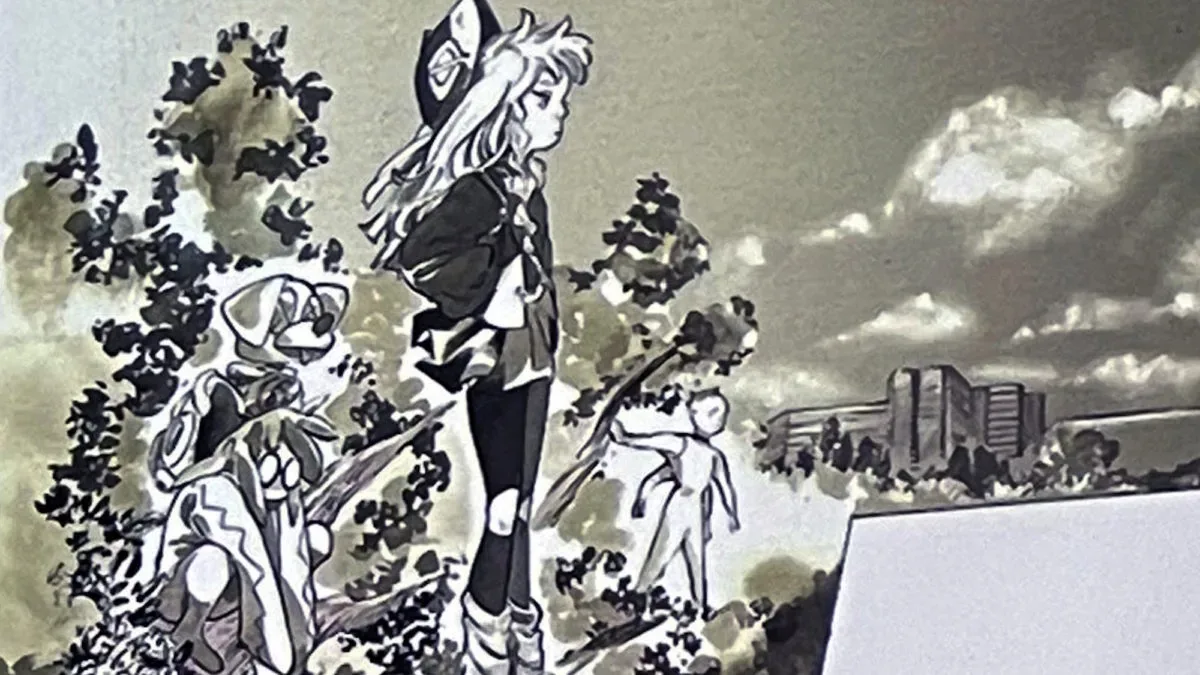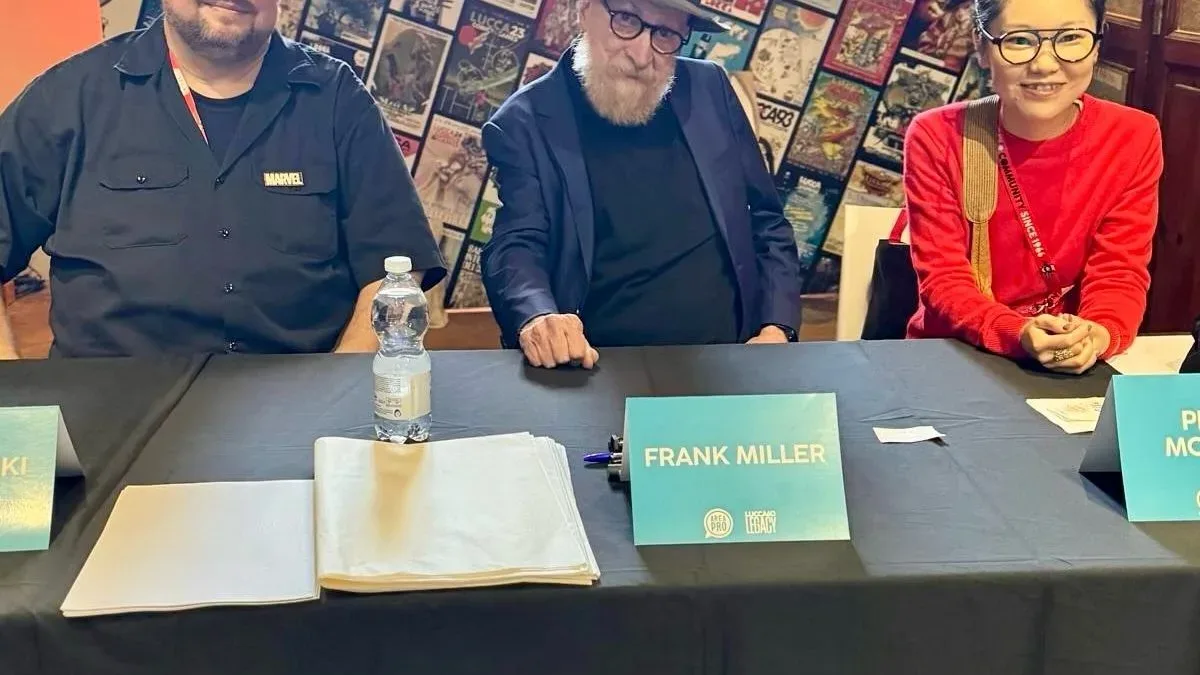
Five emerging Italian artists arrived for a portfolio review at Lucca Comics & Games expecting to meet C.B. Cebulski. They instead found that Frank Miller and Peach Momoko had joined the session, turning a professional critique into an unusually direct mentoring opportunity with two internationally recognised comic creators.
The meeting was framed around the 60th anniversary of Lucca Comics & Games and its theme of Legacy. Miller’s stated motivation was to offer young creators a version of the opportunity he had received while trying to enter comics, when Will Eisner and Neal Adams offered guidance to him.
For the five artists involved, the significance was not simply the surprise. Portfolio reviews are one of the few settings in which an aspiring artist can receive concentrated feedback about work samples, career presentation and creative decisions from people who understand how comics are actually made. In this case, the discussion reportedly covered influences, storytelling, personal style, work ethic, perspective, and the practical differences between working on paper and using tablets.
Cebulski, the former Marvel Editor-in-Chief and current Marvel editor at Asia Originals in Tokyo, described the exchange as a conversation from the heart between established creators and the next generation. That distinction matters: a useful portfolio review is not merely praise for a finished illustration. It can test whether the work communicates clearly, whether its stylistic choices suit the story being told, and whether the artist shows the discipline to develop beyond a single strong image.
A legacy theme put into practice
“Legacy” can be an abstract convention theme, but this session gave it a practical use. Miller connected his desire to mentor newer artists to the help he received from Eisner and Adams. That makes the event less about celebrity proximity and more about a familiar creative chain: working artists share advice, newcomers make use of it, and some of those newcomers may eventually support artists after them.
That does not make a portfolio review a shortcut into comics. No job offers, publishing deals or future assignments were announced in connection with this meeting. But exposure to candid editorial and artistic feedback can be valuable precisely because it identifies areas an artist may need to rethink before approaching future collaborators or publishers.
The format also brought together creators whose work and careers offer different perspectives. Miller’s presence carried the stated legacy connection to Eisner and Adams, while Momoko participated in the discussion of the artists’ work alongside him and Cebulski. The reported topics suggest the group did not reduce comics to a single preferred look or a single production method. Instead, the focus ranged from visual fundamentals to the broader habits that support a sustained career.
What the portfolio topics mean for comic artists
Storytelling is more than a polished drawing
In comics, storytelling concerns how the reader moves through images and understands what happens from panel to panel. An individual drawing can be beautiful while still leaving a reader uncertain about action, emotion, timing or emphasis. A portfolio designed for comics therefore needs to demonstrate that the artist can make narrative information readable, not only render a striking character.
The reported focus on storytelling is particularly useful because it places sequential work at the center of the conversation. An artist’s choices about composition, character placement, expressions and the order of images all contribute to whether a page is understandable. A portfolio review is a suitable place to discuss those choices, since reviewers can ask not only whether an image looks effective but whether it fulfils its job in a sequence.
Perspective provides structure
Perspective is the visual system that creates a convincing sense of space and depth on a flat page. In a comic, it can guide a reader through a room, clarify where characters are standing, make an action scene legible, or establish the scale of a setting. It is not simply an academic exercise: unclear space can make a scene confusing even when the figures themselves are appealing.
That is why its inclusion among the discussion points is meaningful. Perspective is a technical foundation that can support a distinctive visual identity rather than erase one. Different artists can make very different stylistic choices while still using coherent space to make a scene easier to read.
Style and influences need a purpose
Every developing artist has influences, and the session addressed both influences and style. Those are connected but not identical. Influences are the artists, genres, techniques or visual languages that shape someone’s work. Style is the set of recurring choices that becomes recognisable in the finished work: line quality, colour, shapes, pacing, composition and the way characters and environments are presented.
For a portfolio, the practical challenge is showing that influences have been absorbed rather than simply repeated. Feedback from experienced creators may help an artist understand what feels personal in their work, which choices are helping the story, and which may be obscuring their own voice. The available account does not identify individual feedback given to any of the five participants, so it would be wrong to infer specific strengths or weaknesses. Still, these are exactly the kinds of questions a discussion of style is built to explore.
Paper and tablets are tools, not opposing camps
The conversation also considered the benefits of pencilling and inking on paper compared with working on tablets. Pencilling generally refers to the initial drawing stage, where figures, settings, acting and layouts are planned. Inking is the later line-art stage that clarifies, refines or reshapes those drawings. Both can be completed traditionally on paper or digitally, depending on an artist’s workflow.
The important point is that the session treated this as a discussion of benefits, not as a declaration that one method is inherently correct. Paper and tablets require different processes and offer different working experiences. The core skills under discussion—storytelling, perspective, clarity and visual decision-making—remain relevant regardless of the surface on which the work is made.
For an artist building a portfolio, that is a constructive reminder. Tool choice should support the work and the artist’s process, rather than stand in for those fundamentals. A digital page still has to communicate. A traditionally inked page still has to guide the reader. The medium can affect the workflow, but it does not remove the need to make intentional narrative and visual choices.
Work ethic belongs in the same conversation
The inclusion of work ethic alongside artistic subjects is notable. Comics are made through repeated decisions over many pages, and a portfolio gives only a limited view of how an artist handles that process. Discussing work ethic broadens the review beyond technique: it speaks to the consistency and seriousness needed to keep developing work over time.
That does not mean work ethic can be judged from one meeting, and there were no claims made about the participants’ individual habits. Rather, it was one of the professional subjects placed before them. For artists hoping to enter any collaborative creative field, it is a useful framing. Technical ability and a compelling style are important, but so is the commitment to improve, revise and continue producing work.
The session’s value may therefore lie in the range of its advice. It covered artistic foundations, individual expression, narrative communication, production tools and professional approach in one room. Rather than pretending that a single portfolio can settle an artist’s future, it pointed to the many parts of the craft that developing creators can keep building.
Lucca’s wider comics and games setting
Lucca Comics & Games is held annually in Lucca, Tuscany, with programming spanning comics, manga, animation, board games, role-playing games, video games and cosplay. Its 2026 edition marks the event’s 60th anniversary. The convention began in 1965 as the Salone Internazionale dei Comics in Bordighera, moved to Lucca in 1966, and developed into Lucca Comics & Games in the mid-1990s.
The event occupies Lucca’s historic city centre with pavilions, exhibitions and activities. The 2026 programme includes more than 80 publishers and more than 400 international guests, with Go Nagai, Momoko, Cebulski and Miller among the named guests. Tournaments, awards and family areas such as Lucca Junior also form part of the convention’s broader offer.
That scale provides context for why a five-person portfolio session stands out. Large conventions can offer a vast number of things to see, buy and attend, but smaller conversations create a different kind of value. They make space for emerging artists to ask questions and receive feedback that is specific to the work in front of them.
There is also a natural overlap between comics and the wider games culture represented at Lucca. Both depend on visual communication, creative collaboration and the ability to turn an idea into a readable experience for an audience. For more Marvel-adjacent coverage on the site, see our look at Wolverine #1’s planned Punisher showdown.
Why the surprise mattered
There is an easy headline appeal in arriving for a review and discovering Miller and Momoko at the table. Yet the lasting importance of the encounter is better measured by its stated purpose. Miller wanted to extend to newer artists the kind of opportunity that had helped him early in his own career. Cebulski positioned the gathering as part of an ongoing commitment to finding artists from around the world.
For the five Italian artists, the feedback itself remains private, as it should. What is public is the model: a major event used its anniversary theme to create a small, serious mentoring exchange; respected creators discussed both craft and professional practice; and aspiring artists were treated as people whose work was worth close attention.
That is a meaningful expression of legacy. It is not merely looking backward at influential careers. It is making time for the people trying to begin theirs.