Charles Barkley’s card market has the same useful contradiction as Barkley the player: it is impossible to reduce to one neat, conventional template. His most familiar rookie is not necessarily his costliest early issue. A less celebrated second-year Fleer has proved tougher in top condition than the card most collectors call his rookie. And his most expensive card is a modern, one-of-one autograph and patch card tied back to a 1990s uniform detail.
That variety makes Barkley an unusually revealing player to collect. His cardboard runs through the unusual distribution of mid-1980s Star sets, the return of mass-market Fleer basketball, the design-driven insert boom of the early 1990s, and the extremely limited parallels that defined the latter part of the decade. The results also track the three most recognizable NBA stops of his career: Philadelphia, Phoenix and Houston.
For collectors, the central lesson is not that every Barkley card will perform the same way. It is that card identity, scarcity, condition, authentication and recent comparable sales all matter independently. A famous image or a rookie-card label can be important, but neither substitutes for understanding what is actually being bought.
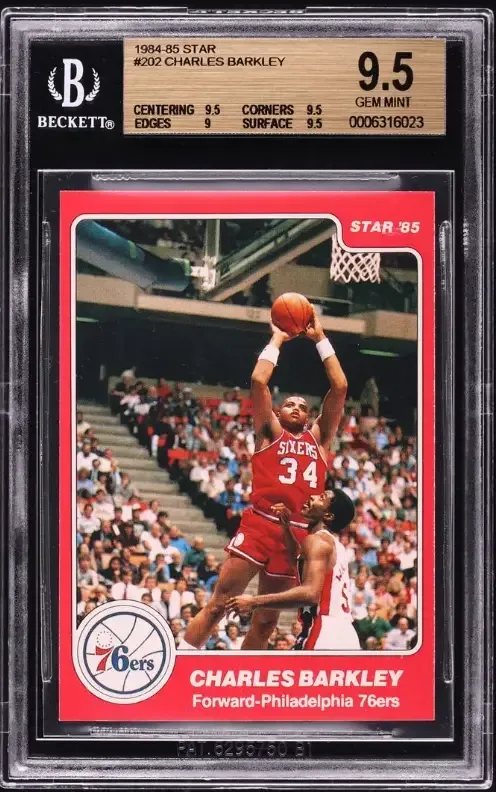
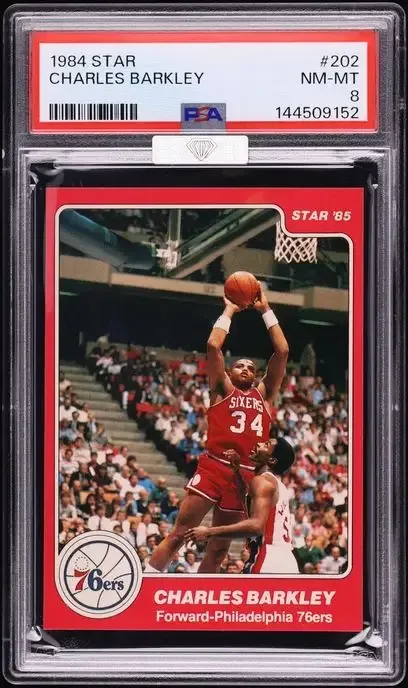
1. 1984 Star #202: the rookie-card debate with serious stakes
Barkley’s 1984 Star #202 is the pivotal issue in his catalog, even though collectors do not entirely agree on what to call it. Star was the only licensed NBA card manufacturer when he entered the league, in a period after Topps had left basketball cards and before Fleer returned. Rather than appearing in standard wax packs, Star cards were distributed in team sets sealed in plastic bags.
For more context, explore Starforce Is Being Rebuilt for Amiga AGA, With Acidbottle Targeting Arcade Accuracy Over Extra Firepower.
That distribution history drives the terminology debate. Some collectors treat the card as a pre-rookie or extended rookie card (often abbreviated XRC); others view it as Barkley’s true rookie card. The label changes the conversation, but it does not erase the card’s historical position as an early, key Barkley issue.
Condition is a major part of its appeal and difficulty. Chipping, off-centering, surface flaws and worn corners make high-grade copies particularly scarce. Of 943 copies in the cited BGS population, only nine had reached BGS 9.5, or 0.95%. A BGS 9.5 sold for $34,200 in a January Fanatics Premier Auction after another had sold for $27,000 roughly a year earlier.
Grading context is especially important here. PSA stopped accepting Star submissions from the early 1990s until July 2022 amid concerns involving counterfeits and cards that appeared after Star lost its NBA license. Its database shows 429 graded examples of Barkley’s XRC, including 12 PSA 8s, one PSA 8.5 and none above that. A PSA 8 most recently sold for $21,000, following a $12,600 sale two months earlier. Those figures illustrate why collectors should compare grade, grader and sale timing rather than treating all copies as interchangeable.
Related coverage includes 8 Charles Barkley Cards That Chart His Hobby Legacy.
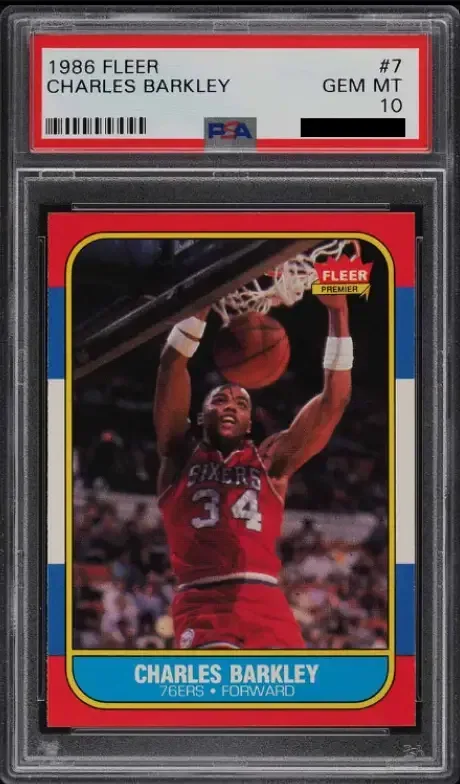
2. 1986 Fleer #7: the classic Barkley rookie
If the Star issue is the hobby-history argument, 1986 Fleer #7 is the conventional answer. It is Barkley’s widely recognized traditional rookie card and arguably his most iconic mainstream release. By the time the set arrived, Barkley was already an All-Star; the supplied career snapshot lists 23 points per game, a league-leading 14.6 rebounds and 1.5 blocks.
That combination gives the card a relatively simple appeal. It comes from the landmark 1986 Fleer basketball set, it depicts a player who had already established star status, and it is recognizable to collectors well beyond dedicated Barkley specialists.
A PSA 10 last sold for $9,900, reported as a 21.10% gain year over year and a 44.53% increase over two years. PSA 9 pricing also rose sharply, from $870 to $1,550 over 12 months. Those are useful reference points, not guarantees: a quoted percentage measures prior sales, while the next result can differ based on eye appeal, auction exposure and the number of bidders involved.
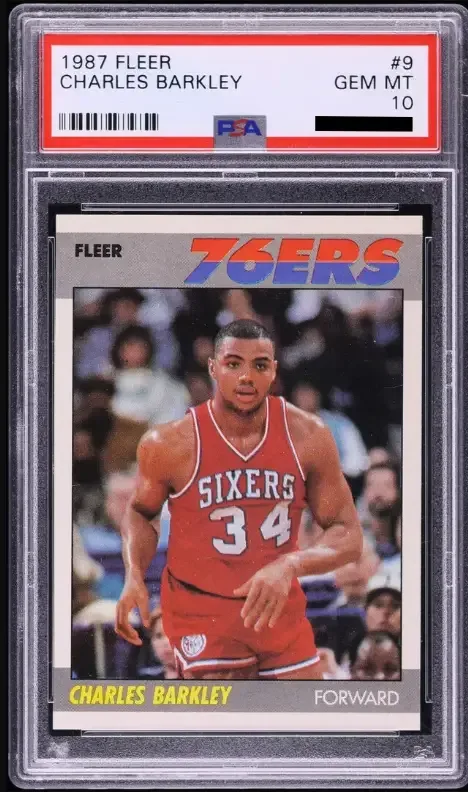
3. 1987 Fleer #9: the second-year surprise
Barkley’s 1987 Fleer #9 demonstrates why “rookie” and “rarest in gem mint” are not the same claim. It receives less attention than the 1986 Fleer rookie, yet it is substantially scarcer in PSA 10 condition. The available population figures show 25 PSA 10 copies of the 1987 card, compared with 246 PSA 10s for the 1986 rookie.
Only five of those 1987 PSA 10s had sold over the prior two years, and the two copies that changed hands in the reported most recent month each brought more than $10,000. That put them above the stated latest sale for the 1986 Fleer PSA 10.
This is a practical collecting distinction. A card can be plentiful overall but exceptionally difficult to find with the centering, corners, edges and surface quality necessary for a top grade. Conversely, a famous rookie can have stronger demand, a deeper sales history and more name recognition even if it has a larger top-grade population. Neither profile is automatically better; they appeal to different collecting priorities.
4. 1993-94 Ultra Scoring Kings #1: a Suns-era insert on the move
Barkley’s 1992 move from Philadelphia to Phoenix set up the next major chapter of his card legacy. He arrived after the 1992 Olympics, won league MVP in his first Suns season and led Phoenix to the Finals. The purple-and-orange years therefore have both visual identity and a major career milestone behind them.
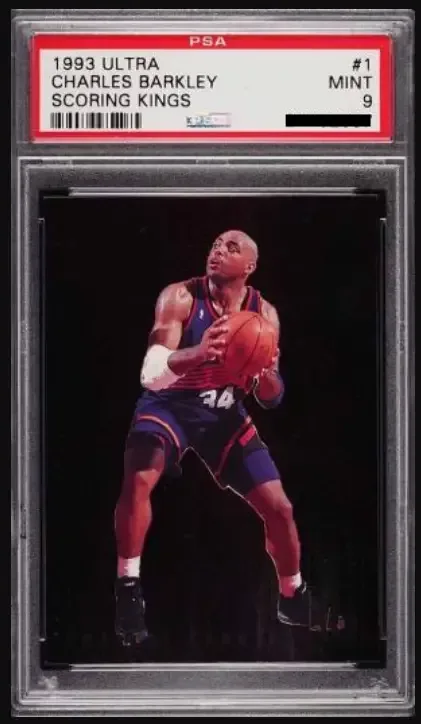
The 1993-94 Ultra Scoring Kings #1 is one of the clearest recent examples of a Barkley insert rising across multiple condition levels. Three of his four largest year-over-year gainers were copies of this card in different grades. A PSA 9 that had been selling around $300 to $350 in June rose to $965 in August and then reached $1,300 in its latest recorded sale. A PSA 8 climbed from $69 to $450 over 12 months, while raw examples moved from $41 to $100.
An insert is a card issued as a special subset within a broader product rather than the standard base-card run. Inserts often use a distinct design, a narrower checklist or a more limited distribution pattern. The Scoring Kings numbers show that the grade can radically change the price conversation, but the parallel movement of PSA 9, PSA 8 and raw copies also indicates interest that is not confined to a single premium slab.
5. 1992 Stadium Club Beam Team #15: design, condition and a flagship 1990s name
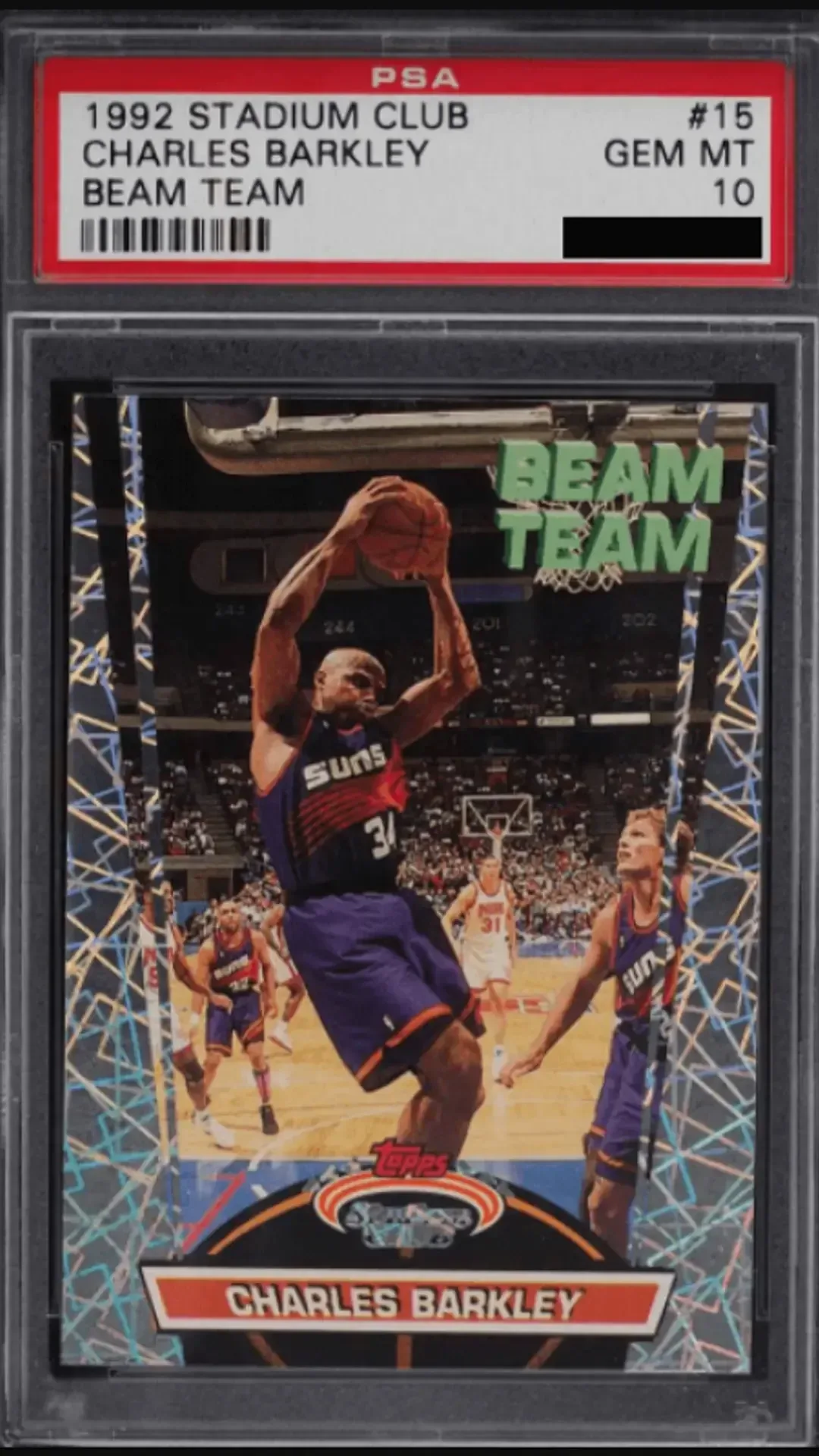
The 1992 Stadium Club Beam Team #15 is another key Suns-period card. It belongs to an insert line that remains closely associated with early-1990s basketball-card design, making it a natural target for collectors who prioritize the era’s visual language as much as pure serial-numbered scarcity.
The reported sales movement is dramatic: a PSA 10 increased from $500 to $2,400 over a year, while PSA 9 sales rose from $100 to a record $353.50. The large difference between the two grades is a reminder that a single point on a grading scale can matter substantially when top examples are hard to locate.
A slab is the sealed plastic holder used by a third-party grading company after it evaluates and authenticates a card. The numerical grade is not an aesthetic verdict everyone must share, but it provides a standardized condition category that makes market comparisons easier. Collectors considering Beam Team should still inspect the individual card where possible: the label identifies a grade, while the scan or in-person view reveals centering and presentation that may matter personally.
6. 2021 Panini Flawless Platinum Logoman Auto: the modern one-of-one peak
The highest reported Barkley sale belongs to a much newer card: the 2021 Panini Flawless Platinum Logoman Auto. This one-of-one card includes an autograph and a gold patch used to mark the NBA’s 50th anniversary during the 1996-97 season. It sold for $144,000 on March 20.
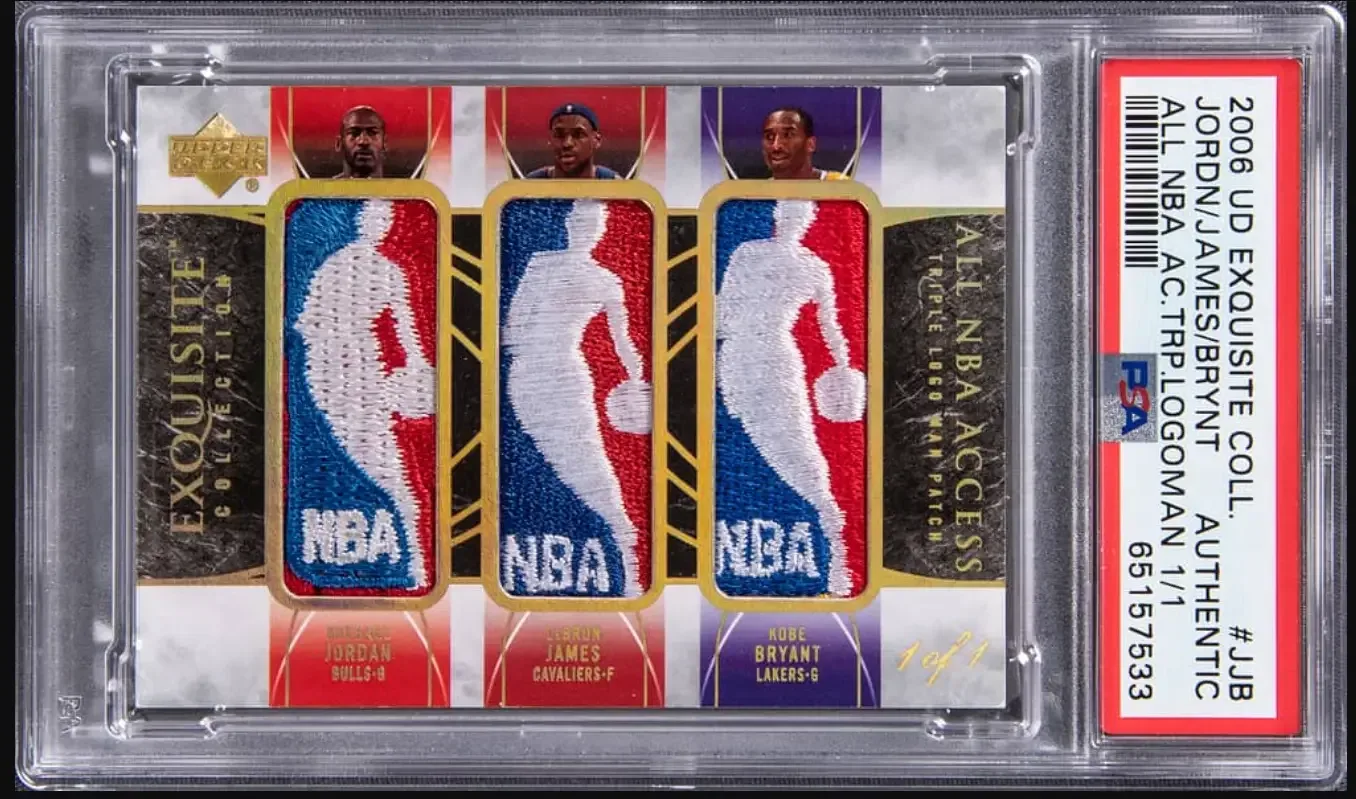
Its construction helps explain its placement at the summit. A Logoman card features the NBA logo patch from a jersey, while a one-of-one is a card designated as the sole copy of that specific version. Adding an autograph and a patch connected to a commemorative uniform creates several collecting hooks in one item: licensed branding, player signature, memorabilia element, scarcity and a link to Barkley’s Houston era.
Other Barkley Logoman sales underline that demand extends beyond the one-of-one. A 2024 Panini Flawless Update ’22 card graded PSA 8 sold for $63,400, and a 2021 Immaculate Collection example graded BGS 8 sold for $37,200. Still, collectors should avoid assuming every patch card carries the same significance. The exact product, serial number, patch type, autograph status and condition are all material details.
7. 1997 Metal Universe Green Precious Metal Gems: the ten-copy grail
After joining Hakeem Olajuwon and Clyde Drexler in Houston in 1996, Barkley entered the period that produced some of the hobby’s most revered 1990s parallels. The Rockets reached the conference finals in his first season there, but the team did not win the championship it had pursued. Barkley’s 16-year career was effectively ended by a ruptured left quadriceps tendon in December 1999, though he returned for the final game of that season.
The 1997 Metal Universe Green Precious Metal Gems, limited to 10 copies, is among the definitive late-1990s Barkley cards. A PSA 6 example sold for more than $79,000 in March. Its Red and Championship PMG counterparts have sold in the $30,000-to-$35,000 range when they have appeared.
A parallel is an alternate version of a card, usually distinguished by a different finish, color, numbering or other design treatment. PMGs became especially significant because their scarcity and distinctive look gave them a status beyond a standard base card. With cards this limited, however, sales can be intermittent. A result from one copy is valuable evidence, but it is not a continuous daily price quote.
8. 1997 E-X2001 Essential Credentials Now: scarce by the numbers
Barkley’s 1997 E-X2001 Essential Credentials Now is another Houston-era heavyweight, numbered to 17 copies. Reported sales include more than $20,000 for a PSA 6 and $17,000 for a copy carrying an Authentic grade without a numerical score.
That latter result offers a useful technical distinction. An Authentic grade confirms that a card is genuine, but it does not assign a numeric condition grade. For cards with extreme scarcity, collectors may accept an authenticated example with visible wear because waiting for a cleaner copy could take a long time. For other buyers, numerical condition may be central. The right choice depends on whether the priority is owning the card at all, pursuing the best condition possible, or balancing budget against rarity.
Across these eight cards, Barkley’s market is not one market. It is a set of overlapping collector interests: early-career history, rookie-card convention, difficult high grades, Suns-era inserts, 1990s parallel scarcity and modern autograph-and-memorabilia centerpieces. That is what gives the catalog its depth. A collector can choose a classic 1986 Fleer rookie, chase the condition challenge of 1987 Fleer, focus on Phoenix inserts, or aim at the high-end Houston grails without pretending those paths are interchangeable.
Anyone buying at the upper end should document the exact card version, numbering, grading company and sale date before comparing values. That modest bit of homework is especially worthwhile for Star cards, PMGs, Essential Credentials and Logomans, where details that seem small on a listing can be the difference between a similar card and a fundamentally different collectible.