A group of active Michael Jordan-related fixed-price listings has produced some eyebrow-raising numbers, topped by a $3 million lot described as rookie-era material. Before anyone starts redrawing the sports-card price guide in permanent marker, the essential distinction is this: these figures are seller asking prices, not completed sales.
That means none of the amounts below establishes a market value, an appraisal, an insurance figure, or proof that a buyer has agreed to pay. An asking price is simply the amount at which a seller has chosen to offer an item at one moment in time. That distinction matters enormously in a category where the details behind a card — identity, condition, grading, autograph authentication, serial number, and provenance — can matter as much as the player printed on it.
The snapshot includes a broad mix of Jordan material: a purported rookie-era multi-card bag, Nike promotional cards, error-card claims, and several Jordan-LeBron James dual-autograph cards. The listings show why Jordan remains a magnet for ambitious collector pricing, but they also provide a useful lesson in how to read marketplace language without treating every headline claim as established fact.
The 10 highest asks in the snapshot
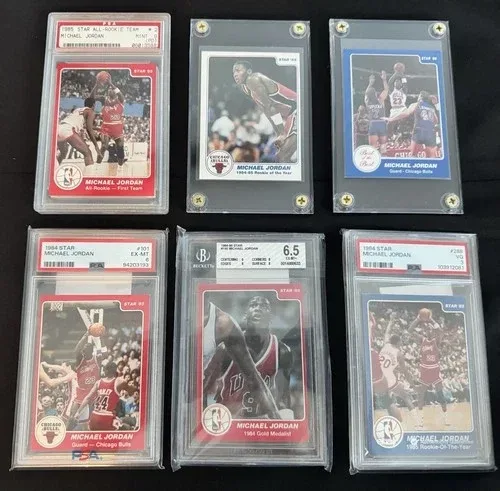
- “Revised! Michael Jordan Rookie PSA Star 1984 101 multip Star cards in orignl bag” — $3,000,000.
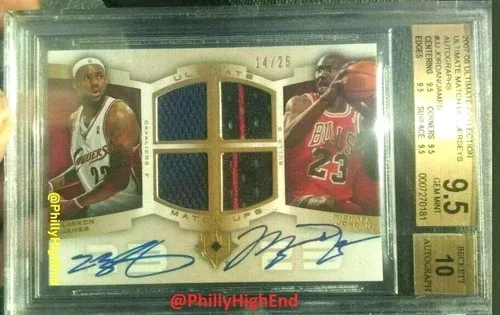
This is presented as a multi-card item, with the title referencing Michael Jordan, 1984, “101,” PSA, multiple Star cards, and an original bag. The supplied title does not state the exact contents of the lot, any PSA grade numbers, or whether every item is graded. “Rookie” is a seller description here, not an independently established classification in this snapshot. - “BGS 9.5 2007 UD Ultimate DUAL JERSEY PATCH AUTO Card Michael Jordan LeBron James” — $1,324,567.89.
The title identifies a 2007 Upper Deck Ultimate card pairing Jordan and LeBron James, described as a dual jersey patch autograph and carrying a BGS 9.5 grade. No serial number, subgrades, or provenance is supplied in the available listing description. - “1989-90 Nike Poster Cards Michael Jordan #891 Playground PSA 4” — $1,000,000.
This title identifies a 1989-90 Nike Poster Card, number 891, labeled “Playground,” with a PSA 4 grade. It does not call the card a rookie issue or supply further authentication information. - “LEBRON JAMES MICHAEL JORDAN 2007 UD Black Dual AUTO Platinum True 1/1 On Card” — $999,999.99.
The seller describes this as a 2007 Upper Deck Black dual on-card autograph featuring James and Jordan, using “Platinum True 1/1” in the title. A 1/1, or one-of-one, normally denotes a card represented as the sole example of a particular version; here it remains a claim in the listing title that would need documentation and inspection to assess. - “Michael Jordan 1996 Skybox & Nabisco NBA Hoops Rare Pop 0 Perf Edge Card SSP” — $934,000.
The title connects the card to 1996 Skybox and Nabisco NBA Hoops and uses “rare,” “Pop 0,” “perf edge,” and “SSP.” In hobby shorthand, population commonly refers to the number of examples recorded at a grading tier, while SSP is often used for “short print” or “super short print.” Neither label, nor the stated rarity, is independently verified by this snapshot. - “Michael Jordan 1992-1993 Fleer Ultra Error Cards. AJ English - 1/1 Set On Ebay” — $899,999.99.
This is described as a 1992-93 Fleer Ultra error-card set, with AJ English referenced in the title and a claimed “1/1 Set” designation. The title does not explain the alleged error, identify precisely which card involves Jordan, or establish why the set would be unique. - “ON CARD AUTO MICHAEL JORDAN ’94 ELMHURST CAMP FULL COA CARD 1993-94 Upper Deck” — $675,000.
The seller claims an on-card Jordan autograph associated with 1993-94 Upper Deck, references “’94 Elmhurst Camp,” and says the card has a full COA, short for certificate of authenticity. The title does not identify the COA issuer, so its scope and authentication value cannot be determined from the supplied information. - “RARE MICHAEL JORDAN 1994 Upper Deck Star Rookies MAJOR ERROR CARD #19 Ebay 1/1” — $600,000.
The listing describes a 1994 Upper Deck Star Rookies #19 as a “major error card” and an “Ebay 1/1.” The latter phrase should not be confused with a manufacturer-issued one-of-one serial designation; in this title, it is simply seller language. No error type or grade is specified. - “LEBRON JAMES MICHAEL JORDAN 2007 UD Black Dual AUTO AMAZING CARD! 6/25” — $595,000.
This 2007 Upper Deck Black Jordan-James dual autograph is labeled 6/25, language that suggests it is numbered sixth in a run of 25. The title does not say whether it is graded, whether signatures are on-card, or how the card’s condition was assessed. - “Nike Air Michael Jordan 4 IV Dual Auto Authenticated Promo Card BGS BAS 1/1 MJ” — $500,000.
The title identifies a Nike Air Michael Jordan promotional card, says “dual auto,” names BGS and BAS, and includes a 1/1 claim. BGS refers to Beckett Grading Services; BAS is an authentication service. The seller’s title alone does not provide a grade, an authentication report, or the identity of the second signer implied by “dual auto.”
Why the wording matters
Sports-card listings often pack a remarkable number of signals into a few dozen words. Some can be concrete identifiers: a year, card number, named set, a visibly stated grading number, or a serial notation such as 6/25. Others are marketing language: “rare,” “amazing,” “major error,” and “Ebay 1/1.” The latter phrases may help a listing surface in searches, but they should not be read as standardized evidence of scarcity or value.
Even terms that have recognized hobby meanings require context. PSA is Professional Sports Authenticator, while BGS is Beckett Grading Services. A numerical grade is generally meant to convey an independent assessment of physical condition, but buyers still need to verify the exact item, label, grade and certification details. BAS refers to an authentication service; its appearance in a title does not, by itself, reveal what was authenticated or how.
Likewise, an on-card autograph describes a signature made directly on the card rather than on a separate sticker later applied to it. A patch card is described in one of these listings as containing dual jersey patches. Those attributes can be important to collectors, but a premium claim has to match the particular card and its documentation rather than the broad category alone.
Jordan’s collector appeal is bigger than a stat line
There is a reason sellers attach very large aspirations to Jordan-related material. Jordan entered the NBA after being selected third overall by the Chicago Bulls in 1984, then constructed a career that included six championships across two Bulls three-peats, six Finals MVP awards, five regular-season MVP awards, 10 scoring titles, 14 All-Star selections and the 1988 Defensive Player of the Year award.
His legacy is also cultural. Nike launched the Air Jordan sneaker brand in 1984, helping connect basketball performance, celebrity, fashion and collecting in a way that continues to shape the market. That crossover helps explain the presence of Nike Poster Cards and Nike Air promotional material alongside conventional trading-card products in this particular group of listings.
Related coverage includes Michael Jordan Cards on eBay: 10 Highest Asking Prices in a Recent Snapshot.
Jordan’s enduring profile comes from moments as well as achievements: his 1982 NCAA championship-winning shot as a freshman at North Carolina, the 1988 Dunk Contest, his famous fadeaway, playoff highlights, and the championship runs of 1991-93 and 1996-98. He was inducted into the Naismith Memorial Basketball Hall of Fame in 2009. For collectors, that long-running cultural footprint can broaden interest beyond fans seeking only traditional rookie cards.
The Jordan-LeBron pairings reveal another layer. A dual-player autograph can unite a defining star of one era with a defining star of another, giving one piece multiple possible audiences. That does not establish a seven-figure market value for any particular card, but it helps explain why such pairings are marketed as elite items.
Practical reading: ask price is the start, not the answer
A buyer researching any high-dollar listing should separate what the seller has explicitly provided from what is being inferred. In this snapshot, the safest facts are the fixed asking prices and the wording of the titles. Everything beyond that — the precise contents of a bagged lot, the nature of an alleged printing error, the authority behind a COA, the meaning of a “Pop 0” assertion, or whether a 1/1 claim is manufacturer-issued — requires evidence beyond a marketplace title.
- Verify the exact card. Confirm the year, set, card number, player or players, and version rather than relying on a search-friendly headline.
- Read grading and authentication details carefully. A named company in a title is not a substitute for confirming the item’s specific label or accompanying documentation.
- Distinguish serial numbering from seller uniqueness. “6/25” and a manufacturer-backed one-of-one describe different kinds of claims; “eBay 1/1” is not automatically either.
- Treat error and rarity language cautiously. An error needs to be identified, and a claimed low population needs context about the referenced grade and database.
- Look for completed-sale evidence separately. Active listings show seller expectations. They do not show what the market has actually paid.
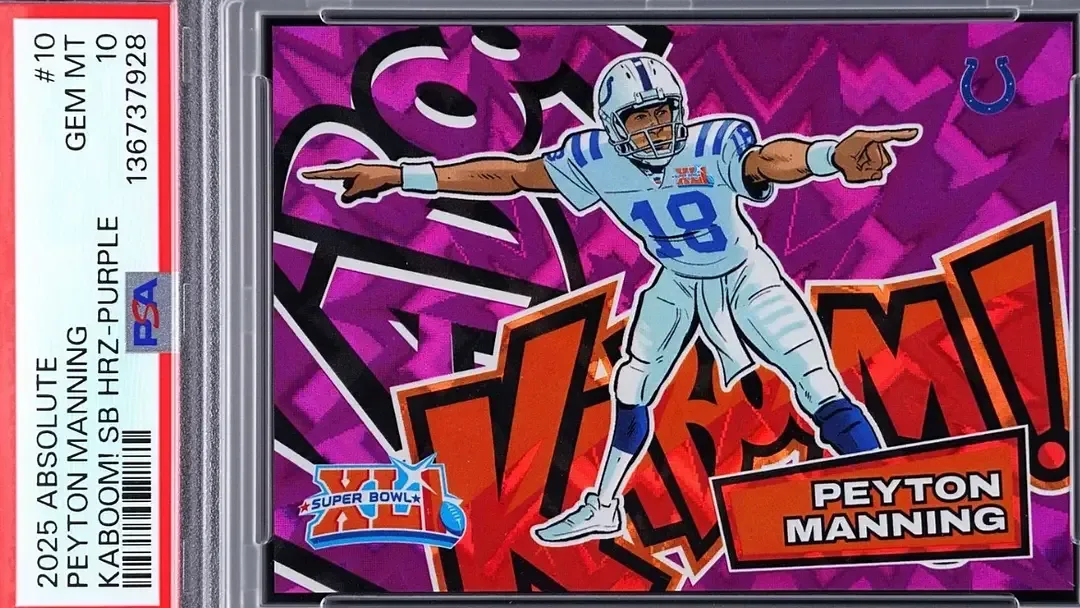
That last point is especially useful when viewing headline-grabbing prices in any segment of the hobby. A recent look at football card sales led by a Tom Brady Kaboom! Gold illustrates the more meaningful category of evidence: reported transaction results rather than unsold asks. The two figures serve different purposes and should not be blended.
What this snapshot actually tells collectors
The list is a record of seller ambition across Jordan-linked cards and promos, not a new all-time valuation chart. Its $500,000-to-$3 million range underscores the pull of Jordan’s name, the allure of graded cards, claimed limited numbering, autograph combinations and Nike associations. But the same list also demonstrates why disciplined language matters.
A $3 million fixed price does not mean a $3 million Jordan card has sold. A “1/1” in a title is not proof of manufacturer-issued uniqueness. A named authenticator is not a complete authentication record. And a PSA or BGS mention does not disclose all the details a serious buyer would need.
For collectors, the sensible takeaway is not that these cards have suddenly set a new price ceiling. It is that marketplace snapshots can be useful discovery tools: they reveal what categories sellers believe will command attention. The harder, more valuable work begins afterward, with exact identification, documentation review, condition analysis and genuine completed-sale research.