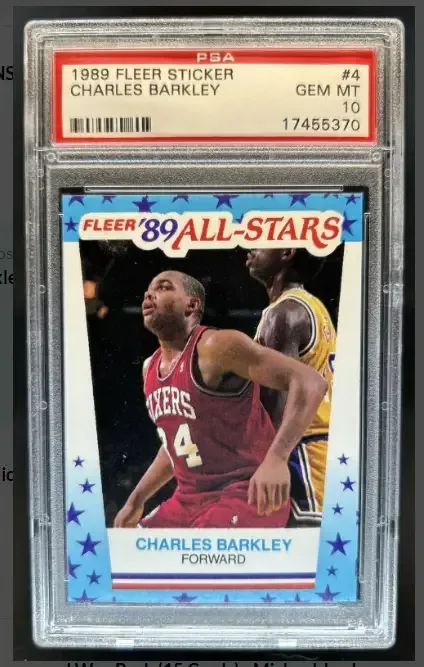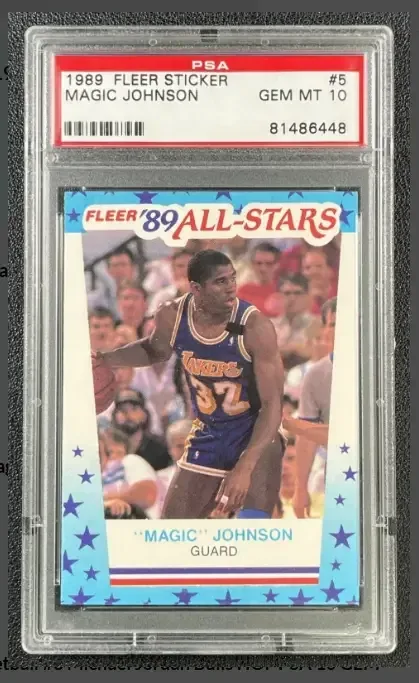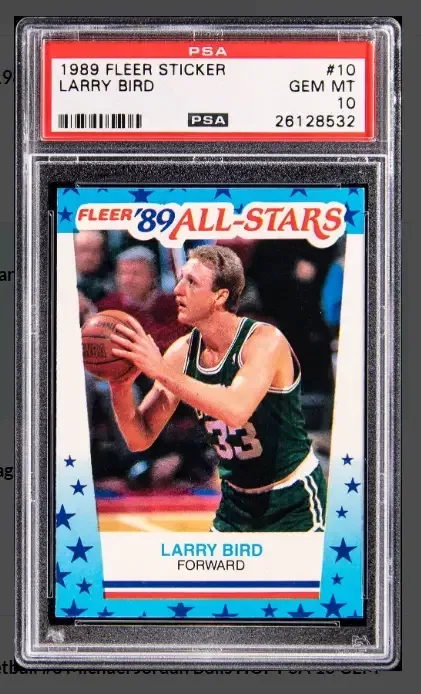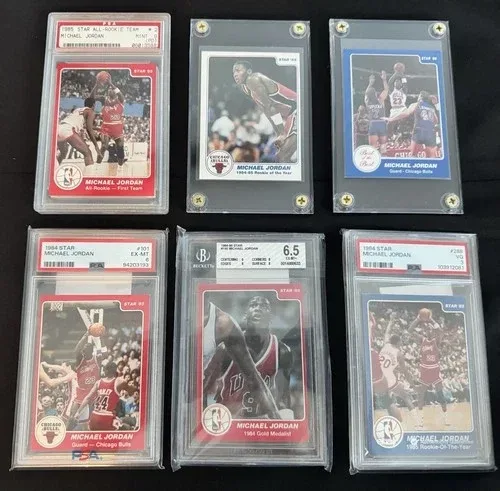
The 1989-90 Fleer Basketball Sticker set occupies an unusual lane in sports collecting. Its stars are immediately familiar—Michael Jordan, Charles Barkley, Magic Johnson and Larry Bird—but the format changes the conversation. These are stickers rather than conventional trading cards, made on thinner material that is more vulnerable to the sort of wear collectors and graders notice.
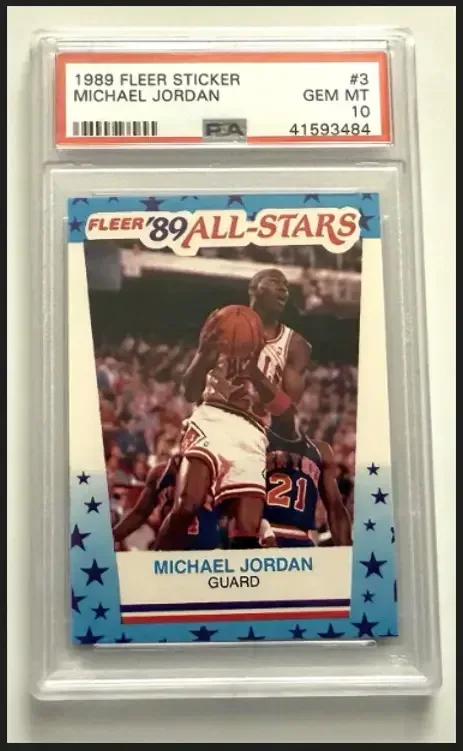
That condition challenge is central to a group of reported PSA 10 sales. A Michael Jordan All-Stars Sticker #3 reached $12,500 on September 14, 2026. Charles Barkley’s All-Stars Sticker #4 sold for $2,450 on August 29, 2026; Magic Johnson’s All-Stars Sticker #5 brought $1,057 on July 22, 2026; and Larry Bird’s All-Stars Sticker #10 sold for $889 on October 12, 2023.
The four results are not a universal price guide for every copy of these stickers. They are individual sales involving examples graded PSA 10, the top grade referenced here, and condition is a major dividing line in this set. Still, taken together, they illustrate a clear collector preference: iconic NBA names become still more compelling when paired with a difficult-to-preserve format and a scarce high-grade population.
Why a sticker’s condition can carry so much weight
In card collecting, a grade is an independent condition assessment assigned to a submitted collectible. Here, the cited examples carry PSA 10 grades. The importance of that label is especially easy to understand with a late-1980s sticker. Compared with a standard card’s thicker stock, the material is less forgiving. Small flaws that may affect visual appeal or grading potential become a bigger practical concern when collectors are pursuing the very highest condition tier.
For more context, explore Jaidyn Alexis Says Blueface Hookup Does Not Mean a Reunion.
That does not mean every ungraded or lower-grade copy lacks appeal. It means the market can treat the top-grade copies as a separate proposition. A collector interested in owning the player may target an affordable raw example or a lower grade. Another collector may specifically be chasing an exceptionally preserved PSA 10. Those are related pursuits, but they do not necessarily produce comparable prices.
“Population” is another useful term in this discussion. A PSA population figure refers to the number of examples recorded at that grade in the grading service’s population data. It is not automatically a count of every sticker printed, every surviving sticker, or every copy available to buy. Its practical value is narrower and more relevant: it gives a sense of how many examples have been graded at a particular level.
For this group, the reported PSA 10 populations help show why collectors focus on the top end. Barkley’s cited PSA 10 population is 15, while Johnson’s is 38. Those figures do not dictate value on their own—player demand, collector preferences and actual market supply still matter—but they help explain why high-grade examples get particular attention.
Michael Jordan sets the high-water mark
Jordan’s 1989-90 Fleer All-Stars Sticker #3 is the clear price leader among these four sales. The $12,500 result recorded on September 14, 2026 stands far above the other examples discussed. Jordan’s broad and durable standing in the hobby is part of the explanation, while the PSA 10 grade and the inherent difficulty of preserving stickers give the result added context.
The sticker also comes from the period before the Chicago Bulls dynasty that cemented Jordan’s larger-than-life status. For collectors, that makes it an item connected to an earlier chapter of an already enormous legacy rather than a later commemorative release. The appeal is layered: the player, the era, the set, the All-Stars designation and the condition all contribute.
There is a valuable lesson in the gap between Jordan and the rest of this quartet. A low population can make a collectible harder to find, but scarcity is not the same thing as demand. Jordan’s result reflects a combination of condition sensitivity and an exceptionally powerful player market. When collectors use one sale to assess another item, the player-specific part of the equation cannot be ignored.
For a closer look at the reported Jordan sale record, collectors can review the linked 1989-90 Fleer Stickers PSA 10 sales history entry. A single result can be informative, but it is best treated as a data point rather than a guarantee of what another copy will command.
Barkley’s Philadelphia-era sticker combines recognition and rarity
Charles Barkley’s All-Stars Sticker #4, showing him with the Philadelphia 76ers, sold for $2,450 in PSA 10 on August 29, 2026. The reported population of 15 PSA 10s is notably small, providing a concrete reason the best examples command attention.
Barkley’s collecting case has several components. The sticker represents his Philadelphia tenure and captures an established NBA star whose career ultimately resulted in Hall of Fame recognition. His continuing profile as a television personality also means he remains familiar beyond collectors who experienced his playing career firsthand. That cross-generational recognition can help keep an athlete’s memorabilia and cards visible to new audiences.
But the condition point remains essential. A Barkley collector can appreciate this particular issue without needing a PSA 10. The $2,450 result is most useful for someone evaluating a comparable gem-grade sticker, not as a shortcut for valuing every Barkley sticker from the set. In practical terms, buyers should identify both the exact sticker number and the exact grade before making comparisons.
Magic Johnson’s point-guard legacy meets a 38-copy PSA 10 population
Magic Johnson’s All-Stars Sticker #5 recorded a $1,057 sale on July 22, 2026, with a reported PSA 10 population of 38. That is larger than the cited Barkley total but remains a limited number for collectors whose focus is strictly on gem-grade examples.
Johnson’s basketball résumé gives the issue its lasting foundation. He was the centerpiece of the Los Angeles Lakers from 1979 to 1991 and again in the 1995-96 season, winning five championships. At 6 feet 9 inches, he was known for a combination of size, basketball intelligence and versatility that reshaped expectations for a point guard.
On a collecting level, that legacy makes the sticker more than a condition rarity. The PSA 10 population matters because it narrows the pool of certified top-grade copies, but the player’s place in basketball history supplies the broader reason collectors want the issue. This distinction is useful whenever evaluating a low-pop collectible: low population may be a catalyst, yet enduring player relevance is often what turns limited supply into persistent interest.
Larry Bird offers the lower reported price point of the four
Larry Bird’s All-Stars Sticker #10 sold for $889 in PSA 10 on October 12, 2023. It is the lowest reported result in this four-sticker comparison, but it also points to a potentially different collecting proposition. The available sale information indicates that Bird PSA 10s have regularly sold below $1,000, putting the issue in a different financial bracket from the cited Jordan and Johnson results.
Bird’s legacy needs little embellishment: three championships, three consecutive MVP awards and a defining rivalry with Johnson give collectors a deep well of basketball history to connect with. The Bird-Johnson rivalry also makes seeing both players in the same All-Stars sticker set especially appealing for collectors who build player-focused groups, era-focused runs or themed displays.
Calling Bird an “entry point” should be understood carefully. Under $1,000 is still a substantial purchase, and the figure applies to PSA 10 examples rather than every version of the sticker. Yet within this narrow group of high-grade legends, Bird’s reported pricing can offer a less expensive route to an elite-condition example from the 1989-90 Fleer sticker set.
What these four sales do—and do not—show
These transactions support a straightforward conclusion: there is meaningful collector demand for high-grade 1989-90 Fleer Basketball Stickers featuring major NBA names. Jordan’s $12,500 result establishes the ceiling among the four cited examples. Barkley at $2,450, Johnson at $1,057 and Bird at $889 show that the market differentiates sharply among legends even when all are PSA 10s from the same release.
The figures also underline why broad statements such as “the set is hot” can be incomplete. The evidence here concerns specific All-Stars stickers, particular grades and isolated sale dates. It does not establish an identical value for other players, other sticker numbers, raw copies, PSA 9s, or future transactions. Buyers and sellers should resist treating a star PSA 10 sale as a direct substitute for an assessment of a different copy.
A practical checklist for prospective collectors
- Confirm the exact issue: Make sure the sticker is from 1989-90 Fleer Basketball Stickers and verify the player and sticker number.
- Separate grade from player appeal: A PSA 10 may command a large premium, but the size of that premium can differ substantially between Jordan, Barkley, Johnson and Bird.
- Read population figures precisely: A PSA 10 population is a graded-population measure, not a complete census of all surviving examples.
- Compare like with like: A prior PSA 10 result is most relevant to another PSA 10 of the same sticker, rather than to an ungraded or lower-grade copy.
- Use sales as context, not certainty: Reported prices describe completed transactions on their listed dates; they are not promises about the next sale.
For collectors who favor the late-1980s NBA, the set’s appeal is easy to see. It gathers four players whose legacies remain firmly rooted in the sport’s history, then presents them in a format that rewards exceptional preservation. The result is a category where the familiar names draw interest, but the thin sticker stock and rare top grades supply much of the tension—and much of the collecting appeal.