Michael Jordan’s card market is getting a concentrated showcase in a sports fall auction scheduled to close on October 25, 2026. The group spans several very different collector priorities: an iconic rookie card in a relatively attainable certified grade, limited game-worn jersey autograph issues, and an especially scarce signed insert from 1997-98 SP Authentic.
That mix matters because “Michael Jordan card” is not a single collecting category in practical terms. A buyer weighing a 1986 Fleer #57 in PSA 8 is evaluating a card with broad recognition and a large graded population. A buyer considering a numbered Upper Deck jersey autograph is also weighing autograph authentication, memorabilia provenance, serial numbering and condition. At the top end, a low-population signed card can carry a value proposition built largely around how few comparable examples exist.
The sale therefore offers a useful snapshot of the information collectors should separate before deciding whether a card belongs in a personal collection or fits an investment-oriented budget. Grade, autograph grade, population count, serial number, prior sales and the story tied to a relic can all be meaningful, but none of them are interchangeable.
The 1986 Fleer #57: an iconic card in PSA 8
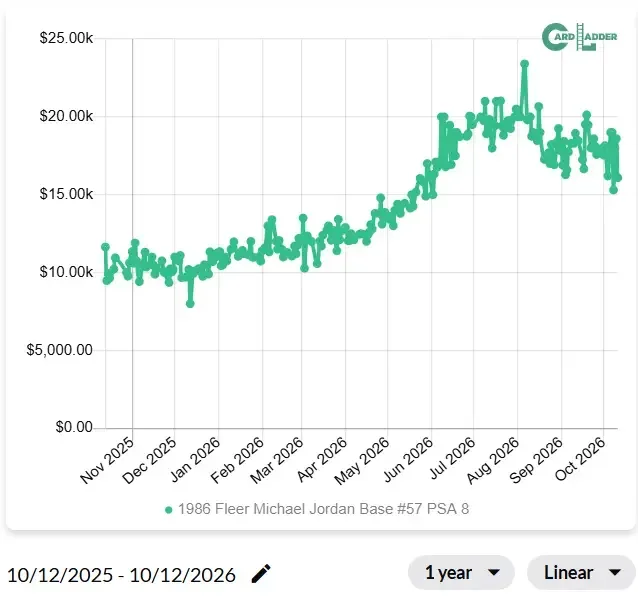
For many collectors, the 1986 Fleer Michael Jordan rookie card is a hobby landmark, with the PSA 10 version often treated as the ultimate target. Two PSA 8 copies of Fleer #57 are among the cards available in this auction.
For more context, explore Paramount Plans to Reopen Pacific Palisades’ Bay Theatre With The Lot Running Operations.
PSA 8 is the most populated grade for the Jordan Fleer rookie, with 9,432 copies cited in the population. That figure is a crucial piece of context. Population, often shortened to “pop,” refers to the number of examples a grading company has recorded at a particular grade. A high pop does not erase demand for a famous card, but it does mean a PSA 8 buyer is not acquiring a uniquely scarce item on population alone.
The stated estimated entry point for a PSA 8 is $16,000, alongside a one-year growth figure of 38.19%. Those numbers are useful market markers rather than guarantees. A one-year index movement describes a recent period, not a promise that the next buyer will realize the same outcome. Individual cards can also vary within the same grade through centering, eye appeal, label history and the timing of competing listings.
For a collector, the PSA 8 can represent a different kind of appeal than a trophy-grade copy: the chance to own the foundational Fleer rookie without pursuing the condition rarity of a PSA 10. The trade-off is clear as well. With thousands of PSA 8s recorded, the card’s importance and collector demand do more work than scarcity at that grade.
Why the grade still changes the conversation
Third-party grading is a condition assessment performed by a grading company and placed into a sealed holder with an identifying certification number. In this case, “PSA 8” identifies the numerical grade assigned to the card itself. It should not be confused with the grade of an autograph, which is assessed separately on some signed cards.
Condition is especially central to the 1986 Fleer Jordan because the same card can exist across a broad grading spectrum. The card design and player are unchanged, but the market treats a card’s surviving physical state as a major differentiator. That is why “1986 Fleer Jordan rookie” is only the start of a useful description; card number, grader and grade are all essential details.
SPx Game Worn Jersey Autograph #13/23 combines several scarcity signals
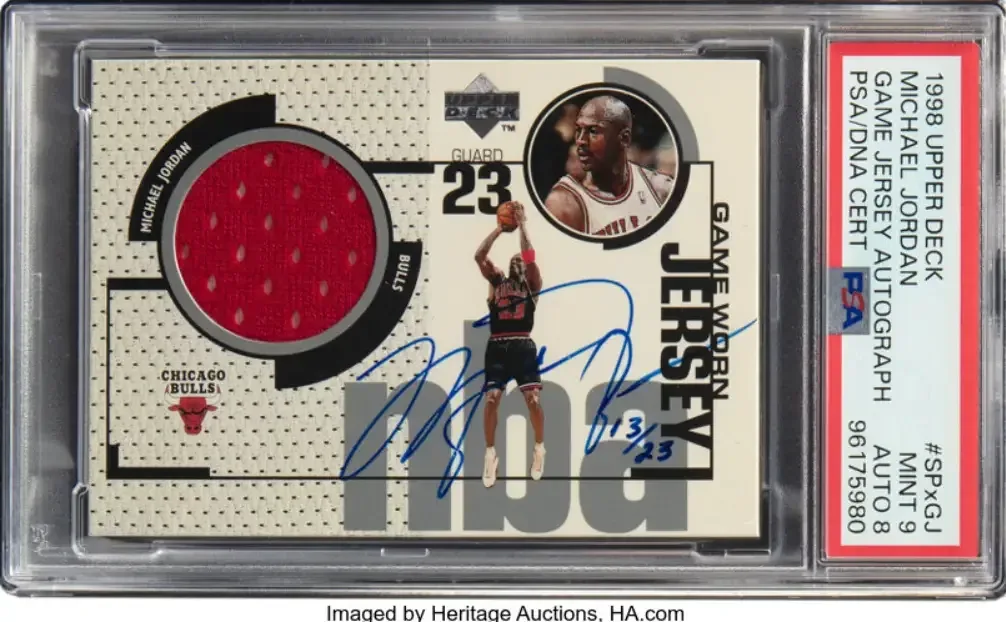
One of the more expensive offerings is a 1998 Upper Deck SPx Game Worn Jersey Autograph numbered 13/23. It is graded PSA 9, with an Auto 8, and is expected to bring more than $350,000 including buyer’s premium. Its stated population is two, with only one example graded higher.
Several labels in that description deserve to be read independently. “13/23” is a serial number indicating that this card is one of 23 produced in that run. Serial numbering gives collectors a defined print run, unlike a general base card where total production may not be printed on the item. It is a direct scarcity feature, although it is not automatically a measure of condition.
“Game worn” identifies the jersey-relic component described on the card. Relic cards incorporate a physical material, here presented as a game-worn jersey piece, in addition to the autograph. The combination provides a tangible connection to the athlete beyond photography and printed design, but collectors should still distinguish the relic designation from the card’s numerical grade and from the autograph evaluation.
The PSA 9 and Auto 8 wording does exactly that. The first score concerns the card, while the autograph receives its own score. A strong card grade does not require an identical autograph grade, and an autograph grade should not be casually treated as an overall grade for every component. The listing’s pop-two figure likewise applies to that graded-card context; it should not be read as proof that only two copies of the underlying 23-card issue exist.
Upper Deck and Jordan extended their long-running partnership in July 2026, leaving Upper Deck as the option for Jordan autograph cards. That context helps explain why authenticated Jordan signatures remain a major point of attention for collectors. Still, limited supply, a signature and a relic are separate attributes. A careful bidder should be specific about which of those attributes is driving their interest and their ceiling.
The MJx card ties its relic to the Bulls’ first three-peat
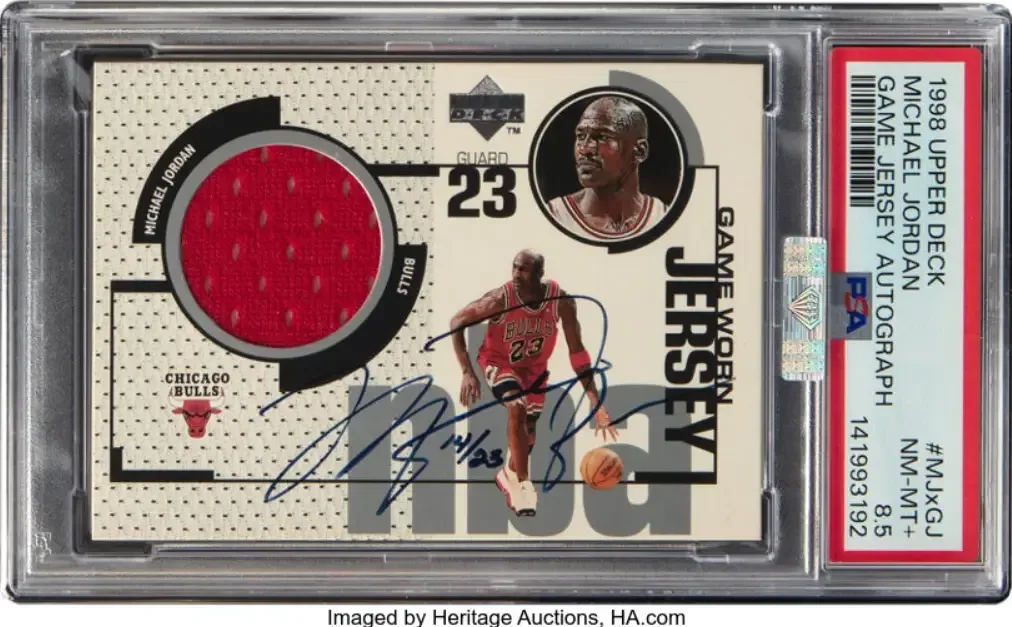
A second game-worn autograph entry comes from the MJx subset: the 1998 Upper Deck Game Worn Jersey Michael Jordan Autograph #MJXGJ, numbered 14/23. This copy is graded PSA NM-MT+ 8.5 and carries an MBA Silver designation. The listing identifies a population of one at that grade, with three graded higher.
The card’s jersey material is connected to the 1992-93 season, the year the Chicago Bulls completed their first three-peat. Jordan averaged 41 points in that season’s NBA Finals and earned his third consecutive Finals Most Valuable Player award. The action image is also noted for showing the Bulls’ red jersey, giving the card a visual and historical link to the season associated with its relic.
This is where memorabilia cards can offer something a base card cannot: a more explicit narrative. A collector is not simply pursuing Jordan’s name, a limited serial number or a certified autograph. The artifact is framed around a particular championship season. That association can make the card compelling to a Bulls-focused collector even before questions of market value enter the discussion.
It is important, though, not to let a low population number blur distinct ideas. A population report reflects submitted and graded examples in a particular grading system. The 14/23 serial number describes the print run. The 1992-93 jersey reference describes the item’s historical association. All three help identify the card, but they answer different questions.
SP Authentic Sign of the Times Stars & Rookies is the auction’s sharpest rarity play
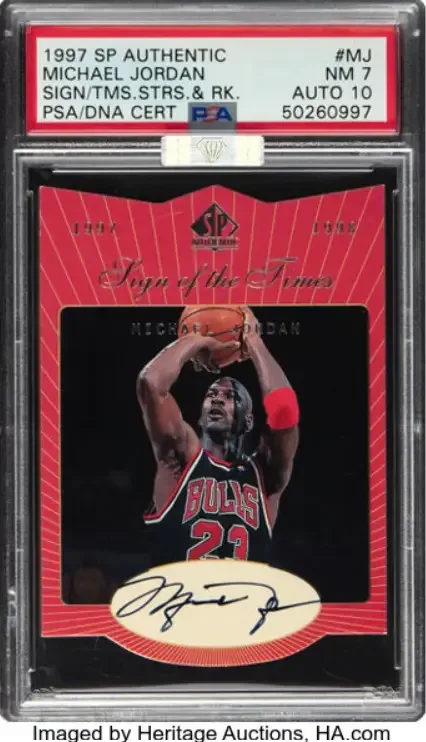
The largest stated expectation belongs to a 1997-98 Upper Deck SP Authentic Sign of the Times Stars & Rookies Michael Jordan #MJ. It is graded PSA NM 7, with a PSA/DNA Auto 10, and is expected to sell for more than $500,000. The reported population is six, with only one graded higher.
On its face, a PSA 7 card grade might appear less dramatic than the PSA 9 attached to the SPx jersey autograph. But the Sign of the Times example illustrates why a grade cannot be interpreted without issue-level scarcity. Its combination of a six-card population, a high autograph assessment and a limited number of higher-graded examples makes it a distinctly different proposition from a widely graded rookie card.
PSA/DNA Auto 10 identifies the autograph assessment. Separating the signed element from the card’s physical grade is particularly valuable for vintage-era autograph inserts, where collectors may value the signature’s appearance and authentication alongside a card that has condition wear. The card grade and autograph grade tell two stories rather than competing to provide one single score.
Two sales of PSA 7 examples were reported during 2025: one at $283,026 on March 15 and another, conducted privately, at $375,000 on December 15. Certification-number checks indicated that those sales involved different cards. That distinction is significant. Repeated sale reporting for the same physical card can create a misleading impression of broader demand or of a consistent price level. Confirming distinct certification numbers helps establish that the records relate to separate examples.
Even so, previous results are reference points, not a fixed valuation formula. A public sale and a private transaction have different levels of visibility, and the auction estimate above $500,000 is an expectation rather than a completed price. Prospective bidders should also account for the buyer’s premium when comparing any hammer price to a total acquisition cost. The SPx card’s stated estimate specifically includes that premium; it is wise to check how every figure being compared is presented.
What this group says about building a Jordan collection
These four entries show why “rarity is value” is useful as a broad idea but incomplete as a buying rule. The Fleer rookie’s attraction is rooted in its enormous cultural significance and enduring collector recognition, even though PSA 8 is a highly populated grade. The two numbered jersey autograph cards add limited production, signatures and game-worn material. The SP Authentic Stars & Rookies card brings an exceptionally low reported population and a top-level autograph grade despite its PSA 7 card grade.
A practical approach is to write down the exact variant before tracking values: year, manufacturer, set, card number, serial number, card grade, autograph grade and any relic description. Then compare like with like. A PSA 8 Fleer base rookie should not be priced as though it were a signed, numbered relic. Likewise, a low-pop signed insert should not be judged solely by its numeric card grade without considering the issue’s documented scarcity.
Collectors interested in the auction can see the broader Jordan-card auction context, but the decisive work remains item-by-item: understand what the label says, what the serial number means, what population data measures and what prior sales do—and do not—establish.
For Jordan collectors, the most durable reason to choose among these cards may be the easiest one to articulate. The Fleer rookie represents an era-defining card. The SPx and MJx pieces connect Jordan’s autograph and jersey material to a limited-card format. The Sign of the Times offering emphasizes scarcity and signature quality. Knowing which story matters most makes the numbers easier to place in proper perspective.