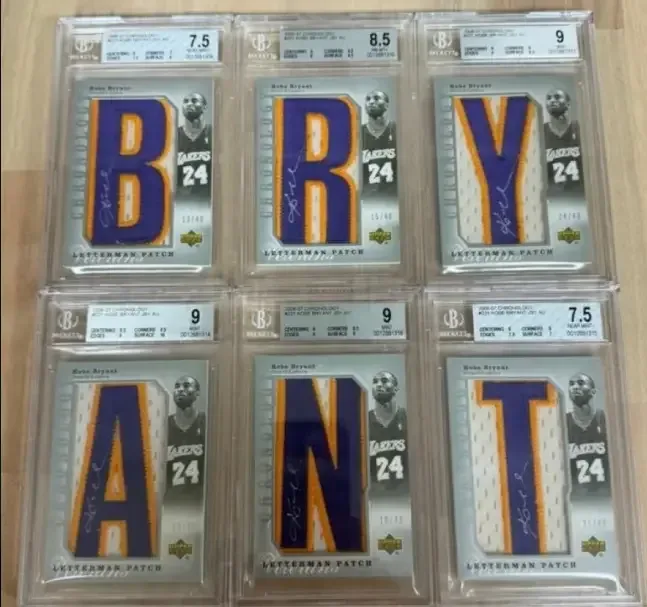
Modern sports-card collecting loves a clean elevator pitch: low serial number, authenticated autograph, player-worn material, iconic name. The 2006-07 Upper Deck Chronology Letterman Patch Autographs packed all of that into a format that remains unusually satisfying nearly two decades later. Instead of treating a jersey fragment as merely another small swatch behind a window, these cards use a letter cut from the player’s surname. Completing a player’s name turns individual cards into a connected display piece.
That concept is the heart of the appeal. A collector can pursue one scarce signed patch card, or take on the substantially harder assignment of assembling every letter in a surname. For a name such as JORDAN, that means six separate cards. For BRYANT, it is also six. The pursuit is therefore about more than finding a single premium card; it is about completing a visual and material sequence that reads clearly even before someone knows the particulars of the set.
The cards’ staying power also makes sense in a hobby increasingly attentive to major game-worn memorabilia. A 1998 NBA Finals Game 3 Michael Jordan jersey recently sold for $12.26 million, a headline-grabbing result that naturally directs more attention to collectibles tied to uniforms. A Letterman card is not a substitute for owning a full jersey, nor should it be treated as one. It is a very different category of collectible. But it offers a compact, authenticated card format where an autograph and a substantial letter-shaped patch combine into a more presentation-oriented object than the typical memorabilia insert.
What makes a Letterman patch card different?
A patch card includes a piece of fabric embedded in the card. In this Letterman format, the fabric is shaped around a letter taken from the player’s last name. Rather than seeing a plain rectangle of jersey material, a collector sees a distinct part of the surname. Put enough cards together and the letters form the player’s name.
An autograph patch card, often shortened by collectors to “patch auto,” combines that embedded material with the athlete’s signature. In this case, the autograph gives each card an additional collecting lane: buyers can weigh the quality and placement of the signature alongside the player, the letter, condition and serial number.
Serial numbering identifies a card’s stated place within its production run. The Chronology Letterman cards discussed here are numbered to 40 copies per letter. That does not mean there are only 40 cards for an entire player name. A six-letter surname with 40 copies of each letter creates up to 240 individual letter cards across the full name, assuming each letter was issued at that stated quantity. Yet a collector who wants one particular complete spelling still needs to locate six specific letters, ideally with matching presentation and acceptable condition.
That is the key distinction between rarity and completion difficulty. A single card may be scarce. A complete name set requires scarcity to line up repeatedly. The specific letters must appear, sellers must be willing to move them, and the buyer must be comfortable with the grade, autograph appearance and price. Repeated letters can complicate a project further because the collector needs more than one copy of the same character. The pursuit is not a simple matter of multiplying a card’s print run by a player’s fame.
Michael Jordan is the obvious headline chase
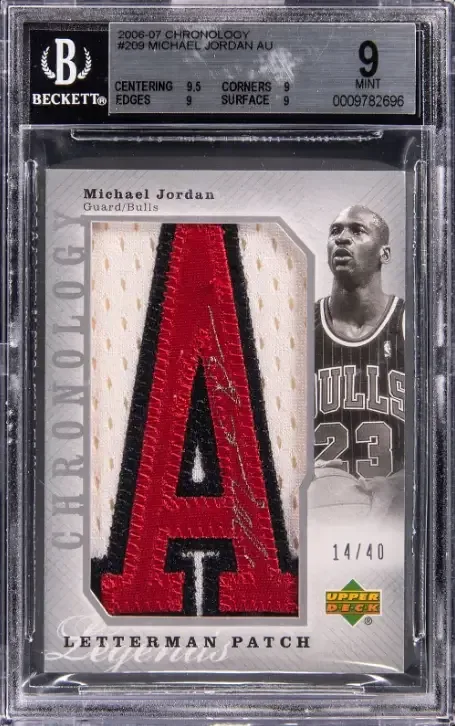
Michael Jordan sits at the sharpest end of the Chronology Letterman conversation. A 2006-07 Upper Deck Chronology Letterman Patch Autograph, numbered 14/40 and graded BGS Mint 9, sold for $18,910 on August 15, 2026. That is a meaningful data point, but it should not be mistaken for a universal price guide for every Jordan letter or every condition level. A grade, the exact letter, eye appeal, autograph quality and the setting of the sale can all influence the number a card realizes.
Related coverage includes Why 2006-07 Upper Deck Chronology Letterman Patch Autos Still Feel Ahead of Their Time.
The full JORDAN build is particularly difficult because the subset has only 40 copies per letter and because each collector looking to finish the name needs the same six letters. Sales records dating back to 2007 show only nine sales of Jordan Letterman Patch Auto cards. That limited public record does not prove how many are held privately, nor does it establish a precise market value for an untraded letter. It does, however, illustrate a practical reality: collectors may wait a long time for a needed piece to surface publicly.
There has been video showing all six Jordan letters together, an image that captures exactly why the format works as a display. Still, public appearances of a complete run do not by themselves confirm ownership, transaction history or a set’s market value. In a thin market, it is wise to separate what is visibly documented from what is assumed. A card can be real, rare and desirable while its next sale price remains highly uncertain.
A Hall of Fame checklist gives the format range
Jordan may dominate attention, but the Letterman subset has depth. Its Hall of Fame names include Jerry West, Larry Bird, Yao Ming, Steve Nash, David Robinson, Nate Archibald and Hakeem Olajuwon. That variety matters because Letterman cards reward different collecting instincts.
Shorter surnames can create a more concise display target. Longer surnames create a larger visual project, more cards to locate and more opportunities for the assembled name to stand out in a case or frame. Neither is automatically better. A collector choosing Jerry West may value a smaller goal, while someone chasing Olajuwon may enjoy the extended search and the impact of a longer completed name.
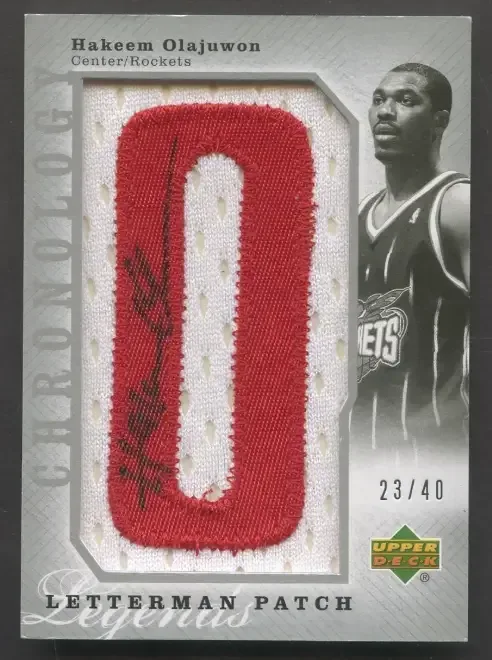
A reported sale for a Hakeem Olajuwon 2006-07 Chronology Letterman autograph patch, numbered 23/40, closed at $232.50 on April 25, 2022. The contrast with the recent Jordan result is a reminder that a shared set design does not make players interchangeable. Superstar demand, collector base, career legacy and the particular card offered all affect market behavior.
It is also a reason not to approach the set only as a speculative checklist. Someone who wants a recognizable Hall of Famer and likes the format’s display potential may find a more personally rewarding route outside the most expensive names. Collecting a favorite player or a name that looks especially good when spelled out is a defensible goal in a subset where completion can be as gratifying as a single-card acquisition.
Kobe Bryant adds another complete-name target
Kobe Bryant’s presence gives the 2006-07 Chronology Letterman subset another major focus: BRYANT. One completed and Beckett-graded Bryant name set has been publicly displayed, demonstrating how the six letters work when presented as a group rather than dispersed across separate holders or storage boxes.
Interest in Bryant memorabilia remains especially visible. On September 30, 2026, a rare gold No. 8 Bryant jersey was placed on the auction block. The jersey was described as a championship-era piece, with the Lakers going 16-1 in games Bryant wore it, and it included a Larry O’Brien Championship Trophy logo. Those details speak to the appeal of full-scale game-worn items: they can carry a direct physical connection to a particular era and visual markers that are immediately legible on a wall.
Chronology’s BRYANT cards appeal for a different reason. They translate the surname into six small, signed collectibles, each with an embedded letter. A framed jersey prioritizes the garment as a whole. A completed Letterman run emphasizes construction, scarcity and the deliberate act of assembling a name one card at a time. Collectors do not need to declare one format superior for both to make sense.
Practical considerations before chasing a name
A Letterman project rewards patience, but it also benefits from a plan. First, decide whether the objective is a single standout card, a full surname or a specific display arrangement. Those are materially different collecting jobs. A one-card purchase can be guided by the player, letter and condition. A name set requires tracking every needed character and accepting that the last missing letter may be the hardest one to secure.
- Identify the exact player and letters needed. Write out the surname before buying. It is easy to be drawn to an attractive card that does not advance a particular completion goal.
- Understand the stated numbering. “Out of 40” is a per-letter figure here, not a guarantee that all desired cards will be readily available.
- Evaluate the individual card, not only the player. Grade, centering, surface, patch appearance, signature presentation and the serial number can affect desirability.
- Use public sale results carefully. A documented sale establishes what one example brought at one time; it does not automatically price every copy or every letter.
- Think about storage and display early. A six-card name run has more impact when the holders, grades and layout feel coherent.
Grading deserves particular context. A third-party grade, such as the BGS Mint 9 on the Jordan card that sold in August 2026, evaluates the graded card under that company’s standards. It can make condition easier to communicate when selling or trading, but it does not erase the subjective aspects of a patch auto. Collectors may still prefer one example over another because of patch shape, letter coverage, autograph placement or overall eye appeal.
For readers who enjoy the broader intersection of collectibles and pop-culture card coverage, TMNT: Journeys #14 offers a separate look at the collecting space.
Why the format still works
Upper Deck Chronology Letterman Patch Autographs endure because the design turns a familiar card ingredient into an objective. The memorabilia piece is not just present; it is part of a surname. The autograph is not merely an added parallel; it helps make each letter feel like a premium artifact. And the numbering to 40 per letter ensures that even a straightforward-looking six-letter name can become a long-term chase.
Whether these cards rise alongside the enormous prices attached to elite game-worn jerseys cannot be known in advance. The two markets overlap in their interest in player association, material and display, but they are not identical. Full jerseys have scale and direct historical appeal. Letterman cards have portability, set-building tension and the distinctive satisfaction of spelling out a legend’s name in signed patches. For collectors, that difference is precisely what keeps the 2006-07 Chronology subset compelling.