The 2026-27 NBA season is only two games old for every team, an important qualifier before anybody crowns a breakout star or rewrites a franchise’s pecking order. Still, the opening days have supplied three unusually sharp storylines with an immediate trading-card angle: Ty Jerome’s 45-point eruption for Memphis, Tyler Herro’s high-volume scoring start in Milwaukee, and Walker Kessler’s strikingly efficient introduction as a Laker.
Each player’s recent PSA 10 rookie-card sale has climbed to an all-time high. That does not establish a durable new price level, and it certainly does not make a two-game sample a dependable forecast. It does, however, show how rapidly collectors can respond when player opportunity, a changed team situation and a memorable box score arrive at once.
The players and cards are very different propositions. Jerome has the loudest individual scoring moment and a relatively small graded population for the card in question. Herro has entered a potentially much larger offensive role, but his comparable Prizm Silver has far more PSA 10 copies. Kessler combines a major move to Los Angeles with early production at center, while the Optic Holo being tracked is the scarcest PSA 10 of the three by a considerable margin.
Ty Jerome’s opener creates a new Memphis question
Jerome produced a career-high 45 points against the Utah Jazz as Memphis opened with a victory of more than 20 points. The performance set a Grizzlies franchise record for scoring in a season opener. Its surprise value is central to the reaction: Jerome is in his eighth NBA season and had exceeded 30 points only once previously in his career.
Memphis has also undergone substantial offensive change, having moved on from both Jaren Jackson Jr. and Ja Morant over the past year. Through two games, Jerome has been the most conspicuous answer to the question of where points will come from. That is a compelling narrative for a player whose profile is suddenly tied to a bigger role rather than merely one extraordinary night.
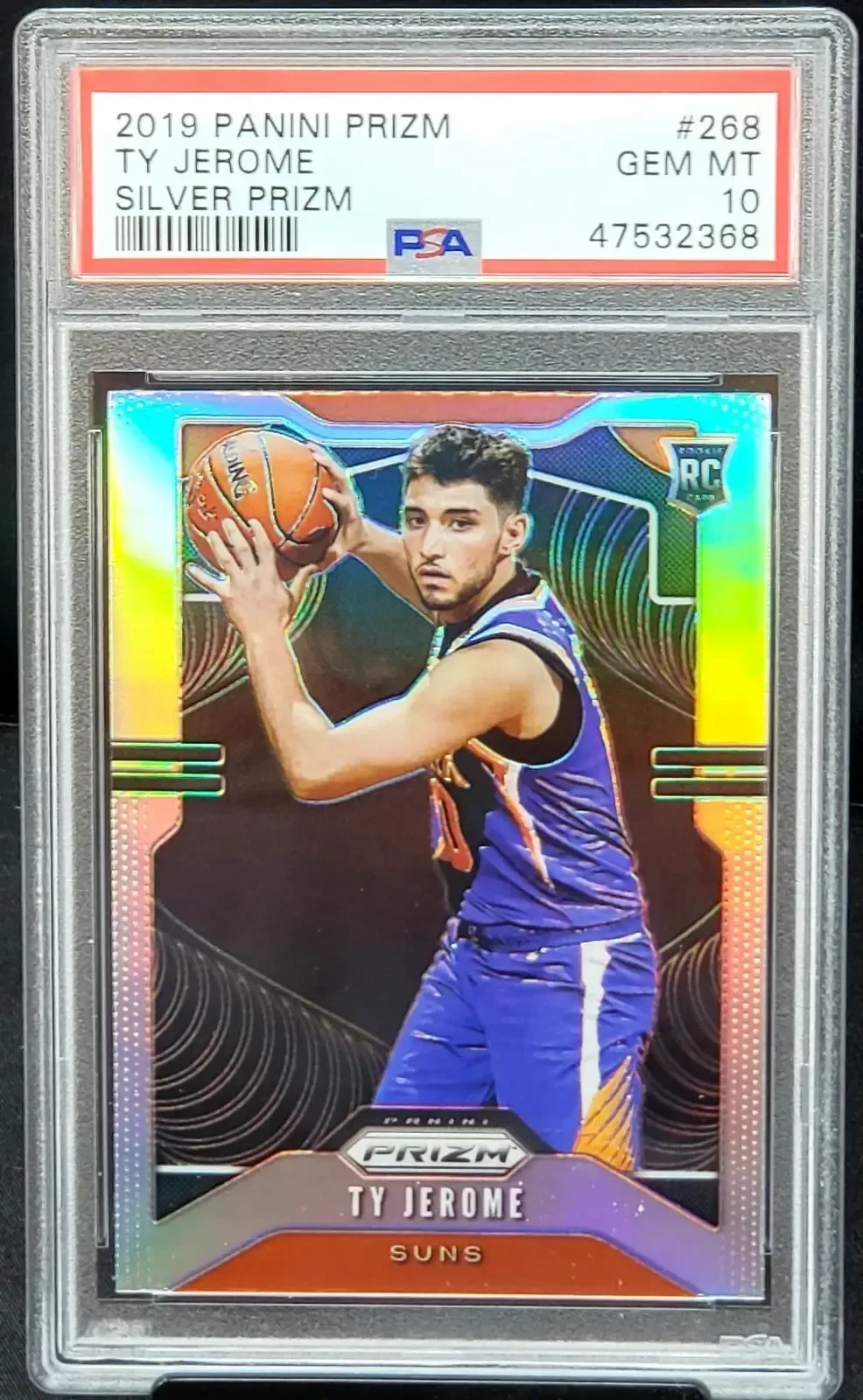
The relevant card is the 2019 Panini Prizm Ty Jerome Rookie Silver Prizm #268, PSA 10. A PSA 10 is a copy awarded the top grade by Professional Sports Authenticator, while “Silver Prizm” identifies a parallel version of the standard Prizm card rather than the regular base issue. The PSA population, or POP, is 86. Put simply, that is the reported number of copies of this exact card that have received that specific grade from PSA.
A PSA 10 copy sold for $99.99 on October 22, an all-time high for the card. That sale was $69.99, or 233%, above its level 2.5 months earlier. The percentage is eye-catching, but the absolute numbers deserve equal attention: a move from roughly $30 to roughly $100 can register as a huge percentage gain without proving that the card now has deep, repeatable demand at $100.
For collectors, Jerome’s next stretch is more informative than the headline game itself. Continued meaningful usage in the new-look Grizzlies offense would strengthen the case that the opener represented a role change. A return to a more modest scoring profile would not erase the 45-point game, but it could make that sale look more like a short response to a singular performance.
Related coverage includes Ty Jerome, Tyler Herro and Walker Kessler Drive Early NBA Card Movement.
Tyler Herro’s new team brings a clearer scoring opportunity
Herro arrived in Milwaukee as a key part of the Giannis Antetokounmpo trade, and the initial evidence points to a central offensive responsibility. He led the Bucks in shot attempts and scored a team-high 24 points in his debut. In Milwaukee’s 132-125 loss to Chicago, he scored 34 points and was the only Bucks player to reach 20, adding five rebounds, four assists and one steal.
Those 58 combined points constitute a career best for Herro across the opening two games of a season. The available evidence is not enough to declare him Milwaukee’s permanent No. 1 option, but it does support the practical reason collectors are paying attention: his shot volume and scoring load have immediately been prominent after a franchise-altering trade.
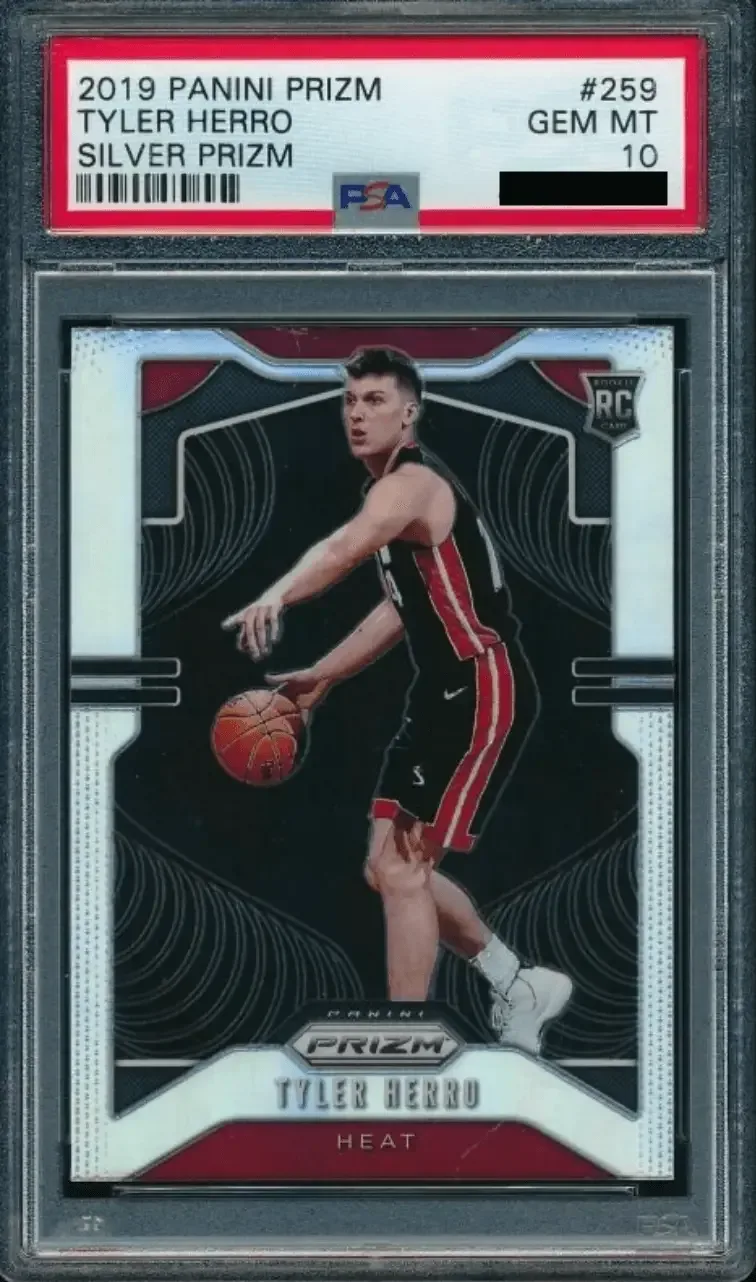
The card that has moved is the 2019 Panini Prizm Tyler Herro Rookie Silver Prizm #259, PSA 10. It sold for $56 on October 20, its all-time high, after a $32.56 increase over the prior month. That represents a 139% rise.
Herro’s card offers a useful contrast with Jerome’s. Its PSA 10 population is 864, compared with Jerome’s 86. Population is not a complete measure of supply—ungraded copies exist, cards can still be submitted, and not every graded copy is necessarily for sale—but it is an essential context point. At the same top grade, Herro’s Silver Prizm has ten times the reported PSA population of Jerome’s tracked card.
That difference can matter when a new wave of buyers pursues a player. A larger number of graded examples may give buyers more alternatives and potentially temper scarcity-driven pressure. On the other hand, broader availability can make a card easier to find for collectors who want the established rookie-year Prizm Silver without needing to chase a particularly limited parallel.
More broadly, a trade can change the lens through which a card is evaluated. Herro did not become a rookie again, and his 2019 card did not acquire a new print run. What changed was the surrounding basketball story: a new uniform, a new offensive ecosystem and an opening pair of games in which he was heavily involved. Collectors should separate that narrative shift from a guarantee of season-long production.
Walker Kessler’s Lakers debut supplies production and scarcity
Kessler’s offseason move has the most explicit long-term organizational investment of the three situations. The Lakers acquired him in a sign-and-trade after he spent his prior NBA career with Utah, which selected him No. 22 overall in the 2022 NBA Draft. Utah received first-round picks in 2031 and 2033, plus first-round swaps in 2028 and 2030. Kessler signed a four-year, $130 million contract.
In his first two games with Los Angeles, Kessler scored 48 points—22 and 26—and posted an 84.6% field-goal percentage, the league’s best at this early point. He went 12-for-12 from the field in his Lakers debut, the second-best shooting performance in franchise history. He then recorded six blocks and three steals, becoming the eighth Lakers player to reach both marks in a game.
Those figures highlight why Kessler’s start has grabbed attention beyond a conventional big-man storyline. The points and perfect debut shooting show efficient offense, while the blocks and steals indicate defensive activity. A center paired with the Lakers’ stars has a straightforward basketball appeal if he can provide interior finishing and rim protection; the first two games suggest that possibility, not a settled verdict.
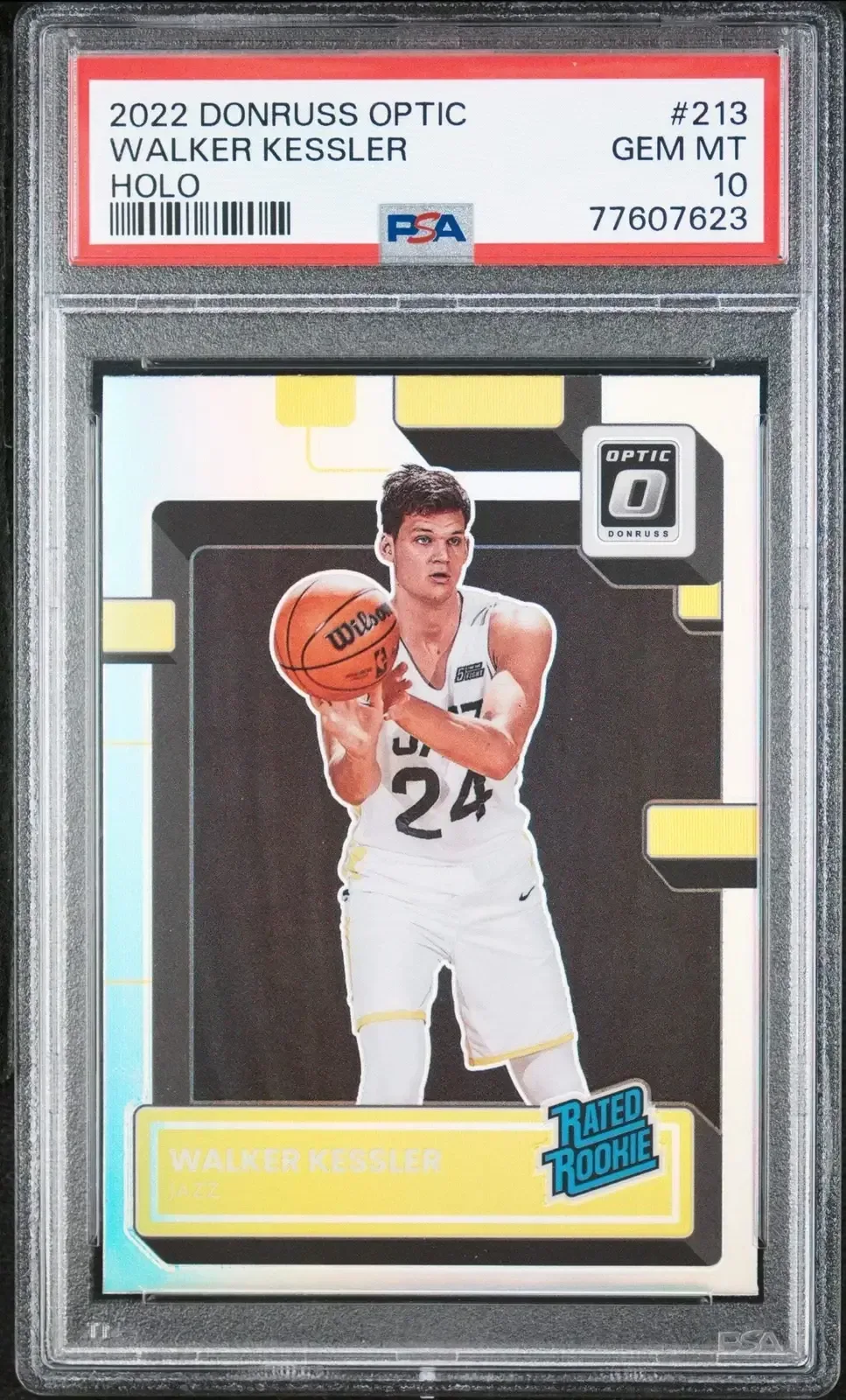
The collectible in focus is the 2022 Donruss Optic Walker Kessler Rated Rookie Holo #213, PSA 10. “Rated Rookie” is Donruss Optic’s rookie-card branding, and “Holo” denotes a parallel with a distinct reflective finish. Its reported PSA 10 population is only 15.
A PSA 10 sold for $119.99 on October 24, an all-time high. That is $94.99 higher, or 380%, than the recorded sale level 1.5 months earlier. The tiny population makes this a particularly sensitive market: a small number of sales can produce dramatic-looking percentage moves, while also making it hard to know whether a single result represents a stable consensus value.
That is not an argument against the card; it is a reason to read its price carefully. Scarcer graded cards can be compelling to collectors precisely because fewer top-grade examples have been reported. Yet scarcity and liquidity are different concepts. A card can be scarce and still lack a regular stream of comparable sales. When the next copy appears, the realized price may differ materially from the previous high.
How to interpret the early card jumps
All three tracked sales reached an all-time high, but the numbers point to three different collector cases:
- Jerome: a veteran’s unexpected 45-point outburst, newly heightened offensive responsibility in Memphis, and a PSA 10 population of 86.
- Herro: immediate scoring volume on a new team, a possible lead-option role, and a more widely available PSA 10 Silver Prizm population of 864.
- Kessler: a marquee-team transition backed by a substantial contract, efficient scoring and defense in his first two games, and only 15 PSA 10 copies of the tracked Optic Holo.
The common temptation is to treat the percentage increase as the whole story. It is not. Percentage movement tells readers how far a sale has traveled from an earlier price, but not how many sales occurred, how consistently the market has priced the card, or whether a buyer will find another copy at a similar number. The card identity, the grade, the population and the player’s changing role all belong in the same conversation.
It is also worth distinguishing an all-time high recorded sale from a guaranteed market floor. The former means a sale exceeded prior recorded sales for that specific card and grade. It does not promise that every future copy will match it. In markets around player performance, values can move quickly in either direction as attention shifts from a spectacular first week to a longer regular-season sample.
There is a broader lesson in the contrast among these three cards. On-court performance can accelerate interest, but collectors are buying specific objects, not just stat lines. Jerome’s Prizm Silver PSA 10, Herro’s Prizm Silver PSA 10 and Kessler’s Optic Holo PSA 10 have different products, parallel treatments and graded populations. Comparing only their dollar gains would obscure the very factors that make each market behave differently.
For a reminder that trading-card value can be driven by multiple kinds of rarity and collector interest—not merely a current box score—see this look at recent high-end collectible sales.
The season is at its earliest possible stage, but these sales document the first reaction. Jerome has supplied the individual explosion, Herro the changed offensive hierarchy and Kessler the new-team fit with a low-population parallel behind it. Whether those stories turn into sustained NBA seasons is unresolved. For now, they have already become three distinct case studies in how quickly basketball-card attention can follow opportunity.