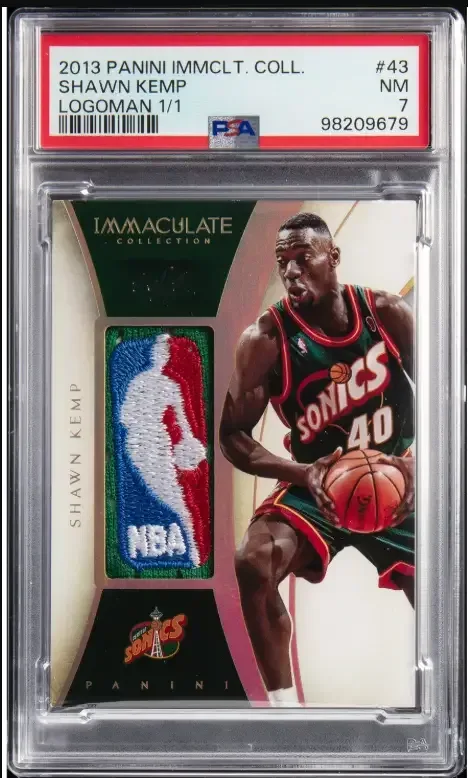
Shawn Kemp’s best basketball cards do more than preserve a player’s image. They preserve motion: a leap, a finish at the rim, a powerful post-up, and the uneasy change of uniform that marked the end of his Seattle peak. For collectors, that makes his catalogue especially compelling. The strongest Kemp cards connect a distinctive visual to a specific piece of a career that included six All-Star selections and three All-NBA nods.
The “Reign Man” is remembered first for forceful dunks, and understandably so. His finishing combined strength, elevation and theatrical timing in a way that made highlights feel inevitable. Yet the five cards below also make room for a more complete reading of his game: a 6-foot-10 forward who improved both his scoring and rebounding averages across six straight seasons in Seattle, could work from the midrange and low post, and became a central figure in the Sonics’ run to the 1996 Finals.
They also illustrate a collecting reality worth keeping in view. A card’s cultural importance, scarcity, condition and recent sale history can all matter, but they do not guarantee a straight-line price climb. Kemp’s market has produced dramatic gains in select grades and equally dramatic short-term swings. The cards can tell an extraordinary basketball story without turning every purchase into a sure investment.
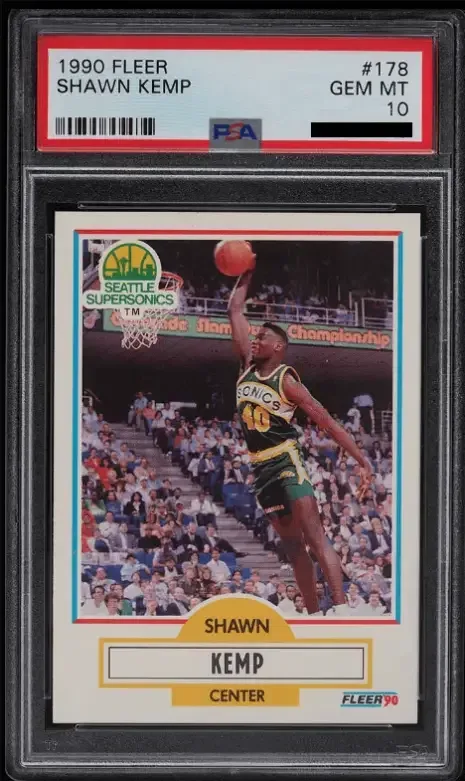
1990 Fleer #178: A rookie card with Dunk Contest lift-off
Kemp’s 1990 Fleer #178 rookie card has a remarkably appropriate image for a player whose reputation was made above the rim. It pictures the 20-year-old on his way to a one-handed dunk during his first All-Star Weekend Slam Dunk Contest appearance.
That detail gives the card more personality than a standard posed rookie. It catches Kemp in the environment most closely associated with his public image, while also documenting an early stage of a career that would become synonymous with highlight finishes. He made four Dunk Contest appearances in the early 1990s and reached the final round twice, although he never won the event.
There is a useful distinction between Dunk Contest fame and the version of Kemp that unsettled NBA defenses. A contest asks competitors to build a single planned spectacle. Kemp’s most memorable work often came amid the chaos of a live possession: running the floor, attacking a rotating big man or exploding through traffic. That is why an airborne contest photo still works so well on this card. It is not the same as an in-game poster, but it communicates the athletic premise immediately.
Recent recorded sale data show a PSA 10 moving from $25 to $61 over a year, a 144% rise. PSA 10 is a condition designation assigned by the grading company PSA; in practical collecting terms, it identifies a card judged at that company’s highest numerical grade. The percentage move is striking, but the dollar values are modest enough to make this an important reminder: percentage increases can look enormous when the starting sale is low. The reported broader Kemp card index also rose 95.47% during that period.
For collectors who want an accessible starting point tied directly to Kemp’s identity, the Fleer rookie has a simple argument: it is an early-career card with an image that feels inseparable from the Reign Man persona.
Related coverage includes Five Shawn Kemp Cards That Trace the Reign Man’s Legacy.
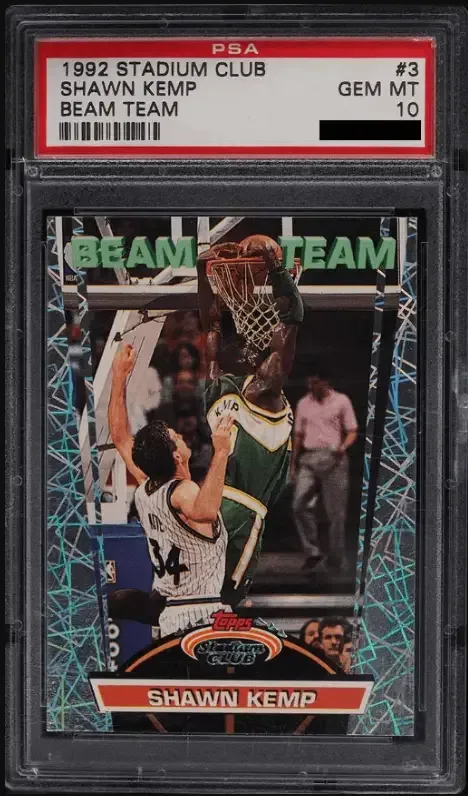
1992 Stadium Club Beam Team #3: The insert that looks like a dunk sounds
If the Fleer rookie is the introduction, 1992 Stadium Club Beam Team #3 is the visual shorthand. The card frames Kemp with silver beams as he completes a two-handed dunk, while Magic center Greg Kite watches. It is an image built for the card’s flashy insert design and for Kemp’s game.
“Insert” is a collecting term for a card issued within a product but set apart from its ordinary base-card run, often through a distinctive design, theme or more limited distribution. Beam Team cards became a celebrated kind of 1990s insert because the presentation itself was so immediately recognizable. With Kemp, that visual excess is not a mismatch. The card does not need to be subtle. Neither did the dunks.
The card is particularly evocative of the kind of moments that defined Kemp’s playoff aura. In a 1992 postseason game against Golden State, he threw down a one-handed slam over Alton Lister, then crouched and pointed toward the fallen defender. Not long afterward, Kemp dunked over Chris Gatling; Gatling responded by getting up and shaking Kemp’s hand. Neither of those exact plays appears on Beam Team #3, but the card carries their energy better than a neutral action photograph could.
Its recent market movement has been substantial. A PSA 10 reportedly rose 254.17% across 12 months, from $480 to $1,770, nearing the high recorded in the available sales database. PSA 9 examples changed, too: while one could be bought for under $70 a year earlier, nine of the 10 most recent recorded sales exceeded $200.
Those figures underline why grade matters so much for sought-after inserts. Two copies of the same card can sit in markedly different value ranges when their assigned conditions differ. They also make caution essential. The PSA 10 price is based on a market for very high-grade copies, not a universal value for every Beam Team #3. A collector should identify the grade, inspect the exact listing and separate a recent sale from an assumption about the next one.
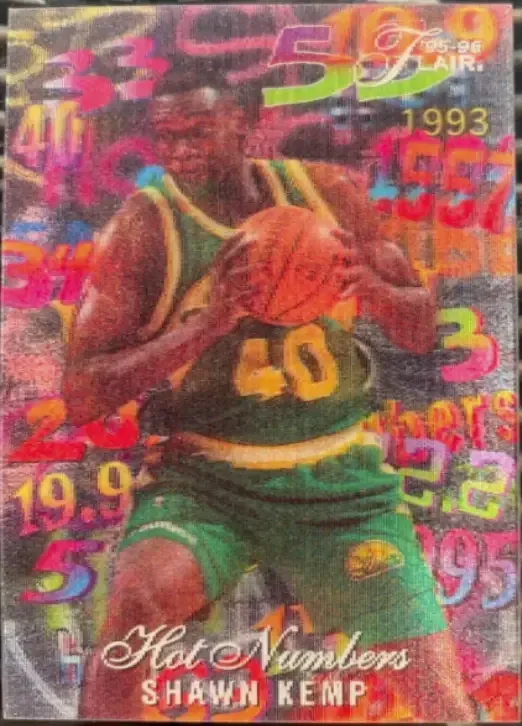
1995-96 Flair Hot Numbers #5: The case for Kemp as more than a finisher
The 1995-96 Flair Hot Numbers #5 shifts the camera angle from spectacle to strength. Kemp holds the ball in both hands in a low-post setting, a fitting choice for the fuller version of his game. At his best, he was not merely a transition finisher waiting for a runway. He had a midrange jumper, physical low-post work and an imposing presence on the glass.
That broader skill set mattered in Seattle’s six-game 1996 Finals series against Chicago. Kemp was so productive in the series against the eventual champions that he received three MVP votes. It remains one of the clearest arguments for looking past the dunk reel when evaluating his peak.
Hot Numbers makes that argument in cardboard form. Its three-dimensional-looking backdrop is packed with multicolored numerals in varied sizes and fonts, a loud period design surrounding a more controlled basketball pose. It may not be as instantly famous as Beam Team, but its composition offers something especially useful in a Kemp collection: evidence of the footwork, balance and power required to operate with his back to the basket.
A raw card is one that has not been placed in an authenticated, graded holder. Recent sales put the raw Hot Numbers card’s move at roughly $45 to $165 over a year. The latest PSA 9 sale reached a record $304, up 80.42% from the comparison point cited in the sales data.
Raw and graded prices should not be treated as interchangeable. A holdered grade reflects an evaluation of condition, while a raw card leaves the buyer to assess condition themselves. That does not make one format automatically better; it makes them different collecting propositions. The Hot Numbers card’s recent movement is meaningful, but its main appeal is how effectively it captures the all-around case for Kemp.
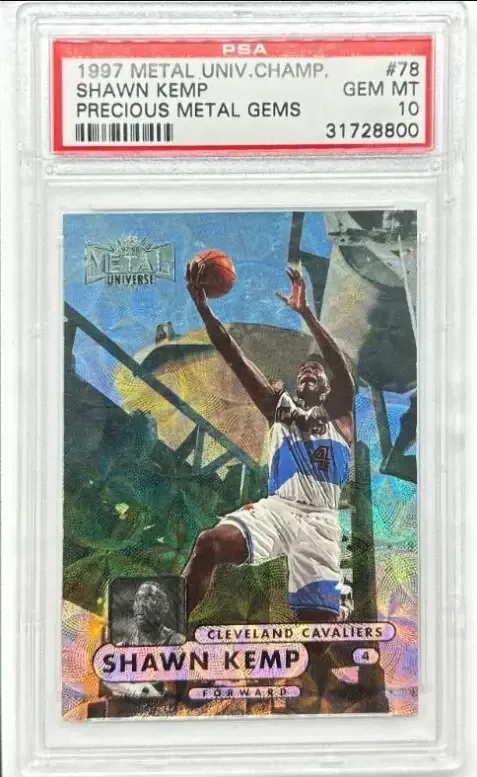
1997 Metal Universe Championship Precious Metal Gems: Scarcity meets a changed career
The 1997 Metal Universe Championship Precious Metal Gems card is where Kemp collecting becomes much more expensive and much more historically complicated. It shows him as a Cavalier, a uniform associated with the aftermath of a painful split from Seattle rather than the franchise’s high-flying apex.
The break followed the 1996 Finals. Seattle signed free-agent center Jim McIlvaine to a seven-year, $33.6 million contract after McIlvaine had averaged 2.3 points, 2.9 rebounds and 2.1 blocks per game in Washington. The fact that the new acquisition earned more than Kemp exacerbated a rift with the Sonics. In August 1997, Seattle moved Kemp to Cleveland in a three-team trade that brought Vin Baker to the Pacific Northwest.
Despite the emotional disconnect many Sonics fans may feel toward the Cavaliers image, the card belongs to Kemp’s sixth and final All-Star season, 1997-98. Its status comes from a convergence of player, brand and scarcity. Precious Metal Gems, commonly abbreviated as PMG, is the card line designation. This version is numbered /50, meaning its stated print run is 50 copies. That limited supply is a major practical difference from a conventional base card.
The lone PSA 10 copy recorded in the available data sold for $12,655 in February 2024. A PSA 8 has recently sold for just under $4,000. That gap is another concrete example of condition’s influence at the high end, even within a limited-print card where every known copy is inherently scarce.
Collectors should resist reducing the PMG to a price tag. Its power is narrative as much as numerical: an elite Kemp card from the season after a franchise-altering trade, carrying the tension between an iconic player’s Seattle legacy and a new Cleveland chapter. For a wider look at how collector attention can also move between sports cards and licensed entertainment, explore this upcoming comic crossover story.
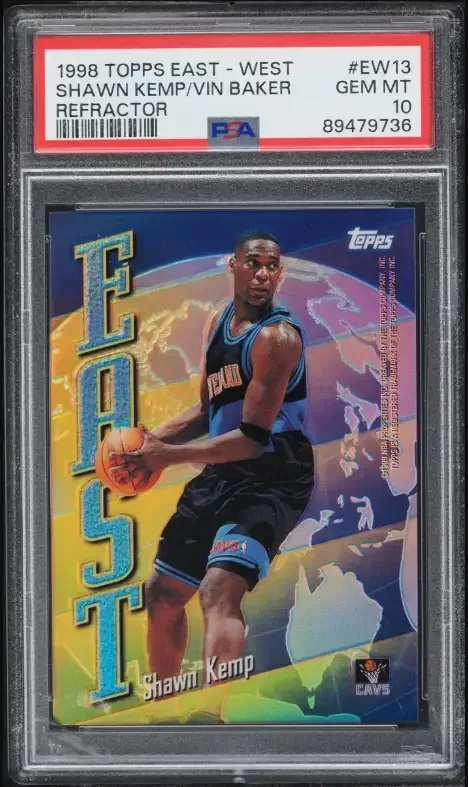
1998-99 Topps East/West Refractor #EW13: The double-sided what-if
The 1998-99 Topps East/West Refractor #EW13 is perhaps the most pointedly symbolic card on the list. Kemp appears on one side, while Baker—the player who arrived in Seattle in the trade that sent Kemp away—appears on the other. A refractor is a card with a reflective, light-shifting finish, and here the finish cannot soften the underlying sting for a Sonics-focused collection.
Seattle came within two wins of an NBA title with Kemp in 1996. Fifteen months after that Finals appearance, he was gone. Placing Kemp and Baker on opposite sides of one card turns a routine player pairing into a small piece of alternate-history cardboard. It invites the obvious question: what might have happened if the Sonics core had stayed intact?
The question is even more poignant because Kemp’s career later changed quickly. After the 1998 lockout, he arrived at training camp significantly heavier. He still averaged a career-high 20.5 points in 42 games that season, but the added weight diminished the explosiveness and mobility that had made him exceptional. Cleveland traded him to Portland by the summer of 2000. His playing time and production declined amid conditioning, substance-abuse and personal struggles, and his NBA career ended after one season in Orlando when he was 33, despite later unsuccessful comeback efforts.
This is the clearest card on the list for demonstrating volatility. One PSA 10 sold for $3,120 in March, while the most recent June sale was $576. That is not a minor fluctuation. It is a sharp warning against using a single sale, particularly a high one, as a permanent benchmark. Timing, bidder participation and the individual card’s condition can all shape a result, and recent sales may point in opposite directions.
For the right collector, though, East/West Refractor #EW13 is valuable precisely because it refuses to be uncomplicated. It is a shiny, premium-looking card about a basketball outcome that still feels unresolved.
A five-card Kemp collection built around story, not just ranking
These five cards form a coherent miniature of Shawn Kemp’s career. Fleer #178 captures the young aerial attraction. Beam Team #3 delivers the iconic in-game force. Flair Hot Numbers #5 makes the case for his polish and power beyond the dunk. The PMG establishes the high-end scarcity chase while documenting the Cleveland transition. East/West Refractor #EW13 turns the Seattle trade into an unusually direct collecting artifact.
That sequence also explains why Kemp remains resonant long after his departure from Seattle. Murals have celebrated him, and he continues to receive enthusiastic receptions from fans wearing the city’s green and gold. His Sonics period was relatively brief, but it was indelible. The cards matter because they give that memory different forms: rookie promise, explosive dominance, complete-star credibility, separation and regret.
Anyone approaching these cards should decide which part of that story matters most. A collector seeking a foundational rookie image may gravitate to Fleer. Someone chasing a quintessential 1990s insert may prefer Beam Team. A buyer who values visual rarity and is comfortable with a much higher entry point may look toward PMG. And anyone compelled by the emotional side of sports history may find East/West impossible to ignore. Kemp’s cardboard legacy is not one card or one price. It is a series of snapshots from a career that could shake an arena, and still gives collectors plenty to talk about.