Chris Webber’s best basketball cards work because they preserve more than the fact that he was an elite player. They preserve the visual language of an era that suited him unusually well: chrome surfaces, metallic inserts, extreme graphics, emerging memorabilia technology and, later, a scarcity of certified signatures that collectors still have to reckon with.
On the floor, Webber was a forward who could handle the ball, see passing lanes from the high post, score with finesse or force, and turn a rebound into a fast break. His career moved from Golden State to Washington, then to the Sacramento Kings teams where his playmaking became the hub of a fast, free-flowing attack. The key cards from those stops do not merely mark a change of uniform. Each captures a different stage in how collectors and manufacturers presented a player whose game was difficult to reduce to one image.
For buyers, the useful distinction is between a card’s cultural appeal and its reported transaction history. A high grade, a low graded population, an autograph or a game-used component can all matter, but none makes a sale price automatic. The available sales below are snapshots, sometimes based on only a few transactions. They are a useful record of collector interest, not a promise of future value.
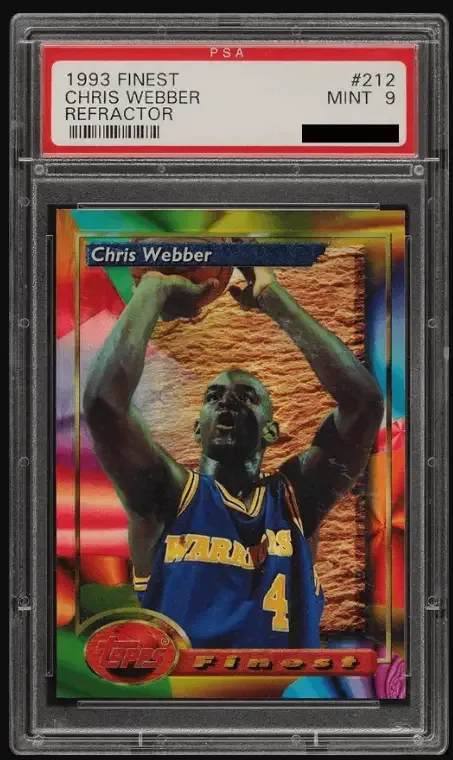
1993 Topps Finest Refractor #212: a rookie card from a new card language
Webber entered the NBA in 1993 after Orlando selected him first overall and traded him to Golden State for Penny Hardaway and future draft capital. That debut lined up with the first Topps Finest basketball release, a pivotal product because it introduced chromium-style stock and refractor parallels to basketball cards.
For more context, explore Travis Scott Reportedly Bought Four Vintage Cars During an Illinois Museum Visit.
A refractor is a parallel with a light-reactive, rainbow-like finish rather than the standard card surface. It is a technical production difference, but it also became part of the card’s identity: tilt a 1993 Finest Refractor and its appearance shifts dramatically. For a player as tied to the visual excess and optimism of the decade as Webber, that finish feels especially appropriate.
The #212 Refractor is generally regarded as Webber’s premier rookie-year card. Its appeal combines rookie status, relative rarity and a release that helped change premium basketball cards. Only two PSA 10 copies sold over the past year in the supplied sales data. The latest reached $5,320, a 44.59% increase. PSA 9 examples rose 44.31%, from $492 to $710.
PSA 9 and PSA 10 refer to third-party condition grades. The difference can be enormous because pristine-looking surviving copies are much harder to find than cards with small print, corner, edge or surface flaws. With chromium cards, surface sensitivity is particularly relevant to collectors, so the grade is not just a number attached after the fact; it helps define which version of the card is being compared.
Related coverage includes 7 Chris Webber Cards That Capture a Transformative NBA Career.
1993 Stadium Club Beam Team: motion, metal and an accessible entry point
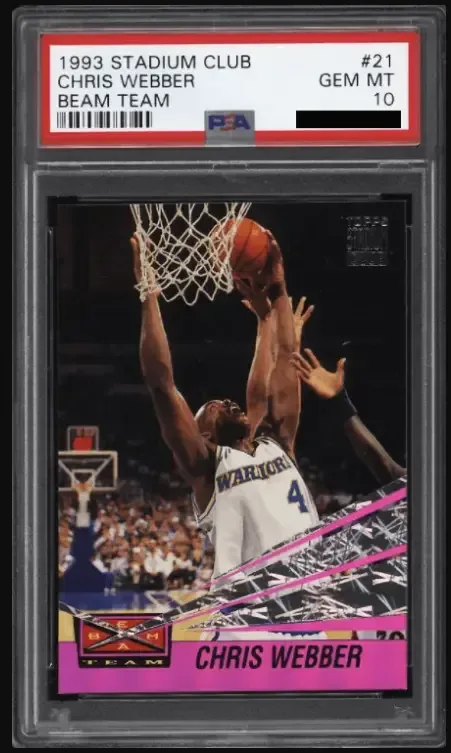
Webber’s rookie year supplied the statistics expected of a top pick: 17.5 points, 9.1 rebounds, 3.6 assists and 2.2 blocks per game for the Warriors, good enough to narrowly take Rookie of the Year over Hardaway. The 1993 Stadium Club Beam Team translates that athletic profile into a particularly strong action image, with Webber rising above two defenders for a rebound.
Beam Team was an insert set, meaning it was not part of the ordinary base-card run. Its defining treatment placed metallic beam effects across action photography. That construction gives the card its period-specific charm without requiring a collector to chase the highest end of the market.
Reported pricing also shows how grade creates separate collecting lanes. Raw, ungraded copies sit around $8, while PSA 8 examples have sold at $31; both were up about 120% year over year. PSA 10 copies rose from $264 to $525, the highest recorded figure in the referenced sales database. A raw card is simply a card that has not been encapsulated and assigned a grade by an authentication and grading company. Its condition can range widely, which is why raw sales should not be treated as direct equivalents to graded sales.
That makes Beam Team a practical choice for collectors who value imagery and set design first. A raw copy can offer the central experience of the card, while a high-grade copy turns the same design into a more condition-sensitive pursuit.
1994-95 Ultra Power in the Key #9: the short Washington chapter in full color
Webber’s Golden State stay ended abruptly. After conflict with coach Don Nelson and an unusual contract escape clause that allowed him to opt out after one season, Webber sat out the start of the following campaign and was dealt to Washington in November 1994. There he rejoined former Michigan teammate Juwan Howard.
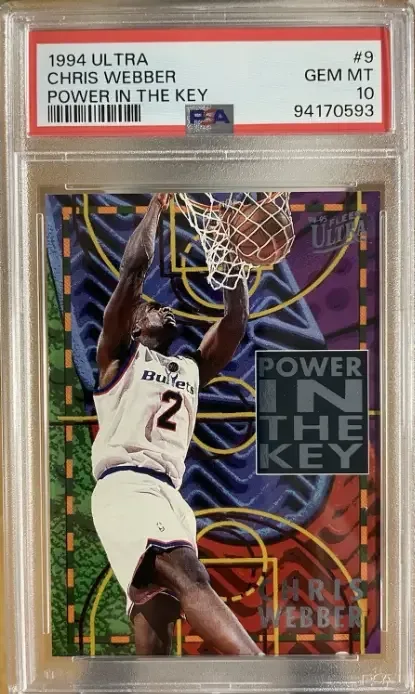
That transition creates the appeal of 1994-95 Ultra Power in the Key #9. Comparatively few second-year Webber cards show him in a Bullets uniform, and this one leans completely into the design instincts of the period. A cutout Webber finishes a two-handed dunk over a multicolored illustrated court. It is not subtle, which is precisely the point.
The card is also a reminder that low population does not settle a card’s market standing on its own. PSA’s database lists a population of five for PSA 10 copies. The latest PSA 10 sold for $300 in June 2025, 50% above the prior sale a year earlier. Yet the last two PSA 9 sales were only $26 and $23. Population reports count examples submitted to a grading company at particular grades; they do not measure every copy that exists, nor do they create demand by themselves.
For a collector, the wide 9-to-10 gap makes condition and personal budget especially important. It also means a lower-grade copy can be the sensible way to collect a memorable Washington-era card without treating it as a chase for registry-level condition.
1997-98 Hoops High Voltage: a Washington card with real visual voltage
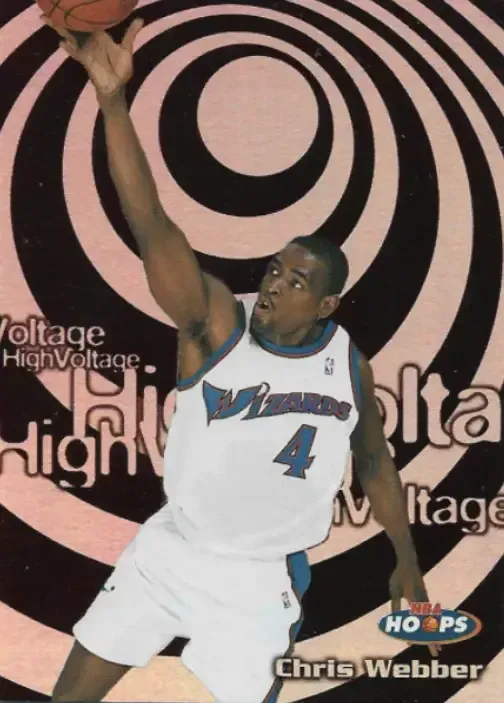
In Washington, Webber posted a 40-point triple-double in his first game against Golden State and became an All-Star-level force over four seasons, averaging roughly 20 points and 10 rebounds while helping return the Bullets to the playoffs. The 1997-98 Hoops High Voltage card channels that electricity rather literally.
Webber is one of 20 players in the set, pictured attacking the basket against dizzying black-and-white swirls. The design may not appeal to collectors who want clean photography and quiet borders. For anyone seeking a card that looks as loud as its title, however, it is one of the clearest expressions of the decade’s willingness to let an insert design dominate the frame.
It also posted the largest year-over-year raw increase among the Webber cards in the provided market data, moving from $20 to $69, a 240% rise. PSA 9 copies climbed 60% to $160. Those figures deserve context: percentage moves can look dramatic when a card begins at a modest price, and the number of transactions behind any comparison matters. Still, High Voltage stands out as a card where an uncommon design and a compelling career stage have clearly drawn more attention.
1999 SkyBox APEX Net Shredders: an early memorabilia experiment
Washington traded Webber to Sacramento in 1998 for Mitch Richmond and Otis Thorpe. The Kings ultimately provided the setting that best fit his range of skills. Webber became the versatile centerpiece of an offense that emphasized pace, passing and movement, turning the power forward position into something closer to a decision-making station.
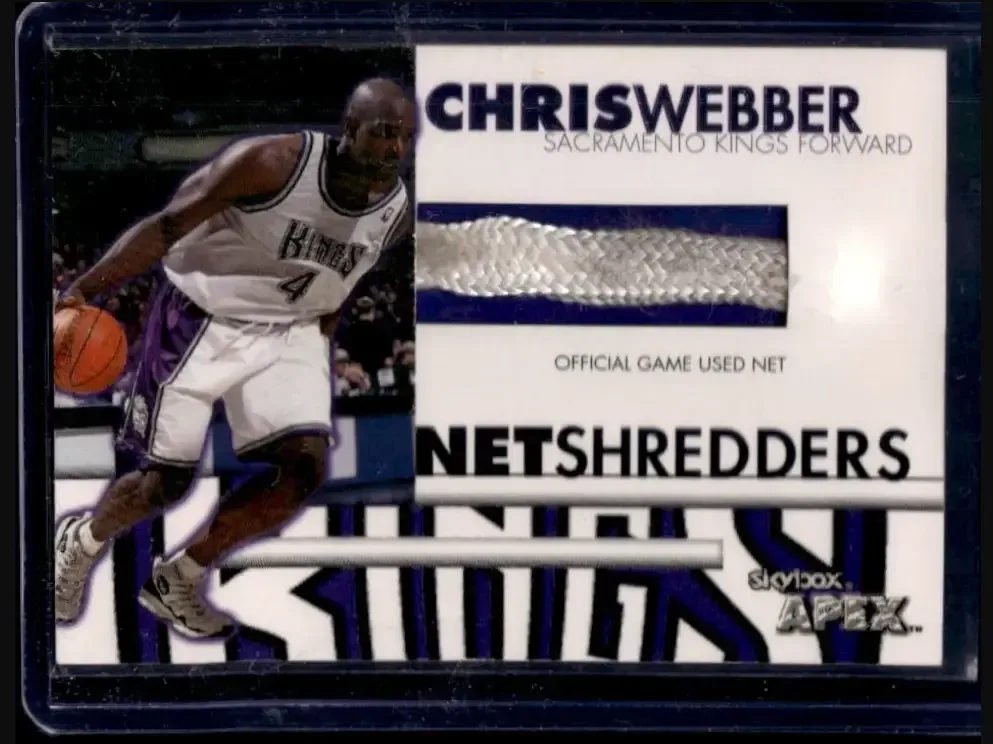
The 1999 SkyBox APEX Net Shredders card is significant because it carries a swatch of game-used basketball net. Memorabilia cards include a physical material identified as connected to equipment or apparel; here, the material was net rather than the more familiar jersey piece. At the time, such concepts were still far from routine. Game-worn jersey cards had only recently entered the hobby, and card makers were beginning to incorporate pieces of courts, basketballs and shoes.
The premise suits Webber’s Sacramento production: in 1999 he averaged 24.5 points per game, sixth in the league. Just three Net Shredders copies sold across the prior two years, ranging from $67 to $104. That is a limited sample, so the range should be read as evidence of recent sales rather than a definitive price guide. Its greater appeal may be historical: it is a tangible example of manufacturers testing what a basketball card could contain.
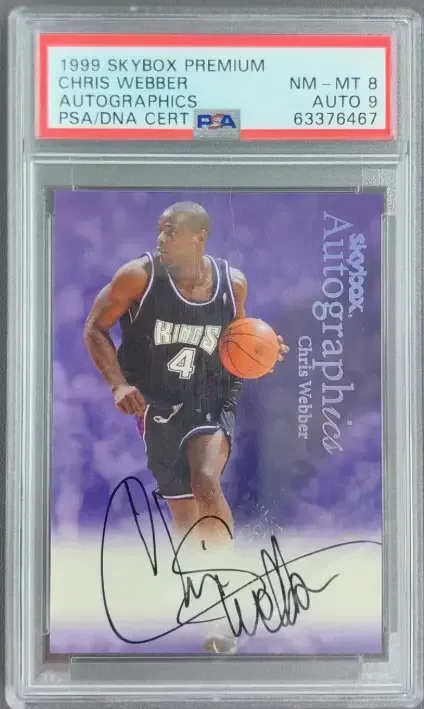
1999 Fresh Ink and SkyBox Autographics: scarcity where it counts
Webber made five consecutive All-Star teams from 2000 through 2004, led Sacramento through five straight 50-win seasons and helped the Kings reach the 2002 Western Conference Finals. Yet collectors looking for pack-issued Webber autographs from his active NBA career face a notably smaller pool than they might expect for a star of that stature.
He was absent from the first three 1990s SkyBox Autographics checklists and appeared only on shared-signature cards in 1997 Stadium Club Co-Signers. In 1999, he signed standalone examples for short-printed Fleer Focus Fresh Ink and SkyBox Autographics.
A pack-issued autograph is a signature included by the manufacturer in the product rather than an autograph added privately after the card entered circulation. That provenance is central to its appeal. Fresh Ink examples have commonly sold in the $200 to $300 range. SkyBox Autographics is the more expensive of the two, reaching $1,500 at its high point; the latest cited sale was $911 in September.
The distinction between these two cards is useful for a focused Webber collection. Fresh Ink can represent a more approachable standalone playing-day signature, while Autographics is a scarcer centerpiece. In either case, the attraction is not merely that the card is signed. It is that the signature belongs to the period when Webber was driving one of the NBA’s most distinctive contenders.
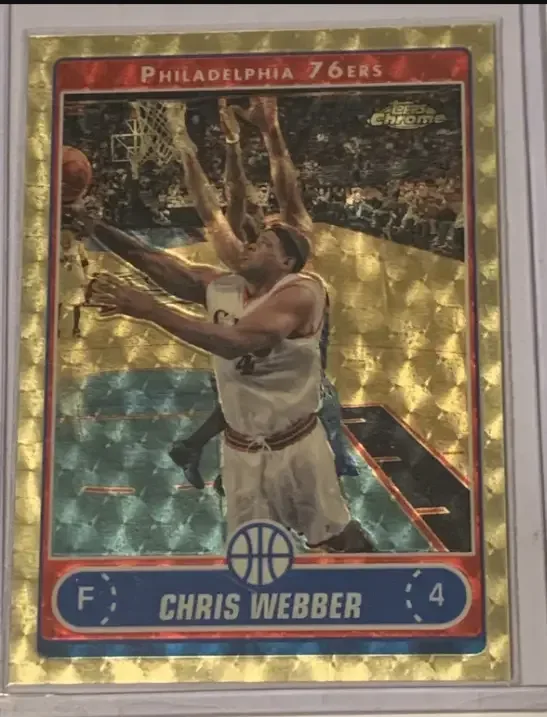
2006 Topps Chrome Superfractor: a late-career one-of-one
A serious knee injury in 2003 changed Webber’s career, reducing the explosiveness and mobility that had defined so much of his game after microfracture surgery. He continued as a skilled passer and mid-range scorer, but Sacramento’s championship window soon closed. Later stops in Philadelphia and Detroit preceded a brief Golden State return that lasted nine games.
The 2006 Topps Chrome Superfractor is a major late-career card because of both its chrome lineage and its status as a one-of-one parallel: a version produced as a single copy. It sold for $6,655 in January 2023. One-of-one cards are inherently scarce, but each is also uniquely vulnerable to the absence of regular public sales. Without frequent comparable transactions, a prior result is a reference point, not a constantly updated market value.
After Webber retired in 2008, Panini became the NBA’s exclusive licensed card manufacturer a year later and produced many more Webber autograph and game-worn patch cards than existed during his playing career. That later abundance has not erased the attraction of the earlier cards. The strongest Webber pieces are often the ones where the design, team chapter and technology all meet: a refractor from the premium-card breakthrough, a wild insert from Washington, an experimental net relic from Sacramento, or a rare signature from his prime.
Collectors deciding where to begin should define the goal first: rookie-era significance, a favorite uniform, dramatic 1990s design, memorabilia innovation, autograph scarcity or top-grade condition. Webber has credible options in every lane, which is fitting for a player whose game rarely had just one answer.