There was a time when finding a real NBA autograph inside a pack did not need a superstar name or a four-figure price tag to feel enormous. The signature itself was the event. SkyBox’s 1996 Autographics gave that feeling a clear identity: a player-signed card, a gold-foil emblem, and a checklist expansive enough that the surprise could belong to a Hall of Famer, a rookie, or a rotation player.
That straightforward formula is why the debut Autographics set remains a landmark for basketball-card collectors. It did not invent the pack-issued autograph, but it made signed cards a major, repeatable pursuit across 1996 SkyBox products. In doing so, it helped show how much appetite existed for certified player signatures in the hobby.
For a useful companion perspective on the set’s place among basketball collectors, see this overview of 1996 SkyBox Autographics’ continuing appeal.
Autographs existed before Autographics, but not at this scale
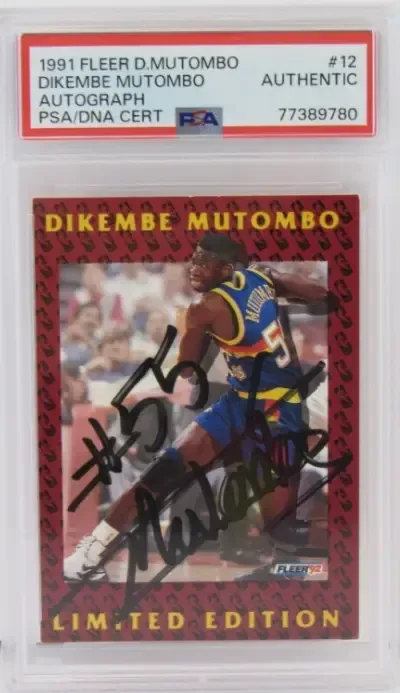
Pack-issued basketball autographs were not wholly unprecedented in 1996. Fleer included Limited Edition autographs of Dikembe Mutombo and Dominique Wilkins in 1991, while Fleer and Upper Deck had other limited signature appearances. Hoops and SkyBox also used signed inserts, redemptions, or exceptionally difficult pulls. Those earlier cards established that an autograph could be part of a modern pack product.
For more context, explore Tiny Quest Reaches Amstrad CPC in Outsoftware’s Latest Classic-System Port.
SkyBox’s achievement was to turn that occasional novelty into a defining chase. The 1996 Autographics checklist covered 95 players. That breadth matters. Rather than reserving the concept for only the game’s most obvious headliners, the checklist included established stars, emerging players, rookies and less celebrated NBA names. A collector could pull something personally exciting without needing every card to be a trophy-level hit.
In collecting language, a chase card is the card—or class of cards—that gives buyers a special reason to open packs. In this case, the autograph itself was the chase. That may sound routine in a market now full of signatures, numbered cards and premium parallels, but it was a meaningful shift in emphasis. The player’s writing was no longer an occasional side attraction. It was the point.
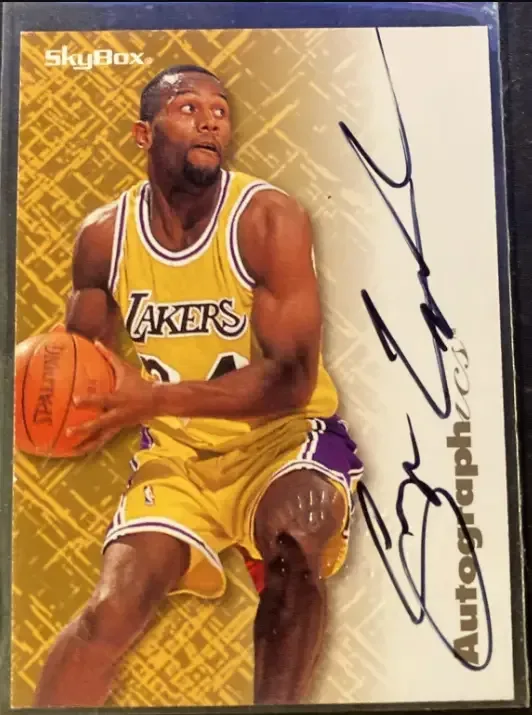
That helps explain why a George Lynch Autographics can carry real sentimental weight despite a recent $5 sale. Lynch’s card is not valuable because the market treats it as an elite-player scarcity. It represents the exact magic this format delivered: the physical evidence that a recognizable NBA player had signed the card in hand. Collecting value and market value overlap sometimes, but they are not the same thing, and this set makes that distinction unusually easy to see.
The design made the signature easy to understand
The 1996 cards are remembered for their clarity. Black-ink signatures sit in a vertical white area at the right side of the card, beside a gold-foil Autographics logo. The layout gives the ink space to breathe. It does not bury the signature under a busy design or treat it as a tiny technical detail in a stack of visual effects.
That design choice has lasting practical importance. An autograph card works best when the collector can immediately identify both parts of the promise: the player’s signature and the product’s autograph branding. The white signing panel makes the handwriting legible, while the foil emblem makes the card’s purpose unmistakable. The result is a card that communicates quickly, even to someone who has never studied the checklist.
The set also has a peculiarity collectors should understand: the rear black border is vulnerable to visible edge and corner wear. Chipping refers to small losses or nicks in the colored surface at an edge or corner. A dark border can make that damage stand out sharply. Combined with signatures that may have faded over roughly three decades, this means an attractive copy and a high-grade copy are not always easy to find.
That does not mean every collector needs to chase graded examples. It does mean prospective buyers should look closely at the autograph’s strength, the black-border condition and overall surface presentation. A card may still be a satisfying collection piece with minor wear, especially at the lower end of the checklist. But condition becomes far more consequential for premium names and scarce ink variations.
Black ink, blue ink and the details behind rarity
Standard black-ink Autographics were inserted at a stated rate of one per 72 packs. Blue-ink cards were the rarer parallel, generally reported with a print run of 100, subject to exceptions. A parallel is a version of a card that shares the player and core design but changes a feature such as ink color, serial numbering or finish. Here, the ink itself is the visual dividing line.
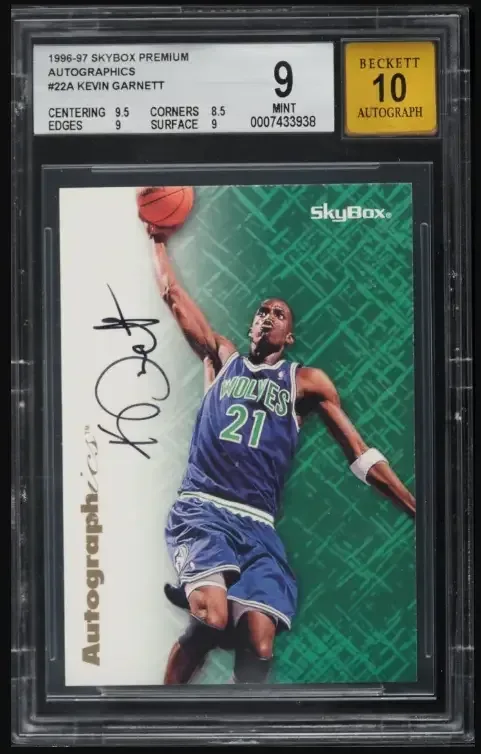
It is tempting to reduce the set to a simple rule: blue equals rarer and therefore better. The checklist is more interesting than that. Kevin Garnett is the standout exception because he signed roughly two-thirds of his cards in blue. That makes his black-ink card the more difficult version. A BGS 9 black-ink Garnett sold for $1,495 on March 16, described as the highest sale for a veteran in the set, narrowly ahead of a raw Damon Stoudamire at $1,475 on July 17.
Hakeem Olajuwon offers a different quirk. He signed his cards in blue, rather than supplying the usual black-and-blue split. His highest reported sale was $940 in August 2025. The lesson is important for anyone building a player run or evaluating listings: color alone is not a complete rarity guide. A collector needs to know the signing pattern for the individual player.
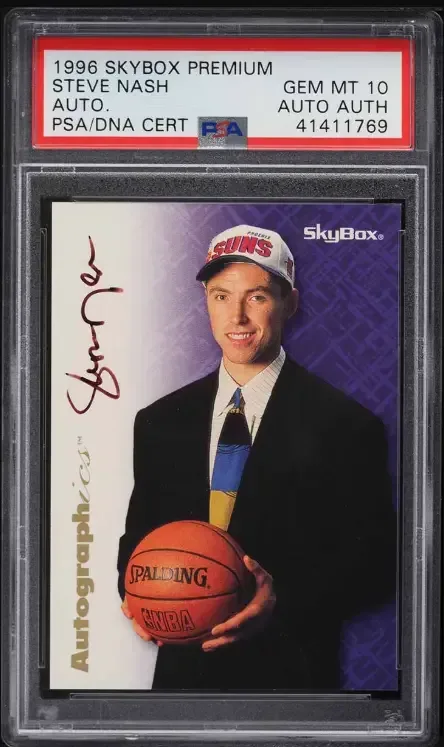
Steve Nash’s sales show how player legacy, condition and ink color can combine. The six highest single-card sales reported for the set are all Nash examples in different grades. A black-ink PSA 10 sold for $3,150 on September 4, while a blue-ink BGS 9 carrying a 10 autograph grade sold for $2,900 in December 2021.
PSA 10 and BGS 9 are third-party condition assessments expressed on each company’s own scale. The separate 10 autograph designation on the BGS Nash is an assessment of the signature, not merely of the card stock and corners. These labels can help establish a common language around condition, but the visual facts still matter: ink can fade, and black borders can make comparatively minor flaws look prominent.
A checklist with stars, rookies and one very strange obstacle
The set has the player depth collectors want from a product that now functions as a mid-1990s basketball time capsule. Hakeem Olajuwon, Kevin Garnett and Scottie Pippen are among its Hall of Famers. The checklist also includes multiple high lottery picks from the celebrated 1996 rookie class. Grant Hill and Ray Allen are among the players whose first pack-issued signatures have exceeded $1,000 in reported sales.
Yet the 95-card checklist is not solely an elite-name hunt. Most of the cards commonly considered “commons” are widely available around $5 to $10. That relative accessibility gives set builders a route into a historically important autograph set without requiring a major budget for every slot. It also preserves the appeal of collecting the actual checklist rather than treating the product only as a vehicle for a handful of expensive names.
Then there is George McCloud. His Autographics is notably hard to locate, with no explained reason given for the scarcity. A raw example most recently sold for $300 on September 6. In card collecting, a short print is a card produced in lower quantity than other cards in its set. McCloud is regarded as an unexpected short print by set collectors, although the reason behind the limited availability is not established here.
The McCloud situation is a useful warning against assuming a set’s least famous player will always be its cheapest or easiest acquisition. Completing a checklist often requires a different strategy from assembling star cards. A collector can make rapid progress through common names, then spend considerable time seeking one obscure, deceptively difficult final card.
How Autographics grew beyond the 1996 debut
SkyBox continued Autographics basketball for four more seasons and extended the concept into baseball, football and hockey. The later basketball sets expanded the parallel structure. In 1997, Century Marks parallels were hand-numbered to 100. Later versions introduced cards numbered to 250 and 50. In 2003, Autographics became a standalone product with standard base cards and numerous signed parallels.
Those changes reflect a lasting hobby pattern: once collectors respond to an autograph format, manufacturers can introduce progressively more explicit scarcity tiers. Hand numbering tells a buyer the stated limitation of a card directly. The original 1996 issue is comparatively restrained in presentation, relying primarily on the signature and the black-versus-blue distinction rather than a maze of printed serial-number tiers.
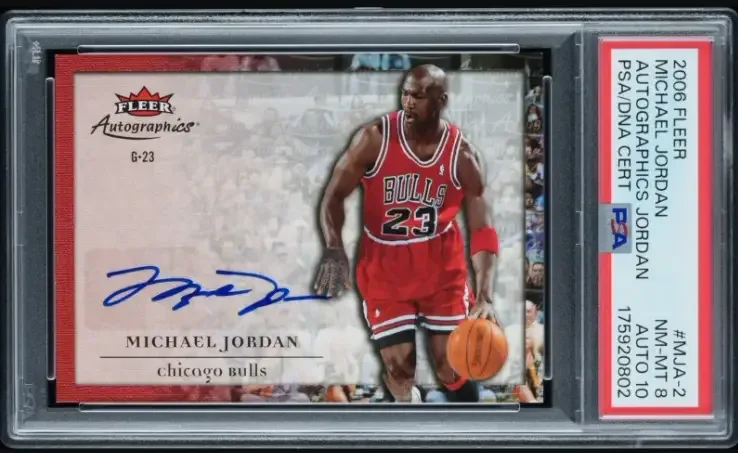
Upper Deck acquired the Fleer-SkyBox properties in 2005 and brought the Autographics brand back to basketball. Starting with 2006 Fleer, collectors could pull a Michael Jordan Autographics. Later Retro releases also revisited elements of the original design. A PSA-graded 2006 Fleer Michael Jordan Autographics sold for $14,500 on September 21, a reminder that the brand name continued to carry weight well after its initial run.
Still, the 1996 debut has a particular standing because it captures the transition before signed cards became a familiar expectation. Its limitations are part of its personality: faded ink is possible, black edges are unforgiving, and player-specific ink patterns create exceptions to the usual parallel logic. Its rewards are just as clear: a big checklist, recognizable legends, a few genuine puzzles, and an autograph design that does not need a decoder ring.
What collectors can take from the original set
- Check the ink before judging scarcity. Blue is generally the rarer parallel, but Garnett’s black ink is the harder version, while Olajuwon signed in blue.
- Inspect border wear carefully. The black-backed design makes chipping easier to spot, particularly on cards being considered for high-grade collections.
- Look at the signature itself. Fading is a meaningful concern on cards from 1996, whether a card is graded or raw.
- Separate player value from set-building difficulty. George McCloud demonstrates that an unexpected short print can outweigh name recognition in a checklist chase.
- Define the goal first. A collector pursuing nostalgia can enjoy a $5 role-player autograph; a condition-focused collector may prioritize elite grades and ink variations.
That is the enduring trick of 1996 SkyBox Autographics: it can support several kinds of collection at once. It is a star-and-rookie set, a parallel-variation project, a grading challenge and a memory machine for collectors who experienced the thrill of finding ink in a pack when that felt almost impossible. More importantly, it helped normalize the idea that an autograph could be the card everyone hoped to pull—and that even the unexpected name on that autograph could become unforgettable.