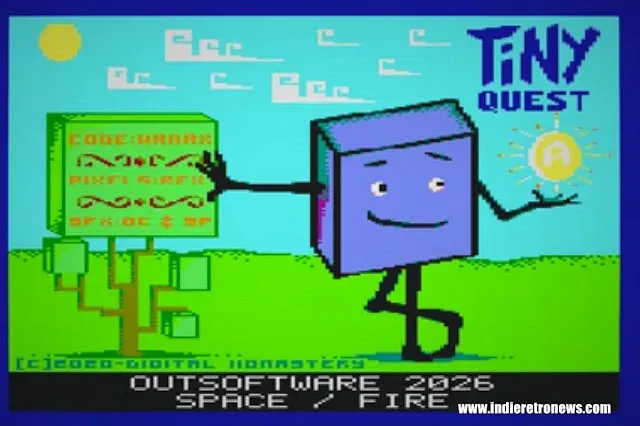
Tiny Quest, a challenging platform game first built for Commodore 64, has been ported to the Amstrad CPC by Outsoftware. The conversion was made possible after original author Andrea Schincaglia shared the C64 source code, giving the developer a direct technical basis for bringing the game to another vintage machine.
The project is one of more than 30 ports Outsoftware has completed after recently focusing on source-code conversions for systems that receive comparatively little modern development attention. That work has included the Sam Coupé, Einstein 256, Timex 2068 and Sinclair QL, alongside the CPC version of Tiny Quest.
A small hero with a severe problem
Tiny Quest puts players in control of Mr. Cube, who must cross dangerous, fast-changing screens in pursuit of his true love. The basic premise is uncomplicated, but the reported structure is deliberately punishing: a draining energy meter creates ongoing pressure, hazardous traps demand precise movement, and each error consumes one of only five lives.
That combination places the game firmly in the demanding end of platform design. A platformer is a game centered on moving a character through spaces with jumps, obstacles and environmental hazards. In Tiny Quest’s case, the important wrinkle is that the action is not simply about reaching an exit at a leisurely pace. Players also have to account for a limited energy resource, making delay as dangerous as a badly timed move.
The result is a challenge built from several simultaneous decisions. A player may need quick reactions to avoid a trap, timing to move safely through a changing section, and planning to determine whether a route is actually viable before spending too much energy trying it. The task is less about blindly rushing forward than recognizing a screen’s rules, then executing under pressure.
What “every screen is beatable” means for players
Outsoftware’s description emphasizes that even screens that appear hopeless can be completed with practice. That is a meaningful promise in a difficult game: it frames failure as part of learning the level rather than evidence of an unwinnable situation.
For players, that likely means treating early runs as reconnaissance. Instead of expecting to clear each screen on first contact, the sensible approach is to identify hazards, watch for changes in the environment, and note where an attempted route fails. Once the screen’s rhythm and safe paths are understood, the next attempt can be more deliberate.
- Reflexes matter when traps or shifting conditions require immediate responses.
- Timing matters when success depends on moving during a narrow safe window.
- Route planning matters because the energy meter penalizes wasted movement and indecision.
- Consistency matters because five lives can disappear quickly when a difficult sequence must be repeated.
The five-life limit also gives mistakes real weight. In many modern games, frequent checkpoints can soften the effect of a failed jump or mistimed dodge. Tiny Quest instead appears designed around concentrated stakes: each loss reduces the room for experimentation during a run. That does not necessarily mean the game is unfair, particularly given the assertion that every level can be solved, but it does mean patience and repetition are central to the intended experience.
Why access to the original source code matters
Source code is the human-readable set of instructions used to build a game. It is distinct from simply having a playable copy of an older release. With the underlying code available, a developer can study how the original game handles its rules, character behavior, hazards and progression, then adapt those systems for the target hardware.
For Tiny Quest, Schincaglia’s decision to share the C64 source code gave Outsoftware the opportunity to make what is described as a faithful CPC conversion. Faithful does not automatically mean identical in every technical detail; different systems have different capabilities and constraints. But access to the original implementation can make it far easier to preserve the game’s core logic and challenge rather than recreate it from observation alone.
This is particularly important for an experience where exact behavior can define the game. If a trap’s movement, a collision boundary, or the rate at which energy drains differs significantly, a platformer’s carefully tuned difficulty can change with it. A conversion informed by original code has a clearer path toward retaining the intended balance of strict timing, scarce lives and screen-by-screen problem solving.
A port for an underserved platform
The Amstrad CPC has received a new version of a Commodore 64 game rather than an unrelated contemporary project, but that distinction is not a criticism. Classic systems remain active in part because developers, programmers and players continue to make games accessible beyond their original machines. Ports can widen the audience for a game while also giving a platform’s community another title designed around its era’s hardware sensibilities.
Outsoftware’s broader run of conversions suggests a focus on machines often left outside the loudest retro-gaming conversation. The Sam Coupé, Einstein 256, Timex 2068 and Sinclair QL are all specifically named among the systems involved in the developer’s recent work. Completing more than 30 ports in three weeks is an unusually intensive burst of activity, and Tiny Quest is one example of the material produced through that effort.
There is a useful distinction between preserving a game and merely remembering it. Memory can keep a title’s name circulating; a functioning conversion gives people on another platform an opportunity to engage with its design directly. In Tiny Quest’s case, the central appeal is not only its rescue-story setup or its cubic protagonist. It is the uncompromising structure built around observation, execution and the willingness to retry a screen that initially looks impossible.
Practical expectations before starting
Players approaching Tiny Quest should expect resistance, not a casual sightseeing tour. The reported energy meter means that standing still, repeatedly probing a bad route, or moving without a plan may carry a cost. The traps mean that confidence alone will not be enough. And the limited lives mean a promising run can end abruptly after several small mistakes.
A more productive mindset is to break the challenge into manageable pieces. First, establish what causes immediate failure. Next, look for the sequence or rhythm of moving dangers. Then choose a route that minimizes risky or wasteful movement. Finally, practice the execution until it becomes reliable. These are general strategies inferred from the game’s described systems, not claims about any individual screen layout.
That style of play can be rewarding precisely because it asks more of the player than a single fast reaction. Tiny Quest appears to demand composure as much as speed. The player who treats a death as information—rather than merely a setback—has a better chance of turning an apparently impossible obstacle into a learned sequence.
Retro development remains an active practice
News around modern game development often focuses on current platforms, launch performance and studio uncertainty, including stories such as the recent questions surrounding Bit Reactor despite estimates for Star Wars Zero Company. Tiny Quest’s CPC arrival points to a very different part of gaming: small-scale technical work enabled by cooperation between an original creator and a developer willing to support older hardware.
Its significance is straightforward. A Commodore 64 platformer centered on Mr. Cube’s high-stakes quest can now be experienced on Amstrad CPC through a conversion built with access to the original source. For players who enjoy exacting retro platformers, the appeal lies in its clear but unforgiving terms: learn the screen, protect the energy reserve, preserve those five lives, and keep moving toward the goal.