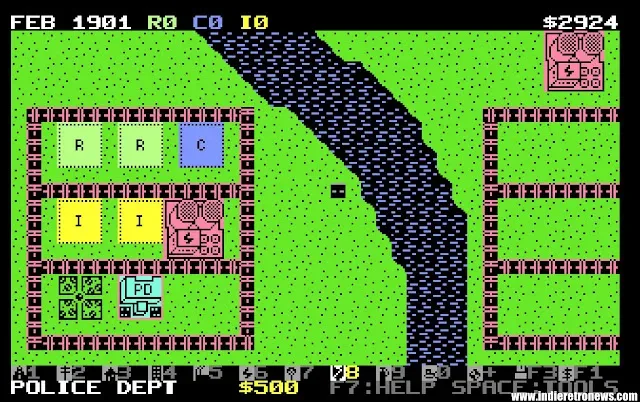
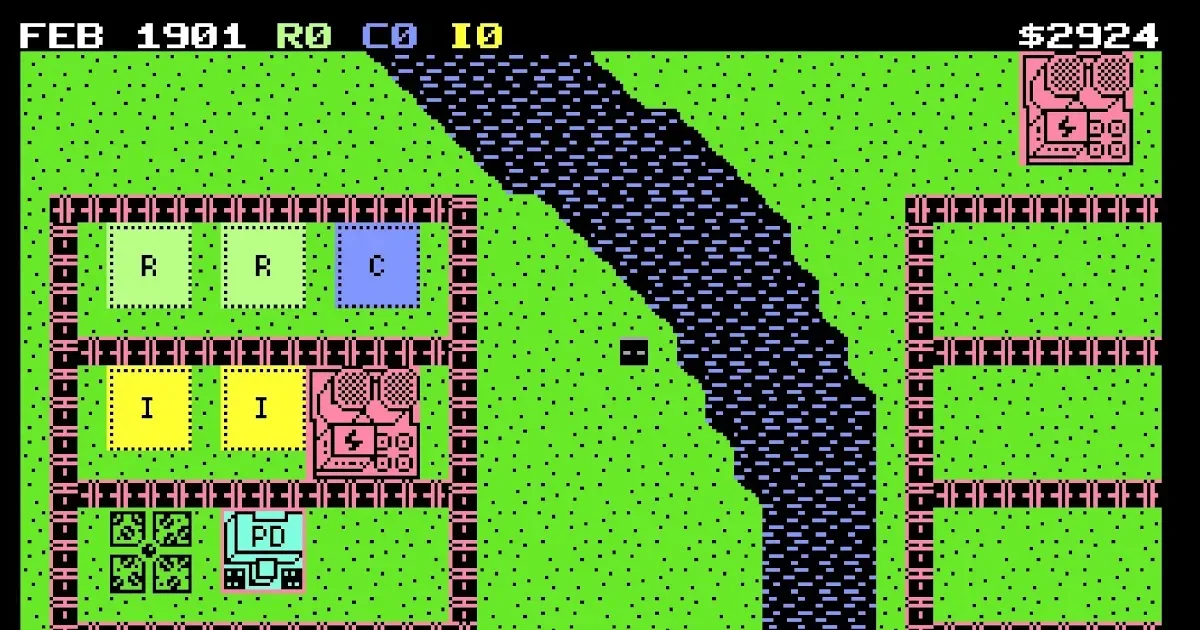
Commodore 64 players have a new municipality to worry about: Jammet has released MicroCity v1.9, an urban-planning simulation that asks players to take the mayor’s seat and turn an empty piece of land into a bustling city.
The game’s stated arc is pleasingly direct. A town starts small, with a single modest home, then develops toward streets of skyscrapers and a glowing metropolis. MicroCity is described as being inspired by the familiar city-management ideas associated with SimCity, placing the emphasis on planning and growth rather than a fixed sequence of levels.
That basic premise is a strong fit for a simulation: the player is not simply decorating a map, but making choices intended to shape how a settlement develops. The goal is not merely to place one impressive structure. It is to move a city from its first signs of habitation toward a larger, denser urban skyline.
What MicroCity v1.9 is asking players to do
At its core, urban planning means thinking about how a settlement is organized as it grows. In a city-building game, that usually turns the map into a problem of priorities. An empty plot is full of possibilities, but it has no character until a player commits to a direction. Starting from one humble home makes the first decisions especially meaningful: the city’s future is not already mapped out by a pre-built metropolis.
MicroCity’s journey from a lone residence to rows of tall buildings gives players a clear visual measure of progress. A skyscraper skyline is not just scenery in this framing; it represents a city that has moved far beyond its initial footprint. That makes the appeal easy to understand even for people who do not normally seek out simulations. There is a natural satisfaction in seeing a blank space become recognizably urban.
The mayor role is equally important. Rather than controlling a single character, the player takes responsibility at the scale of the whole settlement. That perspective changes the kind of question a game poses. Instead of asking where to go next, a planning simulator asks what the city should become next.
MicroCity therefore arrives with a premise built around long-term transformation. The starting point is intentionally humble, while the desired result is deliberately grand. The space between those two points is where the player’s planning matters.
Why the SimCity comparison matters
The comparison to SimCity provides useful shorthand, but it should not be read as a promise that MicroCity duplicates any particular system, scenario, or feature from that series. What the description firmly establishes is inspiration from the broader city-simulation tradition: a player oversees development, begins with undeveloped ground, and pursues the growth of a functioning-looking city.
Related coverage includes MicroCity v1.9 Brings City Planning to Commodore 64.
A city-building simulation is a game genre centered on managing the expansion of a settlement. Its pleasure often comes from interconnected decisions and from watching those decisions change the map over time. MicroCity’s description supports that broad definition because it places the player in charge of a city’s evolution from a home to a metropolitan skyline.
That genre is particularly well suited to replayable, self-directed play. A blank plot does not carry the same implied answer as a mission map with one objective marker. It invites experimentation. Players can approach each attempt as a new civic project, with the later skyline serving as the visible outcome of earlier choices.
The supplied details do not specify MicroCity’s individual building types, economic model, controls, objectives, hazards, or win conditions. Those details should remain open questions rather than being assumed from the genre label. Still, the announced scope is clear enough to establish its central fantasy: build upward and outward from almost nothing.
A contemporary release for a classic platform
MicroCity v1.9 is notable simply because it is a newly released planning game for the Commodore 64. A current release on a long-established platform creates a different kind of appeal from a historical game being rediscovered years later. It gives players an opportunity to encounter a fresh project designed around a platform they already know, while giving retro-focused audiences a new reason to revisit it.
That does not make the game a nostalgia exercise by default. The city-building premise has an enduring advantage: cities are visual stories. A single home communicates a beginning. Towering blocks communicate expansion. A glowing metropolitan view communicates aspiration and scale. Those images are legible without requiring elaborate narrative setup.
For the Commodore 64 community, a newly available simulation also broadens the kinds of experiences associated with the machine. MicroCity is not presented as a score-chasing arcade contest or a linear action campaign. Its focus is civic growth, with the player taking the managerial view and deciding how an undeveloped location earns the right to be called a city.
The larger games business may be dominated by long development cycles and giant productions, an issue explored in this look at how game development has changed. MicroCity illustrates a separate, smaller-scale part of the medium: new ideas and new releases can still appear for older hardware, focused on a single clear concept rather than an enormous checklist of promised systems.
What prospective mayors can reasonably expect
Players considering MicroCity v1.9 can confidently expect an urban-planning game built around a progression from sparse beginnings to a substantial cityscape. They can also expect the game’s framing to put them in the mayoral role and to draw inspiration from the city-management model made famous by SimCity.
They should not treat that description as confirmation of particulars that have not been detailed. There is no supplied information on modes, maps, support for specific peripherals, saving, distribution, cost, building lists, disasters, budgets, population systems, or the precise changes associated with the v1.9 designation. “v1.9” identifies the released version, but it does not by itself describe what differentiates it from earlier builds.
That distinction matters. A good release note separates the game’s confirmed pitch from the features audiences may hope to learn about later. In MicroCity’s case, the confirmed pitch is already straightforward and appealing: claim a vacant plot, guide a settlement through its earliest stage, and aim for an illuminated skyline full of skyscrapers.
The appeal of building from one home
There is a useful dramatic contrast in MicroCity’s stated progression. Many games begin by presenting players with spectacle. This one begins with scarcity: one home on empty land. The spectacle is something to create, not something handed over at the start.
That structure gives the player ownership of the transformation. The final metropolis is meaningful because it is measured against the plainness of the opening plot. It also makes the mayor fantasy more concrete. A mayor is not defined by occupying an office; the role is defined here by guiding development and making the city larger than it was before.
MicroCity v1.9 is now available as a Commodore 64 urban-planning release from Jammet. Its pitch is concise but durable: start with a small settlement, think like a city manager, and see whether that first humble home can become the foundation for a city of towers.