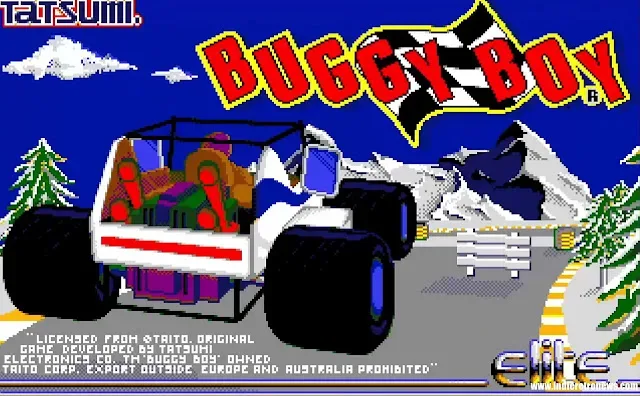

Buggy Boy is back on the Amiga in two notably different forms, and the distinction matters. One project revisits the original Amiga release with an optional performance mode for accelerated systems. The other brings the Commodore 64 version across to Amiga 1200 hardware by translating its original 6502 machine code into 68020 code. Both are fan-led efforts around the 1985 off-road arcade racer, but neither should be mistaken for the other.
For players who remember the era of choosing a home-computer version of an arcade game—and then living with that machine’s particular compromises—the pair makes for an unusually clear preservation story. Vesuri’s Buggy Boy Amiga Enhanced concentrates on how the Amiga edition performs when offered more capable hardware. MrDig’s project concentrates on retaining the C64 edition’s behavior and presentation while making it run on an Amiga 1200.
That means the choice is not simply between a “better” and “worse” version. It is a choice between a faster rendering path for the Amiga game and a separate route to experience the C64 game on Amiga hardware.
Buggy Boy Amiga Enhanced unlocks the original port’s pace
Vesuri’s enhanced release is built around the existing Amiga version of Buggy Boy. Its headline option is enabled through the supplied icons with CUSTOM2=1. On systems with a Motorola 68020 processor or better, that setting removes the original frame-rate cap and allows the game to draw as many frames as the machine can manage.
On a 68030-based setup with Fast RAM, the project is reported to reach 50 frames per second. The practical effect is easy to understand even for readers who have never opened an Amiga case: the forward motion of the road, the arrival of bends, steering response on screen, and passing roadside scenery should be presented more frequently. In a fast-moving driving game, more frequent screen updates can make the image look less stepped and make the flow of a corner easier to visually follow.
It is important not to overstate what has changed. This is a performance enhancement, not evidence of a newly designed game or a ground-up remake. The appeal is that the familiar Amiga release can take advantage of hardware that was not part of the standard baseline when the original game was made.
What the hardware terms mean
The 68000 and 68010 processors are the older, standard-class CPUs referenced by the project. The 68020 and 68030 are later members of the same Motorola processor family. Here, the dividing line is functional: the optional uncapped mode is intended for 68020-or-higher machines, while a 68000 or 68010 system retains the classic behavior.
Fast RAM is additional memory that can be accessed in a way that helps the processor more directly than the Amiga’s shared memory arrangement. CPU caches are small, high-speed stores inside or close to the processor that reduce the time spent repeatedly retrieving data or instructions. The enhancement uses Fast memory and caching to help the game render more fluidly on suitable systems.
Related coverage includes Buggy Boy Gets Two New Amiga Revivals, From Faster Racing to a C64 Code Port.
None of that requires a user to become an assembly-language expert. The relevant practical step is choosing the provided icon option. But knowing what sits behind the setting helps set reasonable expectations: a faster CPU alone is part of the story, while available Fast RAM and cache use are also part of why the smoother mode can work.
Compatibility remains part of the design
The enhanced build does not leave older Amigas behind. On a 68000 or 68010 machine—or if CUSTOM2=1 is not enabled—the game falls back to its traditional 12.5 fps speed. That conservative default is significant. It means the enhancement is optional rather than a new minimum hardware requirement imposed on everyone who wants to run the game.
For owners of unaccelerated machines, this is therefore not necessarily an upgrade that transforms their local performance. It is still a version intended to preserve the established cadence. For owners of faster Amigas, it offers an alternate mode that changes the visual rhythm considerably, up to the cited 50 fps result on a 68030 system with Fast RAM.
Frame rate is simply the number of complete images drawn per second. At 12.5 fps, each frame remains on screen longer; at 50 fps, the display can be updated four times as often. The game’s underlying design is not automatically changed by that arithmetic, but a racing game’s scrolling and turns are especially sensitive to how frequently the scene is refreshed.
MrDig’s project preserves a different Buggy Boy
The second release heads in another direction entirely. MrDig has shared a direct port of the Commodore 64 version for the Amiga 1200. Rather than altering Elite’s original Amiga release, the project uses AI assistance to translate the C64 game’s original 6502 machine code into 68020 code.
That wording carries a specific technical meaning. The 6502 was the processor used by the Commodore 64, while the 68020 belongs to the Amiga’s Motorola CPU family. Machine code is the low-level instruction format executed by a processor. Because those processors do not use the same instruction set, code written for one cannot simply be run natively by the other. Translation is the bridge intended to preserve the C64 program’s frame-by-frame operation on the new hardware.
This is why calling it a remake would be misleading. A remake normally implies rebuilding a game’s content or systems in a new implementation. The stated objective here is different: carry the original C64 code’s behavior into a 68020-compatible form. Likewise, it is not merely an enhancement patch for the Amiga edition, because it begins from the C64 version rather than that release.
What is retained in the Amiga 1200 port
The port includes the C64 version’s original loading screen, its title music, all five courses, and its high-score table. On Amiga hardware, the title music is played through Paula, the Amiga audio chip. Those details are more than decorative extras: they make the project’s identity clear. The aim is not to make the C64 version resemble the original Amiga port, but to make the C64 game itself run on an Amiga 1200.
“Frame-by-frame” should be read as a statement of fidelity of execution rather than a blanket promise about every subjective aspect of play. It identifies the port’s technical approach: retaining the source game’s sequence of operations as it is carried to the new processor architecture. For retro-computing enthusiasts, that approach is often as interesting as the game itself, because it exposes a route between two classic platforms without treating either version as disposable.
What prospective players should keep in mind
MrDig’s build is distributed as an ADF file through The Zone, rather than through a storefront such as itch.io. An ADF is an Amiga disk-image format: in broad terms, it is a file representation of a floppy disk used with appropriate Amiga setups. The project is aimed at an Amiga 1200 and is best paired with some Fast RAM.
The distribution choice is linked to uncertainty over the legal position of hosting the game on larger platforms. That uncertainty is worth taking seriously. A fan project’s technical interest does not settle questions around the rights to the original game. Players should avoid assuming that the existence of a downloadable disk image amounts to an official re-release or an endorsement by a rights holder.
There is also a useful practical division between the two projects:
- Choose Buggy Boy Amiga Enhanced if the goal is to run the original Amiga port with an optional uncapped frame rate on a 68020-or-better system.
- Choose the MrDig port if the goal is to experience the Commodore 64 version, including its own loading screen, title music, five courses, and score table, on an Amiga 1200.
- Keep expectations hardware-specific. The enhanced version retains 12.5 fps on 68000/68010 systems or when its optional setting is off; the C64 port is built for the Amiga 1200 and benefits from Fast RAM.
Why these are complementary, not competing, revivals
It would be easy to reduce this news to “an old racer has two new Amiga builds.” The more useful reading is that each project answers a different preservation question. Vesuri asks what happens when the original Amiga game is permitted to use faster processor and memory resources. MrDig asks whether the C64 edition can be carried into the Amiga environment without being redesigned into the existing Amiga port.
Those are separate achievements. One spotlights fluidity through an unlocked rendering rate; the other spotlights the continuity of a particular eight-bit version’s code and presentation. Together, they give Buggy Boy fans a reason to revisit not only the game, but also the differences that once defined computer ports.
For more retro revival coverage with a platform-specific angle, see our look at Pokémon Heartfelt Gold’s expanded Johto and Kanto rebuild.