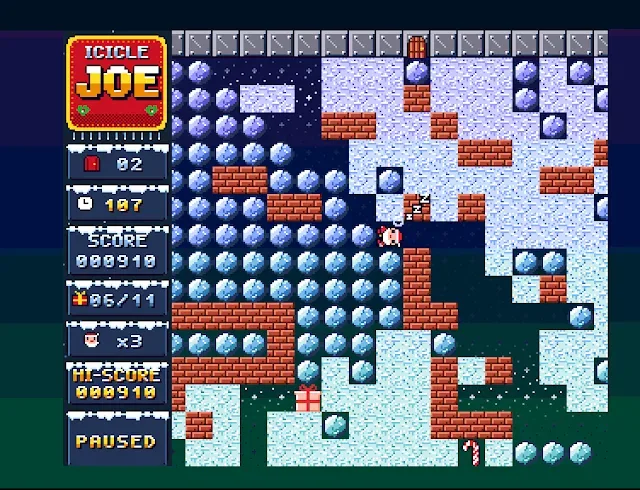
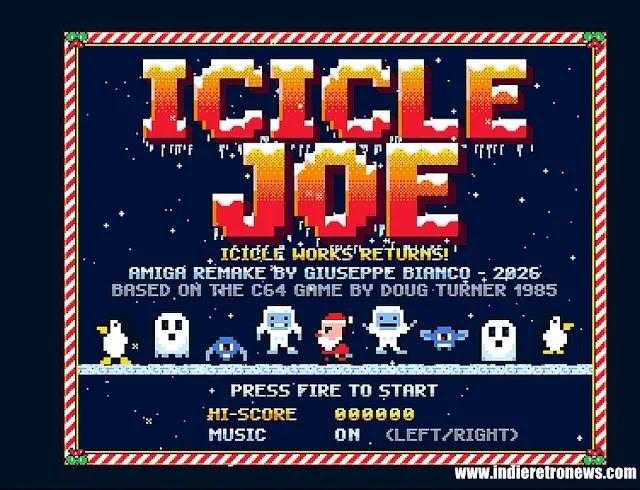
Icicle Joe: Icicle Works Returns! is a new Commodore Amiga remake of Icicle Works, the 1985 Commodore 64 game. Built by Peppe74, it takes the original’s time-pressured ice-cave premise and reshapes it around Amiga presentation while retaining a notably modest hardware target: a standard Amiga 500 with 512K of RAM, or an Amiga 1000 with expanded memory.
That target matters. The project is not framed as a remake requiring a heavily upgraded Amiga configuration. Instead, it is intended for machines close to the platform’s baseline specification, even as it introduces smooth scrolling, a 32-colour palette, three-channel music with sound effects and a larger 256×256 playfield. It is a technical and design-minded revisit of a C64 game rather than simply a version carrying the old name.
A Santa stand-in, an ice cave and a ticking clock
The lead character is Joe, an unlucky Santa impersonator wearing a bargain-bin fake beard and carrying a hip flask. His job is straightforward in the best arcade sense: move through hazardous frozen caves, collect the presents spread around each area, and find the exit before time expires.
The obstacles give that simple objective its pressure. Joe must dig through snow, while falling ice blocks create an additional hazard. The result is a game structure built around route choice and urgency rather than lengthy exploration. A player has to decide where to carve a passage, when to keep moving, and how to avoid letting the changing cave layout turn a planned route into a trap.
For more context, explore GameCube, PlayStation 2 and Dreamcast Game Cases: How to Inspect Water-Damaged Cover Art.
In practical terms, the clock means the presents are not merely decorative collectibles. They are part of the condition for finishing a cave, and gathering them must be balanced against the risk of detours. A stage can therefore become a compact planning problem: identify the necessary pickups, account for diggable snow and falling blocks, then preserve enough time to reach the exit.
What has been preserved from the C64 original
The remake includes all 16 caves from the Commodore 64 game. Crucially, these were reconstructed from the original game data, an approach that points to an effort to preserve the underlying level layouts rather than loosely reinterpret them. For players who know the original, that makes the returning caves the clearest bridge between the two versions.
Faithfulness in a remake can mean many things. It may refer to the same character, premise or broad genre, but level reconstruction goes further because it retains the places where the original game’s challenge was actually expressed. Cave construction determines the relationship between pickups, snow, hazards, exits and time. Keeping those caves allows the Amiga edition to maintain the arcade spirit Peppe74 hopes to carry forward.
Related coverage includes Icicle Joe Brings Icicle Works Back to Amiga.
That does not mean the new version is presented as a museum piece. Its changes are substantial enough to alter how the game is seen and heard, while the original cave set anchors the project. This split is useful: players interested in the historical game have recognizable material to tackle, while the remake also provides a considerable amount beyond those returning stages.
Twenty new caves expand the assignment
Alongside the 16 recreated levels, Icicle Joe adds 20 new levels. That brings the stated total to 36 caves. The new stages include extra bonuses and buddies, plus two new enemies: the Yeti and the Penguin.
The supplied details do not define exactly how bonuses or buddies function, nor do they explain the specific behaviour of either enemy. It would be premature to assume whether the Yeti and Penguin patrol, pursue, block routes or affect the timer in some other way. What is clear is that their inclusion differentiates the newly made content from the restored C64 caves and gives the Amiga remake its own set of threats.
For anyone approaching the game as more than an archival recreation, those 20 additional stages are significant. A remake with only restored material primarily offers a new platform and audiovisual treatment. New level content, new bonus elements, buddies and enemy types make this a larger package with room for its own identity. The older caves establish the baseline; the new ones provide the variation.
Understanding the Amiga-specific presentation upgrades
Several of the remake’s stated enhancements are technical terms worth unpacking, because they describe more than a generic visual polish.
Smooth scrolling and the larger playfield
Smooth scrolling describes movement across a larger game area without the screen jumping from one fixed section to the next. Here, the playfield is 256×256, with a left-hand sidebar beside it. The larger field gives the game more room to present a cave as a continuous space while the sidebar can keep key information visible outside the action area.
That matters especially for a game based on time and navigation. A sidebar reduces the need to interrupt the main playfield with status information, while scrolling can make movement through an icy cave feel more spatially connected. The underlying rules remain rooted in digging, collecting and escaping, but the screen arrangement provides a different framework for reading the level.
32 colours
The remake uses a 32-colour palette. A palette is the set of colours available to the artwork on screen. More colours do not automatically make a game better, but they give an artist more room to separate snowy terrain, ice, objects, enemies and interface elements. In a setting where the scenery is deliberately cold and pale, that extra distinction can be especially valuable for making hazards and routes legible.
The project’s promise is therefore not just “more colour” as a bullet point. It is an opportunity for clearer visual layers across caves that need to communicate what can be dug through, what is dangerous, what must be collected and where progress lies.
Three-channel music with sound effects
Three-channel music means the soundtrack is arranged across three simultaneous audio parts, or channels. In this game, it is paired with sound effects rather than treating music and action noises as mutually exclusive features. That is important in an arcade-style game: the music establishes momentum, while effects can support immediate feedback for movement, digging, collecting or danger.
The music credits also deserve a precise note. Two free MOD files are credited in the game’s credits section, accessible by pressing Up at the title screen, using the information available on the download page. A Tchaikovsky work is also used; that music is in the public domain. The developer has invited the authors of the two MOD files to make contact if they want credit under their real names or want their tracks removed.
A MOD file is a tracker-music format associated with computer music production. The detail here is relevant because it identifies the kind of material credited, while the invitation to creators acknowledges that the available attribution information may not be complete. Players who want to see the existing credits can do so from the title screen rather than needing to begin a cave first.
Why the modest hardware requirement is part of the story
The claimed compatibility with a stock 512K Amiga 500, or an expanded Amiga 1000, is not a minor footnote. It situates the remake within the realities of playing on original hardware. A project designed around those systems can be of particular interest to Amiga owners who prefer software that does not depend on more elaborate configurations.
It also sharpens the appeal of the feature list. Smooth scrolling, a 32-colour palette, audio across three music channels with effects, a 256×256 playfield and a sidebar all have to coexist within that design target. The game’s appeal is not that it attempts to make an Amiga behave like a later machine; it is that it uses Amiga-specific presentation to revisit a game whose original identity was on the Commodore 64.
For retro players, that difference is meaningful. Ports and remakes are often judged on whether they merely reproduce the original or visibly justify the move to another platform. Icicle Joe appears to pursue both goals at once: preserve the 16 original caves from their data, then pair them with expanded content and an Amiga-oriented technical presentation.
What prospective players should expect—and what remains unspecified
The confirmed loop is clear: guide Joe through ice caves, dig snow, evade falling ice blocks, collect presents and reach the exit before the timer ends. The confirmed content count is also clear: 16 reconstructed C64 caves plus 20 brand-new levels. The game’s new enemies are the Yeti and Penguin, and the added stages feature extra bonuses and buddies.
There are also limits to what has been established. No precise description has been provided for control schemes, scoring rules, life systems, distribution format or the exact roles of the added buddies and bonuses. Likewise, the supplied information does not detail the movement patterns or abilities of the Yeti and Penguin. Those are questions for the game itself or its accompanying documentation, not details that should be guessed from the feature list.
Still, the central proposition is easy to understand. Icicle Joe: Icicle Works Returns! brings a 1985 C64 cave game to the Amiga with its original set of levels intact, then substantially enlarges the level count and adapts the experience to classic Amiga hardware. For fans of compact, timer-driven arcade design—and for Amiga users who appreciate software built for a standard Amiga 500—the remake’s blend of restoration and expansion is its strongest hook.