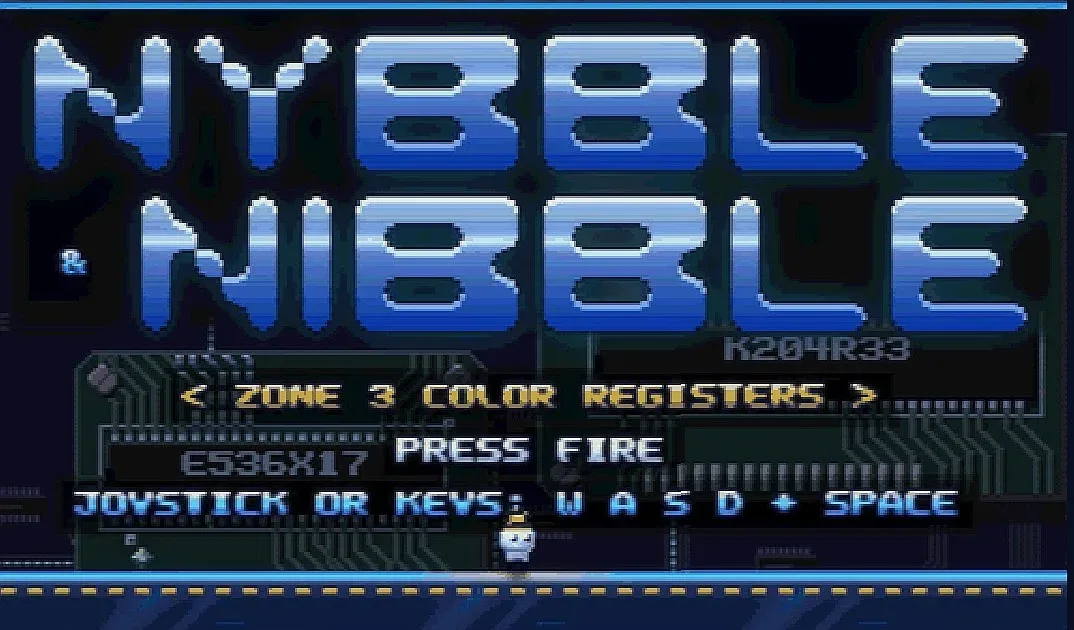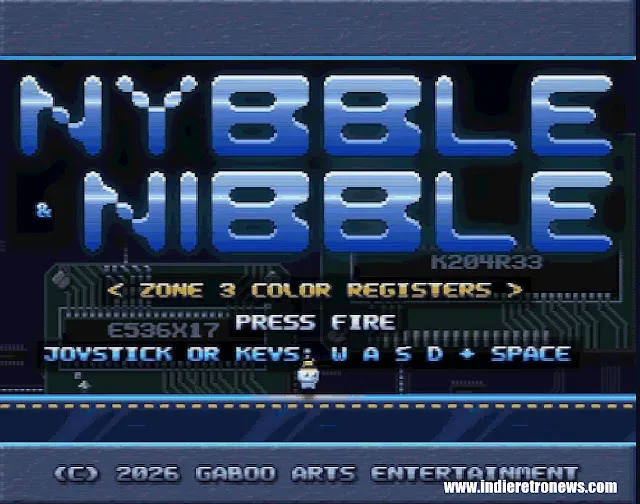
NYBBLE & NIBBLE, a 60-room platform adventure previously built for Commodore 64, has been brought to the Commodore Amiga by Gaboo Arts Entertainment. The Amiga version keeps the central shape of the original: players control Nybble, a tiny half-byte searching for its missing counterpart across six zones of compact platforming rooms.
Its pitch is not simply a change of hardware. The port preserves the original movement toolkit—precise wall-jumps and an eight-direction air dash—while rebuilding the presentation around richer scenery, reworked graphics, custom music and new sound effects. The setting remains a fictional glowing circuit-board world, but the Amiga edition is designed to give that world substantially more visual atmosphere.
For players with original hardware or compatible setups, the practical headline is the modest memory requirement. NYBBLE & NIBBLE requires 1MB of RAM: an Amiga 500 with 512KB of Chip RAM plus a 512KB expansion meets that target, as does an Amiga 1200 with 2MB of Chip RAM. Both PAL and NTSC modes are supported. Testing has been reported in WinUAE with Amiga 500 and Amiga 1200 configurations, including an NTSC playthrough, and on THEA500 Mini.
A compact platformer built around movement precision
A 60-room structure suggests an experience where individual screens matter as much as broad exploration. Rather than describing a large continuous map, the game is framed as a sequence of tightly designed challenges spread over six zones. That makes Nybble’s movement options especially important: a wall-jump lets the character convert vertical surfaces into routes upward, while an air dash that can be aimed in eight directions provides deliberate midair correction and traversal choices.
An eight-direction dash means the dash is not limited to left, right, up or down. It can also be aimed diagonally, allowing it to bridge gaps, redirect a jump path or reach angles that a single-axis move would not. In a room-by-room game, that kind of control scheme can make the difference between a screen feeling like a fixed obstacle course and one that rewards learning a movement rhythm.
The description of the challenges as rhythmic is also worth separating from a music-game label. Nothing here indicates that NYBBLE & NIBBLE is a rhythm game. Instead, the wording points to platforming that depends on timing, momentum and a repeatable cadence of jumps and dashes. The Amiga-specific soundtrack and effects can reinforce that tempo, but the core play remains a platform adventure centered on navigating the rooms.
The result is a concept with a clear modern appeal without claiming modern hardware. Forum reactions cited for the release characterize it as polished and inventive, with a feel comparable to contemporary independent games. That is community response, not a measured technical benchmark, but it helps explain why the port is drawing attention: it is aiming for responsive, focused platform design while operating inside classic Amiga constraints.
What the 1MB target means
The stated baseline matters because it identifies NYBBLE & NIBBLE as a game intended to run on standard OCS Amiga hardware with limited memory, rather than requiring an unusually expanded system. On an Amiga 500, the listed configuration is 512KB of Chip RAM paired with a 512KB expansion. An Amiga 1200’s 2MB of Chip RAM also satisfies the requirement.
Related coverage includes NYBBLE & NIBBLE Brings a 60-Room C64 Platform Adventure to Amiga.
Chip RAM is memory that the Amiga’s custom hardware can access, making it fundamental to work involving display and audio operations. For a game that emphasizes detailed graphics, scenery, music and sound, the explicit memory target gives prospective players a useful compatibility check before they try to run it. It also provides context for the technical choices described for the display engine.
PAL and NTSC support is another concrete compatibility point. These are two television and video standards associated with different regions and display timings. Support for both means the game has been prepared for play in either mode; importantly, an NTSC playthrough is among the reported test cases rather than merely being listed as an intended option. WinUAE testing across Amiga 500 and Amiga 1200 configurations gives emulator users a pair of named starting points, while THEA500 Mini testing is relevant to owners of that dedicated Amiga-style device.
Those testing notes should not be read as a promise of compatibility beyond the configurations specified. They do, however, establish that the game was checked in the two listed emulator profiles, in NTSC play, and on THEA500 Mini—useful information in a scene where players often mix original computers, recreations and emulation.
The graphics terminology, without the mystery
The Amiga version’s visual ambitions are tied to several technical terms: Copper-based PCHG techniques, HAM6 graphics and hardware sprites. They sound forbidding, but their shared purpose is easier to understand than the acronyms suggest. They are methods of making the machine’s visual output appear richer while working within its architecture and memory limits.
HAM6, short for Hold-And-Modify with six bitplanes, is an Amiga display mode that can create the impression of a broad range of on-screen colors by modifying color components from one pixel to the next. It is especially associated with color-rich imagery, though it comes with design constraints that developers must account for. In this case, HAM6 is part of the stated strategy for rendering the glowing electronic environments with more visual depth than a straightforward low-color presentation would suggest.
PCHG is a palette-oriented approach that can vary color information across a screen. Combined with the Amiga’s Copper—a display co-processor capable of coordinating changes as the screen is drawn—it can help a game use changing palettes and effects in carefully planned ways. The release describes Copper-based PCHG being paired with standard HAM6 graphics and hardware sprites to put numerous colors and advanced lighting effects on screen at once.
Hardware sprites are separately handled image elements provided by the system’s custom hardware. In practical visual terms, they can be used for objects that need to sit over a background without every such element being drawn as part of that background. The source material does not specify which game objects use sprites, so it would be speculation to label Nybble, enemies or interface elements as hardware sprites. What can be said is that the technique is one part of the game’s overall display approach.
These details are more than a retro checklist. NYBBLE & NIBBLE’s technical identity comes from the combination of a strict 1MB target and a presentation intended to look substantially more elaborate than that limit might imply. The stated use of palette techniques, HAM6 and sprites indicates an engine planned around the Amiga’s particular strengths, rather than a generic presentation merely transferred from another platform.
A port that preserves the game’s identity while changing its surface
Ports can range from direct conversions to major reinterpretations. NYBBLE & NIBBLE sits between those poles based on the available details. Its 60-room route, six-zone structure, protagonist, objective and movement mechanics are retained from the C64 game. That preservation matters because wall-jumps and directional air dashes are not incidental animation flourishes; they define how the rooms are approached.
At the same time, the Amiga edition is being positioned as a presentation overhaul. Better-developed scenery, revised graphics, custom music and sound effects create a version shaped for the destination machine instead of one concerned only with functional parity. The circuit-board setting is particularly suited to the approach: lighting effects and a larger-looking color range can contribute directly to the fiction of illuminated pathways and electronic spaces.
It is also a useful reminder that “retro” does not describe one uniform design philosophy. A new game for legacy hardware can preserve the restrictions and character of an older system while pursuing the kind of control polish commonly associated with newer independent releases. For a broader look at how older series and their histories can complicate easy assumptions about games, see this discussion of Gears of War: E-Day and the series’ existing history.
Who should pay attention
- Commodore 64 players: The original game’s room count, premise and movement mechanics carry over, so the Amiga edition offers a familiar adventure with redesigned audiovisual presentation.
- Amiga owners: The 1MB requirement gives a straightforward hardware threshold for Amiga 500 users with the specified expansion and for Amiga 1200 users.
- Emulation users: WinUAE tests were conducted with Amiga 500 and Amiga 1200 configurations, including NTSC play.
- THEA500 Mini owners: The game has also been tested on that platform.
- Technology-minded retro fans: The combination of Copper-based PCHG, HAM6 and hardware sprites offers a specific example of developers using Amiga display features to pursue color density and lighting under a small memory footprint.
NYBBLE & NIBBLE’s most notable claim is therefore a balanced one: it retains a compact C64 platform adventure’s mechanical core while treating the Amiga port as an opportunity for a more elaborate audiovisual realization. With documented PAL and NTSC support, named test environments and an accessible 1MB memory requirement, the release provides concrete technical information alongside its six-zone, 60-room journey.