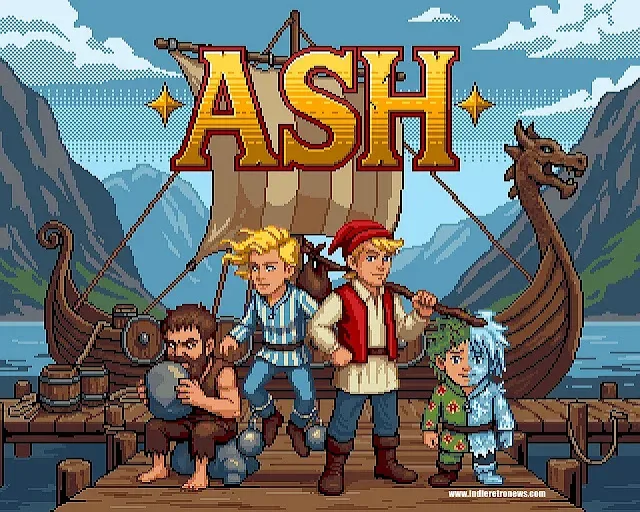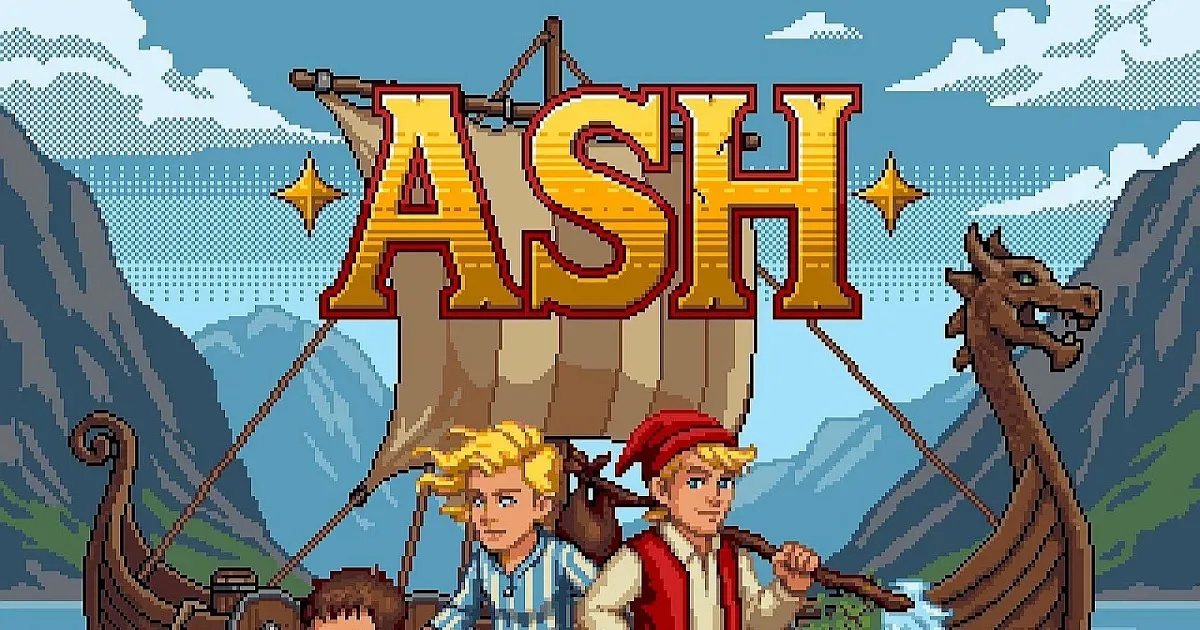
Ash is a platformer in development for Commodore Amiga hardware from Thomas Mayer Foss, and its early pitch has the kind of specificity retro projects need. It is not simply an old-looking game destined for modern PCs: Foss is building it for a standard Amiga 500 OCS configuration with 512KB of chip RAM and 512KB of slow RAM. The project is using Norwegian folklore as its creative foundation, specifically the stories of Askeladden, while aiming to pair its fairy-tale journey with a companion-switching platforming system and true parallax scrolling.
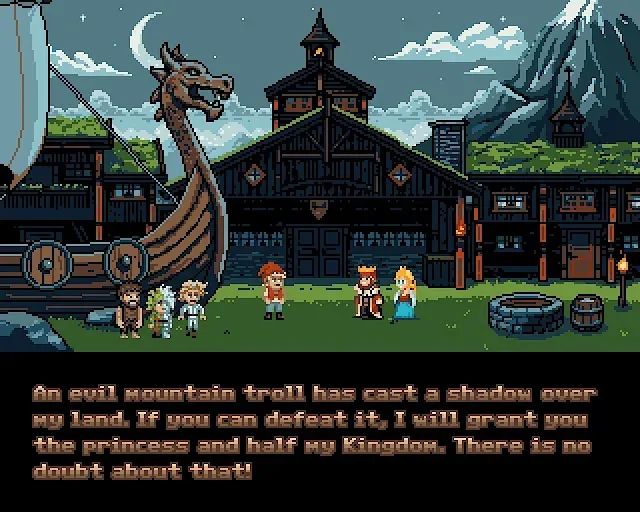
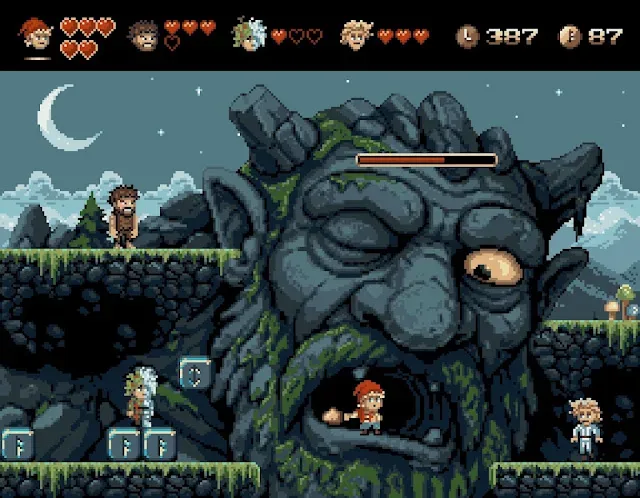
The central figure is the underestimated youngest brother, who sets out to win a princess and half a kingdom. That is a deliberately storybook-sized objective, but Ash’s route is set to be substantial: five worlds stretch from forests and mountains into the clouds, before the adventure reaches the king’s court and a mountain troll’s lair. Early footage has shown the forest environment running on real hardware at 50 frames per second.
A folk-tale quest with a platforming purpose
Askeladden is the key point of reference for Ash rather than a decorative label. The game puts the youngest brother at the heart of its quest, and its three companion characters are framed as practical answers to obstacles on the journey. Players will be able to swap dynamically among the Stone Eater, the Light-Footed One, and the One of Thirteen Winters and Seven Summers. Each has a distinct ability required for progression.
That setup gives Ash a clear design identity. A conventional platformer can ask for timing, jumps and route-reading; a character-switching platformer can also ask the player to identify which tool belongs to the obstacle in front of them. The supplied details do not describe the individual moves or puzzles, so it would be premature to assume exactly how the three companions work. What is confirmed is the important structural idea: progression depends on using their separate talents, not merely treating them as cosmetic alternate characters.
Dynamic swapping matters here. In plain terms, it means players can change companions as they play rather than being locked to one choice for an entire level or an isolated section. If Ash makes that transition quick and readable, it could turn the folkloric party into the game’s moment-to-moment decision-making system. A barrier, gap or terrain feature can prompt a question about abilities as much as reflexes.
The named companions also suggest a game willing to preserve the unusual texture of its source material. “The One of Thirteen Winters and Seven Summers” is not the sort of name designed to disappear into generic fantasy shorthand. Keeping that character alongside the Stone Eater and the Light-Footed One gives Ash an immediately recognizable cast, with the platforming roles tied directly to the tale-inspired premise.
Five worlds, one upward journey
The announced world progression provides a useful sense of scale without promising more than the project has shown. Ash is planned to move through dense forest and rugged mountain settings, then up into the clouds. The king’s court and the mountain troll’s lair form the stated late-game destinations. This establishes an adventure that rises physically as well as narratively, taking the young hero from natural landscapes toward royal and monstrous endpoints.
The forest is the area visible in early gameplay, and it is the best current indicator of the game’s visual direction: colorful scenery presented in motion on original Amiga hardware. The remaining settings should be viewed as planned destinations rather than finished showcases. That distinction is especially important for a hobby project still in development, even one whose creator has expressed a commitment to finishing it.
Related coverage includes Ash Brings Norwegian Folklore to a New Amiga Platforming Quest.
There is an encouragingly concrete division between what Ash intends to do and what can already be observed. Five worlds, companion switching, a final confrontation at the court and troll lair, and the platform target are all part of the stated project plan. The forest footage demonstrates the game running on a real machine. The soundtrack, meanwhile, is explicitly still being worked on. That is a more useful status picture than pretending every portion of a work-in-progress game is equally complete.
Why the Amiga 500 target is central to the story
Ash is being made to push the limits of original Amiga hardware rather than merely imitate the period’s visuals. Foss’s custom engine is written entirely in Assembler, and the stated target is an Amiga 500 OCS with 512KB chip RAM plus 512KB slow RAM.
Assembler is a low-level programming language that works close to a computer’s processor instructions. For this project, that choice is presented as part of the effort to get rich graphics, complex mechanics and scrolling effects from a tightly defined machine. It does not automatically make every game better, but it is an understandable fit when a developer’s goal is to work within a system’s specific constraints instead of abstracting them away.
Chip RAM is the memory accessible to the Amiga’s custom hardware, while the project also specifies 512KB of slow RAM. The exact split is significant because it tells potential players that Ash is not assuming unlimited memory or a later expanded setup. Its visual and mechanical ambitions are being designed around a standard Amiga 500 OCS configuration with those two 512KB allocations.
The reference to OCS, or Original Chip Set, likewise narrows the target. Ash is not just “for Amiga” in the broadest possible sense; it is intended for a foundational Amiga 500 hardware configuration. For enthusiasts who care about whether a new release actually runs on period equipment, that is more meaningful than a retro aesthetic alone.
Perhaps the most immediately visible technical goal is true parallax scrolling. Parallax is an effect where background layers move at different apparent speeds. When a foreground layer travels more quickly than a distant backdrop, it creates an impression of depth as the screen moves. In a side-scrolling platformer, it can make a forest or mountain path feel less like a single flat strip of art. Ash is aiming to deliver that effect on the specified Amiga 500 setup.
The early forest footage is reported to run at a smooth 50fps on real hardware. Frames per second measures how often the image is updated; 50fps means 50 displayed frames in a second. Smooth performance is particularly important for a platformer because jumps, movement and hazards need to remain legible while the scenery scrolls. The footage is a promising proof of the engine’s direction, though it naturally should not be read as a guarantee that every unfinished world and sequence has reached the same state.
No-AI-art stance is part of the project’s authorship
Foss is also making Ash without AI graphics. In the current climate, that is not a throwaway production note. It clarifies that the project’s artwork is not being presented as an automated substitute for the visual labor behind it. The stated approach complements the broader premise of a hand-built hobby project that is writing its own engine for original hardware.
It is worth keeping the distinction precise: a declaration that a game uses no AI graphics does not itself tell us every step of an art workflow, nor does it need to. It tells players the boundary the developer has chosen for the game’s visuals. That clarity is valuable at a time when rushed assumptions about how artwork was made can become their own problem, as discussed in our look at the risks of treating AI-art suspicion as proof.
For Ash, the policy sits naturally beside the technical mission. The project’s appeal is not only that it resembles a game from the Amiga era. It is that its creator is trying to make a new platformer answer to the practical conditions of that era’s machine: finite memory, a particular chipset, real-hardware performance, and an engine tailored to the task. The no-AI-art commitment extends that emphasis on deliberate authorship to the game’s presentation.
What remains to be seen
Ash has several strong ingredients already: a specific folklore framework, a purposeful three-companion structure, an outlined five-world journey, and technical evidence from a real Amiga 500. But it remains in development, and the available information leaves sensible open questions. The soundtrack is unfinished. The details of each companion ability have not been outlined. Nor is there a full accounting of level structure, enemy design, boss encounters, release timing or distribution.
Those gaps do not undermine the concept; they define what should be watched next. The most revealing future updates will be the ones that show how the companion switches change level design, how later worlds compare with the forest footage, and how the music develops around the game’s Nordic folk-tale setting. Foss is sharing development logs, concept art and world previews through the official Ash project page, providing a way to follow that work as it continues.
For now, Ash stands out because its ambitions are concrete. It has a named hardware target, specified memory limits, an all-Assembler engine, a stated 50fps demonstration on real equipment, and a design premise rooted in characters with defined roles. That combination makes it more than a general promise of “a new retro game.” It is a platformer attempting to make its folklore, its mechanics and its chosen machine feel inseparable.