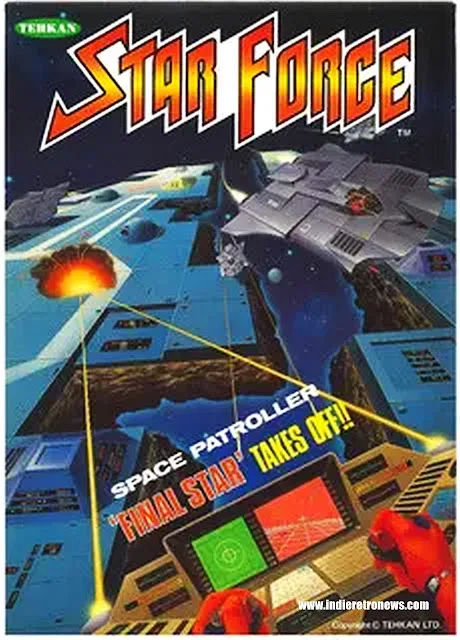
A new Amiga AGA take on Starforce is in development from Acidbottle, bringing the 1980s vertical shooter—and its famously uncompromising arcade structure—to a different retro machine. The project is still being worked on, but a development video establishes the central ambition: preserve the character of the original rather than turn it into a modernised reinterpretation with a pile of new safety nets.
That matters because Starforce, known as Mega Force in North America, is built around a particularly direct kind of shooter design. Players control the Final Star, push through a sequence of Greek-alphabet-themed stages, improve their firing ability within a tight two-level system, and survive long enough to chase a higher score. There are no bombs or missiles in the described design. The craft’s offence and the player’s positioning have to do the work.
For an Amiga project, that is a sensible focus. The appeal is not merely seeing an old game run on new-old hardware; it is seeing whether the pace, pressure and repeatable scoring rhythm of the arcade game can remain intact. The early footage should be judged cautiously, however. Its capture quality is poor and heavy video compression makes visual detail harder to assess. It confirms active development, not a finished conversion or a release timetable.
A conversion built around Starforce’s original rules
The most important reported detail is the intention to stay close to Starforce’s foundational mechanics. The Final Star travels through stages named for letters of the Greek alphabet, with Omega identified as a major late-game target. That stage structure gives the game a recognisable progression even as its play asks for constant reaction and route awareness.
For more context, explore Private-Jet Seller Pushes Back on Rick Ross’ $40 Million Gulfstream G550 Figure.
The weapon design is especially revealing. A two-level power system means weapon growth is deliberately limited: instead of a long ladder of increasingly extravagant upgrades, the game uses a small number of meaningful firing states. The source material also specifies an absence of bombs and missiles. In shooter terms, those are commonly separate emergency or high-damage tools; their omission means the player cannot rely on a screen-clearing panic button or a reserve projectile to compensate for being in the wrong place.
That limitation is not a deficiency. It is part of the game’s identity. A player has fewer systems to manage, but each mistake carries more weight. Enemy waves, incoming fire, stage knowledge and the decision to stay alive rather than force a risky score opportunity become the centre of play. The result is an arcade formula that is easy to describe but demanding to master.
There is an important practical implication for anyone waiting on the AGA version: a faithful Starforce should not be evaluated solely by screenshots, sprite count or how lavishly it dresses up its presentation. Its success depends on movement, timing, enemy pressure and the readability of a crowded playfield. Those traits are difficult to settle from a compressed development clip. They are also the traits that define whether a score-chasing shooter keeps calling players back after the first few runs.
Related coverage includes Starforce Is Heading to Amiga AGA in a New Retro Arcade Conversion.
Why the looping structure is the real endurance test
Starforce is described as having an endless loop structure. Rather than treating the defeat of Omega as a permanent endpoint, the game can continue its challenge. That is a classic arcade proposition: completion is a milestone, while mastery is measured by the ability to continue under sustained pressure and build a score.
The project may also include the legendary “Infinity” stage, encountered long after Omega has been defeated. The wording matters. Infinity is a possibility rather than a confirmed, fully detailed feature, so it should not yet be treated as a guarantee for the Amiga build. But its mention signals that Acidbottle’s goal reaches beyond reproducing only the game’s opening path. It points toward the deep-run experience associated with players who can survive well beyond a conventional clear.
For a genre built around repetition, looping has a distinct purpose. It creates a second layer of competition. One player may be trying to reach Omega for the first time; another may be refining a route, preserving weapon strength, and attempting to maintain composure once the game starts demanding endurance. In that context, a high-score table is not decorative. It is the natural record of the game’s challenge.
The current audio arrangement reportedly lacks a dedicated high-score track. That omission is notable because the post-run moment is part of arcade ritual: a player has either extended a personal best or watched a promising attempt collapse, and the game needs a small space to acknowledge the result. The absence is not necessarily permanent, especially as the soundtrack itself is still due to be scored by IM76, but it is one of the details worth watching as development continues.
Music is planned, while the present build remains a work in progress
IM76 is set to score the game’s pulsing soundtrack. Music carries unusual importance in a shooter whose design is so lean. With no elaborate inventory of special attacks to manage, rhythm becomes part of the game’s texture: the pace of movement, the perceived urgency of encounters and the sense that a run is gaining momentum can all be reinforced by the audio.
At this stage, it is best to separate what is underway from what is settled. The project exists, its development footage has been shown, Starforce’s core mechanics are the stated target, and IM76 is planned for the soundtrack. Conversely, the available information does not establish a release date, price, distribution method, final feature list or final audiovisual quality. The high-score music is absent from the current arrangement, and Infinity remains framed as a potential inclusion.
That distinction is useful in retro-development news, where a playable-looking clip can easily be mistaken for a finished product. Development videos often show a project at one specific point in time. Compression can obscure scroll smoothness, colour detail, sprite definition and audio clarity; it can also conceal unfinished work. The correct takeaway is that the conversion has moved past being a purely hypothetical idea, not that every remaining question has an answer.
From Scorpion Engine prototypes to a broader development process
Acidbottle’s route to this point has not been a straight line. Development began with early prototypes using Scorpion Engine, then moved into a process involving modern AI tools intended to accelerate and help complete the work. This is a concise but meaningful account of the project’s production history.
Scorpion Engine, in this context, refers to the toolset used for the project’s early prototype work. A prototype is an early build made to establish how a game functions before every element is finalised. It can answer essential questions: whether the player ship feels right, whether stages can be assembled, whether enemy patterns are viable, and whether the project’s target experience is achievable.
The reported use of modern AI tools should likewise be read narrowly. They are described as aids to speed up and finalise the project. That tells us something about the workflow, but not which tasks were assisted, how extensively the tools were used, or what final assets they affected. It does not automatically tell players anything about the finished game’s quality. What they will ultimately feel is the responsiveness of the Final Star, the clarity of hazards, the stage flow and the soundtrack’s fit with the action.
Acidbottle is also continuing work on a Centipede beta, alongside earlier attention to Defender. That wider interest in arcade games gives Starforce a useful context: this is part of an effort to bring recognisable arcade experiences to the Amiga rather than an isolated experiment. Still, each arcade conversion asks different questions. Starforce’s test is sustained forward pressure and looping score play, not simply whether familiar names and graphics have made the trip.
What to watch as the AGA version develops
For players interested in the project, a few concrete questions are more useful than speculation about what might be added. First is mechanical fidelity: does the two-tier weapon system retain the deliberate restraint that defines the original? Second is loop behaviour: will the post-Omega continuation work as expected, and will Infinity appear? Third is audio completion: how will IM76’s score develop, and will the missing high-score music become part of the finished arrangement?
Finally, there is the matter of presentation under cleaner conditions. The current video’s compression limits the confidence anyone can have in fine visual and performance details. Future footage with a better capture would make it easier to evaluate the conversion on its own terms rather than through compression artifacts. Until then, the strongest evidence is conceptual: Acidbottle is building a Starforce conversion for Amiga AGA that prioritises the original game’s severe, repeatable arcade framework.
Those following the project can find the available development coverage and project details here. For now, the appeal is clear: an Amiga AGA shooter where surviving the route, protecting a limited weapon state and pushing into the loop matter more than accumulating modern conveniences.