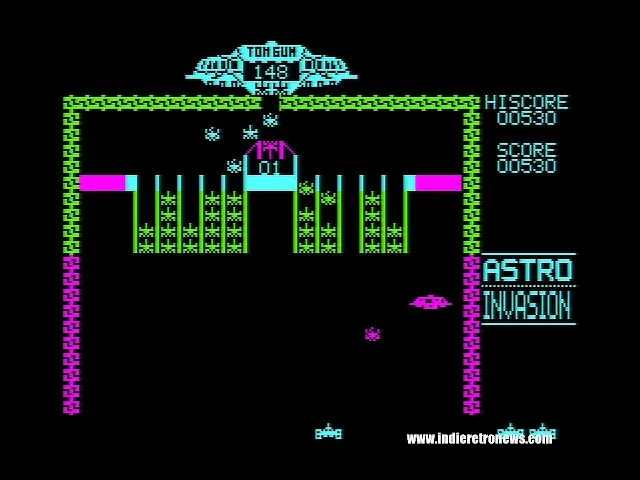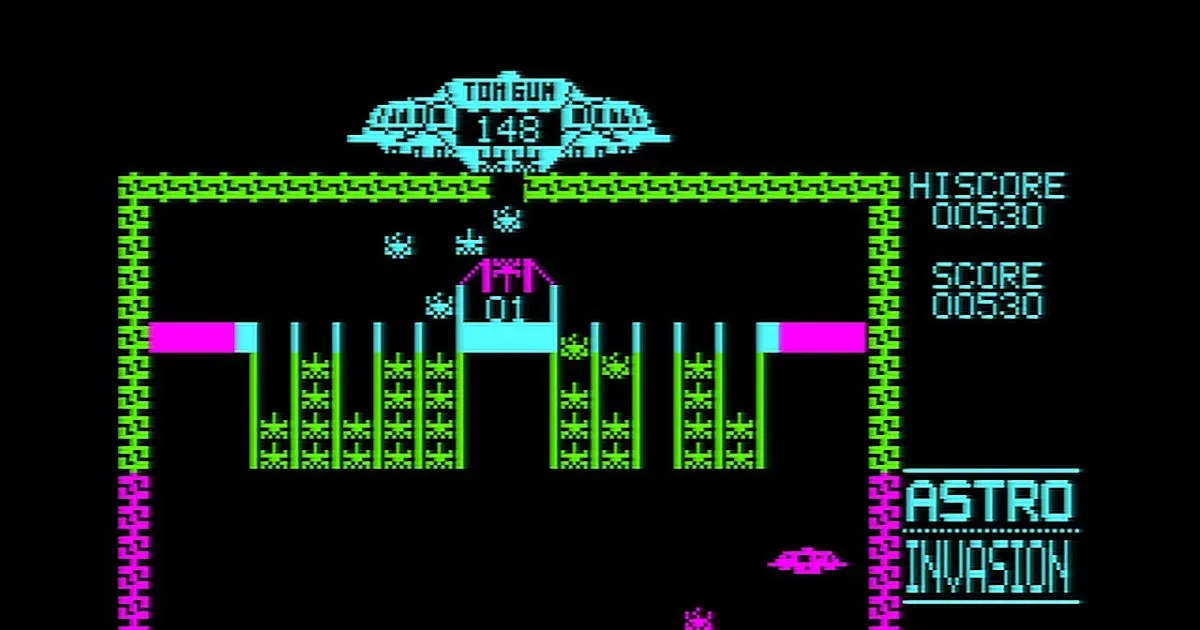
Tom Gun Software has released Astro Invasion, a new arcade-style space shooter built for the Amstrad CPC, Dragon 32, Dragon 64, Dragon by Tano and Tandy Color Computer. Its premise is deliberately direct: take control of a lone starfighter, face an alien mothership and keep descending enemy swarms from overrunning the screen.
The game takes clear inspiration from Stern’s 1979 arcade game Astro Invader, placing it in the familiar tradition of fixed-screen alien shooters where speed, shot placement and immediate reaction matter more than elaborate systems. Rather than treating that lineage as a reason to recreate an old game unchanged, Astro Invasion is presented as a fresh release designed around the character and constraints of several vintage home-computer platforms.
Its central technical claim is just as important as its arcade premise. The game is written entirely in machine code, with the stated aim of keeping action smooth and responsive whether players use a keyboard or a traditional joystick. It also supports PAL and NTSC machines at identical speeds, while Dragon and CoCo versions include automatic keyboard mapping. Amstrad CPC players, meanwhile, receive a full-colour presentation; the other supported systems use a high-definition black-and-white layout.
A shooter built around immediacy
There is no suggestion that Astro Invasion is attempting to bury its core loop beneath a large campaign, progression tree or complicated set of modes. The supplied description instead points to a concentrated action game: the player is immediately in the cockpit, the enemy threat comes from above, and pressure is created by an aggressive mothership and repeated descending formations.
That clarity matters for this particular arcade lineage. A descending-swarm shooter is readable at a glance. Players need to identify where danger is developing, move their ship into a safe lane and fire quickly enough to stop the immediate threat. The appeal is not in learning a long list of commands. It is in converting visual information into action with as little delay as possible.
The stated emphasis on reflexes is therefore more than genre shorthand. In a game built around fast enemy movement and a confined playfield, responsiveness is part of the design itself. Even a small mismatch between input and movement can make a quick arcade shooter feel unreliable. Conversely, consistently quick controls can make repeat attempts feel purposeful, including when the player’s last run ends abruptly.
What “machine code” means here
Machine code is the low-level set of instructions a computer’s processor executes directly. In practical terms, saying that Astro Invasion is written 100% in machine code signals that its developer has targeted efficient execution on the supported older hardware rather than relying on a higher-level runtime during play.
That does not automatically define every aspect of a game’s quality, nor does it tell players precisely how every technical task has been solved. It does, however, fit the release’s focus on fast action. Movement, enemy updates, collision checks and screen work all compete for limited processing time in an arcade game. A machine-code approach can be especially relevant when the intended experience depends on maintaining a brisk, stable feel while many enemies are active.
Related coverage includes Astro Invasion Targets CPC, Dragon and Tandy Hardware.
Tom Gun Software describes the result as smooth, fast action across keyboard and joystick control. That is the practical promise players can take from the technical language: Astro Invasion is meant to feel like a sharp, immediate shooter on the machines for which it was made, not merely a concept adapted to them.
One release, several vintage platforms
The platform list is a notable part of the project. Astro Invasion is intended to work across the Dragon 32, Dragon 64, Dragon by Tano, Tandy Color Computer and Amstrad CPC. These are not simply different labels for one uniform audience. Each machine family has its own expected display characteristics, input conventions and regional considerations. A multi-system release therefore needs to preserve the game’s identity while accounting for those differences.
The game’s visual approach makes that balancing act visible. On the Amstrad CPC, the space battles are rendered in full colour. On the other supported vintage systems, the developer describes the presentation as a crisp black-and-white high-definition layout. Neither is framed as a lesser ruleset or an alternate edition of the game; the gameplay target remains a consistent arcade-style confrontation with the alien force.
For players, this distinction is useful to know before approaching the release. The Amstrad CPC version is the colour-specific version, while Dragon and Tandy/CoCo users should expect monochrome visuals. The shared premise and performance aim are the connecting thread, rather than identical pixel-for-pixel presentation.
That approach is consistent with the broader appeal of new software for classic systems. A modern release can respect a platform’s individual personality instead of flattening every version into the same audiovisual output. It also creates a more meaningful reason to pay attention to which version is being played: hardware differences are allowed to remain part of the experience.
PAL and NTSC parity is a practical feature
One of the more important compatibility details is the developer’s statement that PAL and NTSC formats run at the same speed. PAL and NTSC refer to historical television and video standards that were used in different regions. For software tied closely to display timing, regional versions can sometimes play at different rates if their logic is linked directly to the video refresh frequency.
For a reflex-oriented shooter, differing speed can alter far more than a cosmetic detail. It can affect the pace at which enemies descend, how much time a player has to react and the rhythm of the whole game. Keeping the speed identical across PAL and NTSC formats means that the intended tempo should be shared regardless of which of those regional standards a player’s system uses.
It is a concise feature note, but it addresses the sort of issue that can matter greatly in a game whose identity rests on timing. Players discussing strategies, difficulty or the feel of the action should be engaging with the same intended pace rather than substantially different regional versions.
Automatic keyboard mapping on Dragon and CoCo
Input is another area where cross-platform releases can become awkward if left unattended. Astro Invasion includes automated keyboard mapping for Dragon and CoCo machines. In plain language, this means the game is set up to account for the keyboard arrangements relevant to those platforms rather than making players manually reconcile a generic control layout with their own hardware.
That is especially welcome for a title that also supports joysticks. Not every player will have the same controller setup available, and a keyboard option needs to remain usable rather than existing only as a fallback. The release’s stated support for both keyboard and joystick controls, coupled with automatic mapping on Dragon and CoCo systems, suggests attention has been paid to getting players into the action quickly.
The practical takeaway is straightforward: joystick users have a control method suited to the arcade inspiration, while keyboard players are not excluded from the intended fast-paced experience. On older platforms, sensible input support is not an insignificant convenience; it can determine whether a game feels inviting from its opening moments.
Why the arcade connection fits
Astro Invasion draws heavily from Astro Invader, Stern’s 1979 arcade classic. That connection establishes the game’s broad creative vocabulary: a player ship, hostile invaders, relentless downward pressure and a score-chasing, survival-focused mindset. Those ideas remain effective because they are immediately legible. A player does not need extensive setup to understand the danger when a formation is advancing toward them.
The new release’s emphasis on a mothership and endless swarms reinforces that escalating-pressure model. The player is not described as exploring space or managing a fleet; they are holding a line. That framing gives the game a satisfyingly compact dramatic structure. Every moment is concerned with whether the alien attack can be contained for a little longer.
It also makes the choice of hardware appropriate rather than incidental. Older home computers have a long relationship with short-form action games that reward replay, mastery and familiarity with a system’s controls. A focused shooter that foregrounds clean visual information, speed and direct input speaks naturally to that style of play.
For another recent example of fresh software aimed at classic platforms, see Frogger Junior’s move to Amstrad GX4000 and ZX Spectrum Next. The projects are different games with different platform targets, but together they underline the continued interest in making new experiences for established retro hardware.
What players should expect
- Genre: A fast-paced arcade-style space shooter centered on defending against descending alien forces.
- Inspiration: Stern’s 1979 Astro Invader.
- Supported systems: Amstrad CPC, Dragon 32, Dragon 64, Dragon by Tano and Tandy Color Computer.
- Visual difference: Full colour on Amstrad CPC; a high-definition black-and-white presentation on the other supported systems.
- Controls: Keyboard and classic joystick support.
- Compatibility details: PAL and NTSC releases are said to run at identical speeds, and Dragon/CoCo versions offer automated keyboard mapping.
- Technical approach: The game is written entirely in machine code.
With the available details, Astro Invasion looks most suited to players who want a concentrated test of reactions rather than an elaborate retro-styled adventure. Its value proposition is unusually clear: classic alien-blasting tension, platform-aware presentation and an explicit effort toward responsive performance across a broad group of vintage computers.
The CPC edition will likely be the visual point of interest for players seeking colour, but the wider release deserves equal attention for its compatibility work. Matching PAL and NTSC speed, accommodating keyboard play and supporting multiple Dragon and Tandy-family machines are choices that help keep the core game accessible to the people still using those systems. For a shooter built around split-second decisions, that technical care is inseparable from the action on screen.