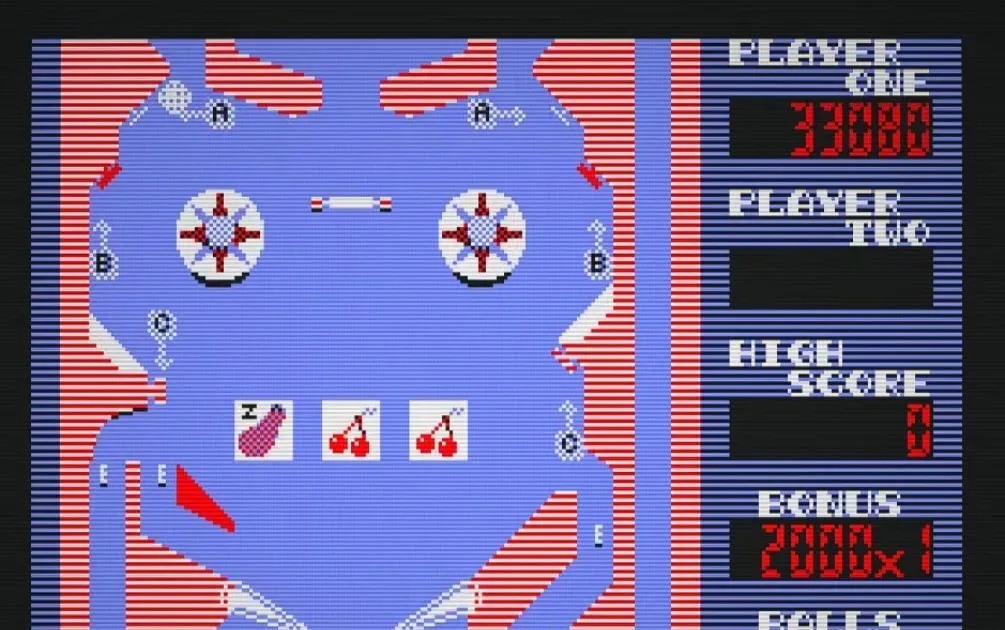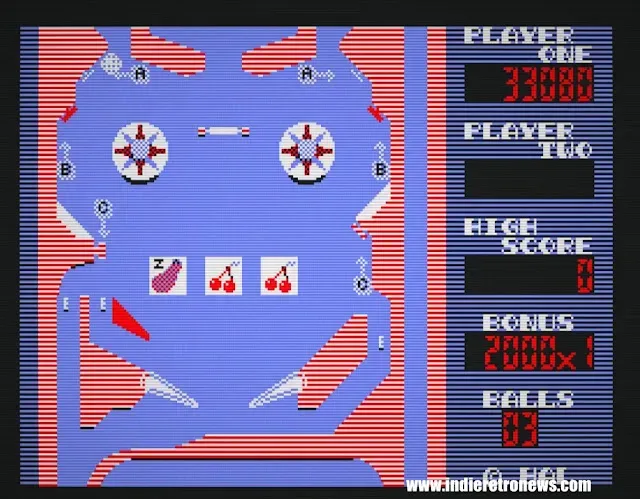
Rollerball CPC, a new homebrew adaptation of HAL Laboratory’s 1984 MSX pinball game, has been released for the Amstrad CPC. Its central technical claim is unusually ambitious: this is presented not simply as a recreation of an older pinball design, but as a version that runs the original game code on CPC hardware.
That distinction matters for a game built around timing, rebounds, targets and score-chasing. Pinball games can look broadly similar while feeling very different in motion. The route a ball takes after a bumper hit, the pace at which it travels through lanes, and the timing window for a save with the flippers all shape whether a table feels recognisable to returning players. Retaining the original code is intended to preserve that behaviour rather than asking a new implementation to approximate it.
The CPC edition is attributed to Oldschool and brings the game’s multi-screen table structure, bumpers, bonus lanes and scoring systems to the Amstrad family for the first time. At the same time, the project adapts the presentation and sound to suit the target machine rather than treating the MSX version as a static visual asset.
A port focused on the playfield beneath the presentation
“Port” can cover several very different kinds of retro projects. A remake normally rebuilds a game from scratch, retaining selected rules or art concepts while replacing its underlying program. An adaptation may preserve the broad structure but change behaviour to fit another system. Rollerball CPC is positioned differently: the original game code is said to run directly on the CPC, while the surrounding presentation has been reworked for that computer’s architecture.
For more context, explore Fire Emblem: Fortune’s Weave May Have One Route Carrying Its Biggest Mystery.
For a pinball game, that approach has practical appeal. The scoring rules and table objects are only one part of the experience. Pinball is also a continuous simulation: the game must repeatedly calculate where the ball is, what it has contacted, and how a collision affects its next movement. Even minor changes to that logic can make a familiar table play differently. The stated goal here is to keep the original physics and gameplay intact while making the game work cleanly on CPC hardware.
The preserved elements include the bumper mechanics, bonus lanes and scoring systems. Those are the fundamentals that turn a pinball screen into a score-attack game rather than a simple reflex test. Bumpers redirect the ball and usually provide points; lanes offer targets or progression conditions; and the scoring system gives every risky shot and recovery attempt a reason to matter. A multi-screen layout further expands the table beyond a single fixed view.
That last point is important because the playfield is described as scrolling between sections. Instead of fitting every target and hazard into one screen, the game follows the action vertically as the ball moves through different parts of the table. It makes a comparatively compact home-computer pinball game feel larger, but it also places a premium on a smooth transition. A jerky scroll can obscure the ball at precisely the point a player needs to react.
How the CPC presentation has been rebuilt
Rollerball CPC reproduces the MSX version’s 256 × 192 resolution. Resolution refers to the number of horizontal and vertical picture elements used for the display. Matching it gives the project a defined visual target, but matching the pixel dimensions alone does not automatically solve the issue of colour on different hardware.
To address that, the CPC version uses Mode 1 dithering to recreate the classic palette. Dithering is a deliberate arrangement of pixels from different available colours that creates the impression of an additional shade or a blended tone when seen at normal viewing distance. It is a common and useful visual technique on older systems, where the artist has to make careful choices within hardware colour and display limits. Here, it is used as part of an effort to retain the appearance of the MSX original while rendering it through the CPC’s own graphics modes.
The scrolling is described as smooth and vertical, carrying the display between table sections. For a game whose central object is constantly in motion, smooth scrolling is more than a decorative upgrade. It helps the screen remain readable as the ball passes from one section of the table to another, keeping the player’s visual relationship with the action consistent.
The release also uses a double-buffered display to remove screen tearing. In basic terms, screen tearing happens when a display begins showing a newly drawn image before the previous one has finished being shown. The resulting frame can contain portions of two different moments, often visible as a horizontal split or discontinuity. Double buffering prepares a new frame in an off-screen buffer and then swaps it into view at the appropriate moment. For a fast moving pinball ball, avoiding that visual disruption supports clarity as much as polish.
Audio has received an equivalent conversion effort. The original music and sound effects have been rearranged for the CPC sound chip. An arrangement is not merely the act of copying notes from one machine to another: it means refitting music and effects to the capabilities and character of the destination hardware. The result aims to preserve the game’s audio identity while using the CPC’s own sound system.
Hardware requirements and control options
Players will need an Amstrad CPC 6128, or an Amstrad CPC 464 or 664 paired with a 128K memory expansion. The memory requirement is a key part of the release rather than a minor footnote. The game is designed around that amount of available memory, so owners of a 464 or 664 should confirm that their system has the necessary expansion before treating the software as compatible.
Both keyboard and joystick controls are supported. That gives CPC players a choice that suits the way they use their hardware, whether it is a traditional computer setup or a joystick-led game session. No additional controller requirements are stated beyond those input options.
The support list also makes the project’s target clear: this is not framed as a generic modern remake with a retro visual style. It is specifically built for the Amstrad CPC line and its memory configurations. That focus is part of what makes projects like this notable within retro computing. The task is not just reproducing an old game’s rules; it is making a particular version operate within the constraints, display modes and audio capabilities of a different period machine.
AI assistance disclosure
The project includes an explicit disclosure that AI assistance was used for code, graphics, sounds and text. That disclosure is worth preserving plainly because it applies broadly across the development work, rather than being limited to a single asset or isolated task.
It does not change the stated technical proposition of the release: Rollerball CPC is presented as an Amstrad CPC version of HAL Laboratory’s 1984 MSX game that uses the original code, alongside CPC-specific graphics presentation, display handling and sound arrangement. But it provides important context for anyone assessing the production process behind this homebrew release.
Why the project stands out
Rollerball CPC’s appeal rests on a combination of preservation and machine-specific craft. The game is not described as a loose homage to 1980s pinball or a modern reinterpretation with a familiar name. Instead, it aims to retain the original play behaviour while solving the practical work of display conversion, palette treatment, scrolling, buffering and sound on the Amstrad CPC.
For players with compatible hardware, the result is a chance to experience a multi-screen MSX pinball game through the CPC’s display and audio hardware, with keyboard or joystick input. For retro-development observers, it is also a useful example of how a port can be faithful in one layer—the underlying game code—while being meaningfully reauthored in others to suit the destination machine.
That balance is the story behind Rollerball CPC: a 1984 pinball design moved onto a new old platform, with its rules and ball behaviour intended to remain recognisable even as its picture and sound are rebuilt for the Amstrad.