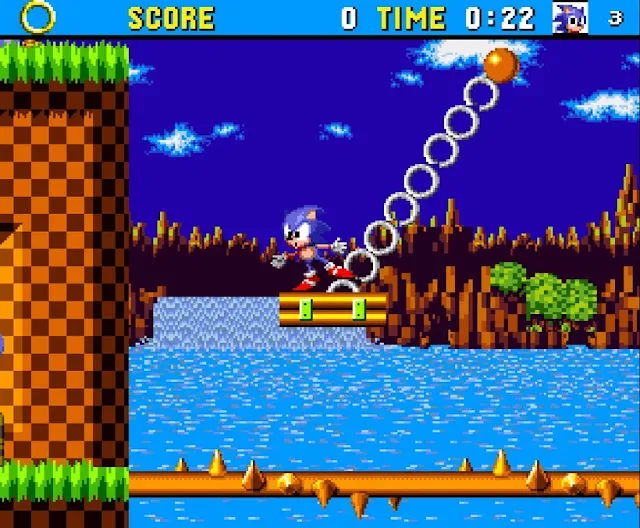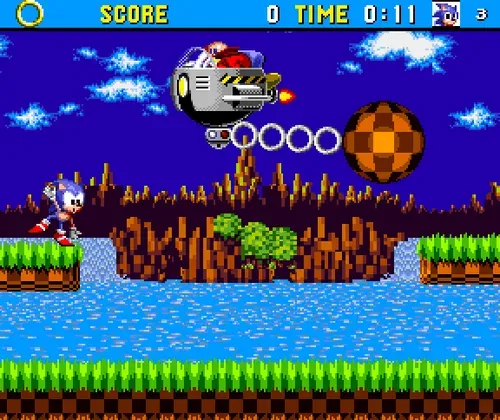
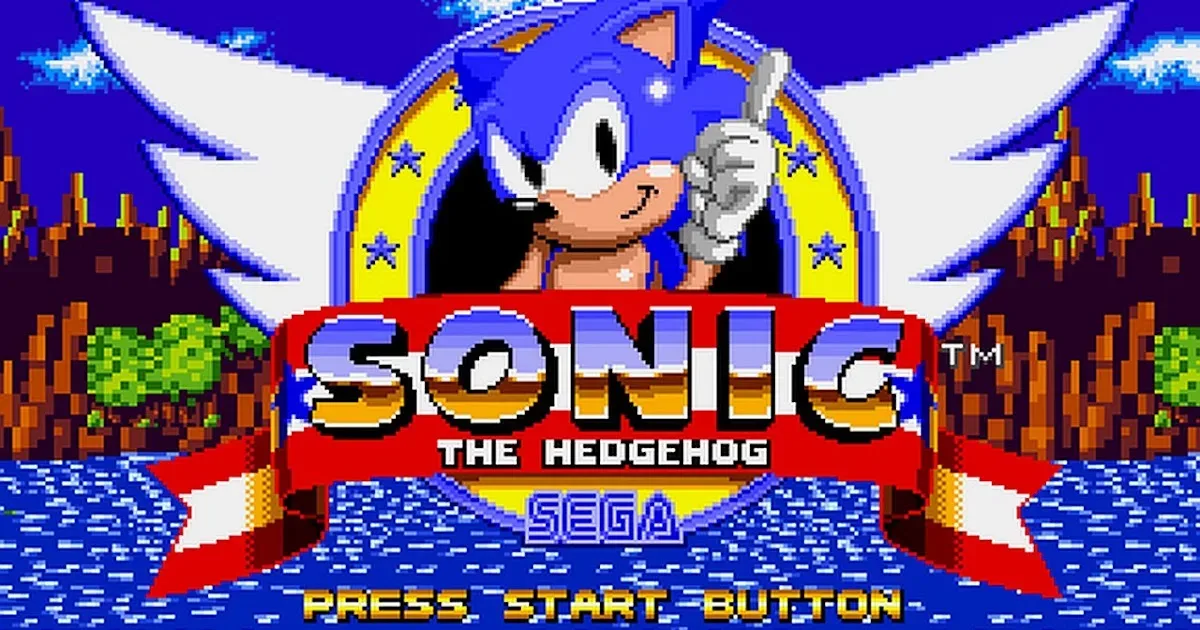
Aonic is an early work-in-progress demo that brings Sonic the Hedgehog to the Commodore Amiga 1200. Developed by reassembler, the project is notable not simply because Sega’s blue mascot is running on different hardware, but because its stated approach starts with the original Mega Drive game’s code structure and tries to preserve the specific feel of the 1991 release.
That is a far more demanding target than merely recreating a familiar-looking Green Hill Zone. Sonic’s identity is tightly bound to acceleration, slope behaviour, momentum and speed. A version can use recognisable art and still feel wrong if those systems differ. Aonic’s underlying engine draws on the comprehensive Sonic disassembly published by the Sonic Retro team, giving the port a shared foundation with the original Mega Drive code rather than treating the game as a loose reinterpretation.
The result, at this stage, is an intriguing technical project for Amiga and Sega fans alike: an attempt to move a console classic onto the Amiga 1200 while retaining its gameplay logic, even where the target machine’s graphics and memory behaviour demand substantial changes behind the scenes.
Why matching Sonic’s movement matters
It is tempting to reduce an old platformer conversion to its sprites, colours and soundtrack. With Sonic the Hedgehog, however, the movement model is the game. Sonic builds and loses speed, carries momentum through slopes, rolls, jumps and interacts with curved terrain in ways players instinctively learn. The moment-to-moment challenge and the satisfaction of mastering a route are consequences of those rules.
Aonic’s use of an original-code disassembly is therefore important context. A disassembly is a human-readable reconstruction of a program’s machine-oriented code. It does not magically turn a game into a ready-made version for another platform, but it can make the program’s systems, data and logic far easier to inspect and adapt than a finished retail cartridge alone would. In this case, the shared codebase is presented as the reason the port can seek parity in physics, momentum and speed.
That distinction also helps set expectations. The project is not described as a finished Amiga-native redesign that merely takes inspiration from Sonic. It is a port in development, with the original gameplay behaviour as a central objective. For players who care about the details of 16-bit platforming, that objective is much more meaningful than surface-level similarity.
Similar CPUs do not make this a simple conversion
The Mega Drive and the Amiga 1200 both use hardware related to the Motorola 68000 family, but a processor connection is only one part of a machine’s design. Games depend on how their entire systems move, display and access data: processor time, graphics hardware, memory, storage and the pathways shared between them all affect what a game can do at speed.
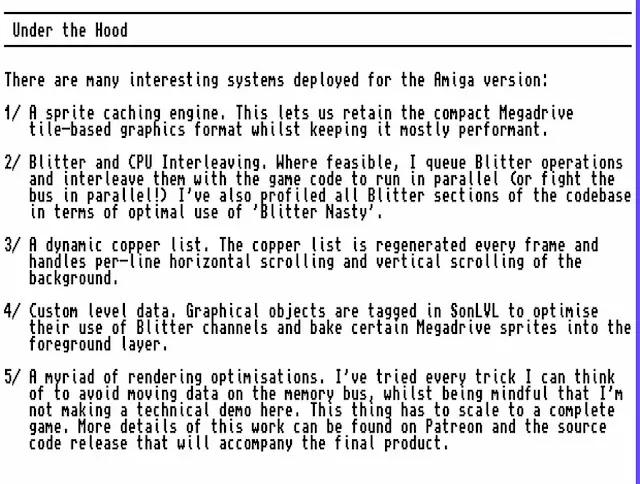
Aonic’s development highlights one such obstacle: bus contention. Put simply, a bus is the route hardware components use to transfer data. Contention occurs when multiple parts of a system need that shared route at the same time. When a game must shift a great deal of visual data quickly, those competing demands can slow work down or complicate timing.
Related coverage includes Aonic Brings an Early Sonic the Hedgehog Demo to Amiga 1200.
For an original Amiga game, developers can construct an engine around the machine’s characteristics from the beginning. A port has a harder job. It must preserve, translate or replace behaviours created for a different set of hardware assumptions. The source material describes large data movement as a particular challenge on Amiga 1200 hardware, which makes sense as a practical engineering concern for a fast-scrolling game with constant animation and terrain updates.
The response in Aonic has been to heavily optimise and rewrite the rendering engine for the Amiga. Rendering is the work of turning a game’s visual instructions and data into the pictures displayed on screen: backgrounds, foregrounds, animation frames and other visual elements. Reworking that layer does not necessarily mean changing the game’s movement rules. In fact, it is precisely the kind of separation a faithful port needs: retain gameplay where possible, while adapting the visual pipeline to the host computer.
Visual deviations are part of the technical story
The project includes necessary visual differences from the Mega Drive version. That is not an incidental footnote; it is a direct result of fitting a game designed around one machine’s display and data-handling model onto another. The supplied material indicates that gameplay has been kept intact while the renderer has been adjusted to overcome the Amiga’s bottlenecks.
For anyone assessing an early demo, the useful question is not whether every frame perfectly matches the console original. It is what has changed, why it has changed, and whether those alterations affect the game’s play. A visual compromise made to maintain stable behaviour or allow rapid scene updates is a very different proposition from an altered movement system that changes how Sonic controls.
That is also why an early build deserves to be viewed as a snapshot rather than a verdict. Aonic remains incomplete, and its performance and design may improve or change before any eventual final release. The remaining portions of the game are still being implemented, so neither the present feature set nor the exact state of the visuals should be treated as final.
What the demo does—and does not—establish
The existing demo establishes that the project has reached a meaningful point: Sonic is running on Amiga 1200 hardware through an engine adapted around that platform’s constraints. It also establishes the intended development philosophy: lean on the original game’s disassembled code for mechanics, then do the difficult platform-specific engineering needed to render it.
It does not establish a finished release, final performance profile, complete level coverage or a permanent list of visual differences. The work is explicitly in progress. That uncertainty matters, especially for a conversion whose primary appeal is fidelity. A small renderer adjustment, an unfinished game system or a later optimisation can affect the experience in ways that cannot be judged solely from an early demo.
The material also does not provide details on distribution, compatibility beyond the Amiga 1200, or the project’s long-term release plans. Those are areas where interested players should avoid assumptions. The clearest current takeaway is narrower: Aonic is a developing Amiga 1200 adaptation of the original Sonic the Hedgehog, and it is built around the difficult goal of bringing the original game’s behaviour with it.
Why Aonic is a compelling retro-development project
Retro hardware projects are often most interesting when they expose the difference between a game and the platform it originally shipped on. The Mega Drive edition of Sonic the Hedgehog is inseparable from Sega’s hardware in the popular imagination, yet the game’s logic can be studied and adapted while its presentation layer is rebuilt for another 68000-based system. That does not erase the hardware gap; it makes the gap visible.
Aonic is consequently as much an exercise in systems engineering as it is a piece of nostalgia. Its developers are not just placing Sonic on an Amiga screen. They are confronting how a fast, data-intensive scrolling platformer behaves when the target machine has different constraints around moving visual information. The reported bus-contention issue and the renderer rewrite are the heart of that work.
For fans of classic Sega games, the value is the prospect of familiar control behaviour on unexpected hardware. For Amiga enthusiasts, it is a showcase for what careful optimisation can attempt on the A1200. And for people interested in preservation-adjacent technical work, it demonstrates why community code research can become a foundation for ambitious homebrew efforts—without making porting effortless or automatic.
The broader retro scene is full of discussions about how games are revisited and reinterpreted; our look at what a remake can change in Ocarina of Time explores that question from a very different angle. Aonic’s focus is less about reimagining a classic than reproducing its core behaviour across a hardware divide.
Early-build caution is essential
There is a tendency to turn impressive demonstrations into finished-product claims, particularly when they involve beloved games and enthusiast hardware. Aonic should be evaluated with a little more precision. The demo’s accomplishment is technical and real: the project has adapted an original-code-derived engine and reworked its rendering for Amiga 1200 constraints. But its developers still have work to complete, and the supplied information explicitly leaves room for both improvement and regression before a final version.
That caveat does not diminish the achievement. It explains why it is interesting. Preserving Sonic’s famous sense of speed is not only a matter of making the game run; it is a matter of making a different system sustain the original game’s logic while handling its own demands. Aonic’s early demo suggests that this balance is the project’s central ambition—and the reason retro players will be watching its continued development closely.