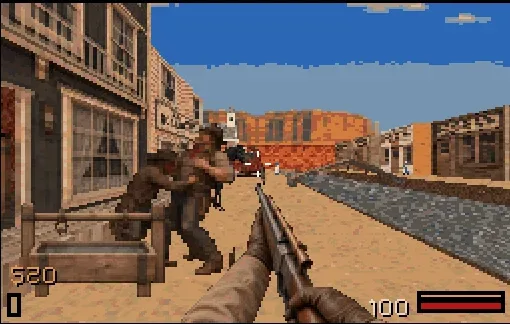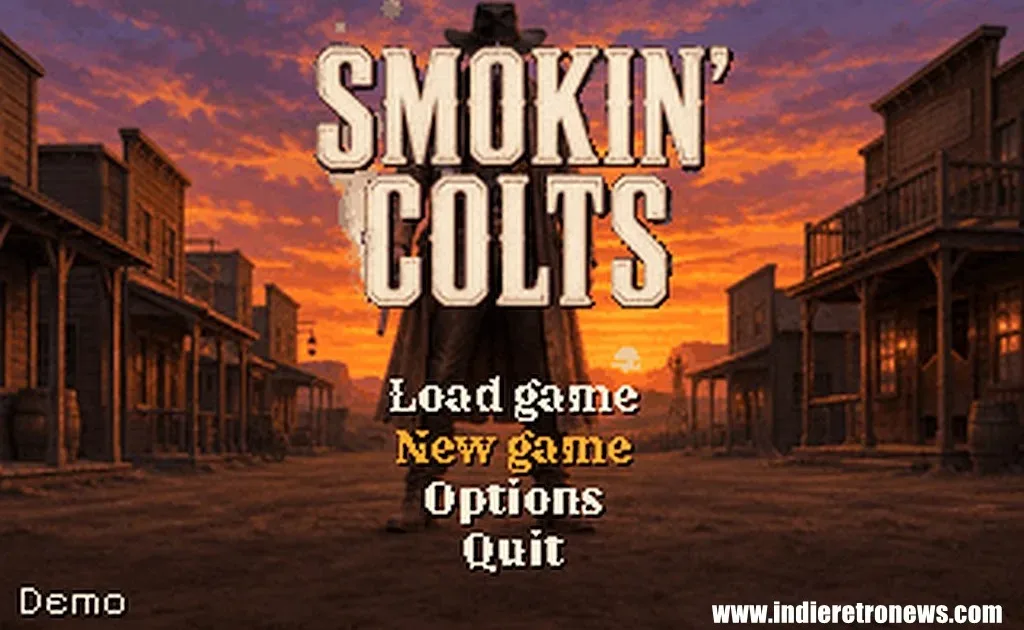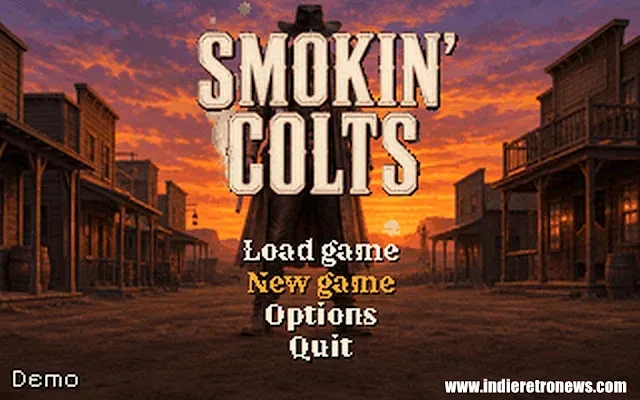
Fliegeralarm Games is developing Smokin’ Colts, a Wild West first-person shooter for Commodore Amiga hardware. The project’s pitch is unusually ambitious for the target machines: a populated frontier town rendered as a fully 3D space, explorable interiors and streets, conversations with local residents, weather reactions, gambling activities and gunfights. Its stated setting is Dusty Creek, where outlaw Bart Hollis and his gang have frightened the town while its sheriff is unable to stop them.
The premise puts the player in the role of a lone gunslinger arriving as the gang is preparing to rob the local bank. One described early turning point is a visit to the saloon. Having a drink there is said to set off a high-noon-style encounter when the outlaws ride into town. That is a notably specific bit of event design amid a broad list of advertised systems, and it suggests the game may combine free exploration with scripted confrontations rather than simply offering a sequence of shooting levels.
There is no release date, price, footage-based assessment, or confirmation of how the project will be distributed in the supplied details. Prospective players should therefore read the game’s scope as developer-stated rather than independently tested. What is clear is the hardware target: this is not a floppy-based release intended for an unexpanded entry-level Amiga. Smokin’ Colts is specified for accelerated AGA machines with hard-disk or CompactFlash storage.
Dusty Creek and its two advertised paths
The game is described as spanning two large chapters. Players will reportedly choose between an army captain and an Apache scout, navigating the frontier through those roles. The available information does not establish whether the two choices lead to substantially different missions, dialogue, objectives or endings. It does, however, position the selection as more than a cosmetic character swap.
The developer also lists a “dynamic world,” a fully populated township and interactions with townspeople. In practical terms, those phrases can mean many things in a game description: moving characters, changing events, dialogue triggers, environmental shifts, or systems that react to player activity. No precise technical or gameplay breakdown has been provided for Smokin’ Colts, so it would be premature to assume a modern sandbox structure or a particular level of simulation. The better-supported reading is that Dusty Creek is meant to feel active and to host gameplay beyond firing a weapon.
Reactive weather and gambling mini-games are among the claimed features. The details do not say which gambling games are included, how weather affects play, or whether either feature has consequences for the main story. Still, their inclusion matters because it broadens the proposed experience beyond the central bank-robbery setup and tactical firefights. For a project designed around classic hardware limits, even presenting multiple kinds of activities alongside a first-person 3D town is a meaningful design objective.
A 3D engine designed around Amiga constraints
Smokin’ Colts is said to use a sector/portal engine. This is a way of structuring a 3D area into separate regions—sectors—linked through visible openings, or portals. Instead of drawing every part of a map all the time, an engine can focus on spaces that are visible through the current chain of openings. That makes the approach a sensible fit for indoor areas, streets, doorways and other bounded spaces, particularly when processor performance is limited.
The developer says its engine supports multi-storey buildings, sloped floors, swinging doors and a 360-degree sky box. Together, those claims point toward a town designed to feel more spatially layered than a flat shooting gallery. Multi-floor structures can make vertical navigation and sightlines part of combat. Sloped surfaces add terrain variation. Doors can divide interior and exterior spaces, which is a particularly relevant challenge when a game is trying to maintain the impression of a continuous settlement.
Related coverage includes Smokin' Colts Brings an Open-World Wild West FPS to Commodore Amiga.
A sky box is the visual backdrop surrounding the play area, typically used to create the impression of a distant sky or horizon. Here, the promised 360-degree sky box is part of the project’s effort to sell a broader frontier environment even though gameplay is running on period hardware. The supplied information does not state whether that backdrop changes with the reactive weather system, so that connection remains unknown.
The other key term is fixed-point math. Computer graphics often use decimal values to handle position, perspective and movement. Fixed-point methods instead represent fractional values using integers scaled by a fixed amount. This can be helpful on systems where floating-point calculations are unavailable or costly. Fliegeralarm Games says Smokin’ Colts runs entirely in fixed-point math on a standard 68030 processor and does not require an FPU.
An FPU, or floating-point unit, is a processor component or companion chip intended to speed up calculations involving floating-point numbers. The developer’s no-FPU claim is significant for compatibility: it means a prospective player should not need that additional mathematical hardware merely to run the game. That does not make the requirements low, though. The stated baseline still calls for a 68030 clocked at 33 MHz or faster, plus both Chip RAM and Fast RAM.
Display options and performance trade-offs
Smokin’ Colts will reportedly offer three selectable screen resolutions ranging from 256×160 to 320×256, as well as a low-detail mode intended to improve speed. This is a welcome acknowledgement that Amiga configurations can vary substantially even among machines meeting the basic platform family. The highest listed mode offers more display area and clarity, while the lower-resolution and lower-detail choices may help prioritize responsiveness.
Resolution is simply the number of pixels used to form an image: more pixels can provide a sharper, more detailed picture, but rendering them takes more work. A low-detail mode generally reduces visual complexity so the system has less to calculate or draw. The exact adjustments made by Smokin’ Colts have not been specified. They could concern the viewing distance, scene detail, rendering approach, or another aspect of presentation; it should not be assumed that every setting changes the same elements.
The feature list is therefore best understood as a balancing act. A 3D scene with interiors, exterior spaces, doors, slopes and a sky backdrop must fit within the CPU and memory envelope of an accelerated Amiga. Offering options gives owners a way to choose between a fuller image and potentially stronger performance, rather than treating every compatible setup as identical.
What Amiga owners will need
The stated hardware requirements are specific:
- An Amiga 1200 or Amiga 4000 with AGA.
- A 68030 processor running at 33 MHz or faster; an FPU is not required.
- 2 MB of Chip RAM and 4 MB of Fast RAM.
- Kickstart 3.x.
- A hard drive or CF card, since music and pictures are read from disk; floppy disks are not supported.
AGA is the Amiga graphics architecture named in the requirements, while Chip RAM and Fast RAM refer to different memory arrangements used by the platform. Regardless of their technical distinctions, the practical takeaway from the listed specification is straightforward: players need the required amounts of both types of memory, not merely an equivalent total in one pool.
Storage is equally important. The game relies on disk-based access for music and pictures, and the developer explicitly rules out floppy support. Anyone preparing a compatible machine will need a hard drive or CompactFlash-based solution rather than expecting to run it from a traditional floppy disk. A CD32 pad or joystick in port 2 is optional, and the supplied requirements also mention mouse use, though the exact control layout has not been detailed.
Technology and credited components
The project’s supplied credits identify ACE, the Amiga C Engine, under the MPL 2.0 license; public-domain chunky-to-planar routines by Mikael Kalms; the Pixelify Sans and Rye fonts under the SIL Open Font License; and WHDLoad by Wepl & Co. It also lists AI assistance. That final credit confirms assistance was used in the project, but it does not identify which parts of development involved it or what assets, code, writing or workflows it affected. It should not be expanded into claims about the game’s content or technology without further detail.
“Chunky-to-planar” is another relevant Amiga term. A chunky pixel layout stores image pixels in a direct sequence, while planar graphics distribute pixel information across bitplanes. Conversion routines bridge those formats, making them pertinent when a 3D rendering process and the display hardware use different data arrangements. The credit does not by itself reveal the engine’s full rendering pipeline, but it is consistent with a game seeking to present a 3D first-person view on AGA hardware.
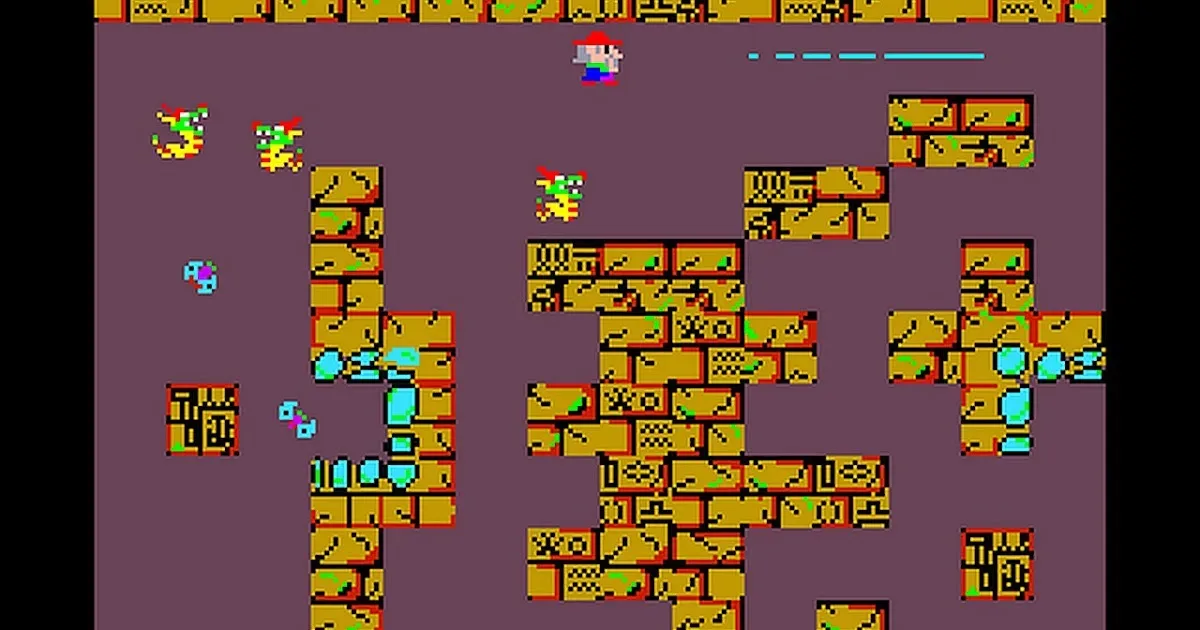
For broader context on contemporary projects still reaching Commodore’s machines, see this look at a new Tutankham tribute for Commodore Amiga systems. Smokin’ Colts takes a very different direction, aiming for a first-person frontier setting and a technically demanding 3D town rather than a revival-style arcade concept.
The most interesting question now is how the promised town systems, character choices and gunplay will come together within the stated Amiga performance envelope. The specifications establish a clear target audience—owners of suitably expanded AGA hardware—and the engine description explains the project’s route to its 3D ambitions. Until more material establishes how those elements play in practice, Smokin’ Colts remains a notable, carefully scoped technical proposition for the Amiga rather than a finished result to judge.