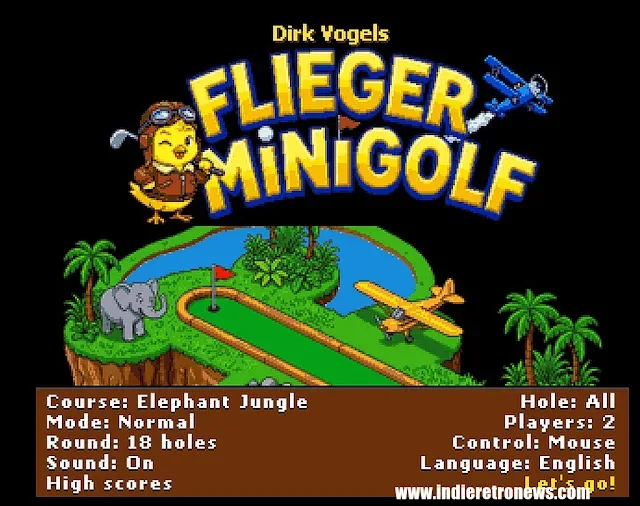
Fliegeralarm Games has two very different sporting projects aimed at Commodore Amiga players: Flieger Minigolf, now released for the Amiga 500 and compatible OCS/ECS machines, and Fliegeralarms Wintergames AGA, an in-development winter-sports game made for AmiGameJam 9.
They share a deliberately old-school focus on score-chasing, joystick control and local competition. They are not, however, interchangeable releases. Flieger Minigolf is built around miniature-golf courses and the earlier Amiga graphics chipsets, while Wintergames AGA is designed for the more capable AGA-equipped Amiga 1200 class of hardware and has its own stated memory, storage and processor requirements.
The pairing is also notable for its explicit disclosure of AI-assisted production. Fliegeralarm Games says artwork was made using the Higgsfield AI image service alongside Blender, and that sound effects used ElevenLabs. That disclosure gives players clear context for what sits behind the projects’ illustrated and audio presentation, rather than leaving them to infer how those assets were made.
Flieger Minigolf puts a scrolling island spin on miniature golf
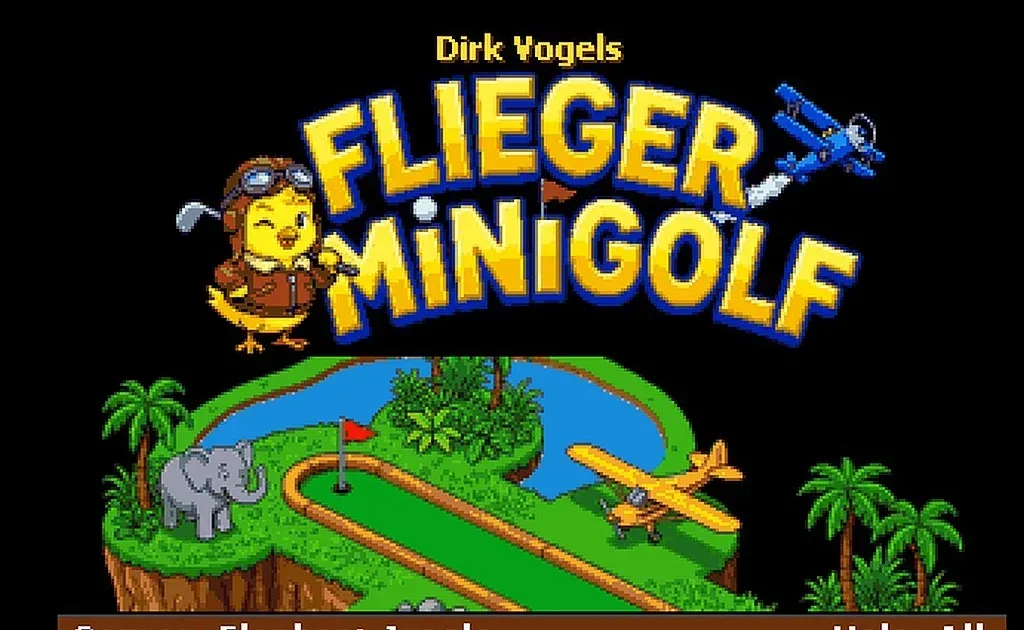
Flieger Minigolf takes an isometric view of the sport. In simple terms, an isometric perspective presents an angled, elevated view rather than looking directly down at the course or placing the player behind the ball. That choice can make the layout more legible as a place with slopes, barriers and routes, while also making shot alignment a central part of play.
Players select a bird character, judge an angle and attempt to send the ball through three AI-crafted courses. Each hole is presented as a floating island that can scroll beyond the initial screen boundaries. That is an important structural detail: instead of treating each hole as a single static board that completely fits on-screen, the game gives the course room to extend outward. A player must therefore account for more than the immediately visible putting line.
The stated hazards cover familiar miniature-golf complications and more variable environmental pressures:
- wooden barriers that can redirect a ball or block a route;
- sand traps and water hazards;
- steep slopes that affect where a putt rolls after impact;
- gusts of wind that can alter a planned shot; and
- obstacles with moving parts.
Moving obstacles are especially relevant to the game’s score-driven structure. A fixed barrier is principally a geometry problem: determine the line, choose strength and execute. A moving component adds timing. The intended route may be apparent, but the moment a player takes the shot becomes another decision. In a game about minimizing strokes, a rushed attempt can be as costly as a poorly calculated angle.
Local multiplayer remains the social centrepiece
Flieger Minigolf supports up to four participants through hot-seat multiplayer, with players passing the joystick around. Hot-seat multiplayer means competitors take turns on one device rather than connecting separate controllers for simultaneous play. It is a natural fit for a turn-based precision sport: every player can watch the previous attempt, react to an unexpected bounce and then try to beat the score.
Related coverage includes Flieger Minigolf Lands on Amiga as Wintergames AGA Takes Shape.
There is also a solo mode for pursuing personal bests and learning the courses. That matters because the challenge described is not only about finding the hole; it is about refining an approach. Slopes, wind and dynamic obstacles create room for repeat attempts even when the objective is immediately understandable.
Compatibility is one of the clearest practical distinctions between the two games. Flieger Minigolf is fully compatible with OCS and ECS hardware, the original and enhanced chipset families associated with earlier Amiga systems including the Amiga 500. For players maintaining an Amiga 500 setup, that means the game is specifically positioned for the older hardware target rather than requiring an AGA machine.
Wintergames AGA is an in-development event collection for later Amiga hardware
Fliegeralarms Wintergames AGA is still in development and was created for AmiGameJam 9. The game is framed as a four-player hot-seat competition in which participants seek to rise through national medal tables. It supports English and German language options.
Its technical presentation is described as using 256 colours, painted backdrops and dynamic copper graphics effects. On the Amiga, a copper effect refers to graphical changes coordinated through the system’s Copper coprocessor. In practical visual terms, this can be used to vary display properties across parts of the screen. The relevant takeaway is not that every effect guarantees a particular gameplay benefit, but that Wintergames AGA is being built to use capabilities associated with the later AGA hardware target.
The game’s events cover several different sports-game control ideas rather than adapting one system across every discipline. The announced disciplines are Ski Jump, Bobsleigh, Biathlon, Downhill and Slalom.
Ski Jump mixes approach, wind and judged landing
In Ski Jump, players manage the in-run, select an angle in relation to wind conditions and attempt a telemark landing. A telemark landing is the split-foot landing stance referenced by the game’s judging setup. Three style judges are part of the event, so distance alone is not presented as the sole concern. The design instead combines the lead-up to the jump, airborne decision-making and the quality of the finish.
Bobsleigh moves to a first-person channel run
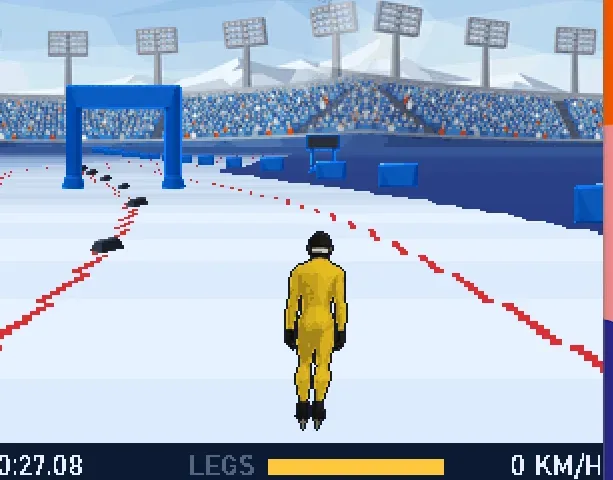
Bobsleigh shifts to a first-person view for a rapid descent through an ice channel. Players are expected to corner aggressively, with the risk of crashing over the lip of the course. A first-person presentation here puts attention on the forward route and approaching bends rather than an overhead tactical view. The stated challenge is managing speed without turning that aggression into a crash.
Biathlon combines movement and shooting pressure
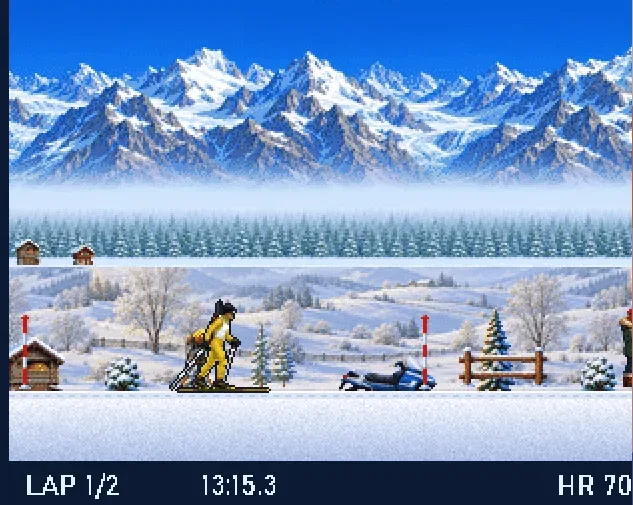
Biathlon combines travel through a snowy landscape with a shooting-range phase. The landscape uses shifting parallax. Parallax is a scrolling technique in which visual layers move at different apparent rates, creating an impression of depth. The gameplay wrinkle is an elevated heart rate before shooting, linking the movement portion to the accuracy test that follows.
That structure makes Biathlon more than two unrelated minigames placed together. The running or skiing section is presented as affecting the shooting-range challenge, so precision must be handled under the pressure created by the preceding event.
Downhill and Slalom use pseudo-3D speed trials
Downhill and Slalom are described as pseudo-3D gate challenges played against a penalty clock. Pseudo-3D means the game aims to create an impression of depth and forward motion without claiming fully three-dimensional rendering. The player’s task is to tuck through gates at speed while avoiding time penalties. It is a familiar fit for a skiing event: route discipline is measured against the desire to maintain pace.
Hardware requirements and controls for Wintergames AGA
Wintergames AGA has a more demanding stated target than Flieger Minigolf. It requires an Amiga 1200 or compatible system with the AGA chipset, a 68020 processor or better, 2 MB of Chip RAM plus 2 MB of Fast RAM, and a hard disk.
Chip RAM is memory shared with Amiga custom hardware, while Fast RAM is additional memory intended for faster processor access. The listed requirement makes the distinction useful for prospective players: meeting only the base machine name is not necessarily enough if the required memory expansion is absent.
Controls support a joystick in port 2, or keyboard input using cursor keys with Space or Return as fire. The specification is helpful for players planning around the traditional single-joystick hot-seat setup, while still providing an alternative input method.
The game also plans custom-sampled effects through Paula, the Amiga audio chip. The identified sounds include crowd noise, cowbells and skis cutting through snow. These details suggest that each event is intended to have a stronger sense of venue and motion than a bare score display, although the project remains in development and its final form should not be assumed from the current description.
What the two projects say about their respective Amiga targets
Flieger Minigolf and Wintergames AGA are connected by approachable competitive formats, bird-themed or sporting presentation, and four-player pass-the-controller play. Yet their hardware positions are deliberately separate. Minigolf is the option for OCS/ECS owners seeking an isometric precision game on Amiga 500-era equipment. Wintergames AGA is the more technically specified project, looking toward AGA visuals, a hard-disk-equipped Amiga 1200-compatible configuration and a collection of distinct events.
For retro players, compatibility details deserve as much attention as the event lists. The original Amiga family spans systems with meaningful chipset and memory differences, so “Amiga game” alone does not settle whether a particular setup is suitable. The clearer separation here should make it easier for players to identify which project matches their machine.
Both games also keep competition close to the hardware. Hot-seat play asks people to share a joystick, compare results in the same room and wait for their attempt rather than depending on network features. That modest format is well suited to miniature golf and winter events where individual runs or shots can be evaluated one turn at a time.
For a broader perspective on how game design choices can stay influential long after a release, see our look at Assassin’s Creed Brotherhood’s lasting open-world design influence.