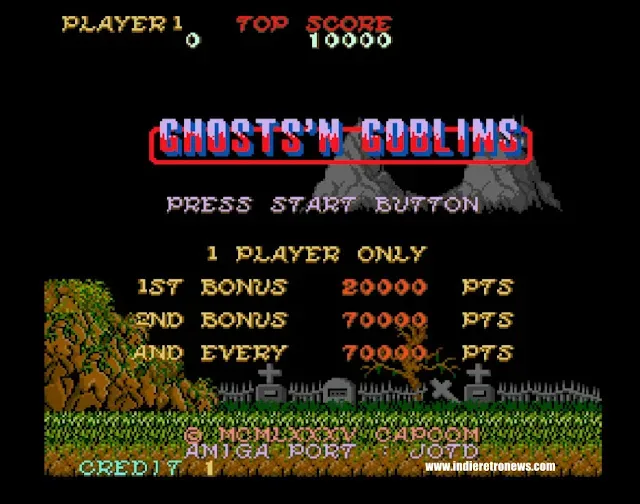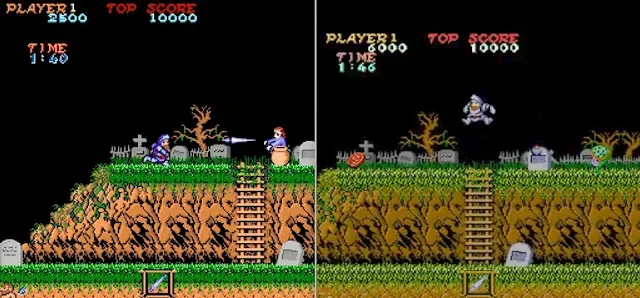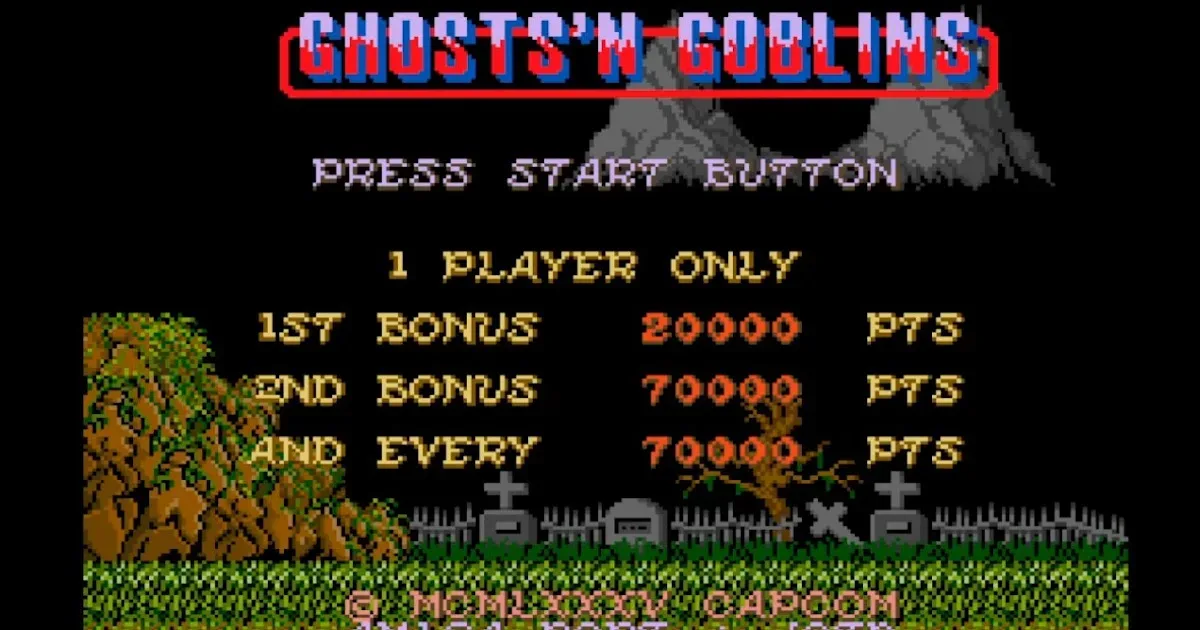
Ghosts ’n Goblins has received a new enhanced Amiga AGA edition from JOTD, bringing the original game’s full seven-level run to Amiga 1200-class machines and above. The project is positioned as a closer technical and visual fit for the arcade original than earlier home-computer versions, while also providing a separate CD32 edition with audio tracks that runs on standard, unexpanded CD32 hardware.
For a game famous for its hostile monsters, stripped-down survival and unforgiving consequences, the value of a version like this is not simply that it exists on another machine. It is in the stated aim of preserving the arcade game’s behavior while taking advantage of the AGA Amiga’s display capabilities. The release uses 64 colors across all seven levels and lists “exact arcade gameplay” among its goals.
The release is credited to JOTD for reverse engineering, 68000 transcoding, graphics conversion and Amiga sound conversion. IM76 is credited for music, PascalDe73 for icons, and Capcom remains credited for the original game. Details on the release can also be found through this report on the enhanced AGA edition.
What the AGA label means here
AGA refers to the Advanced Graphics Architecture used by later Commodore Amiga systems, including the Amiga 1200. In practical terms for this project, the important claim is the 64-color presentation across the complete game. Color count is not a catch-all measure of quality, but it can matter enormously to an arcade conversion: backgrounds, enemies, item pickups and the shifting atmosphere of each stage have more room to resemble their intended artwork rather than being reduced to a narrower palette.
For more context, explore Peter Rosenberg Questions Ye’s Role at Donda West Way Unveiling, Not the Honor Itself.
The AGA edition is specifically described as requiring an Amiga 1200 or higher. It also needs some fast memory. “Fast memory” is memory that the processor can access without sharing the same path used for chipset operations, which can be important when a conversion must keep game logic, scrolling, graphics and audio moving together. The requirement is worth noting for prospective players because it means the release is not presented as a drop-in version for every Amiga configuration.
There is an important exception on the console side: the CD32 build is said to run on a stock CD32. That edition additionally has audio tracks, distinguishing it from the computer-targeted version and giving CD32 owners a route into the project without an added-memory requirement being listed.
Seven levels, arcade behavior and scrolling
The release includes all seven levels of the original Ghosts ’n Goblins. That matters because a conversion can be judged as much by completeness as by graphics. A full level set preserves the game’s escalating structure: players are not getting an isolated technical showcase or a partial recreation, but the complete arcade campaign as represented by this edition.
The phrase “exact arcade gameplay” should be understood as the project’s stated design target, rather than a guarantee that every player will perceive every timing and behavior identically across different setups. Arcade-style action is especially sensitive to movement rhythm, input response, enemy timing and screen scroll. Even small differences can change the way a difficult game feels. Still, the stated objective makes clear that this is an accuracy-minded conversion rather than a loose reimagining.
PAL and NTSC modes are both supported. The release notes recommend NTSC for smoother scrolling. PAL and NTSC are video-system standards associated with different display timing conventions. For players, the practical takeaway is simple: the chosen mode can influence how fluidly the screen moves. That is especially relevant in a side-scrolling action game, where uneven scrolling can make obstacle spacing and enemy movement harder to read.
Version 1.2 specifically addresses “wobbly” items during scrolling, alongside other minor issues. That fix is more meaningful than it may sound. When an object appears unstable relative to a moving background, the result can distract from a player’s ability to judge where an item is located. In a game where positioning and immediate reactions are central, visual stability is part of playability, not merely polish.
Controls and difficulty options
The default hardware expectation is a two-button joystick, though keyboard control is also supported. The project has since added a one-button alternative that uses up for jumping. That expands the range of compatible controllers and may be particularly useful for players whose preferred joystick does not provide a second fire button.
However, the alternate scheme changes how inputs are organized: jumping is tied to pushing upward rather than a dedicated button. Anyone moving between control methods should expect a brief adjustment period, particularly in a game built around fast, precise responses. The two-button option remains the more direct mapping when available.
Difficulty and lives settings are included, as is a service mode. The release notes do not describe the exact functions available in service mode, so it would be unwise to assume specific diagnostics or configuration options. Its presence nevertheless signals that the project includes more than just the basic start-and-play path, while the difficulty and lives settings provide explicit tools for tailoring a notoriously demanding arcade design.
CD32 updates focus on access and audio flow
The CD32 edition has received multiple follow-up fixes. Version 1.1 activates its startup menu and fixes level select. A functioning startup menu is a straightforward but important usability improvement: players can actually reach the options intended for the disc version. Repairing level select also restores a feature that can be useful for revisiting individual stages rather than always beginning from the start.
Version 1.2 for CD32 improves loading and CD-music integration, removing long delays. The wording points to a refinement of the transition between loading behavior and audio playback rather than a change to the core game itself. On disc-based hardware, long waits interrupt momentum before play even begins, so reducing them should make the edition feel more immediate without altering its arcade-focused purpose.
Taken together, the updates show a release receiving practical maintenance after its initial arrival. The core draw remains the same—an AGA-focused attempt to bring Ghosts ’n Goblins closer to its arcade presentation on Amiga hardware—but the fixes concentrate on areas players encounter directly: menus, stage selection, scrolling stability, load behavior and music handling.
Why this release is notable for Amiga players
Ghosts ’n Goblins already has a history on several home systems, including Amstrad, Amiga, Atari, Commodore 64 and ZX Spectrum. This AGA project occupies a different niche from those earlier versions. It is not merely another platform port in the broad historical sense; it is an enhancement effort for later Amiga hardware, with a stated push toward arcade gameplay, a larger color presentation and support for both computer and CD32 configurations.
For Amiga 1200-and-up owners with the required fast memory, the headline features are the complete seven-level game, 64-color visuals, PAL/NTSC support and configurable difficulty and lives. For CD32 players, the appeal is a stock-hardware version with audio tracks and subsequent improvements to startup options, level select, loading and CD music integration.
And for anyone returning to Ghosts ’n Goblins chiefly to find out whether time has made it kinder: the release offers settings that can change difficulty and lives, but it does not claim to soften the game’s arcade identity. Arthur’s ordeal is still the point. This time, it simply has an AGA wardrobe and fewer excuses for a wobbly pickup to steal the spotlight.