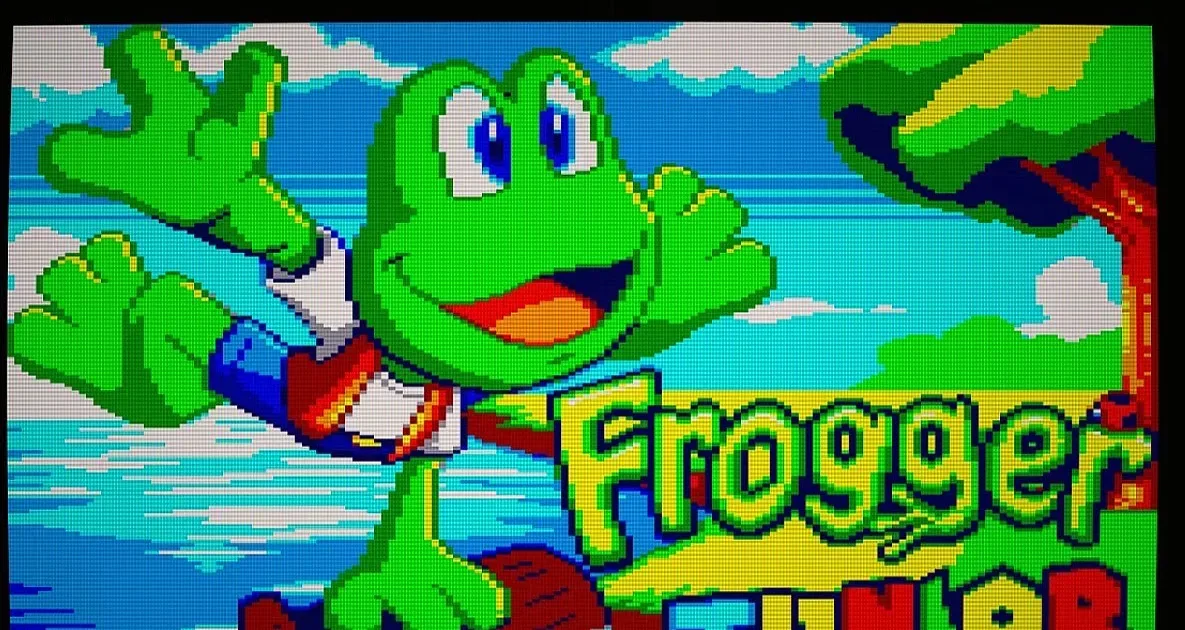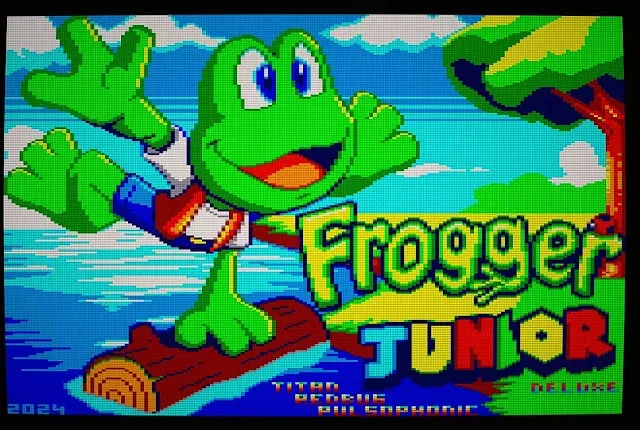
Frogger Junior, a new game from RedBug, Pulsophonic, and TITAN, has arrived for the Amstrad GX4000 and ZX Spectrum Next. It takes the familiar road-crossing and river-hopping structure associated with Konami’s 1981 arcade classic and gives it a notably playful premise: its young frog protagonist is competing for her own property portfolio.
The joke may be real-estate ambition, but the route to ownership is classic arcade peril. A multi-lane highway stands between the frog and the river, with vehicles moving at unpredictable speeds. Beyond that is a changing current, drifting logs, crocodiles, and five empty houses at the far shore. The result is a compact, score-driven challenge built around timing, observation, and maintaining control when a route that looked safe a second ago suddenly is not.
Five homes, one increasingly difficult commute
The immediate objective in Frogger Junior is to guide the frog safely into one of five vacant shoreline houses. Each occupied house is no longer available for the current round, meaning players cannot simply repeat a single preferred route. They need to read the traffic and river again, find another opening, and make a new successful crossing.
That restriction gives the five-home goal more weight than a simple finish line. An initially convenient path may be useful only once, while later runs require a different lane crossing or a different chain of logs. The houses function as a set of distinct targets, steadily reducing the player’s options until the board is cleared.
For more context, explore Disney and Columbia Send Mickey and Friends Outdoors With Rain Shells, Fleece and Trail Accessories.
Once all five homes have been filled, the game increases its difficulty. That escalating structure is central to the arcade format: completing the stage is not the end of the challenge, but the point at which the next, less forgiving version begins. With vehicles already described as moving at wildly variable speeds and the river continually changing, higher difficulty should place more emphasis on quick recognition and decisive movement rather than rote repetition.
Road hazards lead into river hazards
The highway section asks players to navigate between fast-moving vehicles. In games of this design, movement is less about racing ahead continuously than choosing moments. A player must judge lane spacing, the direction and speed of threats, and whether a pause is safer than a hop. The uncertainty introduced by varied vehicle speeds makes that judgment especially important: a gap is only useful if it remains open long enough to cross.
Reaching the river does not provide relief. The second half of the crossing shifts the problem from avoiding traffic to using moving supports. Logs drift through the water, requiring the player to land accurately and account for where the current will carry them. Crocodiles add a separate danger; they must be avoided rather than treated as safe platforms.
Related coverage includes Frogger Junior Hops Onto Amstrad GX4000 and ZX Spectrum Next.
A failed crossing costs a life, whether the frog is struck by a truck, falls into the water, or meets a crocodile. Extra lives can appear randomly on the stage, offering a valuable recovery opportunity. Their random appearance also creates a practical decision: an extra life may be worth pursuing, but only if reaching it does not turn a survivable route into an avoidable loss.
What “route planning” means here
Route planning in Frogger Junior is not a map menu or a long-term build system. It is the moment-to-moment process of selecting a line through traffic and across the river. Players are effectively evaluating several linked questions:
- Which road lanes offer a safe opening now?
- Where will the frog stand after each hop?
- Which log can carry the frog toward an unclaimed house?
- Is a crocodile blocking what would otherwise be the shortest path?
- Which of the remaining houses can be reached with the lowest immediate risk?
Because occupied houses cannot be shared, the best route early in a round is not necessarily the best route later. That is an elegant way to preserve tension in a game with a straightforward goal. Success progressively changes the board’s meaningful destinations, so clearing houses is both progress and a narrowing of the available solutions.
A modern game for two retro-focused systems
Frogger Junior was designed specifically for the Amstrad GX4000 and the ZX Spectrum Next. The platform pairing is significant because it places the game’s modern reinterpretation within systems that appeal to retro hardware enthusiasts rather than positioning it as a release for current mainstream consoles or PCs.
The Amstrad GX4000 is the target named alongside the ZX Spectrum Next, while the latter is a modern Spectrum-focused platform. The supplied details do not outline differences between the two versions, so players should not assume feature parity, controls, performance, or distribution specifics beyond the confirmed platform support.
What is clear is that the project is designed around an arcade template that remains easy to understand: cross the road, negotiate the river, fill the homes, and repeat at a tougher setting. The appeal of that template is its clarity. The danger states are readable in principle—traffic, water, crocodiles—and the pressure comes from execution as movement patterns change around the player.
Pixel art made with Multipaint
Visually, Frogger Junior uses vibrant pixel-art layouts created entirely with Multipaint. Pixel art is an image-making approach in which individual pixels are deliberately arranged to form characters, terrain, objects, and animation. In a game built around fast lane changes and moving river platforms, clear pixel art can do more than establish style: it can help players distinguish safe logs, enemy hazards, road traffic, and the five target homes at a glance.
Multipaint is the graphics tool credited for the game’s layouts. That specific production detail is useful context for fans interested in how contemporary developers make work for retro-oriented systems. It also underscores that Frogger Junior is not merely revisiting an old formula in concept; its presentation has been assembled with a dedicated pixel-graphics workflow.
The available information describes the visuals as colorful and precisely built, which suits the subject. The frog’s property-portfolio goal lends the game a comic identity, while the board itself remains a high-pressure obstacle course. Bright, legible screens are particularly valuable when the player must make split-second calls about vehicle gaps, drifting logs, and the location of an open home.
How Frogger Junior reshapes a familiar formula
The foundational rhythm remains recognizable: advance through two hostile spaces, preserve lives, and reach a set of goals. Frogger Junior’s distinguishing twist is its protagonist and objective. Rather than presenting the far side merely as a row of abstract slots, it makes those destinations shoreline houses in a competition tied to winning property.
That framing is lighthearted, but it is not just decorative. The rule that each house can only be claimed once makes the property idea mechanically visible. Every successful arrival marks one home as taken and forces attention onto what remains. It turns the completion of five targets into a small sequence of changing route problems.
There is also a useful balance between certainty and unpredictability. The player knows the overall rules: vehicles are deadly, water is deadly without a safe crossing, crocodiles are deadly, and each home needs one successful arrival. But the stage remains dynamic through changing currents, drifting logs, varied vehicle speeds, and random extra-life appearances. That combination gives an arcade game replay value without requiring a large rulebook.
Practical takeaways for players
The safest approach suggested by the game’s structure is patience before commitment. On the road, wait long enough to understand the speed and spacing of vehicles rather than reacting to the first apparent gap. At the river, identify not only a log to land on but where it is moving and what it will leave within reach.
It is also sensible to treat every completed home as a fresh board-state problem. Since a claimed house cannot be used again, a route that has worked once should not become an automatic habit. Looking for the remaining open houses before committing to the final river approach can prevent an otherwise successful crossing from being aimed at the wrong destination.
Finally, an extra life is a resource, not necessarily an instruction to take an unnecessary risk. If one appears along a route that is already safe, it can provide welcome insurance against the increasingly difficult rounds. If it appears in a dangerous position, the existing life may be more valuable than a speculative detour.
Frogger Junior’s appeal lies in that clean equation: a mischievous new setup, instantly understandable hazards, and enough shifting movement to make every trip across the road and river feel earned. For Amstrad GX4000 and ZX Spectrum Next players looking for an arcade-style challenge with a colorful contemporary coat of pixels, this young frog’s home-buying campaign is built around exactly the kind of reflex test that refuses to stay solved for long.