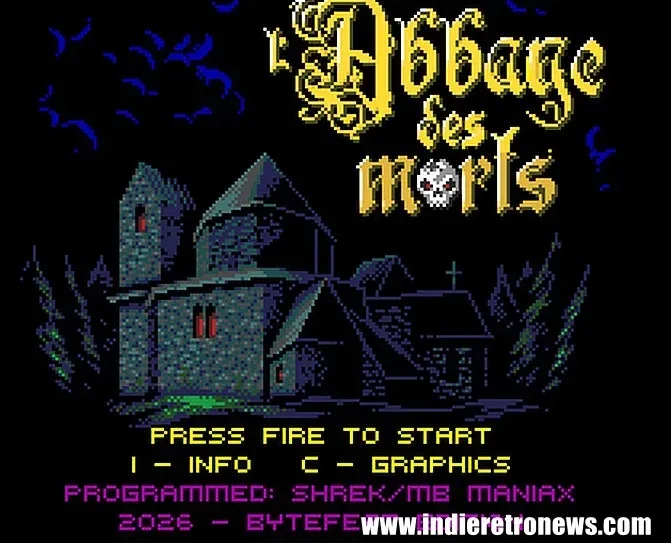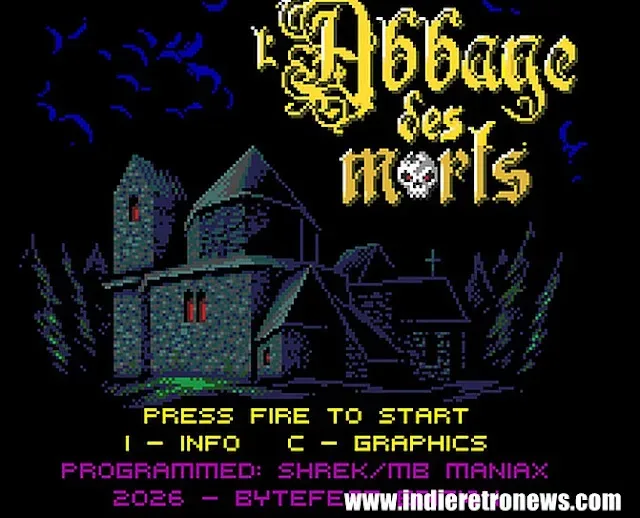
L’Abbaye des Morts has received a ZX Spectrum Next port built for ByteFest 2026, bringing Locomalito’s compact, non-linear platform adventure to the modern Spectrum-compatible machine with a set of hardware-conscious enhancements. The port preserves the game’s original 256 × 192-pixel display resolution, while offering two selectable visual treatments: a classic 8-bit presentation and a shaded 16-bit-style alternative.
The project credits Locomalito for the original game, Gryzor87 for music and sound effects, nevat and contributors for the open-source SDL port, and Shrek/MB Maniax for the ZX Spectrum Next conversion’s code and music. It supports both keyboard controls and a Kempston joystick, and its single adventure is estimated to last roughly 30 minutes.
A familiar resolution, expanded visual options
Keeping the display at 256 × 192 pixels is a meaningful design choice rather than a mere specification. That resolution gives the conversion a presentation closely tied to the game’s established visual proportions: level layouts, character scale and the readable relationship between platforms, hazards and passages can remain intact. For players coming to the title from earlier versions, the port’s screen composition should therefore feel rooted in the existing game rather than rebuilt around a different canvas.
The notable addition is the pair of switchable graphics sets. One is described as a classic 8-bit look, while the other is a shaded 16-bit version. These should not be read as two separate games or two different level designs. The supplied details establish visual alternatives, not changes to the adventure’s content, route structure or duration. Their value is instead in letting players choose between a deliberately period-oriented appearance and a more heavily shaded treatment.
That flexibility suits a game arriving on the ZX Spectrum Next especially well. A classic mode can foreground the concise, high-contrast visual language often associated with 8-bit platform games. A shaded mode can place more emphasis on depth and texture without requiring the port to abandon the original resolution. It is a practical way to make a conversion speak to different visual preferences while retaining the same play space.
What “switchable graphics sets” means here
A graphics set is the collection of artwork used to draw the game: environments, characters, objects and other on-screen elements. Switchable sets mean the player can select between two distinct visual packages. The confirmed information does not specify when a player may switch, whether a selection is made in a menu, or whether both treatments alter every asset. What is clear is that the conversion has been designed around two visual identities rather than a single fixed one.
The distinction also matters for preservation-minded players. Ports often face a balancing act between keeping an original work recognizable and taking advantage of a new target system. Here, the original resolution and a classic 8-bit option point toward continuity, while the shaded alternative presents an explicitly enhanced choice. Neither approach has to displace the other.
Using ZX Spectrum Next-specific display features
The conversion uses Layer 2 backgrounds and hardware sprites, two features identified as part of its ZX Spectrum Next adaptation. In plain terms, these are display tools that can help separate background art from moving game elements and handle character or object graphics through dedicated hardware support.
Related coverage includes L'Abbaye des Morts Arrives on ZX Spectrum Next With Dual Visual Modes.
A background layer is exactly what it sounds like: a visual plane behind the action. Layer 2 backgrounds give the port a defined facility for presenting scenery independently of foreground elements. Hardware sprites, meanwhile, are graphics handled as discrete moving objects by the system’s graphics capabilities rather than being treated solely as part of a background image.
These terms describe implementation and presentation infrastructure, not automatically a promise of a particular gameplay feature. The information provided does not claim new stages, additional enemies, changed physics, scrolling behavior or a performance comparison with another edition. But it does establish that the port was tailored to the capabilities of its destination hardware rather than simply described as a generic Spectrum release.
For a platformer, the separation of background art and active objects can be especially useful as a visual design principle. The player needs to recognize where the character is, what surfaces are meaningful, and which objects demand attention. The available details do not provide a frame-rate or responsiveness claim, so it would be inappropriate to infer one. Still, the use of Layer 2 and sprites signals a conversion that is engaging specifically with the ZX Spectrum Next’s display architecture.
That hardware-oriented approach is part of a broader pattern visible across contemporary retro-system projects. Enhanced conversions can remain respectful of a game’s original identity while finding room for platform-specific work. The same interest in adapting established action games around a target machine’s strengths can be seen in a recent Amiga AGA conversion of Bad Dudes vs DragonNinja, though the two projects have different technical details and should not be treated as directly comparable.
Audio and interface work tailored for the machine
The port also adapts its music, sound effects and status panel for ZX Spectrum Next hardware. This is an important detail because a conversion is more than its character sprites and backdrops. Music helps set pace and atmosphere; sound effects provide feedback for movement and action; and the status panel is the part of the screen that communicates game-state information to the player.
A status panel may show information such as progress or other persistent gameplay data, but the supplied material does not specify exactly what L’Abbaye des Morts displays. The safe reading is simply that the interface has been adapted rather than left unaddressed. In a short, self-contained adventure, clear status information can matter just as much as visual polish, particularly when players are navigating a non-linear structure.
The credits reveal a layered development lineage. Locomalito is credited with the original game, while Gryzor87 is credited for its music and sound effects. The open-source SDL port is credited to nevat and contributors. SDL, short for Simple DirectMedia Layer, is commonly used as a software library for multimedia and input-related tasks; in this case, the relevant fact is that an open-source SDL port forms part of the credited chain behind the new conversion. Shrek/MB Maniax handled code and music for the ZX Spectrum Next port.
Those credits help clarify that this is not presented as an entirely new game. It is a platform-specific adaptation built upon existing creative and technical work, with the new port receiving its own code and music credit. That distinction is valuable both for readers interested in the original creators and for anyone tracking how games travel between systems through ports, open-source projects and new hardware-focused implementations.
A short non-linear adventure
L’Abbaye des Morts is described as a single non-linear adventure lasting approximately 30 minutes. “Non-linear” is a useful term, but it can be overstated. It means the game is not framed solely as one unbroken, mandatory sequence in which every player must encounter each area in precisely the same order. It does not, on its own, confirm the number of routes, the presence of multiple endings, a map system, optional objectives or any specific kind of puzzle structure.
Even so, non-linearity is a significant fit for an adventure of this length. A roughly half-hour design can be concise without necessarily being simplistic. It can focus on a tightly bounded space, ask players to orient themselves, and encourage repeat visits without requiring the scale of a long campaign. The supplied description suggests a complete excursion rather than an episodic package or an endless-score challenge.
For prospective players, that duration is best understood as an approximation, not a guaranteed completion time. Individual results can vary with familiarity, exploration, navigation decisions and general platforming skill. No difficulty rating, completion requirement or route-by-route estimate has been provided, so the 30-minute figure should be treated as a useful indication of scope rather than a stopwatch promise.
Control support and practical expectations
The ZX Spectrum Next edition supports keyboard input and Kempston joystick controls. Kempston is a joystick interface standard historically associated with Spectrum software, and its inclusion gives players an option beyond the keyboard. The announcement does not identify other controller standards, key mappings, remapping options or configuration steps, so prospective users should avoid assuming support beyond what is explicitly listed.
The practical appeal of this control support is straightforward: platform games depend on timely directional movement and action inputs, and players can use the input method that suits their setup. For those approaching the port through Spectrum traditions, Kempston compatibility is a recognizable detail. For keyboard-first players, native keyboard support remains present rather than being treated as an afterthought.
Just as importantly, the available information does not state release timing, download location, physical edition plans, price, supported firmware, emulator behavior or installation instructions. ByteFest 2026 is identified as the occasion for which the port was created, but that alone should not be expanded into claims about wider distribution. Those are separate questions, and the provided material does not answer them.
Why this port is notable
This conversion stands out because its enhancements are specific and bounded. It keeps the original 256 × 192-pixel resolution. It offers two visual modes rather than presenting one replacement look as the only option. It uses Layer 2 backgrounds and hardware sprites. It adapts audio and the status panel for the system. And it retains direct keyboard and Kempston joystick support for a short, non-linear platform adventure.
That is a focused technical and artistic proposition. The project is not described as attempting to turn L’Abbaye des Morts into a radically expanded remake. Instead, it appears designed to carry the game onto ZX Spectrum Next while making deliberate use of the platform’s features and leaving players a choice in how its world is rendered. For retro-platform fans, that combination of preservation, adaptation and clear technical intent is the central story.