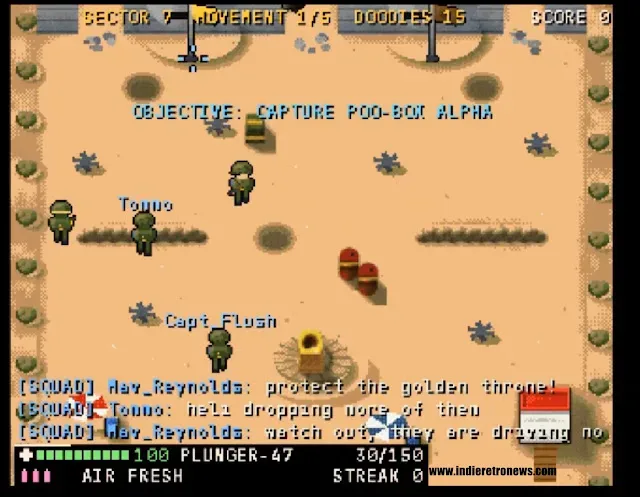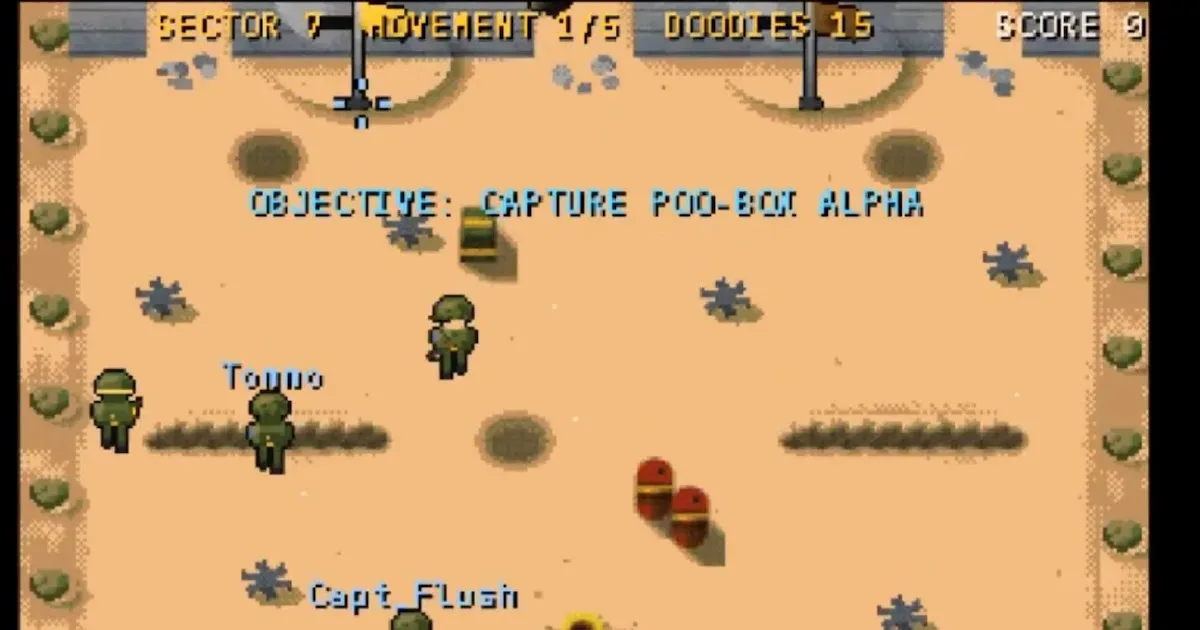
Doody Calls: Turd World War is a newly detailed top-down squad shooter for the Amiga 1200 from Software Amusements. It takes the v1.33 browser game as its starting point, but has been built from scratch for the Amiga A1200’s AGA hardware. Its premise does not attempt to hide the joke: a brown-tinted, family-friendly conflict fought with air fresheners, toilet brushes, Poo-copters and a helicopter called the “Poo-nook.”
Behind the deliberately juvenile battlefield vocabulary, though, the described feature set is that of a fairly substantial campaign shooter. Players lead Squad Alpha through nine sectors and 45 stages, taking on objective-focused missions that include beach assaults and mountain captures before reaching boss encounters. The game also combines computer-controlled teammates, environmental danger, local multiplayer, weapon choices and a lengthy rank system.
That combination makes the project notable for Amiga players looking for a purpose-built A1200 game rather than a simple revival of an older browser release. The presentation may be built around toilet humor, but its structure points toward a compact tactical-action game with room for both solo command and shared-screen chaos.
A top-down shooter built around Squad Alpha
Doody Calls places the player in charge of Squad Alpha, a three-member team of AI teammates described as highly talkative. The important gameplay claim is that these companions dynamically flank enemies and use cover, rather than merely following the player in a line.
In a top-down shooter, “flanking” generally means approaching an opponent from the side or rear instead of attacking directly from the same angle. It can force players to think beyond simply firing at the nearest target: a teammate drawing attention from one direction may create a safer opening elsewhere. Likewise, taking cover suggests squad positioning matters when enemy fire is heavy.
The supplied details do not define how much direct control players have over the other two squad members, whether commands can be issued, or how consistently the AI responds to obstacles. Those are meaningful unknowns. Still, the presence of behavior specifically built around cover and flanking distinguishes the premise from a straightforward lone-character run-and-gun setup.
Squad Alpha reaches the combat zone aboard the Poo-nook helicopter, establishing the game’s comic-book military framing. Its nine named regions include the Sewage Works and the Good Ship Stinky, with the campaign moving through 45 total stages. That works out to a sizable number of missions for a game centered on contained tactical scenarios, though stage length and individual objective complexity have not been specified.
Objectives, bosses and hazards should change the pace
The campaign is described in terms of strategic objectives rather than exclusively enemy elimination. Beach storming and mountain capture missions imply that players will need to push toward positions and complete goals amid resistance. This matters because objectives can give top-down shooting a clearer rhythm: advance, secure space, survive incoming threats and move to the next point.
Related coverage includes Doody Calls: Turd World War Brings Squad Shooting to Amiga A1200.
Boss battles sit at the other end of that mission structure. Bosses usually ask players to recognize a larger or more dangerous opponent as the immediate priority, perhaps while still managing surrounding enemies and terrain. No boss types or mechanics have been detailed, so it would be premature to assume how these fights operate. Their inclusion does, however, suggest the 45-stage campaign is designed to have peaks of pressure rather than a completely even stream of skirmishes.
Enemies include Poo-copters, tanks and armored jeeps. Together, those categories point to threats with different battlefield roles: airborne attackers, armored ground targets and mobile vehicles. The game also includes moving trains as environmental hazards. A hazard is an element of the level that can endanger the squad independently of a conventional enemy attack. If the train paths cut through active combat spaces, players may have to consider timing and movement as carefully as aim.
The central practical question for players will be how clearly the game communicates those hazards and how much room levels give a squad to maneuver. The available details confirm moving trains, but not their frequency, the penalty for getting caught near one, or whether terrain can affect enemy routing. Those specifics will determine whether the tactical label becomes a deep layer or mainly a colorful description of fast action.
Four firearms, air fresheners and a close-range brush
Squad Alpha has four distinct firearms available, plus explosive Air Freshener grenades and a toilet brush intended for close-quarters emergencies. The game’s comedy is most obvious in these names, yet the equipment list also lays out a conventional action-game toolkit: ranged weapons, thrown explosives and a last-ditch melee option.
The four guns are identified as distinct, although their exact categories, ammunition behavior, effective ranges and upgrade paths have not been provided. That leaves their practical identities open. A varied gun selection can matter greatly in a game where enemies include ground vehicles and aircraft, but it is not known whether each weapon is specialized against a particular threat.
Grenades offer a tactical possibility separate from gunfire. In broad terms, explosives can be useful when several enemies occupy a confined area, when a player needs to disrupt a push, or when direct shots are unsafe. Whether the Air Freshener grenades follow any of those patterns in Doody Calls remains unspecified. What is confirmed is that they are explosive, preserving the game’s silly theme while supplying an area-of-effect weapon.
The toilet brush rounds out the loadout with an explicitly close-quarters answer. Melee weapons tend to become relevant when ammunition, distance or enemy proximity turns a gun into the less convenient choice. It is too early to infer damage, reach or special properties for the brush, but its presence means the game has a fallback tool beyond its firearms and grenades.
Local multiplayer has a specific hardware wrinkle
Doody Calls supports up to four people on a single screen. This is local multiplayer: players share the same display rather than connecting over an online service. Shared-screen games can turn squad positioning into a social negotiation, since everyone needs to respond to the same action at once and keep the group’s attention on a common play area.
The stated setup uses standard joysticks alongside Alinea Computer’s Octodapter hardware. That detail is important for anyone considering a four-player session. The game supports the mode, but the described arrangement includes an additional piece of hardware for expanding controller connectivity; it should not be assumed that every existing Amiga joystick setup automatically accommodates four participants.
For solo players, the AI companions remain a major part of the design. For groups, the four-player option potentially shifts the emphasis from directing computer teammates toward coordinating with other people. The supplied information does not say whether the campaign is fully playable in multiplayer, how players join, or whether AI fills empty slots. Those are the kinds of logistical questions that will matter when fuller instructions are available.
There is a useful broader point here for retro multiplayer design: local support is not merely a checkbox when hardware ports are limited. The controller solution is part of the experience. Players interested in a four-joystick A1200 gathering should pay attention to the Octodapter requirement rather than treating it as incidental.
Career ranks and local scorekeeping give the campaign persistence
The game includes a 200-rank career progression system and local leaderboards saved to disk. A career progression system tracks advancement over time, generally through ranks that mark continued play or achievement. With 200 ranks, Doody Calls has a long progression ladder on paper, though the requirements for each rank and any associated rewards have not been outlined.
The leaderboards being local and disk-saved sets a clear expectation: scores are stored on the player’s own media rather than presented as a confirmed online ranking service. That approach suits the platform and gives repeat players a persistent way to compare results within their own setup. It also means the available information should not be read as a promise of network competition.
The package includes an attract mode as well. An attract mode is a self-running demonstration that begins after a game is left idle at the menu. Historically, this kind of feature helps communicate how a game moves and looks before someone starts playing; it can also make a machine at an event or gathering feel less static. In Doody Calls, it means the title can demonstrate itself without menu input.
Players who enjoy games where tactical decisions meet constant pressure may also find the design discussion in this look at timing and pressure in a one-lane strategy game relevant, even though its real-time strategy format is very different from Doody Calls’ squad shooting.
What an A1200 needs to run it
Software Amusements says Doody Calls runs on a stock Amiga 1200 with 2 MB of chip RAM. Chip RAM is memory shared by the Amiga’s custom hardware, including the components responsible for graphics and sound work. For prospective players, the key point is straightforward: the stated baseline does not require an expanded A1200 configuration.
Fast RAM is nevertheless recommended for better performance in the game’s particle-heavy action. Fast RAM is additional system memory that is not shared in the same way as chip RAM. The practical claim is not that fast RAM unlocks the game, but that it can improve performance when effects become especially busy.
Particle-heavy action refers to scenes with many small visual elements—such as debris, blasts or other effects—appearing at once. These are often useful for making explosions and gunfire feel lively, but they can add processing work. Players using an unexpanded machine should therefore expect the game to be supported at the stated minimum, while players with fast RAM may see smoother results during its most crowded moments. No exact performance figures or comparison measurements have been provided.
A knowingly ridiculous theme with a more ambitious feature list
Doody Calls: Turd World War is plainly committed to its name and its scatological military parody. The enemy names, Air Freshener grenades, brush melee weapon and travel by Poo-nook leave little ambiguity about the intended tone. Yet the reported substance goes beyond a single gag: nine sectors, 45 stages, boss encounters, squad AI, environmental dangers, four-player local play, 200 ranks and disk-saved scores create a notably broad checklist for an A1200 shooter.
There are still practical details to be confirmed, including distribution, release timing, price, gun behavior, controls, the precise role of the AI, and the setup process for four-player play. None of those should be assumed from the announced feature list. But for Amiga 1200 owners, the essentials are already clear: this is an AGA-focused top-down squad shooter designed to run on a stock 2 MB chip-RAM machine, with fast RAM positioned as a performance benefit rather than a baseline requirement.
Whether its tactical ambitions land will depend on the moment-to-moment relationship between the player, Squad Alpha, objectives and hazards. For now, its appeal is easy to summarize: a full campaign-sized A1200 action game that combines old-school local-play sensibilities with an aggressively unserious world of armored jeeps, moving trains and very weaponized bathroom supplies.