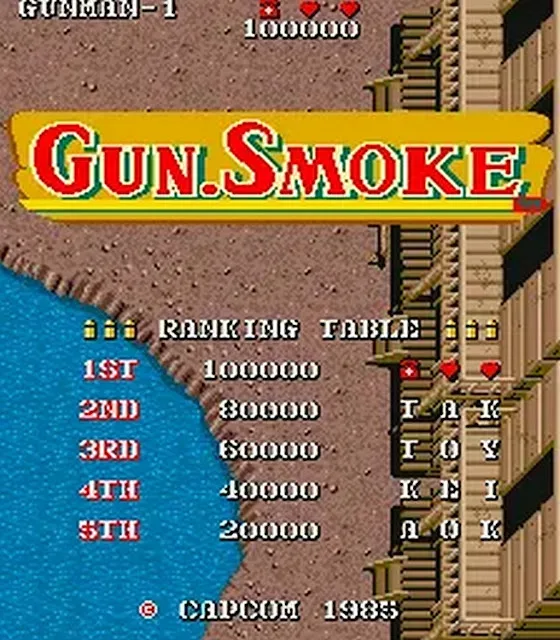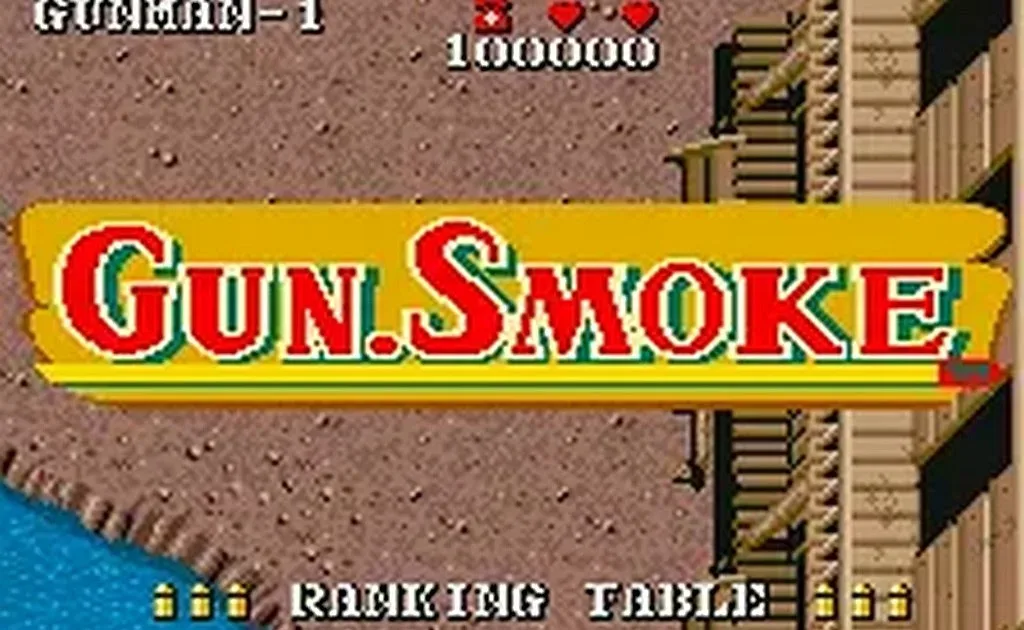
Capcom’s 1985 arcade western Gun.Smoke is being brought to AGA-equipped Amiga computers by Modern Vintage Gamer. The project follows the developer’s Amiga version of Zippy Race, but it represents a distinctly bigger technical undertaking: a busy vertical-scrolling coin-op built around constant enemy pressure, weapon pickups, bosses and ten levels of action.
The stated ambition is admirably clear. The port is intended to preserve the urgent feel of the arcade original while targeting smooth performance at 50 or 60 frames per second. That is a meaningful target for a game whose challenge comes not merely from moving through a Wild West setting, but from reading danger across a crowded screen and responding quickly with its unusual shooting system.
There is one major caveat, and it is the central story of the port so far: memory. The goal is for the game to run on a stock Amiga 1200, but Chip RAM is already under substantial pressure. The developer has indicated that Fast RAM may ultimately be needed for the complete experience. Until the work is further along, that leaves the final baseline hardware requirement uncertain.
What makes Gun.Smoke an arcade standout
Gun.Smoke is a vertically scrolling action game designed by Yoshiki Okamoto. Players control bounty hunter Billy Bob as he hunts dangerous outlaws through the game’s western setting. Rather than relying on a conventional single forward-shot setup, the arcade game uses a three-button directional firing arrangement. That means shooting is tied to distinct angles, giving players a wider tactical spread while asking them to make rapid decisions about where the next threat is coming from.
In practical terms, that control scheme is a large part of the game’s identity. A vertical scroller typically pushes the player into a flowing lane of incoming hazards. Gun.Smoke complicates that rhythm by demanding awareness to the left, right and ahead. The player is not simply steering through a stage; they are selecting firing directions as enemies swarm the screen.
The arcade original was also commercially successful. By the first half of 1986, it ranked as Japan’s sixth highest-grossing table arcade game. That standing helps explain why it remains a compelling candidate for a modern Amiga conversion: it is both a recognized coin-op of its era and a game with mechanics that can still pose a practical porting challenge.
The route from arcade ROM to Amiga code
Rather than constructing every part of the game anew, Modern Vintage Gamer is reverse-engineering the original arcade ROM into C source code through a transcode-based approach. A ROM is the data and program code taken from the original game hardware. Reverse engineering, in this context, means studying how that original program works so its behavior can be recreated in a form suited to different hardware.
C is a programming language widely used for software that needs close control over performance and memory. Translating or reconstructing the arcade logic in C can provide a more efficient starting point than making a comparable game from scratch, particularly when the goal is to retain the original’s levels, pickups, enemy behavior and boss encounters.
Related coverage includes Gun.Smoke Is Riding Toward Amiga AGA in a New Retro Port.
This does not mean the Amiga version is a simple copy-and-paste exercise. Arcade boards and AGA Amiga machines have different graphics, memory and processing arrangements. A successful conversion still has to make the original logic work within the target machine’s limits, display the action convincingly, manage sound and input, and keep the frame rate responsive during the busiest moments.
The method has been compared with work associated with JOTD, whose projects are well regarded in the Amiga conversion scene. The relevant point is not that all such efforts are identical, but that source-assisted reconstruction can be a sensible answer to the scale of a demanding arcade port. Recreating ten levels, pickups and bosses entirely by hand would be a far longer project.
Why 50/60 fps matters for this particular game
A frame rate is the number of complete images a game presents each second. The 50/60 fps target refers to smooth update rates aligned with the video standards commonly relevant to the hardware. For a slower or turn-based game, fluctuations can be less immediately noticeable. For a scrolling shooter-style action game full of enemies, bullets and directional decisions, responsiveness is inseparable from how the game feels.
At a steady frame rate, scrolling motion reads cleanly, movement is more predictable and a player has a better chance of understanding a rapidly changing threat pattern. When a game’s pace falters under pressure, the result can be more than a cosmetic blemish. It can undermine timing, input response and the legibility of dense action.
That makes the reported enemy swarms especially important. The port is not only trying to show western scenery moving vertically across the screen. It must keep track of numerous active objects and update them quickly enough to sustain the arcade game’s pace. Each enemy can bring position updates, movement behavior, collision checks and visual work. Projectiles, pickups and bosses add further load.
The early build is said to look promising, but performance in these high-density moments is exactly where a port earns its credibility. The project’s eventual compromises, if any are necessary, will matter most when the screen gets crowded—not during a quiet stretch of scrolling.
Chip RAM versus Fast RAM: the constraint to watch
The Amiga memory discussion can sound opaque, but its relevance here is straightforward. Chip RAM is memory that the Amiga’s custom chips can access. That makes it fundamental to graphics and other tasks that rely on those chips. Fast RAM is additional memory that can be useful to the CPU, helping create more room for program code and data that do not need to occupy the tightly contested Chip RAM pool.
In a graphics-heavy arcade conversion, Chip RAM can become a bottleneck because the game needs space for visual assets while also maintaining the systems needed to draw the action. When a developer says Chip RAM is tight, it does not automatically reveal the final shipping configuration or prove that a stock machine cannot run the game. It does, however, identify a genuine engineering pressure point.
The current objective remains a stock Amiga 1200, an AGA model. AGA, short for Advanced Graphics Architecture, is the Amiga graphics chipset family relevant to this conversion. Yet the possibility of requiring some Fast RAM illustrates a familiar divide in retro-computer development: a project can be designed around a baseline machine while the most reliable or fullest version may benefit from expanded hardware.
For prospective players, the responsible reading is that compatibility is still being worked out. Anyone with an Amiga 1200 should not assume a final RAM requirement until the developer settles it. Conversely, owners with Fast RAM may have an advantage if the project’s memory needs remain as tight as described.
A conversion built around the right priorities
There is a sensible hierarchy in the project’s stated goals. First, the port needs to reproduce the distinctive game structure: the ten levels, weapon pickups, bosses and three-direction shooting that define Gun.Smoke. Second, it must maintain a pace appropriate to an arcade action game, especially when enemy counts rise. Finally, it needs to fit that work within hardware configurations that real Amiga users can access.
Those objectives can pull against one another. More assets and more elaborate handling of active enemies can put more pressure on memory and performance. A lower hardware requirement broadens the potential audience, but it also narrows the technical budget available to the port. The reverse-engineering and transcode approach is valuable precisely because it can focus effort on adapting the original game’s behavior instead of spending the same time rebuilding its full structure from zero.
That balancing act is part of why new software for legacy systems remains interesting. The hardware does not change, but development techniques, accumulated knowledge and a willingness to revisit arcade material can produce projects that were once unlikely. Recent Amiga activity also extends beyond one game; other current Amiga projects show a scene still building for machines with very specific strengths and constraints.
What remains unknown
There is no confirmed final release timing, final memory specification or finished feature list in the information currently available. It is also too early to declare exactly how closely the port will match the arcade game in every technical detail. The visible direction, however, is concrete: Gun.Smoke is being adapted for AGA Amiga systems, it is using a reverse-engineering-driven C workflow, and smooth 50/60 fps action is the goal.
For fans of the original, the headline is less about nostalgia alone than about fit. Gun.Smoke is an arcade game defined by fast scrolling, relentless foes and an immediately recognizable firing layout. Those are qualities worth preserving, and they are also the qualities most likely to test an Amiga conversion. Whether a stock Amiga 1200 can carry the final version without extra Fast RAM remains the project’s big open question.